Investment reports and market data
Documents


Wyniki Finansowe 1H25
This financial summary details the performance of PCF Group (People Can Fly) for the first half of 2025, reflecting a period of organizational restructuring and portfolio transition.
- PCF Group revenue grew to 115.3 million PLN in 1H 2025, up from 76.3 million PLN in 1H 2024.
- EBITDA turned positive at 2.9 million PLN in 1H 2025, recovering from an 11.3 million PLN loss in the same period last year.
- The company narrowed its net loss to 21.3 million PLN in 1H 2025, compared to a 33.3 million PLN loss in 1H 2024, despite accounting write-offs from the Chicago studio merger.



Global Gaming Report Q3 2025
The third quarter of 2025 underscores the continued premium placed on hardware and platform players within the global gaming ecosystem, as investors assign a wide spectrum of valuation multiples that reflect divergent growth narratives and market positioning.
- Investors are heavily favoring platform-centric companies over traditional hardware manufacturers, with high-growth firms like AppLovin and Nvidia commanding EV/EBITDA multiples exceeding 25x, compared to roughly 1x for legacy hardware firms like Dell and HP.
- Roblox led equity performance with a 136.9% year-to-date appreciation, driven by successful user engagement and monetization strategies.
- Unity recorded a 77% year-to-date gain, underscoring the market's high valuation of cross-platform development tools and real-time 3D content adoption.

💸 UA financing Secrets: Scale your game without selling your soul
User acquisition financing serves as a vital, non-dilutive mechanism for mobile game studios to scale proven titles without sacrificing equity or operational control.
- User acquisition (UA) financing is a non-dilutive alternative to venture capital that allows studios to scale titles while retaining equity, with the market projected to reach $2.5 billion by 2027.
- To qualify for UA financing, studios typically need a minimum monthly marketing spend of $100,000 and at least six months of verified performance data.
- Developers should prioritize unsecured loans that limit lender recourse to specific revenue streams, avoiding agreements that allow for the seizure of broader company assets during periods of cohort underperformance.

Why the Games Industry Might Triple (Despite Its Challenges)
The global games industry stands at a pivotal inflection point, poised to expand into a $600 billion market by leveraging historical growth patterns and emerging technological shifts.
- The global games industry is positioned to triple in size to a $600 billion market by shifting away from high-stakes, traditional development models.
- Leadership should categorize games into four distinct quadrants based on casual versus immersive experiences and offline versus online play to better align developer skill sets and operational focus.
- The traditional AAA greenlight process is becoming obsolete, necessitating a shift toward a barbell strategy that balances stable 'forever games' with small, autonomous teams focused on iterative experimentation.

Video Game Industry Inspection Mission: Canary Islands
The announcement serves to formalize the issuance of a new series of stock options by Nippon Ichi Software Co., Ltd., a listed entity on the Tokyo Stock Exchange Standard Market.
- Nippon Ichi Software will issue 1,882 stock options on 22 July 2025, with each option representing 100 shares.
- The exercise price for the new stock options is set at ¥89,600 per option, or ¥896 per share.
- The allocation targets a broad range of internal stakeholders, including 560 options for company directors and 1,097 for employees.

The Truth About Startup Life Nobody Tells You with Joseph Kim, CEO of LILA Games
Founding a startup is an inherently grueling endeavor that demands a profound reconciliation between professional ambition and personal well-being.
- Founding teams with a history of prior collaboration and established workflows are significantly more likely to succeed than teams assembled without pre-existing trust.
- Founders should prioritize sustainable, profitable growth over the venture-backed model of rapid, forced scaling to mitigate the risks of team instability.
- Investors frequently misallocate capital by prioritizing superficial market trends and metrics over the deep-seated alignment and vetting of the founding team.
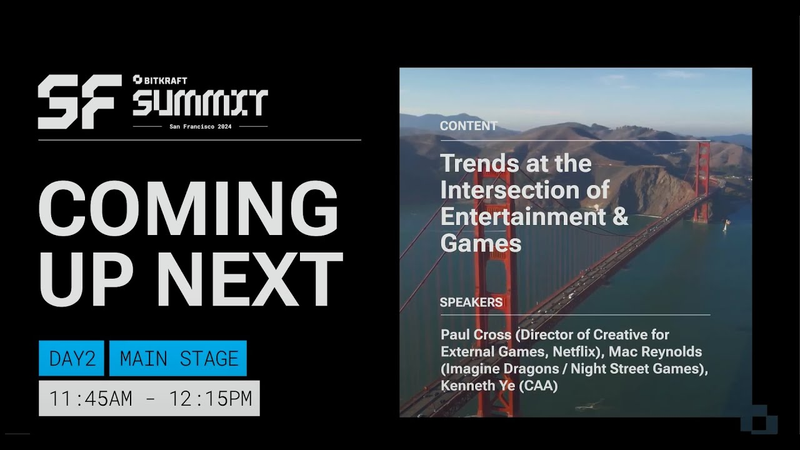
Trends at the Intersection of Entertainment & Games | BITKRAFT Summit 2024
The evolution of modern entertainment is defined by a strategic shift toward transmedia ecosystems where intellectual property is cultivated through deep, authentic audience resonance.
- Successful transmedia strategies require identifying the core emotional experience of an IP—such as the feeling of being a rock star or the tension of a specific narrative—and translating that essence across mediums rather than just replicating mechanics.
- When integrating external IP into games, developers must prioritize the player's desire for fun over brand restrictions, ensuring that new additions align with the existing emotional promise of the game world.
- Authenticity in IP expansion is driven by deep community engagement, whether through radical transparency and social media interaction or, conversely, by cultivating mystery and avoiding direct engagement to build anticipation.

Get Real: AI at Work | BITKRAFT Summit 2024
The BITKRAFT Summit 2024 panel, "Get Real: AI at Work," explored the practical integration of generative AI into the gaming industry, emphasizing the transition from experimental chatbots to sophisticated, game-aware character engines.
- Integrating AI into games requires custom infrastructure and model configuration, making it unlikely for studios to achieve high-quality results within a 1–3 month timeframe.
- To solve the problem of unpredictable, non-linear server costs, the industry is shifting toward on-device, end-to-end AI systems that run locally on PCs and consoles.
- Public foundation model endpoints often fail to meet the latency and performance requirements of core game mechanics, forcing developers to move to dedicated servers with strict service-level agreements.
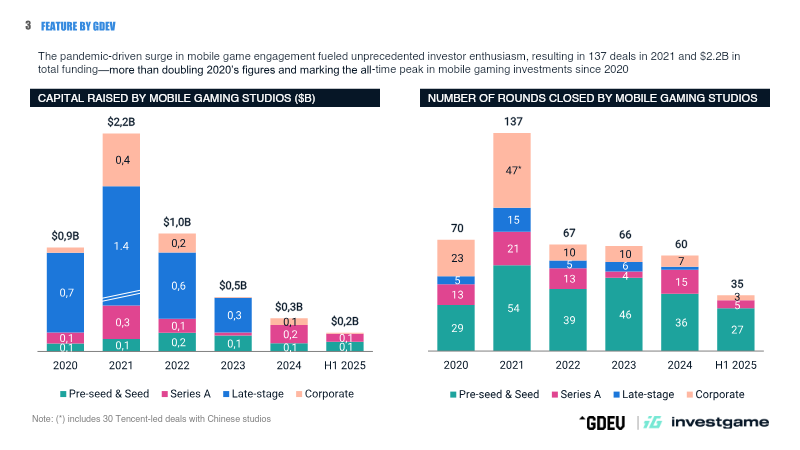
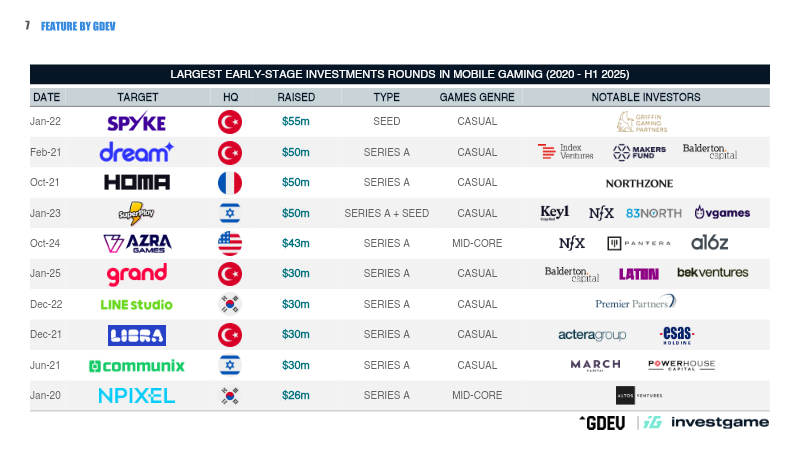

The Great Mobile Reversal: Why Buyers Pay Billions for What VCs Abandoned
The analysis examines the evolution of mobile gaming investment and M&A activity from 2020 through the first half of 2025.
- Mobile gaming accounted for 61% of total gaming deal value (excluding ATVI) between 2020 and H1 2025, with strategic buyers and private equity firms driving nearly all deal volume in the first half of 2025.
- Strategic consolidation has replaced VC-led growth, highlighted by $7 billion in mobile M&A activity across six major deals, including Af’s $12.7 billion acquisition of 2yga and Scopely’s $4.9 billion purchase of GamesGroup.
- Venture capital interest has shifted heavily toward casual gaming, which now captures 65% of all deals due to its broader audience reach and faster iteration cycles.

Week in Mobile Games podcast E60 - Investment tips, Clash Royale's evolution, and China's rise
The current mobile gaming landscape is defined by a shift toward rigorous operational discipline and the successful revitalization of established intellectual property.
- The Chinese gaming market remains a global leader with annual revenues estimated between $44.8 billion and $48.7 billion, now characterized by a shift toward AAA, cross-platform development and a more accessible licensing environment for foreign-funded projects.
- Investors are moving away from reputation-based funding, now requiring developers to provide tangible prototypes, deep market research, and realistic budget projections to secure capital.
- Clash Royale achieved its highest daily gross revenue since late 2021, hitting $3.8 million on July 8th following a design overhaul that introduced new gameplay modes and streamlined rewards.

TWIG #338 Apple’s Cat-and-Mouse Game, Xbox's Doom Loop, and Splitgate 2’s $100M Misfire
The gaming industry is currently navigating a period of profound instability characterized by widespread workforce reductions and the failure of high-budget projects to capture market share.
- High-budget game launches are increasingly failing to gain traction, exemplified by the $130 million Splitgate 2, which failed to match the concurrent player counts of its predecessor due to a market dominated by entrenched titles like Fortnite and Counter-Strike 2.
- Microsoft’s strategic shift toward Game Pass and third-party hardware is creating a 'doom loop' that devalues its intellectual property and alienates its core consumer base.
- Long-term revenue stability is still possible through rigorous lifecycle management, as evidenced by Rainbow Six Siege generating $300–$400 million annually a decade after its initial release.

BBC Interview Reveals Supercell’s Next Move!
Supercell is currently navigating a period of strategic transition, characterized by a push for bold innovation and a potential move toward an initial public offering.
- Supercell is signaling a potential IPO by shifting its communication strategy toward institutional investors, emphasizing AI integration and risk-taking via new labs in Helsinki and San Francisco.
- The company’s portfolio performance has declined by approximately 20% when comparing the first half of 2024 to the same period in 2025.
- Brawl Stars revenue has experienced a sharp correction, falling from a peak of $80 million to roughly $40 million in monthly revenue.