Funding reports and market data
369 game industry reports, presentations and talks about funding from writers such as PocketGamer.biz, Deconstructor of Fun and Naavik, newest from 2026. Every document has a summary and key insights with the page they come from, and 624 charts and tables are extracted as data.
Key figures
Over 80 percent of private funding was directed toward AI-native development, 3D foundation models, and advanced tools, with notable investments in Tripo AI, Nex, and PixVerse.
Drake Star Partners, 2026 · Global Gaming Report: Q3 2026, p. 9
As of Q3 2025, the US hosted 830 active unicorns with a combined post-money valuation of $3.9 trillion, though many face significant liquidity constraints and difficulties securing follow-on funding.
PitchBook, 2026 · 2026 US Venture Capital Outlook, p. 10
While 92% of programs identify project funding as a critical challenge for studios, only 40% provide direct financial support, typically capped at under $50,000 per team.
International Game Developers’ Association, 2026 · 1st Census on Game Incubation and Acceleration, p. 6
While early-stage funding remains stable with median check sizes around $10 million, Series A and later-stage rounds have become increasingly rare due to heightened scaling challenges.
InvestGame, 2025 · The Great Mobile Reversal: Why Buyers Pay Billions for What VCs Abandoned, p. 6
Investor capital is increasingly shifting toward artificial intelligence and Web3 technologies, while the eSports sector faces a 66% decline in funding.
Quantum Tech Partners, 2025 · 2025 Gaming Industry Report: M&A and Fundraising Update, p. 30
Documents

EA shuts down BioWare and Supercell buys Metacore | Week in Mobile Games
The mobile gaming industry is currently navigating a period of significant structural change, characterized by studio closures, strategic acquisitions, and a shift in how developers approach user acquisition and market viability.
- Electronic Arts is closing BioWare and laying off approximately 400 employees to prioritize established live-service franchises like Apex Legends and Battlefield over high-budget single-player projects.
- Supercell has fully acquired Metacore, the developer of Merge Mansion, to bring the title under direct management following a long-standing financial partnership.
- Mika Games has launched a $10 million funding initiative specifically designed to support mobile studios during the soft-launch phase by financing user acquisition testing.

Subnautica's Rise: How Charlie Cleveland Beat the Odds in Gaming
The trajectory of Unknown Worlds Entertainment serves as a case study in the resilience required to navigate the independent game development landscape.
- Unknown Worlds Entertainment achieved independence in 2021 by executing a full buyback of the studio following the commercial success of the Subnautica franchise, which has sold over 12 million copies.
- The studio utilized a 2011 acquisition by Perfect World to secure the necessary capital to complete the development of Natural Selection 2, demonstrating the strategic use of external funding to survive financial instability.
- The transition from niche multiplayer titles to the mass-market Subnautica was driven by a commitment to open development, early crowdfunding, and the integration of player feedback into the design process.
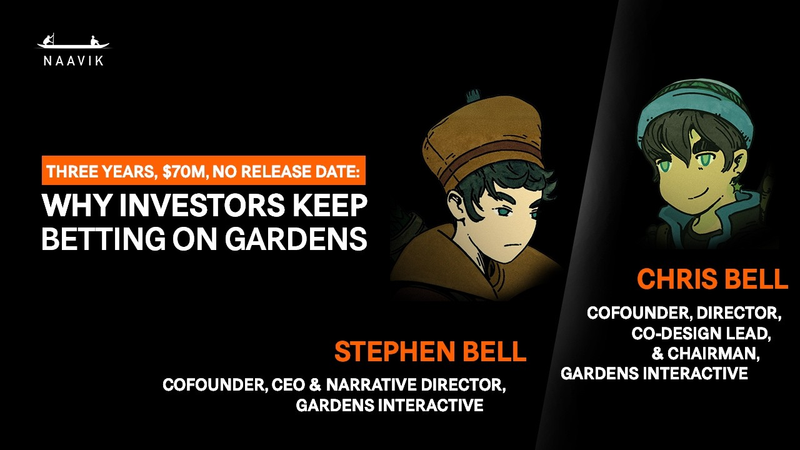
Why Investors Keep Betting on Gardens
Gardens Interactive is positioning itself at the forefront of a new wave of social-first gaming, securing $70 million in total funding, including a recent $35 million Series B round that values the studio at $190 million.
- Gardens Interactive has secured $70 million in total funding, including a $35 million Series B round that brings the studio's valuation to $190 million.
- The studio is developing a 'strandbox' game model that prioritizes emergent social interaction and player-driven world-shaping over traditional algorithmic or AI-generated content.
- Development utilizes the Unreal engine combined with a proprietary foundation that integrates procedural generation with hand-authored design to ensure visual longevity.
Global Gaming Report: Q3 2026
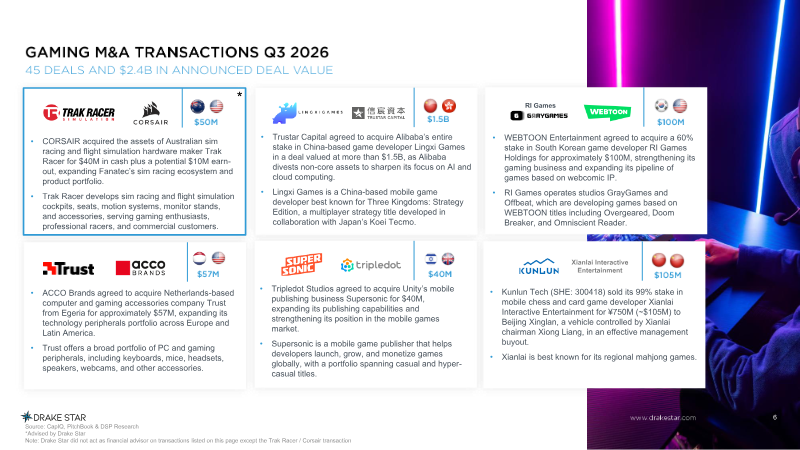
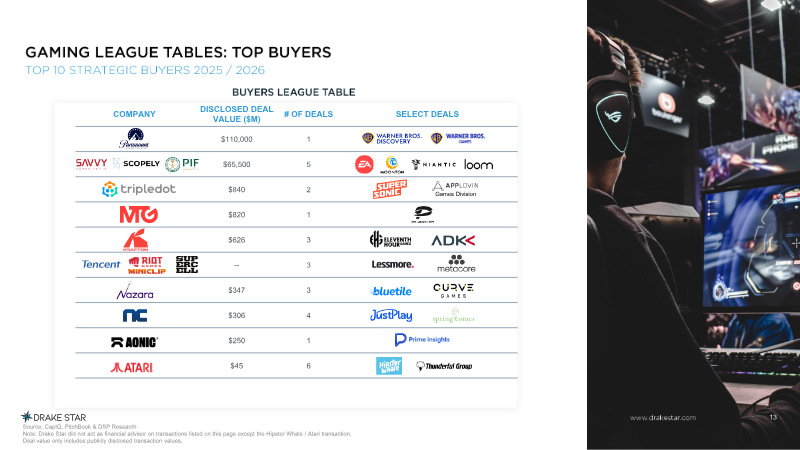
The global gaming industry experienced a period of significant financial revitalization during the third quarter of 2026, characterized by a robust rebound in market valuations and sustained investment activity.
- The gaming industry saw $4 billion in total capital activity in Q3 2026, comprising $2.4 billion across 45 M&A deals and $1.6 billion in private financing.
- Over 80 percent of private funding was directed toward AI-native development, 3D foundation models, and advanced tools, with notable investments in Tripo AI, Nex, and PixVerse.
- The Drake Star Gaming Index reported a 12.4 percent return for the quarter, reflecting a strong recovery in market valuations.

Is Gaming in an AI Bubble? What the Deal Data Says
The gaming industry is currently undergoing a structural transition characterized by a shift from speculative content creation toward infrastructure, hardware, and artificial intelligence.
- Gaming financing reached a 12-month high in Q2 2026 with over $2.5 billion raised, despite the total volume of deals dropping from roughly 200 per quarter in 2021-2022 to below 100.
- Capital allocation has shifted away from general content and studio funding toward AI, ad-tech, and hardware, with AR glasses emerging as a significant platform bet.
- The current funding landscape for game studios is bifurcated; while AI-native gaming companies are attracting massive capital, studios that raised small rounds in 2021-2022 are struggling to secure follow-on financing.

The Real Math on Cohort Financing (And Why You're Losing Money)
Cohort financing serves as a critical growth engine for mobile game studios, enabling them to scale user acquisition (UA) beyond the limitations of organic cash flow.
- Prioritize structural flexibility and clear exit clauses over headline interest rates when selecting a financing partner to ensure the studio can navigate periods of underperformance.
- Avoid duration mismatches by ensuring that financing terms align with the actual growth trajectory of the game, as using short-term debt for long-term strategies risks liquidity crises.
- Maintain a conservative financial buffer to protect core operational costs, such as payroll and server expenses, from aggressive lender amortization triggered by cohort underperformance.
“Some of the offers were actually offensive” – How Forza Horizon rival Clutch found its publisher
Maverick Games is positioning its debut title, Clutch, as a cinematic, story-driven racing experience designed to carve out a distinct niche rather than directly challenging established industry titans like Forza Horizon.
- Maverick Games secured a publishing partnership with Focus Entertainment for its debut title, Clutch, after an initial deal with Amazon Games was terminated due to shifting corporate priorities.
- The studio successfully retained full intellectual property rights following the Amazon Games split, allowing them to reject unfavorable offers and maintain creative control.
- Clutch is being developed as a cinematic, story-driven racing game set in the South of France, intentionally designed to occupy a niche distinct from major competitors like Forza Horizon.
Questions Istanbul Founders Stopped Asking I Akin Babayigit, Arcadia Gaming Partners
The Turkish gaming ecosystem has evolved into a formidable global hub, driven by a culture of intense competition and a blueprint for success established by early pioneers like Peak Games.
- Success in the current mobile gaming market has shifted from simple innovation to superior execution, requiring mastery of platform algorithms like AppLovin and capital-intensive user acquisition.
- The Turkish gaming ecosystem, pioneered by companies like Peak Games, has matured into a global hub characterized by a Darwinian, high-intensity work culture that consistently produces unicorn-scale companies.
- Founders now face a significantly higher barrier to entry, necessitating exceptional data-driven judgment to maintain profitability in crowded genres such as match-three.

The Real Math on Cohort Financing
Cohort financing has emerged as a primary mechanism for funding user acquisition (UA) in the gaming industry, shifting away from traditional equity-based models.
- Cohort financing is frequently marketed as a risk-sharing model, but contractual terms often function as high-risk, full-recourse secured loans that shift the entire financial burden back to the developer.
- Lenders often employ cross-collateralization, allowing them to recover losses from underperforming cohorts by seizing revenue generated by a studio's successful cohorts.
- While some providers claim not to take a formal lien on a business, restrictive covenants often grant lenders primary access to cash flows and prevent developers from securing additional financing.
A New Era of Publishing
The traditional game publishing model is currently undergoing a fundamental transformation as the industry shifts away from rigid, high-stakes ownership structures toward flexible, service-oriented partnerships.
- Midwest Games operates a hybrid publishing model that combines traditional invest-and-revenue-share deals with 'Shadow Publishing,' a for-hire services model where developers retain full ownership of their IP and revenue.
- The gaming industry is experiencing a 'fractured' landscape where developers increasingly self-fund, leading to a menu of flexible publishing options such as marketing-only deals, shared recruitment, and UA-only financing.
- Maintaining a high volume of releases—ideally one per month—is essential for publishers to stay current with market trends, as knowledge of discoverability tactics degrades significantly if a firm has not launched a title in six months.
The Good, The Bad and The Ugly of UA Financing
User acquisition financing serves as a critical lever for scaling mobile game studios, yet it requires a sophisticated approach to balance growth ambitions against significant financial risk.
- Effective annualized interest rates for UA financing range from 14% to over 40%, requiring studios to integrate these costs directly into marginal cost calculations to avoid over-bidding on ad inventory.
- Developers must distinguish between traditional receivables financing backed by verified platform payouts and speculative cohort-based models that rely on future performance projections.
- Aggressive contract terms such as cross-collateralization and hidden liens can jeopardize a studio’s long-term liquidity by prioritizing lender capital recovery over operational stability.

💳 A Credit Card that resets your LIMIT when Your ROAS is good: PVX's UA financing card is here!
Mobile game studios and app developers face a persistent challenge in maintaining consistent user acquisition momentum due to the restrictive repayment cycles and fixed limits of traditional corporate credit cards.
- PVX is launching a dynamic UA financing card in Q4 that adjusts credit limits based on real-time return on ad spend (ROAS) rather than fixed repayment cycles.
- The financing model integrates directly with mobile measurement partner data to allow developers to scale marketing spend without operational interruptions from standard balance clearance requirements.
- The product is specifically designed for early-stage studios and solopreneurs in the UK and European markets to provide capital at rates more competitive than traditional credit card APRs.