VideoTwo & a Half Gamers
💸 UA financing Secrets: Scale your game without selling your soul
18 Aug 202546 min video

Transcript
If you could bootstrap your way to a point where you can get to UA funding, I think it becomes the best option. And in fact, most of actually the companies we're working with have raised VC funds. So it's not like it's not like this is replacing VC funding. It's more replacing growth growth equity fun.
I still think it's 100% better than the other option because you again retain the shares and stuff.
Exactly. The thing that I wanted to mention here, the the the devil in the details is that you need somebody competent to spend it.
It's the dice drops made of golden coins. We're the two and a half gamers. The midnight crew talking UA adverts and game design too. Mate feeling shak bringing the insight. We're rocking those vibes till the early daylight. Master Eyes on the prize. Tracking data through the cyerspace skies. Feeling stacks colors like a wizard in disguise. Crafters lift us to the high. Two and a half gamers talking smack. Slow hockey stick got your back. Ads are beautiful.
They light the way. Click it fast. Don't delay. Uh-huh. Uh-huh. Uh-huh. Uh-huh. Ah. introduction. Hello everybody. Welcome. This is a very very special episode. All the special episodes, but it's a very special extra special episode because today we're going to talk about Yak. What are we going to talk about?
We going to talk about UA financing.
Very good. And that's why we have Jeff uh from PVX on the podcast as well. He's going to explain a lot of stuff that Yakob doesn't really understand. Then he will ask a lot of questions because Yakob is also a founder, right? And maybe you are a
Oh yeah, sure.
We are all founders. Anyway, welcome. My name is Mate Anchar.
I'm Felix Broberg. And I'm Jacob.
And
we are
your host.
Host. And we have Jeff as a special guest. Welcome Jeff to the podcast. Could you please introduce yourself to the audience? I mean, we know you for a long time, so
I almost jumped in there a bit too early, so I uh apologize to that. I'm I'm Jeff Cohen. I lead the origination team here at PVX. What that means basically is I'm the main person in charge of of finding the companies that we want to invest in. Prior to joining PVX, uh I led the Corp Dev team at HOMA, which I'm sure a lot of the listeners of this podcast are familiar with, the big French publisher. So, there's a pretty good chance if if you're a founder or an exec in the mobile gaming space, I've probably reached out to you at some point in the last five years about either acquiring your company or investing into it. Uh, so apologize for that if you weren't interested. About a year ago, uh, I joined PVX. Um, and what PVX is is one of the early pioneers in uh, the UA financing space, really targeting gaming companies. Over the past year, we've we've signed up 20 plus companies uh, that we're currently working with on a monthly basis. funding
typically between about 500k and and 2 million a month per customer. I live in the states in New Jersey, but pretty active on the European gaming conference circuit as you guys know. So, if uh if you like what you hear today and you want to you want to learn more, please come up. I'll be at Gamescom. I don't know when we're putting this out, but uh come come say hi.
Awesome. As we like to tell our listeners, PVX partners, the simplest and most effective credit line for marketing.
We've got the tag on. There you go. Definitely. So, you wrote an article about um how to choose the right UA financing partner and what I said before the because Yaku is a founder. I mean, we're all founders. It's a founders's guide.
No, no. I'm just trying to grab the reality of me being a founder.
I mean, of course. Of course. So, what's what is this all about? Because before you start, let's say, well, Yakob is not not really a founder that in that case. I'm a founder. I just bought an app and let's
say I want a UA financing like who should I who should I talk to? How should I kind of pick the the right partner for for myself and
well I guess that's what we'll be talking about the whole time. So maybe we'll dig into it point by point but let me I guess take a step back and tell you what what is UA financing because I think
you know a year ago when I started at PVX I think a lot of people honestly didn't didn't really even know what UA financing was. It wasn't something that was common out there. Actually, the first thing I would usually get asked when I would reach out to people would be like, "Is this the same thing as Pollen VC?" So, shout out to Martin for building a pretty incredible brand over there. The mind share that that they had was was pretty amazing.
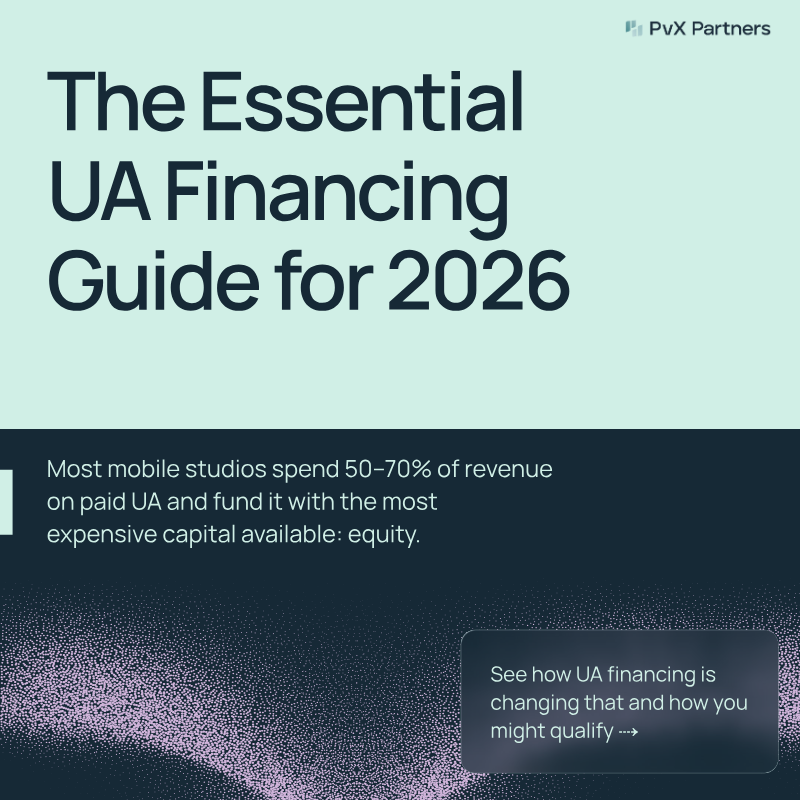
For what it is, it's not the same thing as Pollen VC, but we can get into that. What UA financing is is it's a relatively new form of of non-dilutive funding uh that's become available for consumer apps and and for games for non I guess non- finance folks. What non-dilutive means is just that the capital is offered in the form of a loan uh in exchange for
more buzzwords.
So you give they give you back money plus interest rather than equity where you give people money and they give you a uh a piece of their their company. So you don't give Jeff shares from your company.
Yes. We PVX will never take any percentage of your company.
That's what I always say. You don't really sell your soul for for money.
No, that's great.
That's it.
To be honest, the reason you're, you know, it's we're hearing more and more about it now is because it's a solution that's really needed in the market. So, as you guys know better than anyone and the listeners this podcast know, I mean, UA has gotten more difficult. Many company unless you're working with mate, I suppose.
Exactly. Thank you. the balance is is tougher and companies have seen paybacks expand and it's just just more challenging
because of those challenges and and also like the lack of sizable exits I would say in the space we've seen a real pullback of growth capital coming into mobile from the private equity and VC side the past couple years but like very few VCs are willing to write you a $20 million check uh to fund UA in 2025 you
know unless maybe you're one of like a handful of sick companies in Turkey
unless you're brand was expecting when Turkey comes up.
They seem to still be able to get money, but generally speaking, it's it's it's really tough out there for founders. So, what's happened is that UA financing has become a very compelling option for these companies and and kind of filled that hole in the market. UA funding ends up being a very capital efficient way for companies to scale because if you think about it, you access additional funding as you or financing as you need it. You don't have to forecast and say, "Hey, I think this year I'm going to need to spend 20 million on UA. let me go raise 20 million, you know, right at at right at once. Because at that point, you may find yourself in a situation where you thought you needed 20 million, but you really only needed five. Well, now you just raised 20 million and you didn't actually need it. You can't just go give that money back to a VC. They're not going to give you that part of the company back.
Yeah. They got the shares instead.
So, so it ends up being just a very efficient way to to fund yourself
overall. You know, it's still it's still a fairly nent market, but it's growing pretty rapidly. I mentioned we've done 20 plus deals of this of this kind and have frankly another 10 plus will sign in the next month or so. I saw a recent report by Invest Game that full disclosure PVX was like kind of funded that report as well or sponsored the report, but it's a great report that I recommend everyone check out. They're expecting the market to be two and a half billion by 2027. So, I I hope I hope they're wrong and it's higher, but that in and of itself is a massive number. 100%. I think well as you mentioned UA is tough. Well UA is dead for eight years at least.
It's been dead since I joined the industry pretty much.
Exactly. Exactly. do I do I get that right as just said in the beginning like he probably didn't know and like I guess a lot of people don't know even that there's this option because if I understand correctly most of the people that even I think I had this conversation literally this week with someone like oh we need to find a
publisher
for us to to like solve the marketing problem or the marketing question
so the marketing question is the like the the money question usually
yeah both actually
okay
so it depends to to be totally honest it depends where they are at the stage of the project, right? So, one of, I guess, if I will be completely objective, a downside of UA funding is that you need to have the game built, right? We're not giving you funds to build the game. We're also not necessarily funding soft launch. We're not funding right away when you go to global launch. We need to see, you know, several months, whether it's 6 months, 12 months, whatever it is. We need to see some quantum of data to make sure that we get our money back. So it's it's not like I'm not here to say that publishing is dead or this is 100% better than publishing. It just depends on for different companies at different stages. If you could bootstrap your way to a point where you can get to UA funding, I think it becomes the best option.
In fact, most of actually the companies we're working with have raised VC funds. So it's not like it's not like this is replacing VC funding. It's more
replacing growth growth equity.
I still think it's 100% better than the other option because you again retain the shares and stuff. Uh the thing that I wanted to mention here the the the devil in the detail is that you need somebody competent to spend that money because that's not on the publisher side.
Yeah. Like nobody for us so we don't have to worry about no but like that that's one of the big differences. But assuming that what you said that the companies you get into contact with or like most of the clients I guess are already past that point where do you need to see like positive ROI campaigns or like somebody that like oh yeah we have a great game by the way lend us 20 million like we spend it I guess that's not the conversation but like oh we have a great game we have the roas like like we used to say on the podcast like if you have a game that's printing money you know get the mortgage and run it through if you know how to do UA why why do you need a publisher? So this is pretty much a better option than the mortgage.
Yeah, the games we're funding are postp productduct market fit. You know, they're not in soft launch. They they
have proven proven rorowaz curves, proven metrics. It's now just about putting putting more fuel to the fire.
Yeah, I was talking about this the um like cohorts and like how how that works with DJ when he was here uh on the last episode because that was quite
that was a great episode.
So let's say I have a game and I'm meeting the cohort criteria. How much uh how much money can I get?
Well, I guess first of all, I didn't really want to make this necessarily a pitch about about PVX. Uh
it's too late.
I mean, we typically work with companies between, you know, starting at around 100k a month and then, you know, up to two million a month when they start working with us. Once they start working with us, they can scale up into the several millions per month. I think our biggest customers spending four million a month. So, we can we can support, you know, higher than that. Okay, that's that's pretty cool. So like okay well then why why writing the article now? I mean right now I mean PVX is not the new company now. So you are
on the market for some time. So how to choose the right UA financing partner like why is it now the
Yeah. Yeah. So interesting.
Candidly we're we're you know you guys may have noticed this as well. We're seeing more and more folks entering this this market.
Like even today I saw another announcement of of a new fund. I guess just to be clear, taking my PVX hat off. This is great overall for the space. Obviously, I think PVX is the best option out there. And, you know, we'd love to work with every company, but having competition in the market is clearly going to be beneficial for publishers in terms of pricing and and the terms that they're able to get. But what really drove me to write the article and and write it now was was honestly this this frustration that I was having because I talked to a few different founders and they a couple of them had made comments to me sort of along the lines of like well money is money and you know at the end of the day I'm just going to take the cheapest rate and that's kind of all I care about which I get to some extent but like now having done 20 plus of these deals I think that mindset is is is pretty flawed. Obviously, pricing is important.
So, I'm not trying to sit here and say don't care about price, but I think there's a lot of other things that people should consider. And so, I kind of put this together in a bit of frustration one one night and then it turned into a blog post. Uh, and actually the founder that said that to me, we I think we are going to end up working with him. I'm not going to say who it is obviously, but uh
the So, I'm I'm happy that we we will hopefully win that deal, but yeah, it's really meant to the article if you you know, I'm sure we'll post it in the show notes or something. It's it's not meant to be like a pitch for PBX. It's really meant to say, "Okay, these are the things that I think you should consider as a founder looking at at UA funding, whether it's PVX or or someone else."
Yeah. Look, Jeeoff, I think it's it's very important and that's why like to educate the the industry and that's why we also started the podcast because there's all there was a big hole in knowledge and like knowledge sharing in general because if if the the industry is, you know, getting all the information from different sources, they're always more educated. they they make better decisions whether it's PVX,
whether it's somewhere else, but at least they have the information so they can make the decision and they know. So yeah, tell us all tell us more. Oh, first
So yeah, we just learned that Jeff won't take your shares and he will lend you money. What makes Jeff lend you money in the first place? That's the question.
Was that a question that your your audio is you were making is worse than mine. Is this always how it is?
H basically how does it work for you? like that. I guess that would be one of the questions for for people like getting into.
How does it work for us in terms of what I mean? So, so our process
as a business model,
you know, when we so how it works for us as a business model, I mean, we we uh we lend money and then we get the money back plus interest and that's the interest is
pretty much pretty much it.
That's the basic, you know, the simple math of it, right?
And it's that simple like nothing else in it or like, you know, you tell me.
It's a bank, bro. We have a lot of capital. We have a funding provider and and we we then lend out the money and and we make money off the interest when
it when it comes back basically. I mean that's the long and short of it essentially.
Yeah. But speaking speaking of interest, so why is not the lower interest better?
Yeah.
Why why is not because obviously that's
I mean generally speaking all else all else equal. If everything else we're about to talk about is equal then yes like obviously having lower interest is is better. But one pricing can be pretty complicated. Like every fund has a different way of calculating interest, when it's paid, how it's paid. So for founders who aren't super financially sophisticated, it's actually fairly opaque,
which is Yakoup, as you might have noticed.
Yeah. So like the first thing you should do or I recommend to everyone who's comparing different rates is to calculate the IRRa for each offer that you have to make sure you're you're and I Yakob, I see your head spinning. I'm going to explain sort of what that is. You want to make sure you're calculating kind of apples to apples. What irr is is it's kind of a nerdy finance term, but it's a relatively simple Excel function. What it does is take into account the time value of money and when the capital is actually returned. So, like for
example, if you have a lender that charges you 10% on a loan, but the 10% interest is paid month one versus another lender that pays that charges you 10% on the same loan, but the interest is paid in month 10. you're paying the exact same dollars of interest, but the effective, like the IRRa is going to be significantly higher on the first month. So, you want to make sure you're, you know, you're comparing apples to apples. Once you've done that exercise, you know, you can, you can actually know which option is the cheapest. It's sometimes not the one that from the eyeball test, just like based on numbers on a page, might you might think it is. Um, that's one thing to point out. The second thing I I guess I'd look out for is calculate the total dollar amount of interest that you'll have to pay under your different offers. So like if you think about for example if one lender requires you to take a minimum draw down or for example maybe requires you to fund 100% or 70 whatever some percentage of their spend of your spend every month
through them then and while the other while another lender might give you flexibility to say hey some months you could take zero some months you could take whatever percentage you want the one with less flexibility may actually cost you more because they're effectively forcing you to take capital
okay may actually
cost the the draw draw something. I just drone in the middle of that
the draw down.
Yeah. What does this mean?
Paying.
So the way the way the UA financing works is every month you request a or you you get a certain amount of capital. When we when we put together these credit facilities and we make an announcement, hey, you know, we are funding Malpa Games and it's a $20 million facility. We're not writing a check $20 million and handing it to Malpa Games. every month they come and say, "Hey, we spent two million. We want you to fund 1.5 million of that." So we wire them 1.5 million and then we get that that money back over time. But it with with PVX for example, we are very flexible. So we say any month you can take 0% up to 80%.
So you have complete flexibility to manage your capital. Like let's say you have some months where you
did a really live ops and you have a bunch of revenue coming in or your subscription, you have a big subscription renewal. you don't need to take our capital if you don't need it. Whereas there may be some other models out there where they say, "Hey, we'll give you funding, but you every month have to take a 100% of whatever you spend." Well,
that's the that's the hidden part. Okay. So, you require necessarily hidden. It's just not saying they're like obuscating these things. It's just the reality of like
No, no, but like as you said like the the beginning goes was like we lend you money, we take on the interest. It's quite simple. But, but this this doesn't
But you have to spend the money. You have to spend the money basically.
Yeah. In this case,
you have to lend the money.
In every of these cases,
we know how much you spent. So, it's not like you could come and say, "Hey, we are going to spend 2 million. We give you 2 million." And then they're like, "Turns out I bought a Ferrari and like we spent 500k on UA." It's like, "Well, that works.
Deal done."
Yeah. Couple two other things I guess
I'll I'll mention around pricing just real quick. So, one, watch out for like hidden fees, like stuff like if there's a setup fee or like non-refundable legal fees or a fee to close down the facility, they're just adding on little, and it may not seem like much. It's like, well, it's a $2,500 setup fee, okay? But on, you know, on a percentage basis, that could be 5%. Well, when you're, you know, if you're calculating IRRs, it makes a difference. Last thing, I guess, is like bundled offerings with with SAS tools or something like that. Just want to make sure are these if you're taking the capital because you want to use the tool like just make sure it's the a tool you actually want to use or is there maybe better or cheaper alternatives out there so you're not locked in just because they're giving you like a certain rate.
So you
that's all pricing
you can be forced to lend you can have hidden fees. Any other hoops that you need to watch for?
Those are probably the main ones I would say. I mean, I'm sure as the market gets gets more mature, people will find different ways to screw people.
Let's say let's say get let's say get creative.
Just like anything else, like they'll figure out like any bank, like you know, they'll figure out ways to extract money from from customers.
Yeah. I I guess one of the themes we talked quite a lot about uh putting on my UA hat because I would listen to Matia when he talks on this podcast is how payback periods are getting longer and longer. like what sort of category of games do you usually finance the most? Is there a specific trend there or is there any type of payback window that you kind of prefer or what's the story there?
We're we're pretty agnostic to in terms of categories. So, we don't come from like a top down place and say, hey, we love the merge genre. We really want to fund merge games. We we tend to look at the data and if any game has the kind of rorowass performance data that passes our our underwriting criteria, we'll we'll fund it. And in terms of the payback that we expect, we look at the data for that as well. So we'll we'll kind of see what the game is projecting to currently. And then based on looking at kind of the rorowes curves and running sort of all of Zj's analytical
wizardry, we'll we'll come up with a payback period that we're comfortable with kind of accepting.
Felix, you know what you can do? You can plug your data into PVX Lambda and you will see if you're eligible for funding. There you go. Okay. Jokes aside, Jeeoff, you mentioned facility twice. I have no idea what that mean.
Yeah, that was the other word I wanted to ask.
Yeah, that's that's Yeah, I guess that's a funny way. Facility is basically just like the credit line. I don't know why in in private credit they like to have these fancy terms for for things like basis points instead of saying percentages and
I can also like throw in fancy psychological terms that you don't know [ __ ] about. Like it's very easy to do these conversations
back in the day. So I'm sorry I throw some throw some words out there.
Facility size is is is quite important. It's like we allocate that money for you. That that's that's what it means. Yeah.
Yeah. When I say facility size, I mean like the line of credit that you can ask, right? Like cuz if you come to us and you're spending briquet a month on UA, we're not going to say, "Okay, here's 10 million. You could just go
spend it as as you wish. You know, you'll probably get a credit facility of like 2 million or something like that. But what's really important is that you want to make sure when you're picking a partner that you have a partner that can that can scale their facility size with you. So, like the last thing you want to do is go through the whole process of putting a facility in place and then hit your credit line pretty quickly, your credit limit, and basically have the lender be unwilling to expand it because they may, let's say they have a $50 million fund, and then you all of a sudden are 10 or 20% of that fund. They're probably not going to want you to have,
you know, be too much exposure to their fund for their own risk management.
Switching lenders is not as easy, I would say, as people think. you know, you're likely going to have to pay off your outstanding balance before you close the facility. And even in a best case scenario, like it's going to cost you time, money, and legal fees, and just operational headache in order to switch lenders. So, like you're looking at probably a few months at minimum. And as you guys know, if you have like a wellperforming creative or you see
positive rorowaz, like the last thing you want to do is slow down because, you know, you went with a subscale lender, you know, that that maybe couldn't couldn't grow to what you needed. I left finance 10 years ago. I'm hearing so many terms that I haven't heard in 10 years.
Yeah.
So good. Yeah.
It's very It's like when you say facility, I was like, "Okay, why just close the storage facility next on the next street?" Yeah,
it makes sense. Lenders like if we take all all the fancy versions is basically like your mortgage can get bigger if you need it because suddenly you can get bigger mortgage if you don't have the stuff for it basically. So that's super super good. Of course like doesn't make sense if you are into like that's the first place why you approached this whole thing I guess because you want to scale it up not just you know stay on some
yeah but then like what happens when you you want to scale it up and then hit like the ceiling and then suddenly everything goes to [ __ ] and then you need to scale down
because I mean things happen obviously.
Yeah. But like based on chess model you just land less
but like if you're not flexible enough then you can you can do that.
Oh yeah. Yeah, like if you're forced to land, you're not not in good great place. I think that was the part where all Guy Richie movies flashed in front of my eyes.
Yeah, that's when we send in, you know, the the bounty hunters. No, I think uh
goons.
Send in the goons.
There's a bit of uh there's a bit of nuance here to understand. So, every every lender is going to have risk limits, right? So like meaning for every deal that they sign or resign, they're going to have a total exposure that they're willing to assume and a payback that they're going to allow the company to stretch to. So like for PVX and for example, when we sign a deal, we set a threshold rorowaz curve kind of like we talked about before based on historical performance that we'll we'll expect them to outperform that threshold rorowaz curve.
And in our cont management is basically risk management.
Exactly. So, in our contracts, we lay out clearly what happens if we one of those thresholds is breached and kind of what the consequences are. There are
some other lenders, I believe, in the market or some of our competitors where they may not explicitly have thresholds like that in their contract, which at first, you know, you might say to yourself, "Wow, sorry PBX, that sounds a lot better. Why are
they're going to send the guy reaching out?"
Hopefully not not that. I don't think anyone's doing physical harm, but I think it adds And uh I think it adds a lot of unknown risk for you as the borrower because if you don't know what the lender's risk controls are and how comfortable they are at different paybacks, you're at risk that you might have your payback go from like four months to 6 months, which you're totally comfortable with based on your rorowes curves, but your lender decides for some reason that doesn't fit their risk model. So they just they decide to pull pull their funding. So not having that clearly communicated and put in a contract up front, I think is opening would open folks up to a lot of uncertainty and potential, you know, challenge in, you know, once
I can I can already hear Darth Vader
with like I altered the deal. Don't force me to alter it again. what I what I'm I'm kind of hearing it it reminds me my discussion with Xeno Frontier ads and he he basically said look if if you're a UA manager and you are going to run the rewarded UA network you need to ask a lot of questions and you you need to integrate like the the rewarded UA partners do I really need to do and it sounds like I really need to do my background check on all all the partners
way way before I kind of go to I don't know about background chair, but I think the counterparty risk is is sort of real here. And this this is a bit of like an interesting take from me maybe and it's it's kind of a hot take sort of spicy maybe. I'd say from from first principles, you you always want to make sure incentives are aligned. So, in my opinion, I think you want your lender to be lending you money because they're in the business of lending out money and then making money when they get paid their interest back. Not because they're
using this as like some sort of loss leader, you know, way to hook you in to monetize you in in some other way. I'd say we've seen over the past six months a bunch of different competitors enter the market. And like without I guess mentioning specific companies because I have respect for all of our competition,
I'll paint some like edge case, worst case scenarios. So let's say let's say your lender is a publisher themselves. Well, publishing is a much higher margin business than lending. Owning and publishing a successful game, you're going to make literally a hundred times the amount that you'll make if you're just providing a game with UA funding. So, this is a purely hypothetical example, but let's say this scenario, you start working
as a publisher, not
working with a publisher using under UA financing agreement, not a publishing, UA finance it. You scale up your spends from half a million to three million a month. The game's crushing it. At that point, you've hit your credit limit. You go to them. You say, "Hey, I want to increase my credit line. I think that could scale from three million, you
know, to 10 million." They say, "Nah, sorry. We no, we can't we can't increase your credit limit, but actually, we'd like to make an offer to buy you."
Well, now you're potentially in a pretty bad You may be in a bad spot
because it's going to probably be tough to get other UA funding because you have a bunch of outstanding debt. You may be in a position where you have to take an offer or sell your company when you don't want to. So, that's that's one example. Let's say your lender is a VC because we've seen a lot of, you know, seen or heard a lot of VCs getting into getting into this business and I understand why they would. If they're not your VC, meaning they're not on your cap table, well, do you really want all of your proprietary data to be shared with someone who is also literally in the business of funding your potential competition? I think that's probably not something I would necessarily want to do. If they are your VC, so meaning they are one of your investors. This situation, I'd say, is a bit more nuanced. It may seem great to take non-dilutive capital from someone already on your cap table
already diluted you.
For for founders, I guess, you know, listening to this, I actually think that may be a bad idea. So, if you think about it, your your VCs already have board seats and a fair amount of power within your company.
Exactly. I'd be pretty careful giving more power to any one institution where they then own equity and they have the debt leverage over you because at some point and you hope this never happens but your interest and their interest may not be fully aligned. Like what if you want to take an offer to sell and they decide they don't want to. Well, the last thing you want to do is just have them have additional leverage over you. And then I guess the last thing I would say like if if the company is a SAS company or doing you know selling you an analytics tool or something like that I would question okay how committed is this business to actually being in the lending business. Are they getting into UA financing just because they want to onboard you as a SAS customer and they're willing to kind of give you a small amount of capital at potentially a lower rate to sign you up as a client but then they don't actually want to scale with you. They just want to have
you as a SAS customer. I'd potentially be wary of that situation.
To be
still exist on the market
to be clear, you know, I don't think any of the companies entering the space today, and I intentionally didn't use names. I don't think any of them have bad intentions or plans to hurt companies that they work with. But like I do think it's always in life important to be careful to make sure incentives are aligned. Like there's there's too many. You guys are
Can I say a a fun example that I had with a client? I think it was two and a half years ago. It was a mediation provider. I'm not going to say who, but you probably know who it is. And the client I was working with, they got offered to stay on a mediation platform to be paid out 6 months of that network's earnings, like estimated earnings for the next 6 months if they spent it on the UA platform. And then every six months they basically redid that deal to make sure they always stayed on the mediation platform which meant that they were always locked in.
Yeah. Pretty uh
Yeah. I mean we've seen so many examples and I guess I won't name them but you probably can but like companies that that sort of have been bad actors in the space or just like built built businesses using other businesses. Again, won't name names.
Well, welcome to the gaming industry. Ex
Exactly. And and it's fine. There's nothing and again if they're giving you a better price in LL SQL and you go in knowing the risks and understanding it there's really nothing there it's fine but it's just things I would be like thinking about.
Yeah. Know like I I I just want to make clear to everybody like why we're talking about this because we are in the space for a long time. We are getting really old. So we've seen all of this but people are coming into the industry and they don't know. And when I talk to like some of my clients as well, like they're very surprised like I didn't know these guys are not really nice guys
even that there's this option basically.
Exactly. Or there's an option like this. So it's not like we are kind of cheating on people. It's just throwing the kind
of multiple options out there and the possible outcomes of just to make it clear.
Yeah. Like but I think like from my perspective like the whole space is pretty much changing very much because even if you take the whole publishing thing that we've been talking about like most of the times that I see and like talk to some of my clients is basically
publishers are funding the teams to build prototypes for them these days rather than just being the marketing analytical machine of the previous five years or whatever it was always like we need UA whatever something something so we find the publisher these days I think is much more towards the like we have the lottery tickets with our developer So we fund their you know lottery ticket and that's it because like the days of sending hundreds of prototypes to a publisher are over basically. So that's not the case here. But yeah like was sorry sorry to barge but the last example that you mentioned Jeff like that's real like a SAS company having this kind of lending facility which is still the priority for the company to be a SAS company and keep you as a client.
Okay, that's not it's not a bad think about it like right like Yeah, it's not a bad CAC, right? Like it's pretty good. It's quite clever. No,
no, like for the for the company. Yeah, but uh not for the I guess the developer because again,
no, it can it can actually be a great value proposition for the developer. I would just I would just make sure that you know where their incentives are, know that they are long-term in the business, know that they can scale with you. But yeah, if you're working with a company already and they're going to give you financing at a very good rate, then it it may actually be a very good option. So,
I understand like but but just in this kind of a ladder of like you having worse and worse and worse leverage, this is like actually one of the worst ones.
Yeah.
Yeah. Exactly.
Yeah. on. So if I well not if I'm I'm the founder, but uh I want to know if if like I screw up and like things go wrong, is there kind of like uh anyone that
kind of can share the risks with me? Because I mean it's that's pretty that's pretty important.
Yeah. So this this is something I think you know people don't really think matters um until it does and then it's kind of at that point the the only thing really that matters. People always think about the positive situation where it's like, oh, if I make the money back, how much interest are you going to charge me? Blah, blah, blah. But they they don't tend to think about the scenario of like, well,
life doesn't work like that. Life doesn't work like that.
Yeah. So, I guess getting this will get a little like nerdy finance for a second, but broadly speaking, there's there's two types of of loans out there. So, one is like secured and and unsecured. Some UA financing is done as an unsecured loan. This is typically what we do at PVX. And so what that means is that the loan is actually not backed by the assets of the company, but rather only from the revenues from the cohorts in our funding period. So what that means in practice is that if the revenues from those cohorts don't end up being enough to cover the money that we
lent you, we actually assume that risk. However, there are there are some other offerings out there that I've seen that are fully secured by the assets of the company. So what that means is that if the cohorts that the comp know this lender funded don't pay back, you actually are legally obligated to figure out a way to pay pay them back off the you know the balance sheet the cash on your balance sheet. And if you don't that lender will be able to put you into bankruptcy or take over your company or figure out some way to to legally get get their money rich.
Yeah. And that's that's a risk. And now, just to be to be clear, because I always like playing devil's advocate or kind of giving giving both sides of it. I'm not saying that taking on a secured loan is necessarily the wrong thing to do. In fact, actually, I've talked to some very smart people in our in our space who if they're confident enough about the cohorts and you have a good enough cash buffer, it actually can make a lot of sense to take out a secured loan in order to get cheaper funding. You should just be clear on what those risks are
and understand that when you compare the different pricing structures. So like I've literally had customers who have come to me and been like, well I have this cheaper offer from XYZ and you know what can you do? This is cheaper than you guys. And when I dig into the details it's a secured loan. So they're comparing an unsecured loan from a secured loan. I'm like well it's not the same thing. Like I'm not going to be able to compete on pricing with that because there's literally the risk calculated. So yeah, like if someone wants to take that to go down that route, I think that's totally fine. They should just know the risks, you know, the risks that they're taking up front.
And do I do I get that right, Jeff, that if scenario one happens, which unsecured loan from you, cohorts doesn't pay back, you take a loss or what's the what's what's the setup there?
Yeah. So under under PVX specifically, if the cohorts don't pay back, usually we have the ability to cross collateralize across cohorts in our funding period in most of our contracts. So we could pull from cohorts that have paid back in order to pay off
collateralized.
But let's say let's say the you know all
of the cohorts you know basically the game something had happened it blew up.
We would then take that risk. So we wouldn't
a little bit of switcheroo basically into the past and then there goes from there. Yeah. or you know different months, different different cohorts much different but still I mean still still I guess lower [ __ ] lower leverage over the company because it's unsecured loan rather than a secured one which again guy richy dudes can come in.
Yeah, it's just a totally different product. It's like uh you know a mortgage versus like let's do it this way like your mortgage rate because it's secured by your last words
like you know you're going to get a mortgage at whatever 5% or 7% whatever it is these days but like your credit card they're going to charge you 25% because it's unsecure. It's actually the perfect example. They're completely different products and completely different pricing.
You're talking about guy riches dudes. I mean it's almost come down like to to the reputation. So does it's still money, right? So like does it really
matter? Felix just said like there's no it's high finance. There's nothing like Kyrie's dudes.
He's from finance man. This is obligation. This is true.
Fair.
He's from the same side.
Richie has died. I think uh I think the f you know call it whatever you want. The fund's reputation or just how well you know what how well you know the fund. I think it it matters. When when founders raise an equity round, it's pretty common knowledge or pretty well understood at this point that you want to dig into the VC that you're taking money from. You want to understand their portfolio. Who have they backed in the past? How do they treat companies they invest in? Do they add value? You know, how does the partner act as a board member? Is he really a pain in the ass to work or he or she kind of a pain in the ass to work for or sorry, work with?
How do how do you get these background checks? By the way, just just asking for
or you figure out who you know you figure out who they're working with. You know, we we put out deal announcements for pretty much most of the deals we do. And we are actually a lot of times we push people before they sign with us to
speak with people that have worked with us. We say, "Look, you want to understand how we treat the companies, our portfolio, how we operate. Please talk to literally any founder we've worked with because I think that's the only way that you you sort of know what you're getting yourself into." You know, frankly, like when you're dealing with a lender, they're if you pick the wrong one, they could actually make your life pretty miserable relative even relative to an equity investor. So, definitely always ask for references. If possible, ask for references for companies that have stopped working with them. The industry is pretty nent, so there may there may not be a ton of I I've seen I've seen stuff where equity investors can make your life pretty miserable firstand, so I can understand that
for sure. I mean,
you want to make sure when [ __ ] goes bad, you want to know how they're going to treat you because,
you know, if things go well with a credit agreement, it's like, we're going to give you money, you're going to pay it back, we're going to high-five at conferences, and like everyone's going to be happy. Like, when things go poorly, when they're like, "Hey, our Rozage just went down 30%." Like, like what do we do? You know, like you want
to make sure the lender treats you in a way that is reasonable and fair and doesn't like come and take your company or something. you you just want to make sure that they operate in a way that you would want to be treated.
Okay. And when I was reading the the article, I mean to this point, fine. I mean, thanks for expl explaining all of stuff, but the last point is like ease of use. And I was like, okay,
yeah, this one,
what does that even mean? This one's a little a little vague, but generally speaking, you want this to just be as seamless of a process as okay as as possible and have it make sure it doesn't create operational burden for you. So like you know PVX is structured as a company that then then owns the funds like we are building a whole bunch of internal tech internal tools you know Q the PVX lambda mentioned but like you you want every process in this to be very seamless and productized like you don't want to have to go back and forth on spreadsheets every month to say like how much did you actually spend like send us the receipts from your ad networks like you want everything to be
incredibly
smooth so you're not adding burden to your finance team you're not adding burden to yourself. That's kind of the main thing of what I mean by that. It's a little vague, but like the whole process from like the negotiating the term sheet, the do everything should just be incredibly smooth, you know, as easy as it is to deal with.
I guess I guess the follow-up question here is about deal velocity, right? What's the quickest deal and what's the slowest deal that you've been a part of?
The quickest deal we've done is probably between four weeks. It's probably around four weeks. Meaning like
the day that I first met the company to like us funding them money was was four weeks. The slowest I mean well we have had deals that have dragged down for months but that's not on our side. That's like we just
either negotiating that happens money.
Yeah. Size of the company matters as well.
Yeah. I'm quite curious like as you said like about the big deal that you mentioned there. What's the smallest year like for people to understand like if like if it's you know worth their
time or whatever like the lower
we typically have a threshold of like if a if if a customer spending over a 100,000 a month um and has at least six months of of data sort of at that scale we can we can start to consider it.
Usually we'd like to see bigger scale and more cohorts but that's kind of like the low end of the thresholds of where we'll where we'll start to be able to sharpen our pencil. Okay. So, yeah. Yeah. I hope you are not not there yet as a founder. Me neither.
Ask for a friend, you know.
For a friend.
Ask him for a friend. No. But I think like this for us as founders and even as small founders was helpful. What should what are like the the last thoughts or like main takeaways like that like founders should should think about?
Yeah. Yeah. Yeah. So, I think the you know the theme of make sure you and your lender are aligned is a crucial one. make sure they're able to scale up with you. Um, and are aligned that when you as the company spend more and push out
your paybacks, they should be happy. You know, if if you're going from spending a million a month to three million a month and they're like, well, maybe you should scale a little slower or giving you something like that, like that is probably a sign that maybe they have not structured their business properly in order to be able to support you. That's number one. Don't don't treat this process like you're opening a new credit card. You know, it's not like a faceless, nameless company that you're dealing with. I would argue treat this kind of very much like an equity race. Consider the reputation of who you're working with, how they've treated people they've worked with in the past. Make sure you talk to people that have worked with them. Ask them for references. Figure out who they're working with. I mean, this is a small industry. We all we all know everyone. That's kind of it. If anyone wants to talk about UA funding, I'm very open to chat whether you work with us or not ultimately.
Yeah. Like Felix likes likes to to ask this like what are like let's let's name like three red flags that everybody needs to like watch for like three red flags when you're talking to the
financing a partner like
for your land that sounds to me like the number one red flag
if they have goons standing next to them.
That's like afterwards.
That's not before.
Oh man, I don't know. I would say like just know what know what kind of contract you're getting into. Like if it's a factoring contract and they're taking over your Apple and Google account, that that can be fine, but that's just a different type of financing. I would look at for some of the things I talked about earlier like the price around pricing, just like hidden fees or whatnot. Not that there's anything wrong with those things, just know that you're paying them, right? Like just calculate that into the the sort of effective interest that you're paying. Another red flag I would say, these are kind of all going back to the things we've already talked about, but like is just around the facility sizing. Like if they're giving you a low rate, but they're like, "Well, we can fund you up to like half a million a month, but like, you know, if you get bigger than that, I don't know if we'll be able to scale." Like just red flags around how big their fund is. Because again, I think you want to work with someone that can work with you to get you to the finish line. Like you don't want to have to like work with someone when you're
spending 100k to 500k and then find someone else when you're spending 500k to 2 million, then find someone else when you're spending 2 million to 10 million. like you kind of just want to find one person, never have to deal with this again and just like work with that person for, you know, for the duration.
So, basically, make sure that your lender has risk assessment management covered.
Yeah, exactly.
Make sure they're going to be around. Make sure they have the funds. Make sure they're treating people right.
Awesome. I mean, Jacob, you know what you should do?
Sure. Of course. I'm starting to do unsecured loans business for sure. And I will I will put the the blog into the show notes definitely and also your details. So guys, if you want to if you want to chat with Jeff, here's your guy.
Thank you very much for coming.
Yeah, thanks a lot, man. Like did learn a lot today.
It's uh been a long time listener. Excited to, you know, it's like a dream come true.
Sure. Happy to have you.
Thanks for coming. Okay, dear listeners,
join the Slack channel. If you have any questions, uh, definitely put them into the comment section on the YouTube or just join the Slack channel and then we can discuss different things there. Thank you very much. See you next time.
Bye-bye. [Music] [Applause] [Music] Heat. Hey, Heat. [Music]
Auto-generated captions from YouTube — names and numbers may be misheard.
Key insights
Distilling the key insights…
Ask AI about this video
Cite this video
Citation
Generating citation…




















Comments