Updated Jun 1, 2026 by InvestGame
Report
Published by InvestGame
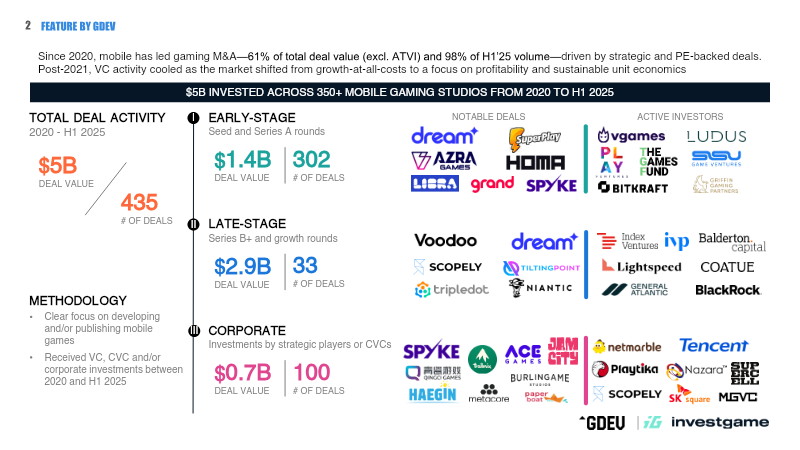
Since 2020, mobile has led gaming M&A—61% of total deal value (excl. ATVI) and 98% of H1’25 volume—driven by strategic and PE-backed deals. Post-2021, VC activity cooled as the market shifted from growth-at-all-costs to a focus on profitability and sustainable unit economics $5B INVESTED ACROSS 350+ MOBILE GAMING STUDIOS FROM 2020 TO H1 2025 TOTAL DEAL ACTIVITY I EARLY-STAGE NOTABLE DEALS ACTIVE INVESTORS 2020 - H1 2025 ...
#12¹ FEATURE BY GDEV FEATURE BY The Great Mobile Reversal: Why Buyers Pay Billions for What VCs Abandoned invest
2 FEATURE BY GDEV Since 2020, mobile has led gaming M&A—61% of total deal value (excl. ATVI) and 98% of H1’25 volume—driven by strategic and PE-backed deals. Post-2021, VC activity cooled as the market shifted from growth-at-all-costs to a focus on profitability and sustainable unit economics $5B INVESTED ACROSS 350+ MOBILE GAMING STUDIOS FROM 2020 TO H1 2025 TOTAL DEAL ACTIVITY I EARLY-STAGE NOTABLE DEALS ACTIVE INVESTORS 2020 - H1 2025 Seed and Series A rounds oream 5B 1.4B 302 AZRL HumH GAMES DEAL VALUE 435 DEAL VALUE # OF DEALS L18RA SPYKE # OF DEALS II LATE-STAGE Series B+ and growth rounds Voodoo dream Index Balderton ccapital $2.9B 33 SCOPELY COATLIE METHODOLOGY DEAL VALUE # OF DEALS NIANTIC GENERAL • Clear focus on developing and/or publishing mobile III CORPORATE • games Investments by strategic players or CVCs JAM Received VC, CVC and/or $0.7B 100 lence corporate investments between JTZNL SUP 2020 and H1 2025 Nazara DEAL VALUE # OF DEALS INaza ELL MADE ON game
> **[Chart page]** This page contains visual data — view in PDF for the best experience. 3 FEATURE BY GDEV The pandemic-driven surge in mobile game engagement fueled unprecedented investor enthusiasm, resulting in 137 deals in 2021 and $2.2B in total funding—more than doubling 2020’s figures and marking the all-time peak in mobile gaming investments since 2020 CAPITAL RAISED BY MOBILE GAMING STUDIOS ($B) NUMBER OF ROUNDS CLOSED BY MOBILE GAMING STUDIOS $2,2B 140 137 0,4 120 47* 0,9B 1,0B 80 70 15 67 66 1.4 0,2 60 23 21 10 10 60 5 6 7 0,7 0,6 $0,5B 40 5 13 4 15 35 13 3 0,3 0,3B 0,2B 54 39 46 5 0,3 0,1 0,1 20 29 36 27 0,1 0,1 0,2 0,1 0,2 0,1 0,1 0,1 0,1 - 2020 2021 2022 2023 2024 H1 2025 2020 2021 2022 2023 2024 H1 2025 Pre-seed & Seed Series A Late-stage Corporate Pre-seed & Seed Series A Late-stage Corporate Note: (*) includes 30 Tencent-led deals with Chinese studios MADE ON game
> **[Chart page]** This page contains visual data — view in PDF for the best experience. 4 FEATURE BY GDEV Midcore deals plunged from 49 in 2021 to just 8 by H1’25, hit by high CPIs and high competition. Casual studios dominated—capturing 65% of all deals—driven by faster iteration, broad audience reach, and adaptable monetization strategies TOTAL CAPITAL DEPLOYED BY MOBILE GENRES* ($B) NUMBER OF ROUNDS SPLIT BY MOBILE GENRES* 2,0 $2,2B 1,5 1,0 0,9B 1.7 1,0B 39 49 46 41 40 0,5 0,1 0.8 $0,5B 31 21 25 20 27 0,8 0,5 0,3 0,3B 0,2B 8 0,2 0,2 0,2 0,1 0,0 0,1 2020 2021 2022 2023 2024 H1 2025 2020 2021 2022 2023 2024 H1 2025 Mid-core Casual Mid-core Casual Note: (*) genres reflect the primary types of games a company develops and/or publishes. Casual genre includes hybrid- and MADE ON game
> **[Chart page]** This page contains visual data — view in PDF for the best experience. 5 FEATURE BY GDEV Turkey led casual gaming with 27% of all deals—powered by repeat founders and proven playbooks (Peak, Dream Games). Europe and Asia dominated midcore, driving 66% of all deals in 4X, RPGs, and shooters—genres demanding deeper systems and advanced monetization TOTAL CAPITAL DEPLOYED BY GEO ($B) NUMBER OF ROUNDS SPLIT BY GEO 2,0 $2,2B 137 0,3 1,5 55* 0,5 1,0 0,9B 0,2 1,0B 70 31 67 66 60 0,2 0,2 27 20 20 17 1.0 0,1 $0,5B 9 12 10 35 0,5 0,2 $0,3B 17 16 9 6 14 14 0,6 0,3 7 12 4 0,4 0,1 $0,2B 19 26 10 5 0,3 0,1 0,1 19 18 15 4 0,0 0,1 0,1 4 10 2020 2021 2022 2023 2024 H1 2025 2020 2021 2022 2023 2024 H1 2025 Turkey USA UK Europe (excl. UK) Other Turkey USA UK Europe (excl. UK) Other Note: (*) includes 30 Tencent-led deals with Chinese studios MADE ON game
> **[Chart page]** This page contains visual data — view in PDF for the best experience. 6 FEATURE BY GDEV By H1’25, early-stage activity held steady at pre-seed & seed levels, but Series A and beyond became increasingly rare as structural challenges and tougher performance benchmarks limited most studios’ ability to scale MOBILE GAMING: EARLY-STAGE ROUNDS VALUE & NUMBER MEDIAN CHECK SIZE OF EARLY-STAGE ROUNDS ($M)* 54 46 13,1 29 21 39 36 27 11,0 10,0 13 385 13 4 15 5 7,5 8,5 159 280 119 208 221 135 3,9 3,0 92 156 72 152 65 1,8 1,4 2,3 2,2 2,3 67 104 136 69 70 2020 2021 2022 2023 2024 H1 2025 2020 2021 2022 2023 2024 H1 2025 2020 2021 2022 2023 2024 H1 2025 Series A (m) Pre-seed & Seed (m) Pre-seed & Seed Series A Note: (*) median check sizes are based on deals with disclosed, non-zero values MADE ON game
The interim filing presents the fourth‑quarter 2025 financial results for a midcore‑casual gaming group, emphasizing a record‑setting revenue run and the successful execution of a transformation agenda that includes the integration of the Plarium acquisition and the rollout of a new district structure in early 2026. Revenue reached SEK 3,123 million, reflecting 108 % organic growth year‑on‑year and a 25 % increase on a constant‑currency basis, while adjusted EBITDA rose to SEK 717 million, delivering a 23 % margin that matches the full‑year figure. Unlevered free cash flow amounted to SEK 878 million, with a cash‑conversion rate of 66 % and a leverage ratio of five times EBITDA, underscoring robust liquidity and disciplined capital management. User‑acquisition spending accelerated, representing 38 % of quarterly revenue—up from 37 % in the prior quarter—and grew 76 % on a reported basis, driven by heightened investment in original studios, new casual titles, and the racing franchise. The direct‑to‑consumer channel expanded by 600 basis points to 32 % of total revenue, reflecting a strategic shift toward higher‑margin in‑app purchases. Across the fiscal year, the company posted a 9 % organic revenue increase, with word‑games, racing, and RAID franchises delivering the strongest quarter‑end performance. Operating cash flow for the quarter stood at SEK 840 million, while adjusted net income was SEK 1,390 million, translating to an adjusted EPS of SEK 11.33. The financial outcomes exceed guidance and position the firm to meet its medium‑term outlook, with a pre‑IPO study for PlaySimple concluded and the midcore transformation progressing as planned.
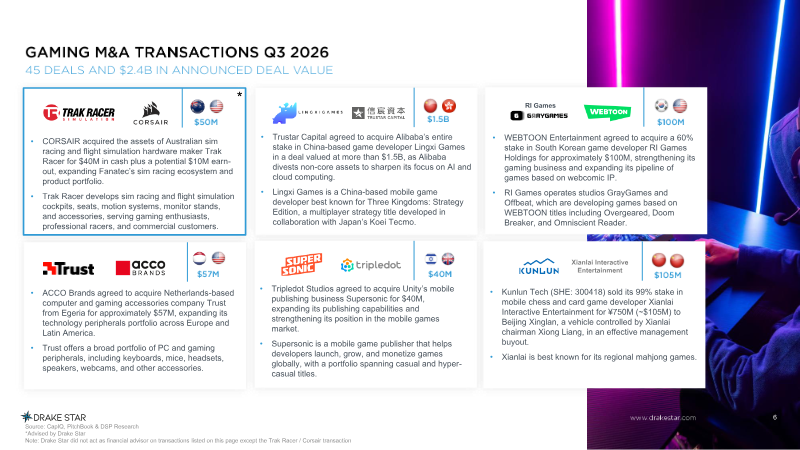
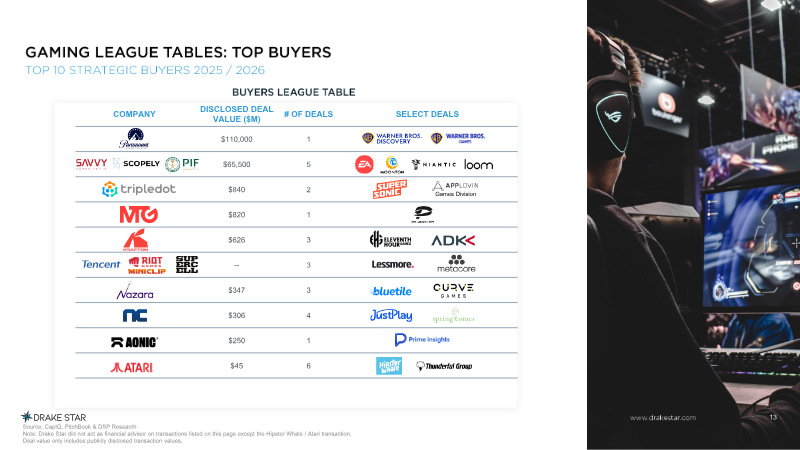
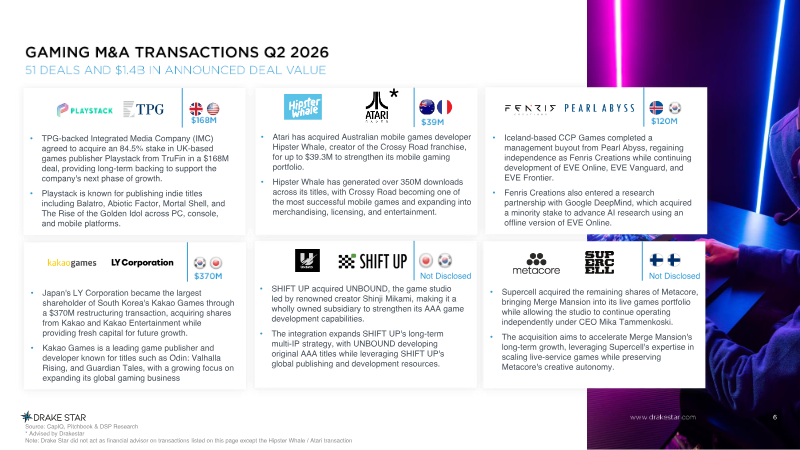
The global gaming industry experienced a notable resurgence in early 2025, characterized by a rebound in merger and acquisition activity and sustained interest in private financing. During the first quarter, 48 announced acquisitions reached a total value of $4.4 billion, anchored by the significant $3.5 billion acquisition of Niantic’s games division by Scopely. Simultaneously, the private placement market remained active, recording 149 deals worth $3.5 billion. These investments were primarily concentrated in mobile-focused developers and companies integrating artificial intelligence into their entertainment platforms, with major strategic entities like Savvy Games Group and Tencent continuing to drive market momentum. Despite this activity, the financial landscape remains bifurcated. While the broader sector shows signs of recovery, with the Drake Star Gaming Index posting a 16.37% gain, performance remains highly volatile across the top 35 public gaming companies. Valuation disparities are particularly pronounced; industry leaders such as NVIDIA and AppLovin command premium revenue multiples, while many other firms face a more challenging environment. Furthermore, while early-stage funding remains accessible, later-stage financing continues to present significant hurdles for companies seeking capital. Looking forward, the industry is positioned for a gradual increase in consolidation as public markets stabilize. Strategic focus is shifting toward the integration of AI and advanced technological platforms, which are expected to serve as primary catalysts for future growth. As market conditions improve, the sector is likely to see a renewed pipeline of initial public offerings, signaling a transition toward a more mature and diversified investment climate for global gaming stakeholders.
• 2024 market size: $188bn (+2.1% YoY) Total gamers in 2024 by region (millions): • Public markets: leading public gaming ETFs up 22- • 36% YTD (vs S&P 500 = 21%) Middle East & Africa Venture funding in Q3‘ 24: $517m across 92 deals 559 (funding +1% QoQ, number of deals -14% QoQ) (16%) • Epic sidesteps Apple in the EU, sues Google Europe (454 3,422m • Discord launches Activities ...
The third quarter of 2024 marks a period of stabilization for the global gaming industry, signaling a transition from post-pandemic volatility toward a new, normalized market environment. The industry has moved past the extreme fluctuations of the COVID-19 era, with capital deployment for private investments settling at approximately $1 billion across 120 rounds. While public markets remain under pressure, the quarter saw the first initial public offering in two years, suggesting a cautious but potential thaw in public listing activity. Key findings reveal a strategic shift in investor focus, as capital increasingly flows toward platform and technology sectors rather than traditional gaming content. This trend is evidenced by a sharp uptick in private investments for infrastructure, payment, and development tools. Within the gaming segment, early-stage venture capital remains consistent, while late-stage fundraising continues to face significant headwinds. Corporate venture capital has emerged as a vital component of the ecosystem, frequently co-investing with traditional venture firms to support studios and tech providers. Geographically, North America and Western Europe remain the primary hubs for investment activity, though the mobile market continues to rely heavily on Asian developers for new top-performing releases. Steam sales data reflects a divergence in performance, with AA and indie publishers driving a 35% year-over-year growth in gross revenue, while AAA titles have experienced stagnation. The analysis relies on tracking closed transactions within the video game industry, excluding pure gambling, betting, and non-gaming blockchain entities. By monitoring deal types—including control and minority mergers and acquisitions, venture capital rounds, and public offerings—the data provides a comprehensive view of capital flows. The findings emphasize that while the gaming sector faces ongoing challenges in late-stage funding, the broader ecosystem is finding stability through diversified investment in gaming-adjacent technologies and a resilient indie development scene.