Updated Mar 17, 2026 by PROEXCA
Report · July 22, 2025
Published by PROEXCA
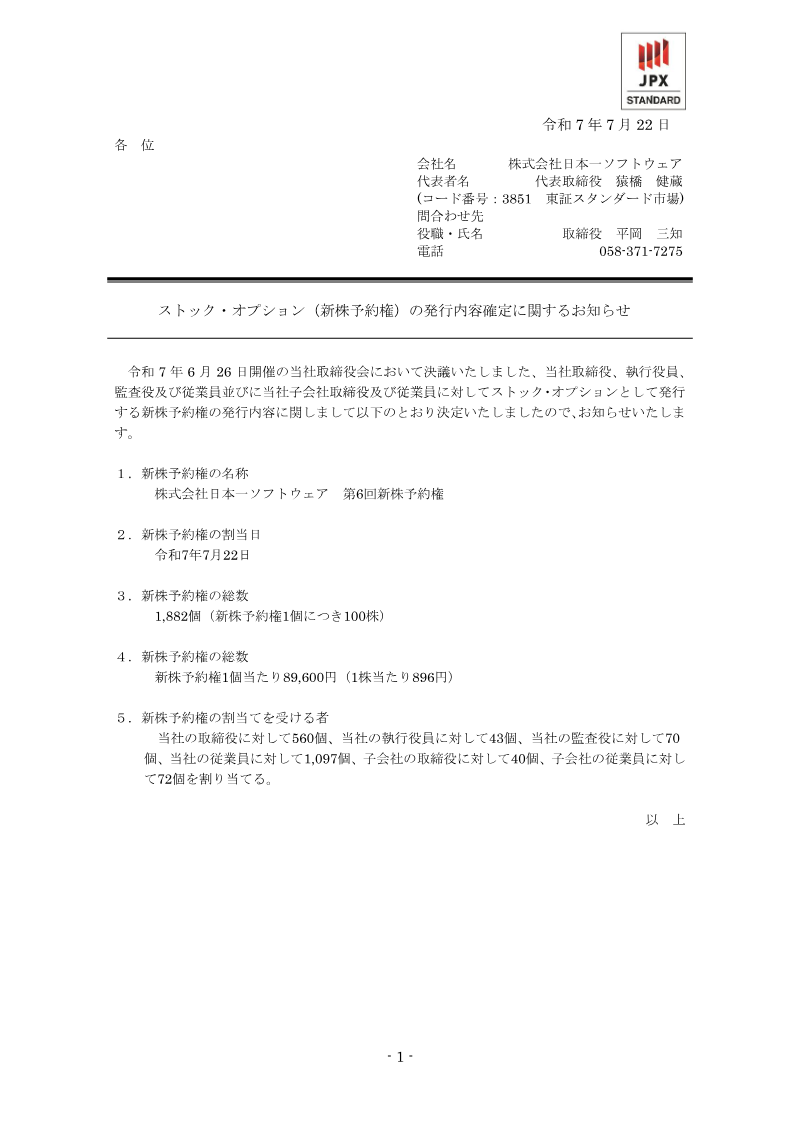
The announcement serves to formalize the issuance of a new series of stock options by Nippon Ichi Software Co., Ltd., a listed entity on the Tokyo Stock Exchange Standard Market. Following a board resolution on 26 June 2025, the company will allocate 1,882 stock options, each representing 100 shares, with an exercise price of ¥89,600 per option (equivalent to ¥896 per share). The allocation date is set for 22 July 2025, and the distribution targets internal stakeholders across the corporate hierarchy and its subsidiaries. The breakdown of the allocation assigns 560 options to company directors, 43 to executive officers, 70 to auditors, and 1,097 to employees. Within the subsidiary structure, 40 options are designated for subsidiary directors and 72 for subsidiary employees. This distribution reflects a strategic effort to align the interests of management and staff with shareholder value, reinforcing incentive structures within the organization. Contact details for inquiries are provided, listing Director Hiraka Mitsuchi as the point of reference, with a telephone number for direct communication. The notice underscores compliance with corporate governance standards and aims to ensure transparency regarding equity compensation for all eligible participants.
STANDARD 令和 7 年 7 月 22 日 各 位 会社名 株式会社日本一ソフトウェア 代表者名 代表取締役 猿橋 健蔵 (コード番号:3851 東証スタンダード市場) 問合わせ先 役職・氏名 取締役 平岡 三知 電話 058-371-7275 ストック・オプション(新株予約権)の発行内容確定に関するお知らせ 令和 7 年 6 月 26 日開催の当社取締役会において決議いたしました、当社取締役、執行役員、 監査役及び従業員並びに当社子会社取締役及び従業員に対してストック・オプションとして発行 する新株予約権の発行内容に関しまして以下のとおり決定いたしましたので、 お知らせいたしま す。 1.新株予約権の名称 株式会社日本一ソフトウェア 第6 回新株予約権 2.新株予約権の割当日 令和7 年7 月22 日 3.新株予約権の総数 1, 882個(新株予約権1個につき100株) 4.新株予約権の総数 新株予約権1個当たり89, 600 円(1 株当たり896円) 5.新株予約権の割当てを受ける者 当社の取締役に対して560個、当社の執行役員に対して43個、当社の監査役に対して70 個、当社の従業員に対して1,097個、子会社の取締役に対して40個、子会社の従業員に対し て72 個を割り当てる。 以 上 - 1 -
The announcement sets out the terms under which Nippon Ichi Software Co., Ltd. will issue new share subscription rights to its directors, executive officers, auditors, employees and the same categories at its subsidiaries. The primary aim is to boost motivation and morale and to align the interests of key personnel with the company’s performance, in accordance with the Companies Act and the approval obtained at the 32nd ordinary shareholders’ meeting. A total of 1,908 subscription rights will be granted, each covering 100 ordinary shares for a combined target of 190,800 shares. Allocation is divided among 560 rights for directors, 43 for executive officers, 70 for auditors, 1,123 for employees, 40 for subsidiary directors and 72 for subsidiary employees. Recipients comprise five directors, one executive officer, three auditors, 121 employees, three subsidiary directors and 23 subsidiary employees. No cash contribution is required at grant, and the exercise price will be calculated as the average closing price of the company’s ordinary shares for the month preceding the allocation date, multiplied by 1.05 and rounded up, with a floor at the allocation‑day closing price. The allocation date is set for 22 July 2025, and the exercise window runs from 1 August 2028 to 31 May 2035. Capital increases resulting from exercised rights are limited to half of the statutory increase ceiling, with the remainder allocated to capital reserves. Rights may be reclaimed free of charge if the holder ceases to meet the eligibility conditions or in the event of mergers, share exchanges or other reorganisations, and any transfer of rights requires board approval. The framework applies to the company’s listed shares on the Tokyo Stock Exchange and its subsidiaries, reflecting a corporate‑wide incentive program spanning the next decade.
Nippon Ichi Software faced a challenging 32nd fiscal year ending March 31, 2025, characterized by a transition from profitability to a consolidated net loss of ¥157 million. While net sales remained relatively stable at approximately ¥5.3 billion—supported by robust North American performance and digital download revenue—the company recorded an operating loss of ¥274 million. This downturn was primarily driven by a 21.3% surge in manufacturing costs, increased research and development investments for high-performance consoles, and significant extraordinary losses related to affiliated companies. The geographic scope of operations highlights a heavy reliance on the North American market, which contributed ¥3.06 billion to total sales, and a concentrated distribution network where four major partners account for nearly 32% of revenue. To mitigate risks associated with high development costs and dependence on core intellectual properties like the Disgaea series, management is implementing a strategy to develop new titles capable of exceeding 200,000 domestic sales. This recovery plan is supported by a new organizational structure led by President Kenzo Saruhashi, who assumed his role in January 2025. From a governance and financial perspective, the company maintains a stable asset base of ¥111.5 billion, including ¥5.19 billion in cash and equivalents, despite a decrease in retained earnings. The group is prioritizing internal reserves for talent acquisition and game development while maintaining a year-end dividend of 5 yen per share. Independent auditors confirmed the effectiveness of internal controls and the fairness of financial reporting, specifically noting the valuation of work-in-progress as a key audit matter. Moving forward, the company aims to balance fiscal recovery with long-term growth initiatives, including a commitment to management diversity and the strengthening of its global development and sales capabilities.
Nippon Ichi Software concluded its 31st fiscal year on March 31, 2024, reporting consolidated net sales of ¥5.34 billion, a 10.5% increase over the previous year. This growth was primarily driven by the entertainment segment, which accounts for over 98% of total revenue, bolstered by strong digital sales and the international performance of titles such as Disgaea 7. Despite the rise in top-line revenue, operating profit declined by 46.2% to ¥401 million, and ordinary profit fell 10.5% to ¥842 million. These contractions are attributed to rising manufacturing costs, increased advertising expenditures, and higher general administrative expenses. The geographic distribution of revenue underscores a heavy reliance on the North American market, which contributed ¥3.14 billion, or 58.8% of total sales. NIS America remains a critical subsidiary in managing these international operations, particularly through partnerships with major entities like Nintendo and Koei Tecmo America. To mitigate risks associated with high dependency on existing franchises and foreign exchange volatility, management is prioritizing the development of new intellectual property with a domestic sales target of 200,000 units per title. This strategy involves enhancing graphic quality and strengthening internal development systems to remain competitive amid shifting hardware trends. Financially, the group maintains a stable foundation with ¥5.36 billion in cash and deposits, though it saw an increase in long-term debt to ¥8.8 billion to fund capital investments, including significant land acquisitions. Critical audit matters identified for the period include the valuation of ¥674.6 million in game content inventories and the estimation of ¥426.7 million in refund liabilities for overseas sales. Despite these complexities, internal controls over financial reporting were deemed effective, ensuring the accuracy of the group’s financial position as it seeks to balance rising development costs with the pursuit of global market expansion.
PCF Group S.A. initiated a strategic capital restructuring and governance overhaul through a series of resolutions aimed at financing an expanded production pipeline. The primary objective involves a share capital increase via the private subscription of up to 5,853,941 Series F ordinary shares. This issuance, targeting a fundraising goal between 205 million and 295 million PLN, is designed to bypass traditional pre-emptive rights to expedite funding for key development projects, including Project Dagger, Bifrost, and Victoria. While existing pre-emptive rights are waived to facilitate a book-building process among qualified investors, shareholders holding at least 0.25% of the company are granted priority rights to maintain their proportional ownership. The structural changes extend to the company’s Articles of Association, formalizing a concentrated governance model centered on a Group of Authorized Shareholders. This group, led by Sebastian Wojciechowski, retains the personal right to appoint the majority of the Supervisory Board and its Chairperson provided they maintain a collective 40% voting stake. Furthermore, specific provisions grant Wojciechowski the personal authority to appoint the CEO as long as his individual holding remains above 25%. These amendments are paired with the elimination of authorized capital provisions to protect investors from further dilution following the Series F issuance. Operational and financial protocols are also modernized to support the company’s growth on the Warsaw Stock Exchange. The updated statutes mandate the establishment of an Audit Committee and allow Management Board members to receive separate compensation for direct involvement in game production or advisory services. Financial transparency is reinforced through strict reporting timelines and the authorization of dividend advances. These measures collectively establish a framework for PCF Group S.A. to scale its production capabilities while consolidating executive control and ensuring the dematerialization and listing of new securities.