Investment reports and market data
Documents

Llibre Blanc de la Indústria Catalana del Videojoc 2024
I’m ready to combine the section summaries into a cohesive overview, but I’ll need the remaining sections to capture the full scope, key data points, and conclusions of the 2024 Catalan video-game industry analysis.
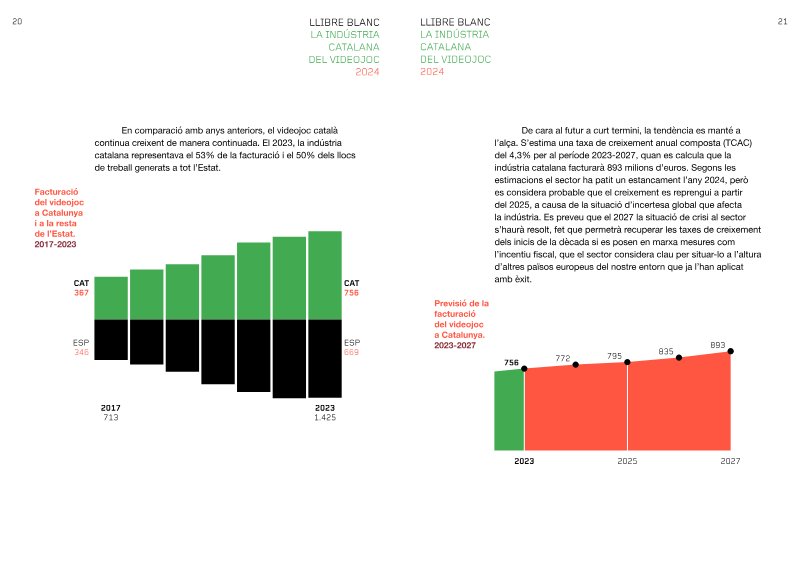
- The Catalan video game industry generated €756 million in 2023, representing 53% of Spain's total revenue and a 6.6% increase from 2022. It employed 5,174 professionals, accounting for 50% of the national total.
- The industry is projected to reach €893 million by 2027, with an estimated compound annual growth rate (CAGR) of 4.3% for 2023-2027, despite an anticipated stagnation in 2024.
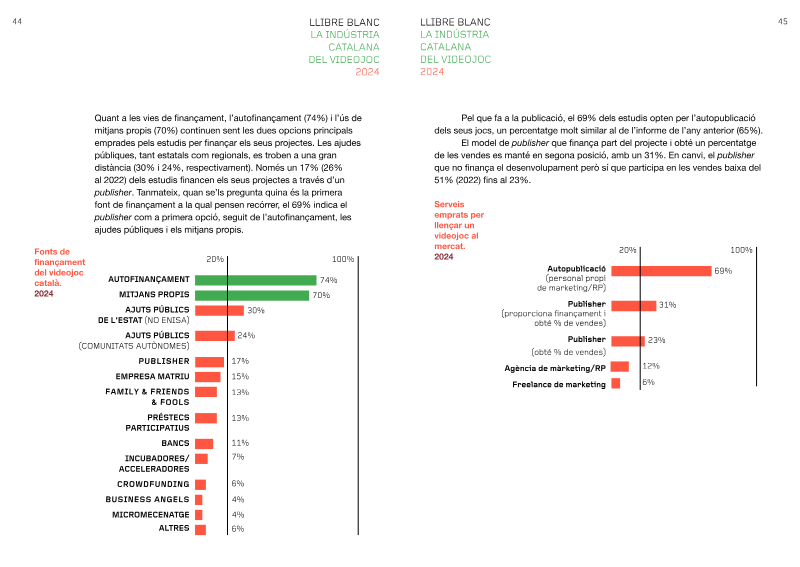
- In 2024, there were 262 video game studios in Catalonia, with 161 formally constituted as companies, a 10% increase from the previous year.

Walking Away from Venture Capital with Sophie Vo
The pursuit of venture capital often forces founders into a rigid framework of hyper-growth and high-stakes exits that frequently conflicts with personal well-being and long-term business sustainability.
- Venture capital models prioritize rapid valuation markups and high-stakes exits, which frequently conflict with long-term business sustainability and founder well-being.
- Founders who rely on external investment often face forced growth trajectories, problematic cap tables, and burnout, whereas bootstrapping allows for greater autonomy and control over the business vision.
- Modern leadership should shift away from aggressive, hyperscale metrics toward self-awareness, active listening, and strategic silence to better align business goals with personal values.

Journey to the East | BITKRAFT Summit 2024
The global gaming industry is undergoing a fundamental transition, moving away from the speculative play-to-earn models of the past toward high-quality, entertainment-first experiences.
- Asia remains a dominant revenue driver for the global gaming industry, with China, Japan, Korea, and the US accounting for 90% of revenue for major titles like Genshin Impact and Honkai: Star Rail.
- Web3 gaming has evolved from simple 'farm' mechanics three years ago to a focus on high-quality game design, though user acquisition remains distinct from traditional Web2 models due to the need for converting players to asset ownership.
- The Asian gaming market is characterized by high receptivity to experimental monetization models, such as gacha systems and loot boxes, which are driven by significant economic disparities and long-standing consumer conditioning.

“We need our studios to believe they can grow again” – Ukie
The United Kingdom’s video game industry is undergoing a strategic pivot toward long-term sustainability and economic independence, supported by a new government-backed growth package.
- The UK government is launching a strategic growth package for the gaming sector, featuring £10 million in startup funding and the establishment of a dedicated UK Video Games Council.
- The industry is pivoting toward long-term sustainability by decoupling gaming from film and television to establish it as an independent economic and cultural pillar.
- Workforce development is being prioritized through the Game Skills Network, which focuses on apprenticeships and leadership training to foster high-quality intellectual property as a defense against AI-generated content.

How Studios Can Win with Financial Storytelling That Moves Investors
Financial storytelling serves as a critical bridge between creative vision and capital acquisition, enabling gaming studios to transition from reactive bookkeeping to proactive, long-term strategic planning.
- Financial data does not speak for itself; founders must craft a narrative around their numbers to explain how metrics relate to the company's vision and future strategy.
- Studios should shift from reactive accounting—focusing on invoicing and payroll—to proactive financial modeling that prepares the organization for investor scrutiny and long-term scaling.
- When facing financial challenges, studios should prioritize creative problem-solving and operational pivots over seeking immediate capital injections, as demonstrated by one studio that achieved 77% year-over-year growth by reframing obstacles as opportunities.

How Two of the Most Hyped Game Studios Became Cautionary Tales
The gaming industry is currently witnessing a wave of high-profile studio failures and performance struggles, driven by unsustainable spending, lack of oversight, and a misalignment between venture capital models and AAA game development.
- The venture capital model, characterized by rapid scaling and exit strategies, is fundamentally misaligned with the long, capital-intensive development cycles required for AAA gaming.
- The Believer studio closed in under two years after burning through $55 million in funding without delivering a viable product, demonstrating the risks of providing large capital injections without rigorous milestone-based oversight.
- Build A Rocket Boy, despite raising hundreds of millions in capital, failed to achieve market success due to poor execution, outdated gameplay, and the departure of key executive leadership.

Session: From Spawn to Scale – Navigating Funding Rounds In The Gaming Industry - Rick Verma.
This presentation outlines the operational and financial requirements for gaming companies as they navigate various funding stages, from seed rounds through series D. The core thesis emphasizes that as gaming startups scale, they must proactively build robust, automated financial infrastructure to meet escalating investor…
- Gaming industry funding experienced a sharp contraction, falling from approximately $11 billion in 2022 to under $3 billion in 2023.
- Investors have shifted their focus away from pure content plays toward scalable platform technologies and infrastructure, though early-stage seed funding remains resilient.
- Founders must transition from manual spreadsheet-based processes to automated financial infrastructure to avoid payment failures, compliance risks, and administrative bottlenecks as they scale.

Why Do $200,000,000 Games Keep Getting Canceled? | EA’s Black Panther Greenlight Failure
The modern AAA game development model faces a systemic crisis characterized by ballooning budgets, extended production cycles, and a flawed greenlight process that often prioritizes presentation over commercial viability.
- AAA game development is currently defined by unsustainable production cycles lasting six to eight years, with projects like EA’s Black Panther languishing in pre-production for up to four years before cancellation.
- The greenlight process for high-budget titles is often a performative 'dog and pony show' that prioritizes curated visual presentations and biased research over objective data regarding gameplay quality.
- Executive decision-making is frequently compromised by sunk cost fallacies, where the pressure to maintain momentum prevents stakeholders from killing failing projects early in the development cycle.

Finding Games Gold In Tough Times: Ideas, Players & Funding | BITKRAFT Summit 2024
Modern game development demands a strategic synthesis of creative intuition and rigorous, data-informed player feedback.
- Successful game development requires being 'data-informed' rather than 'data-driven,' using intuition to guide creative decisions while using split tests to validate assumptions, noting that roughly 50% of tests often contradict initial intuition.
- Early validation is critical; one studio achieved a 53% retention rate in a 5-month playtest cohort and tracked a K-factor (virality) of 1.3, confirming strong organic growth potential before a full public launch.
- Studios should actively seek to disprove their own hypotheses by testing across diverse demographics—including age, geography, and non-core player segments—to avoid the confirmation bias of hardcore early adopters.

Venture into AAA | BITKRAFT Summit 2024
The traditional definition of AAA gaming, historically anchored in massive production budgets and high-risk capital expenditure, is undergoing a fundamental transformation.
- The definition of 'AAA' is increasingly decoupled from massive budgets, as the democratization of toolchains allows smaller, well-funded startups to achieve AAA-level production quality with significantly lower costs than legacy studios.
- Large, established game companies often suffer from extreme risk aversion, where internal design processes prioritize safe, incremental changes over innovation to avoid potential failure or negative stakeholder feedback.
- Successful AAA product design relies on 'addition by subtraction,' where developers focus on core mechanics and player experience rather than bloating games with excessive features or unnecessary realism.

In it for the tech - How to Choose a Chain | BITKRAFT Summit 2024
The blockchain gaming industry is currently undergoing a strategic shift from infrastructure-centric debates toward a focus on user experience and application-level value.
- Game developers should prioritize established ecosystems like Ethereum and Solana, which currently represent the primary liquidity hubs outside of stablecoins, rather than chasing smaller grants on newer, unproven chains.
- Infrastructure selection should be driven by the specific needs of the project, such as whether the game requires the high-performance, local fee markets of Solana or the interoperability and shared standards of the Ethereum-based Optimism stack.
- The gaming industry is power-law driven, meaning that while generalized infrastructure layers provide the foundation, specialized ecosystems like Immutable and Sonic SVM are emerging to solve vertical-specific challenges like congestion, asset management, and developer tooling.
Video Game Business Snapshot: Q2 2025
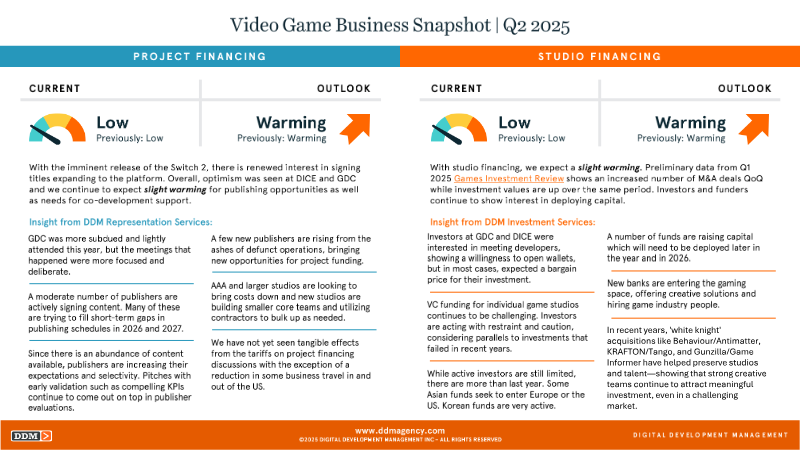
The gaming industry is experiencing a period of cautious optimism as it enters the second quarter of 2025, characterized by a slight warming in both project and studio financing.
- Q2 2025 is defined by a surge in 'white knight' acquisitions, where major conglomerates are purchasing studios facing closure or downsizing to preserve creative talent and intellectual property.
- Notable rescue acquisitions this quarter include KRAFTON’s purchase of Tango Gameworks, Behaviour Interactive’s absorption of Antimatter, and Gunzilla Games’ involvement with Game Informer.
- The industry is shifting away from speculative growth toward strategic preservation, as large publishers prioritize securing proven development teams to stabilize long-term production pipelines.