India

22 documents·16 publishers

Documents

Page 1
Report276 pages

India's Media & Entertainment Sector: March 2024

India’s media and entertainment landscape is in the midst of a rapid digital pivot, with online platforms projected to surpass traditional television as the leading revenue driver by 2024. The sector is expected to grow at a 10 % CAGR, reaching INR 3.1 trillion ($37 billion) by 2026, driven largely by new‑media segments such as OTT video, gaming and digital advertising. Traditional channels—print, radio, out‑of‑home (OOH) and regional TV—continue to expand modestly, reinforcing a “linear + digital” model that balances legacy audiences with emerging consumption patterns.

Key growth engines include a surge in mobile‑first media, where 904 million broadband subscriptions and 574 million smartphone users fuel a daily mobile media spend of over four hours. OTT video viewership now covers 98 % of smartphone owners, with regional‑language content rising from 47 % to 52 %. Gaming dominates the mobile gaming market, with Free Fire and BGMI generating a quarter of in‑app purchase revenue, while esports viewership climbs to 78 % of gamers. Music and radio also expand through digital monetisation, with streaming revenues growing 10 % to INR 24 billion and radio advertising up 17 %.

The sector’s future hinges on cross‑platform content strategies, bundled FAST/OTT offerings, AI‑driven personalization and unified audience measurement. Challenges persist: low OTT profitability, ad‑rate pressure, regulatory uncertainty around gaming and gambling, and the need for first‑party data in a cookie‑less environment. Nonetheless, India’s position as the world’s largest app‑download market and its growing 1 billion active screens by 2030 underscore a resilient, technology‑driven growth trajectory across film, television, gaming, music and live events.

  • India's media and entertainment sector is projected to reach INR 3.1 trillion ($37 billion) by 2026, growing at a 10% CAGR as online platforms overtake traditional television as the primary revenue driver.
  • Mobile-first consumption is the primary growth engine, supported by 904 million broadband subscriptions and 574 million smartphone users who spend over four hours daily on mobile media.
  • Gaming is a dominant market force, with Free Fire and BGMI accounting for 25% of in-app purchase revenue and esports viewership reaching 78% of the gaming population.
  • OTT video viewership has reached 98% of smartphone owners, with regional-language content consumption increasing from 47% to 52% of the market.
  • Digital monetization is expanding across legacy segments, evidenced by a 10% growth in music streaming revenue to INR 24 billion and a 17% increase in radio advertising.
EYJan 2024
Page 1
Report12 pages

Leveling Up: State of India Gaming FY'23

The Indian gaming market demonstrated significant resilience in FY23, reaching a value of $3.1 billion with projections to hit $7.5 billion by FY28 at a 20% CAGR. This growth is increasingly driven by non-real money gaming (RMG) segments, specifically casual and midcore games, as in-app purchases and advertising revenues rise. While the RMG sector grew 33% in FY23, future growth is expected to be muted due to new tax policies and industry consolidation.

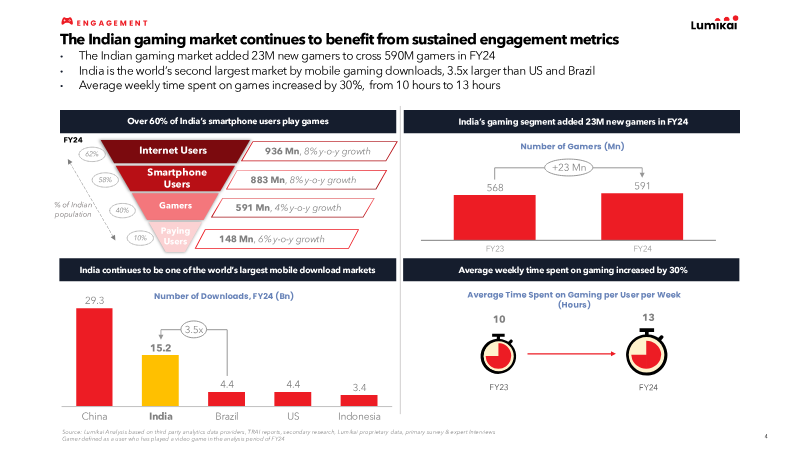
The player base expanded to 568 million gamers, a 12% year-on-year increase, with 25% identified as paying users. Engagement metrics are strong, with average time spent increasing by 20% to 10-12 hours per week. India remains a global leader in game downloads, recording 15.4 billion in FY23. Notably, monetization remained stable despite the suspension of major titles like BGMI and Free Fire, as in-app purchase revenue for other titles grew by 37%.

A survey of over 2,000 users reveals a 60:40 male-to-female ratio and a shift toward non-metro regions, which now account for 66% of gamers. Users are showing a higher propensity to experiment with new genres and pay for content, with 62% preferring UPI for transactions. However, 60% of users anticipate that new GST and TDS regulations will negatively impact their play frequency in the RMG segment.

The regulatory landscape is evolving with the government’s recognition of esports and the establishment of the AVGC taskforce to promote India as a global development hub. Although venture capital funding decreased by 75% in 2023, mirroring global trends, strategic investments from major international entities suggest long-term confidence in the ecosystem's digital infrastructure and development capabilities.

  • The Indian gaming market reached $3.1 billion in FY23 and is projected to grow at a 20% CAGR to $7.5 billion by FY28.
  • The player base grew 12% to 568 million users, with non-metro regions now accounting for 66% of the total demographic.
  • While the Real Money Gaming (RMG) sector grew 33% in FY23, future growth is expected to slow due to new GST and TDS regulations, which 60% of users believe will reduce their play frequency.
  • Non-real money gaming segments, specifically casual and midcore titles, are driving market expansion, evidenced by a 37% increase in in-app purchase revenue for non-RMG titles.
  • Engagement metrics remain robust, with average weekly play time increasing 20% to 10-12 hours and total annual downloads reaching 15.4 billion.
+1
Lumikai Investment AdvisorsOct 2023
Page 1
Report25 pages

The State of Mobile Gaming in India: 2023

India’s mobile‑gaming ecosystem is experiencing rapid expansion, with a projected market value of $8.6 billion by 2027 and more than 600 million active users. Growth is fueled by affordable smartphones, low data costs, and a pandemic‑accelerated surge in casual, hyper‑casual, and real‑money titles. Install rates spiked up to 90 % during lockdowns, while in‑app purchase revenue is expected to reach $284 billion by 2026. To sustain this momentum, brands must deploy comprehensive customer‑engagement platforms that provide real‑time analytics, segmentation, and personalized push campaigns to enhance retention and monetization.

Push notifications and in‑app messaging prove critical for user engagement. Data shows a 3.34 % click‑through rate and up to 91 % delivery success for push alerts, while in‑app campaigns achieve 15–44 % conversion rates and a 38 % average on one million impressions. Segmentation techniques such as RFM, affinity profiling, and predictive AI models (e.g., Sherpa) enable targeted, omnichannel flows that reduce churn and lower acquisition costs—new customers cost five times more than retaining existing ones. App Store Optimization tools like AppTweak further amplify visibility; for instance, RummyCircle’s keyword strategy increased visibility by 14.2 % and drove a 200,000‑download spike after A/B testing.

Despite the market’s growth, brands face declining installs, stickiness, and revenue. The solution lies in data‑driven engagement: hyper‑personalized messaging powered by AI unlocks deeper customer insights, improves retention, and provides a competitive advantage. Platforms such as MoEngage, already trusted by Fortune 500 and internet‑first brands worldwide, offer the scalability required for publishers to thrive in India’s dynamic mobile‑gaming landscape.

  • India’s mobile gaming market is projected to reach a value of $8.6 billion by 2027, supported by a user base of over 600 million active players.
  • In-app purchase revenue in the Indian mobile gaming sector is forecasted to reach $284 billion by 2026.
  • Retention is critical for profitability, as acquiring new customers is five times more expensive than retaining existing ones.
  • Data-driven engagement tools are highly effective, with in-app campaigns achieving conversion rates between 15% and 44% and push notifications maintaining a 3.34% click-through rate.
  • Advanced segmentation techniques, including RFM analysis and predictive AI models like Sherpa, are necessary to reduce churn and lower acquisition costs.
+5
AppsFlyerJan 2023
Page 1
Report25 pages

The State of Mobile Gaming in India: A Look at India's Casual, Hyper-Casual, and Real Money Gaming App Industry Trends

This analysis examines the rapid expansion and evolving user behavior within the Indian mobile gaming market, focusing on the casual, hyper-casual, and real-money gaming (RMG) segments. The primary thesis asserts that while the COVID-19 pandemic and increased smartphone penetration triggered a massive "gold rush" in installs and engagement, the industry now faces a critical inflection point. As organic growth stabilized in 2022, the focus for developers has shifted from simple acquisition to sophisticated, insights-led retention and monetization strategies to sustain long-term profitability.

Key findings value the Indian gaming industry at $2.6 billion, with projections to reach $8.6 billion by 2027. Data indicates that India has surpassed the United States in terms of user base, exceeding 300 million gamers. During the 2021 pandemic waves, casual games saw a 90% uplift in installs, while RMG apps experienced significant revenue fluctuations, including a 35% increase in April 2021. However, the data reveals a downward trend in "stickiness" and installs moving into 2022, highlighting a retention crisis where 68% of users engage with an app fewer than ten times.

The scope of the research covers the Indian market from 2021 through the first quarter of 2022, utilizing data from over 100 gaming brands. The methodology relies on a combination of market analysis from MoEngage, AppTweak, and AppsFlyer, incorporating normalized trends in installs, In-App Advertising (IAA), and In-App Purchases (IAP).

The conclusions emphasize that technical optimization and personalized engagement are mandatory for survival. Effective strategies identified include App Store Optimization (ASO) to improve discoverability, RFM (Recency, Frequency, Monetary) segmentation to target "champion" players, and the use of predictive AI to prevent churn. The findings suggest that brands utilizing multi-channel engagement platforms can achieve push notification conversion rates as high as 91%, which is essential for navigating India's highly competitive and maturing digital landscape.

  • The Indian gaming industry is projected to grow from $2.6 billion in 2022 to $8.6 billion by 2027, supported by a user base exceeding 300 million gamers.
  • The industry is facing a significant retention crisis, with 68% of users engaging with a gaming app fewer than ten times.
  • Following a pandemic-era surge where casual game installs rose 90% and RMG revenue grew 35% in April 2021, organic growth stabilized and declined throughout 2022.
  • Brands utilizing multi-channel engagement platforms can achieve push notification conversion rates as high as 91%.
  • To combat churn and sustain profitability, developers must shift from acquisition-focused models to strategies like RFM (Recency, Frequency, Monetary) segmentation and predictive AI.
+2
MoEngageJan 2023
Page 1
Report62 pages

State of Mobile India 2022

India’s mobile ecosystem in 2021 experienced a surge of activity, with total app downloads reaching 26.7 billion—a 41 % increase from the previous year—and Android users spending an average of 4.7 hours per day on apps, up 27 % from 2019. Consumer spend hit $417 million, positioning India as a dominant force in global downloads (10 % of worldwide figures) and driving significant growth in finance (+27 %) and medical (+38 %) categories. The country’s high usage time and spend levels make it a key growth engine for advertisers and developers.

Gaming shifted sharply toward hyper‑casual titles, which now dominate worldwide downloads. In 2021, hyper‑casual action and puzzle games generated over $5 billion in consumer spend, while strategy‑based “4× March‑battle” games captured nearly $10 billion in revenue. These trends highlight a pivot toward low‑friction, highly engaging experiences that accelerate user acquisition and monetization.

Food & drink apps saw explosive growth, with user sessions rising 33 % YoY to 12.1 billion in Q4 2021 after a pandemic dip. Rapid‑delivery services such as Zepto, Getir, Gorillas and Flink experienced double‑digit download surges, driven by international expansion and hyper‑fast grocery models. Brand‑centric searches dominate India’s market, while generic terms (“food”, “delivery”, “coffee”) rise in emerging regions, indicating a blend of branded and discovery‑driven usage.

Travel and rideshare apps rebounded strongly in H2 2021. India alone accounted for 259.5 million travel‑app downloads, up 15 million from H2 2020, while global downloads approached pre‑pandemic levels at 1.95 billion versus 2.08 billion in H2 2019. Rideshare demand recovered sharply, with rider sessions outnumbering driver sessions by roughly 3:1 in key markets such as the US, UK, and India. Travel apps and on‑demand transport services are regaining traction, with India playing a pivotal role in the global rebound.

In 2021, the most downloaded and highest‑spending apps in India included Google Pay, Instagram, Flipkart, Jio MyJio and Hotstar. In gaming, Free Fire (Tencent), Call of Duty: Mobile (Activision Blizzard) and Gardenscapes – New Acres (Playrix) led downloads, with Free Fire and Call of Duty: Mobile also topping spend charts. These figures underscore India’s status as a leading mobile market across diverse verticals and user segments.

  • India’s mobile market saw 26.7 billion app downloads in 2021, a 41% year-over-year increase, with Android users spending an average of 4.7 hours per day on apps.
  • Gaming revenue is driven by two distinct models: hyper-casual action and puzzle games generated over $5 billion globally, while strategy-based '4× March-battle' games captured nearly $10 billion.
  • Food and drink app engagement in India surged 33% year-over-year to 12.1 billion sessions in Q4 2021, fueled by the rapid adoption of hyper-fast grocery delivery models.
  • Travel and rideshare sectors are recovering toward pre-pandemic levels, with India recording 259.5 million travel app downloads in H2 2021 and a 3:1 ratio of rider-to-driver sessions in key markets.
  • India’s consumer spending hit $417 million in 2021, with significant growth in finance (+27%) and medical (+38%) categories.
+1
IntelJan 2022
Page 1
Report24 pages

Games: India Plays!

The report examines the rapidly expanding Indian mobile gaming market, highlighting a projected 91 % share of online gamers playing on smartphones and an estimated revenue of US$2.2 billion in 2022, with a projected average revenue per user of US$1.5 by 2027. It distinguishes between non‑real‑money gaming (non‑RMG) and real‑money gaming (RMG), focusing on the top five non‑RMG genres—Adventure, Battle Royale, Puzzle, Arcade, and Racing—and key RMG categories such as card‑based games, sports‑fantasy, and casual RMG. Data sourced from Newzoo consumer research and MAAS campaign analytics reveal that 62 % of non‑RMG players are male, while RMG users skew slightly more balanced at 55 % male. Millennials and Gen‑Z (ages 13–41) dominate, with 55 % of adventure and battle royale players in the 13‑27 bracket. Motivations differ: non‑RMG gamers seek entertainment and challenge, whereas RMG players are driven by seasonal events like cricket tournaments or festive card‑game gatherings.

Key performance indicators for advertisers include install‑to‑registration rates of ~50 % for casual games and ~25 % for card‑based RMG, with retention dropping from 30 % on day one to 3 % by day thirty for casual titles. The analysis underscores the importance of vernacular creatives, cross‑interest programmatic targeting, and multi‑channel optimization to reduce audience overlap. It also notes emerging trends—Web3 play‑to‑earn models, esports growth, and super‑app consolidation—that signal continued market maturation. The report concludes that while monetization remains a challenge for non‑RMG segments, strategic acquisition and in‑game advertising innovations can unlock substantial growth across India’s diverse gaming ecosystem.

  • The Indian mobile gaming market generated US$2.2 billion in 2022, with smartphones accounting for 91% of the online gaming audience.
  • Non-real-money gaming (non-RMG) is dominated by Adventure, Battle Royale, Puzzle, Arcade, and Racing genres, while real-money gaming (RMG) centers on card games and sports-fantasy.
  • Demographics skew young, with 55% of Adventure and Battle Royale players falling into the 13–27 age bracket, and 62% of non-RMG gamers being male.
  • Advertiser performance metrics show a 50% install-to-registration rate for casual games compared to 25% for card-based RMG, with casual game retention dropping from 30% on day one to 3% by day thirty.
  • Average revenue per user is projected to reach US$1.5 by 2027, necessitating a focus on vernacular creatives and in-game advertising to overcome current monetization challenges.
+2
EAJan 2022
Page 1
Report62 pages

State of Mobile 2022 India

The Indian mobile ecosystem is undergoing rapid transformation, driven by a convergence of gaming, financial services, and entertainment applications. Hyper‑casual titles, primarily action‑puzzle games, have surpassed five billion downloads worldwide, while 4X march‑battle strategy games commanded the highest consumer spend in 2021, generating roughly ten billion dollars. This surge in gaming activity coincides with a 28 percent year‑over‑year increase in finance‑app usage, pushing total downloads beyond one billion and reaching 1.2 billion installations. Cryptocurrency platforms such as Binance, WazirX and CoinDCX recorded the strongest gains in sessions per user, signalling a growing appetite for digital‑asset services. Retail and video‑streaming applications also expanded markedly, with shopping apps alone accounting for 7.57 billion hours of user engagement.

The market in 2021 was dominated by a blend of global and domestic firms. Google, Meta, Reliance, the Times Group, ShareChat and Bharti Airtel led both download and spend rankings across categories. In the gaming segment, Chinese and U.S. publishers—including Tencent, Jinke Culture (Outfit7), Voodoo, ironSource and Supercell—held top positions, with popular titles such as Carrom Pool and My Talking Tom Friends driving user acquisition. This competitive landscape underscores the importance of cross‑border content while highlighting the rising influence of Indian platforms.

Overall, the data illustrate a diversified mobile market in India where high‑growth sectors—hyper‑casual gaming, strategic spend‑heavy titles, and fintech services—are reshaping user behavior and revenue streams. The coexistence of strong domestic players with leading international publishers suggests a dynamic environment poised for continued expansion throughout the coming years.

  • The Indian mobile market is defined by high-growth sectors in gaming, fintech, and retail, with 4X march-battle strategy games generating approximately $10 billion in global consumer spend during 2021.
  • Finance application usage in India grew by 28% year-over-year in 2021, resulting in over 1.2 billion total installations.
  • Hyper-casual action-puzzle games have achieved significant scale, surpassing five billion downloads worldwide.
  • Cryptocurrency platforms including Binance, WazirX, and CoinDCX experienced the strongest growth in sessions per user, reflecting a rising demand for digital-asset services.
  • Retail applications saw massive user engagement, with shopping apps accounting for 7.57 billion hours of total usage in 2021.
+1
data.aiJan 2022
Page 1
Report24 pages

Games India Plays!: A Look into the Gaming Habits of Indian Mobile Gamers and How to Reach Them

The Indian mobile gaming industry is undergoing a significant transformation, driven by affordable data, increased smartphone penetration, and a shift toward digital entertainment. This analysis, covering the 2022-2027 period, segments the market into Real Money Gaming (RMG)—including card-based and fantasy sports—and non-RMG categories like adventure, battle royale, and puzzles. Utilizing data from Newzoo and Affle MAAS, the findings highlight a market of 373 million online gamers as of 2022, with 91% playing on mobile devices. Revenue for 2022 reached $2.2 billion, with RMG contributing over 50% of the total industry revenue in the preceding year.

Demographic data reveals a young, male-skewing audience, particularly in the adventure and battle royale genres, where 55% of players are aged 13-27. While non-RMG players are motivated by stress relief and time-filling, RMG players are driven by seasonal events and the opportunity to earn rewards. Fantasy sports see massive spikes during major cricket tournaments, while card-based RMG peaks during festive seasons. Engagement is exceptionally high, with over 80% of mobile gamers consuming gaming video content and 44% engaging with esports.

For advertisers, the report establishes critical benchmarks and growth strategies. Successful user acquisition relies on navigating a complex funnel where install-to-registration rates hover around 25-50% depending on the sub-genre. Experts suggest that growth is increasingly driven by Tier 2 and Tier 3 cities, facilitated by UPI-based micro-payments. To maximize return on ad spend, marketers are encouraged to use vernacular creatives, programmatic targeting to reduce audience overlap, and a mix of ad formats like playable and short-video ads. The industry is poised for further disruption through the integration of Web3 technologies, blockchain-based play-to-earn models, and the rise of "gaming malls" or super-apps.

  • The Indian mobile gaming market reached $2.2 billion in 2022, driven by a base of 373 million online gamers where 91% play exclusively on mobile devices.
  • Real Money Gaming (RMG), including fantasy sports and card games, accounts for over 50% of total industry revenue.
  • The core demographic for adventure and battle royale genres is young and male-skewing, with 55% of players falling within the 13-27 age bracket.
  • User acquisition in the mobile gaming sector faces a 25-50% install-to-registration rate, with future growth increasingly concentrated in Tier 2 and Tier 3 cities.
  • High engagement levels are evidenced by 80% of mobile gamers consuming gaming video content and 44% participating in esports.
+1
NewzooJan 2022
Page 1
Report3 pages

India Market Update: September 2021

The Indian gaming and esports landscape is undergoing a period of rapid institutional growth and diversification, characterized by significant foreign investment and the expansion of domestic infrastructure. During the 2021 period, international developers such as Sumo Digital, Kwalee, and CrazyLabs have deepened their commitment to the region. Sumo Digital’s establishment of a second studio in Bangalore and the expansion of its Pune facility highlight a strategic shift toward utilizing India as a hub for end-to-end creative development rather than just a support center. This trend aligns with forecasts predicting substantial increases in India’s online population, player base, and total number of paying users over the next four years.

The mobile gaming sector remains a primary driver of market activity, though it faces operational hurdles. Krafton’s Battlegrounds Mobile India has seen explosive growth but must navigate the technical challenge of maintaining competitive integrity. The company has permanently sanctioned over 1.52 million accounts to combat cheating, illustrating the friction between accessibility in free-to-play titles and the necessity of robust anti-cheat measures. Simultaneously, the real-money and fantasy gaming segments are accelerating, evidenced by Mobile Premier League reaching a $2.3 billion valuation following a $150 million Series E funding round intended to fuel global expansion into markets like the United States.

The esports ecosystem is maturing through consolidation and the convergence of gaming with broader entertainment sectors. Market leader NODWIN Gaming has expanded its reach into the casual and mid-core demographics by acquiring OML Entertainment’s IP business and partnering with PVR Cinemas to pilot in-theater esports viewing. These moves signify a transition toward a more integrated media model where gaming, music, and comedy intersect to drive brand engagement. Overall, the Indian market is evolving into a sophisticated environment defined by high-value capital raises, localized content strategies, and the professionalization of the broader creator economy.

  • India is transitioning from a support-focused hub to a center for end-to-end creative development, evidenced by Sumo Digital expanding its Bangalore and Pune facilities.
  • Mobile Premier League achieved a $2.3 billion valuation following a $150 million Series E funding round, signaling significant investor confidence in the real-money and fantasy gaming segments.
  • Krafton’s Battlegrounds Mobile India has permanently banned over 1.52 million accounts to address cheating, highlighting the operational challenges of maintaining competitive integrity in high-growth free-to-play titles.
  • NODWIN Gaming is diversifying its esports model by acquiring OML Entertainment’s IP business and partnering with PVR Cinemas to bring esports content into theater environments.
  • International developers including Sumo Digital, Kwalee, and CrazyLabs are deepening their strategic commitments to the Indian market in anticipation of growth in the online population and paying user base.
NewzooSept 2021
Page 1
Report40 pages

India: Mobile Market Spotlight: A Booming Mobile Economy

This analysis examines the rapid expansion of India’s mobile economy, focusing on user behavior, app categories, and market growth between 2019 and mid-2021. Utilizing proprietary intelligence data, the findings characterize India as one of the world’s most mobile-first markets, ranking second globally in total app downloads. In 2020, Indian users downloaded 24 billion apps, a 28% year-over-year increase, and spent a total of 651 billion hours on Android devices. Driven by the COVID-19 pandemic, average daily time spent per user rose from 3.3 hours in 2019 to 4.8 hours by the third quarter of 2021.

Mobile gaming represents a significant pillar of this growth, with India becoming the largest market for game downloads in the first half of 2021, accounting for nearly one-fifth of global installs. While titles like Ludo King and Free Fire dominate active user and spend charts, homegrown publishers represent only 7.6% of the top 1,000 downloaded games, suggesting a major opportunity for local development. Additionally, monetization strategies are evolving, with a 15% increase in top-grossing games adopting hybrid models that combine in-app purchases with advertising.

The financial services sector has also seen a dramatic transformation. Hours spent in investment and trading apps grew by 65% in 2020, led by platforms like Upstox Pro and WazirX. The Unified Payments Interface (UPI) continues to drive the market, with transaction volumes doubling year-over-year by mid-2021. Emerging segments such as "Buy Now Pay Later" and merchant utility apps like Khata Book are gaining significant traction. Beyond finance and gaming, the report highlights surging engagement in digital-first shopping, video streaming services like MX Player and Netflix, and a growing demand for mental health resources through meditation apps.

  • India is a global mobile-first leader, ranking second in total app downloads with 24 billion installs in 2020, a 28% year-over-year increase.
  • India became the world's largest market for game downloads in the first half of 2021, accounting for nearly 20% of global installs.
  • Daily mobile usage per user surged from 3.3 hours in 2019 to 4.8 hours by Q3 2021, fueled by pandemic-driven engagement.
  • Homegrown publishers hold only 7.6% of the top 1,000 downloaded games, indicating a significant market opportunity for local developers.
  • Monetization in top-grossing games is shifting toward hybrid models, with a 15% increase in titles combining in-app purchases and advertising.
+2
data.aiJun 2021

Publishers

Related Topics