The number of gamers in India grew by $12 \%$ compared to last year, while the number of paying users grew by $1 7 \%$ .
Source: Leveling Up: State of India Gaming FY'2350% of gamers were in the age group 18-30 years
Source: Leveling Up: State of India Gaming FY'23AVGC Promotion Taskforce report was released in 2022
Source: Leveling Up: State of India Gaming FY'233 SRB proposal applications received
Source: Leveling Up: State of India Gaming FY'23India was home to 568 Mn gamers in FY23, of which $25 \%$ were paying users
Source: Leveling Up: State of India Gaming FY'23Of the surveyed users, $4 1 \%$ mentioned that they’ve graduated from playing casual games to all kinds of games, while $2 8 \%$ showed a proclivity to experiment with new genres.
The total number of gamers grew by $12 \%$ in in FY23.
Source: Leveling Up: State of India Gaming FY'23India’s gaming market hit $3.1$ Bn in FY23 and is projected to reach $7.5\mathsf{Bn}$ by FY28.
Source: Leveling Up: State of India Gaming FY'23
This icon represents mobile performance or analytics, typically used in industry reports to denote growth, positive trends, or data-driven insights within the mobile gaming sector.

This bar chart illustrates the gender distribution within a specific group, showing that 61.7% of the population is male and 38.3% is female.

Gaming app age group percentage India FY 2024 - 25

Data Source: Sensor Tower App Performance and Audience Insights

India Top Genre by Downloads FY 2024 - 25

Mobile Game Downloads Trends in India FY 2019 - 20 to FY 2024 - 25
The survey, covering September 2024 to September 2025, examines India’s interactive media landscape across video, audio, social, gaming and emerging AI‑driven content. It finds that 46 % of consumers are women, with two‑thirds residing outside metro areas and 80 % using more than 1 GB of mobile data daily. Video consumption averages six hours weekly, driven by exclusivity and celebrity presence; OTT platforms dominate paid content, yet microdramas and anime are gaining wallet share. Audio listeners favor podcasts over music, with 60 % willing to pay for audio apps, especially during commuting and chores. Social media usage averages 10 hours weekly, skewing male and non‑metro, with participative platforms (astrology, dating) rising. Gaming remains mobile‑first but 30 % use PCs and 22 % consoles; casual and midcore titles command the most time (8 hours/week) and spend, with UPI accounting for 90 % of in‑app purchases. Monetization patterns show a preference for monthly subscriptions over annual plans, and a shift away from RMG/fantasy genres. Across price points, games capture 70 % of wallet share above INR 1,000, while video and social command 30 % each at INR 200‑500. AI adoption is higher in metros, with over half of users open to AI content but skeptical about AI companions. The study draws on a mixed‑method survey of 3,000+ respondents nationwide, integrating usage logs and payment data to map consumption, willingness to pay, and emerging trend trajectories.
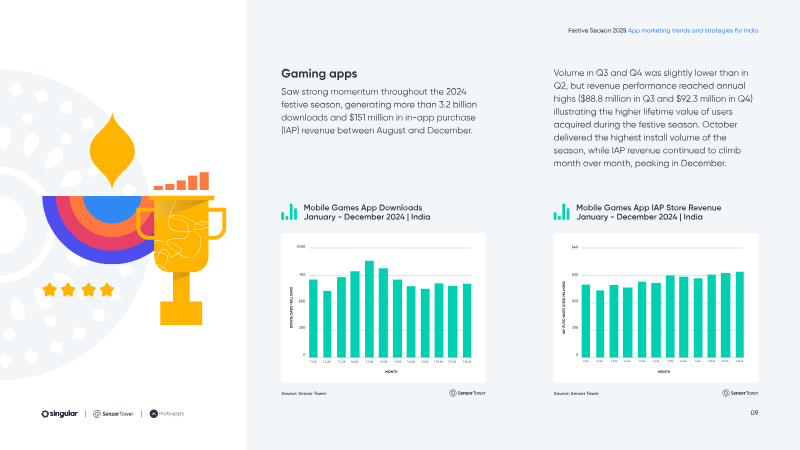
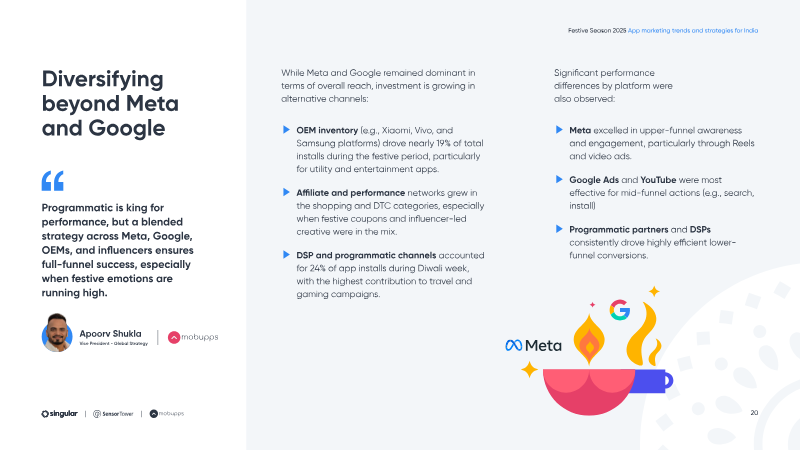
India’s festive season—from Onam in August through Diwali and Christmas in December—drives more than 30 % of the country’s annual digital advertising spend, making it a pivotal period for app marketers. In 2024, mobile games alone attracted over 3.2 billion downloads and generated $151 million in‑app purchase revenue, while non‑gaming verticals such as shopping, food delivery and OTT experienced sharp install spikes during key festivals. The data reveal a 53 % rise in mobile ad spend from Q1‑Q2 to Q3‑Q4, with installs up 36 % and re‑engagements soaring 69 % during the peak festive window, underscoring the season’s high‑value user acquisition and monetisation potential. User‑acquisition efficiency improved markedly, with CPI falling by approximately 12 % while CPA remained stable. Video and playable ads delivered the highest ROAS—up to 4.2× in fintech and 3.8× in e‑commerce—and programmatic/OEM placements on Xiaomi and Samsung yielded significant conversion lifts, particularly in Tier‑2 and Tier‑3 cities. Creatives that refreshed weekly, incorporated localized language, and employed urgency cues such as countdowns outperformed static ads, highlighting the need for agile, culturally relevant creative and a diversified media mix that extends beyond Meta and Google into programmatic and OEM channels. Marketers are increasingly leveraging data‑driven platforms—Singular, MobuppsX, Sensor Tower, Pathmatics and others—to optimise acquisition, retention and media spend. By integrating MAFO, iRTB, advanced fraud prevention and audience‑retention analytics, brands can reduce wasted spend, improve advertising ROI and accelerate growth across web, social and mobile channels. A unified data‑house approach enables faster campaign optimisation, measurable engagement gains and stronger competitive positioning during India’s lucrative festive period.
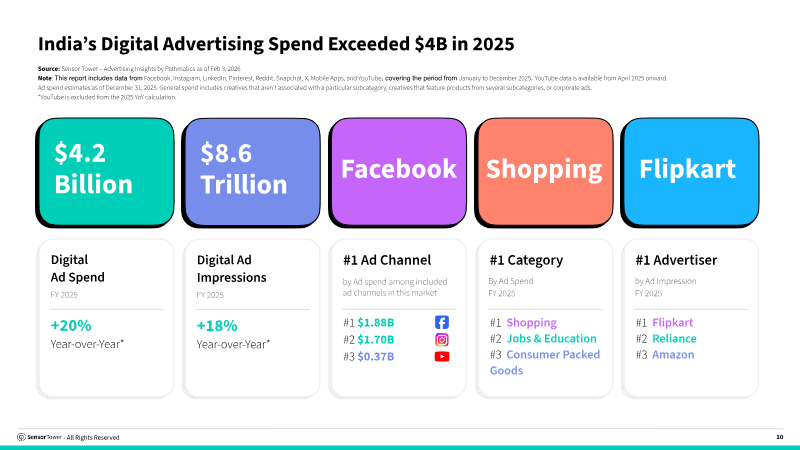
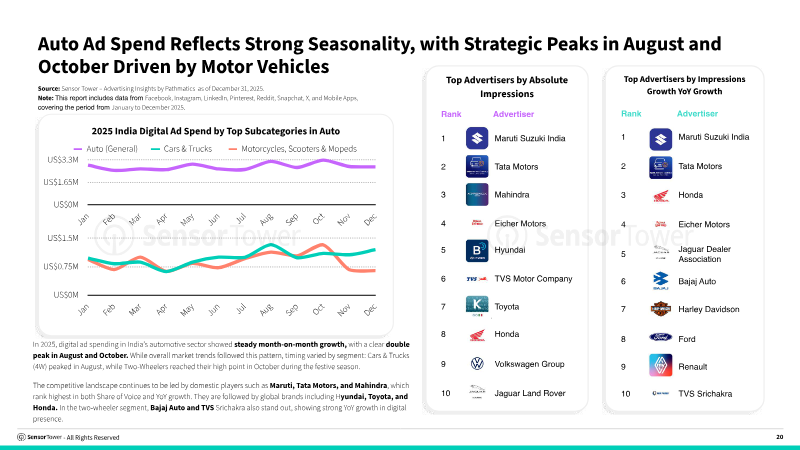
The analysis presents a comprehensive overview of India’s digital‑advertising landscape, emphasizing its rapid expansion and the shifting strategic focus of advertisers. In 2025 the market surpassed the $4 billion threshold and is projected to exceed $5 billion in 2026, reflecting robust demand across multiple verticals. Shopping emerged as the dominant category, accounting for 28 % of total spend and delivering an 18 % year‑on‑year increase, while software recorded the strongest growth rate at 84 % YoY. Food‑and‑dining services and automotive sectors also posted notable gains of 38 % and 4 % respectively, underscoring a diversified expansion beyond traditional e‑commerce. The competitive environment is concentrated among a handful of large advertisers, with Flipkart, Amazon and Reliance leading in impression share. A clear strategic shift is evident toward performance‑driven, audience‑specific creative, as brands increasingly deploy tailored messaging to capture high‑yield, short‑duration placements. This trend intensifies during the festive half‑year, when domestic players in generative‑AI services, food‑delivery, and film promotion amplify spend on segment‑focused creatives to maximize visibility. Overall, the findings illustrate that India’s digital‑advertising ecosystem is entering a phase of accelerated growth, driven by both expanding spend in core categories and a pronounced move toward data‑centric, personalized creative execution. The outlook suggests continued market deepening, with advertisers likely to prioritize precision targeting and seasonal intensity to sustain momentum through 2026.
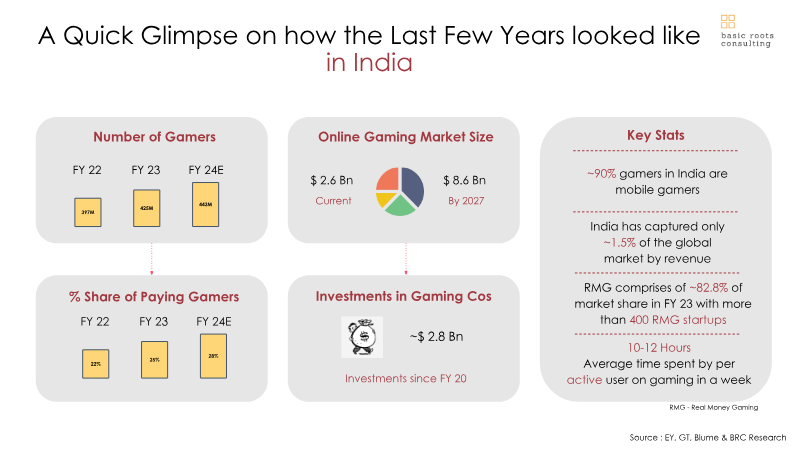
The Indian gaming market is projected to reach ₹8.6 billion by 2027, expanding at a 28 % CAGR from FY20‑23, while the global market is expected to hit $340 billion. A recent 28 % GST on total deposits—up from an 18 % tax on gross gaming revenue—has pressured real‑money gaming (RMG) firms to diversify geographically, slowed revenue growth, and triggered layoffs. These developments have spurred calls for tax reforms that align with international standards. Despite the fiscal headwinds, segments such as esports, indie studios, and mobile casual games continue to grow, with blockchain, AR/VR, and generative AI identified as high‑growth opportunities. Indian online gaming firms are responding to the GST amendment and broader market dynamics by absorbing or passing on tax costs, consolidating through acquisitions, and diversifying into new genres such as hyper‑casual games and esports. RMG now accounts for approximately 82 % of India’s gaming revenue, yet monetization remains weak relative to download volumes; only 10 % of global gaming funding reaches Indian startups. These strategic shifts aim to improve unit economics and capture higher‑spending segments. Investment activity underscores the sector’s resilience. Casual mobile games remain the most attractive category, with recent Indian titles raising between $1 M and $8.5 M in seed to Series A rounds, while blockchain‑based mobile titles have attracted a combined $396 M. The next three to four years are expected to be driven by AR/VR integration, generative AI, competitive multiplayer mobile titles, and blockchain‑enabled gameplay. Major venture funds—including Accel, Sequoia, and Lightspeed—are actively backing the full value chain, reflecting strong institutional confidence in the industry’s expansion.
India is positioned as the world’s largest mobile‑gaming market, with 8.45 billion downloads recorded in FY 2024‑25 yet only $400 million in in‑app purchase (IAP) revenue, underscoring a pronounced monetization gap despite high engagement. Downloads have stabilized post‑pandemic while IAP spending has accelerated, largely driven by Google Play’s dominance and an expanding share of higher‑spending iOS users. Demographic analysis shows that 77 % of players are aged 18‑34, 86 % are male, and lifestyle titles uniquely attract a larger female audience. Genre‑level insights reveal that casual, family‑oriented categories—Simulation (driving/flight), Arcade (platformer/runner), and Tabletop board games—generate the bulk of download volume. In contrast, monetization is concentrated in competitive, engagement‑heavy segments such as Shooter (Battle Royale), Casino, and Strategy (4X). Publishers are advised to pair mass‑appeal casual titles with monetization strategies that target the growing cohort of high‑value, competitive gamers. India‑based publishers maintain robust domestic download volumes through culturally resonant titles like Ludo King and Dream11, yet monetization remains modest. To offset this challenge, publishers are expanding overseas revenue streams, with the US, Saudi Arabia, and the UK emerging as key markets. The dual strategy of leveraging local appeal for mass reach while pursuing international growth is presented as a pathway to enhance overall profitability in India’s mobile‑gaming ecosystem.
India is the world’s largest mobile gaming market by volume, reaching 8.45 billion downloads in the 2024-25 fiscal year. Despite this massive scale, which is more than double that of Indonesia, the market faces significant monetization hurdles. Total in-app purchase revenue stands at approximately $400 million, reflecting a cost-sensitive consumer base that favors free-to-play models. However, the market shows signs of evolution, with revenue growing 8.5% year-over-year, driven largely by high-value spenders on iOS and the increasing adoption of digital payment systems like UPI. The player base is predominantly young and male, with 77% of gamers aged 18-34 and 86% identifying as male. While casual subgenres such as driving simulators, platformers, and tabletop games dominate download charts due to their cultural resonance, revenue is concentrated in core competitive genres. Shooters, specifically Battle Royale titles like Garena Free Fire and Battlegrounds Mobile India, command 50% of total market revenue. Strategy and Casino games also represent significant portions of the spending landscape, highlighting a divide between mass-market reach and deep-engagement monetization. A central fixture of the domestic industry is Ludo King, which has remained the most downloaded game in India since 2017, surpassing 1.25 billion lifetime downloads. Its success is attributed to the digitization of a traditional board game combined with social features like live voice chat. While domestic publishers like Gametion and Dream11 maintain strong local positions, there is a growing trend of India-based firms expanding into overseas markets, such as the United States and Saudi Arabia, to capture higher per-user revenue. The findings are based on Sensor Tower’s App Performance and Audience Insights data for the period of April 2024 through March 2025. The methodology utilizes estimates from the App Store and Google Play, excluding ad revenue, third-party Android stores, and pre-installs. The scope focuses on the Indian mobile ecosystem while providing comparative context against other major Asian markets.
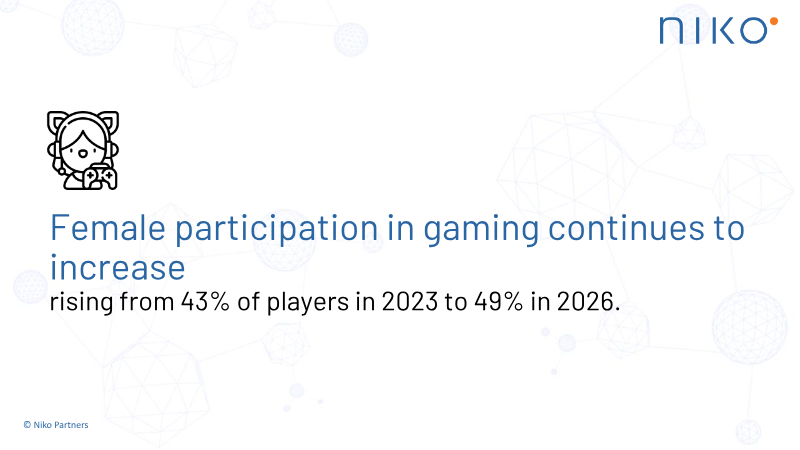
The Indian interactive media and gaming market reached a valuation of $3.8 billion in FY24, representing a significant 30% share of the country’s broader $12.5 billion new media sector. Growth is characterized by a 20% five-year projected CAGR, with expectations to exceed $9.2 billion by FY29. This expansion is primarily driven by a 41% year-on-year increase in in-app purchase revenue, particularly within the midcore segment, which grew by 53%. While Real Money Gaming (RMG) remains a major contributor, recent changes to the GST regime have led to margin compression and increased user acquisition costs for operators in that sub-sector. The player base in India has expanded to 590 million gamers, with 148 million identified as paying users. Engagement metrics show a 30% increase in average weekly time spent, rising from 10 to 13 hours. Demographic data reveals a diversifying landscape where 44% of gamers are women and 66% reside in non-metro cities. Notably, there is a high degree of overlap between gaming categories, as over 60% of RMG paying users also spend money on midcore titles. Payment behaviors are heavily modernized, with 83% of users utilizing UPI or digital wallets for transactions. The regulatory environment is shifting toward formal recognition and support, with the government identifying gaming as a "sunrise sector." New frameworks distinguish between RMG and Free-to-Play (F2P) games for taxation purposes, while esports has been officially integrated under the Ministry of Youth Affairs and Sports. These findings are based on a mixed-methods research design conducted between May and October 2024, incorporating a primary survey of 2,269 smartphone users across 16 Indian cities alongside secondary analysis of financial statements and proprietary industry data.
The Indian media and entertainment sector reached a valuation of INR2.32 trillion in 2023, marking an 8.1% growth rate driven primarily by digital media and online gaming. While television remains the largest individual segment, the industry is transitioning into a "linear and digital" hybrid market, with digital media expected to become the dominant segment by 2024. Total industry revenue is projected to exceed INR3 trillion by 2026, supported by a 10% CAGR and a massive expansion of active screens, which are expected to reach nearly one billion by 2030. The digital surge is characterized by a "vernacular-first" strategy and the rapid rise of Connected TV, which is anticipated to reach 100 million homes by 2030. Online gaming has emerged as a powerhouse, surpassing filmed entertainment to become the fourth-largest segment despite a new 28% GST mandate. While traditional mediums like print and radio remain resilient and profitable, they are pivoting toward niche audiences and hyper-local advertising to maintain relevance. Meanwhile, the filmed entertainment sector saw record revenues in 2023, fueled by a revival in Hindi cinema and premium experiential offerings, even as theater admissions faced pressure from rising costs. The industry is currently navigating a "profitability-first" era defined by consolidation and technological integration. Generative AI is expected to provide an INR450 billion boost by 2027 through enhanced content creation and operational efficiencies. However, significant challenges remain, including low digital monetization relative to high engagement levels, digital ad fraud, and a tightening regulatory landscape. New frameworks, such as the Digital Personal Data Protection Act and updated broadcasting bills, are forcing companies to balance aggressive AI-driven personalization with stringent compliance and data transparency requirements.
India’s media and entertainment landscape is in the midst of a rapid digital pivot, with online platforms projected to surpass traditional television as the leading revenue driver by 2024. The sector is expected to grow at a 10 % CAGR, reaching INR 3.1 trillion ($37 billion) by 2026, driven largely by new‑media segments such as OTT video, gaming and digital advertising. Traditional channels—print, radio, out‑of‑home (OOH) and regional TV—continue to expand modestly, reinforcing a “linear + digital” model that balances legacy audiences with emerging consumption patterns. Key growth engines include a surge in mobile‑first media, where 904 million broadband subscriptions and 574 million smartphone users fuel a daily mobile media spend of over four hours. OTT video viewership now covers 98 % of smartphone owners, with regional‑language content rising from 47 % to 52 %. Gaming dominates the mobile gaming market, with Free Fire and BGMI generating a quarter of in‑app purchase revenue, while esports viewership climbs to 78 % of gamers. Music and radio also expand through digital monetisation, with streaming revenues growing 10 % to INR 24 billion and radio advertising up 17 %. The sector’s future hinges on cross‑platform content strategies, bundled FAST/OTT offerings, AI‑driven personalization and unified audience measurement. Challenges persist: low OTT profitability, ad‑rate pressure, regulatory uncertainty around gaming and gambling, and the need for first‑party data in a cookie‑less environment. Nonetheless, India’s position as the world’s largest app‑download market and its growing 1 billion active screens by 2030 underscore a resilient, technology‑driven growth trajectory across film, television, gaming, music and live events.
The Indian interactive media and gaming sector has emerged as a significant economic force, reaching a market valuation of $12.5 billion in fiscal year 2024. Within this landscape, gaming stands out as the fastest-growing segment, contributing $3.8 billion to the total market. Driven by a 20% compound annual growth rate, the gaming industry is projected to reach $9.2 billion by fiscal year 2029. This growth is underpinned by a massive user base of 590 million gamers, which expanded by 23 million individuals over the past year, and a 30% increase in average weekly engagement time, now reaching 13 hours per user. Monetization trends reveal a shift toward midcore gaming, which experienced a 53% year-on-year revenue increase. In-app purchases remain the primary growth driver, with the average revenue per paying user rising 15% to $22. While real-money gaming continues to be a major contributor, it faces margin compression due to recent regulatory and taxation adjustments. Despite these challenges, the sector benefits from high user sophistication, with significant overlap between real-money and midcore gaming audiences. The findings are based on a comprehensive mixed-methods study conducted between May and October 2024, incorporating primary survey data from 2,269 smartphone users across 16 Indian cities alongside secondary market analysis and industry expert interviews. The research highlights a maturing ecosystem supported by government recognition of gaming as a "sunrise sector." Policy developments, including the establishment of Centers of Excellence for Animation, Visual Effects, Gaming, and Comics, and the formal classification of esports as a sport, signal a transition toward a more structured and mainstream industry environment.
The Indian gaming market demonstrated significant resilience in FY23, reaching a value of $3.1 billion with projections to hit $7.5 billion by FY28 at a 20% CAGR. This growth is increasingly driven by non-real money gaming (RMG) segments, specifically casual and midcore games, as in-app purchases and advertising revenues rise. While the RMG sector grew 33% in FY23, future growth is expected to be muted due to new tax policies and industry consolidation. The player base expanded to 568 million gamers, a 12% year-on-year increase, with 25% identified as paying users. Engagement metrics are strong, with average time spent increasing by 20% to 10-12 hours per week. India remains a global leader in game downloads, recording 15.4 billion in FY23. Notably, monetization remained stable despite the suspension of major titles like BGMI and Free Fire, as in-app purchase revenue for other titles grew by 37%. A survey of over 2,000 users reveals a 60:40 male-to-female ratio and a shift toward non-metro regions, which now account for 66% of gamers. Users are showing a higher propensity to experiment with new genres and pay for content, with 62% preferring UPI for transactions. However, 60% of users anticipate that new GST and TDS regulations will negatively impact their play frequency in the RMG segment. The regulatory landscape is evolving with the government’s recognition of esports and the establishment of the AVGC taskforce to promote India as a global development hub. Although venture capital funding decreased by 75% in 2023, mirroring global trends, strategic investments from major international entities suggest long-term confidence in the ecosystem's digital infrastructure and development capabilities.
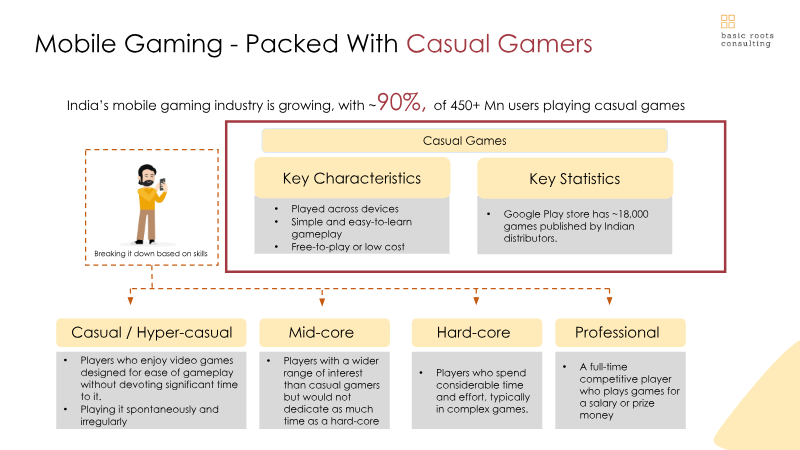
This analysis examines the rapid expansion and evolving user behavior within the Indian mobile gaming market, focusing on the casual, hyper-casual, and real-money gaming (RMG) segments. The primary thesis asserts that while the COVID-19 pandemic and increased smartphone penetration triggered a massive "gold rush" in installs and engagement, the industry now faces a critical inflection point. As organic growth stabilized in 2022, the focus for developers has shifted from simple acquisition to sophisticated, insights-led retention and monetization strategies to sustain long-term profitability. Key findings value the Indian gaming industry at $2.6 billion, with projections to reach $8.6 billion by 2027. Data indicates that India has surpassed the United States in terms of user base, exceeding 300 million gamers. During the 2021 pandemic waves, casual games saw a 90% uplift in installs, while RMG apps experienced significant revenue fluctuations, including a 35% increase in April 2021. However, the data reveals a downward trend in "stickiness" and installs moving into 2022, highlighting a retention crisis where 68% of users engage with an app fewer than ten times. The scope of the research covers the Indian market from 2021 through the first quarter of 2022, utilizing data from over 100 gaming brands. The methodology relies on a combination of market analysis from MoEngage, AppTweak, and AppsFlyer, incorporating normalized trends in installs, In-App Advertising (IAA), and In-App Purchases (IAP). The conclusions emphasize that technical optimization and personalized engagement are mandatory for survival. Effective strategies identified include App Store Optimization (ASO) to improve discoverability, RFM (Recency, Frequency, Monetary) segmentation to target "champion" players, and the use of predictive AI to prevent churn. The findings suggest that brands utilizing multi-channel engagement platforms can achieve push notification conversion rates as high as 91%, which is essential for navigating India's highly competitive and maturing digital landscape.