Germany reports and market data
Documents
Arbeiten in der Games-Branche: Kreativität trifft Technologie
The German games industry has evolved into a significant economic pillar and a primary driver of technological innovation, transcending its traditional role as a mere entertainment sector.
- The German games market is experiencing significant growth, with revenue increasing by 15% in 2017 compared to the previous year, and projections showing continued growth from 3689 million Euros in 2016 to an estimated 5295 million Euros in 2021.
- Digital sales and microtransactions are booming in the German games market, driven by mobile games and the free-to-play model, while sales of physical media are stagnating or declining.
- The average German gamer is 36.1 years old, with the largest player group being over 50, and women constitute 47% of players, indicating a broad and diverse audience for games.

Game Fokus: Esports 2019
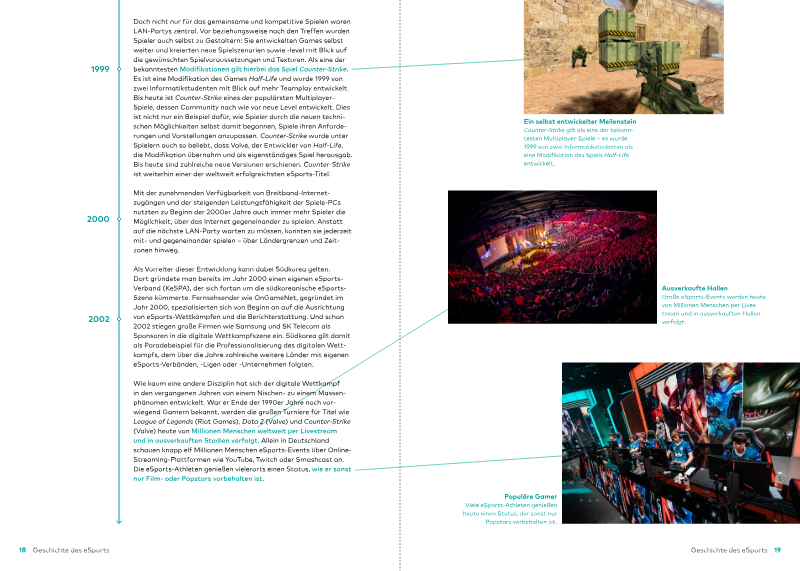
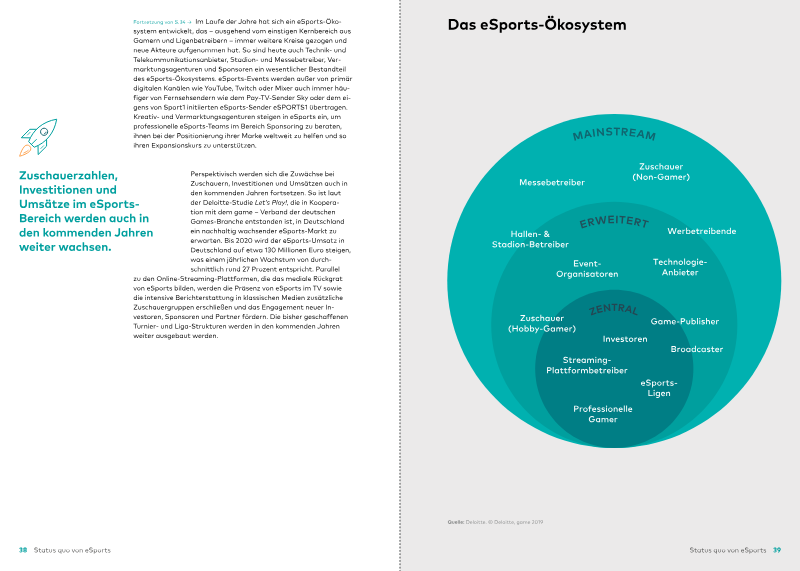
Esports has evolved from its origins in 1980s arcade competitions and LAN parties into a global mass-market phenomenon, characterized by high levels of professionalization and integration into mainstream entertainment culture.
- The German eSports market is projected to reach approximately 130 million Euros by 2020, representing an average annual growth of around 27 percent.
- Despite its growing relevance, eSports in Germany faces significant hurdles due to a lack of official recognition as a sport, unlike 50 other countries (including EU states like Austria, Netherlands, and Sweden) that already acknowledge and promote it.
- The German government, through the 2018 coalition agreement, has pledged to support eSports as its own sport with club and association rights, and the Foreign Office eased entry requirements for non-EU eSports athletes in August 2018, yet full equality with traditional sports is still missing.
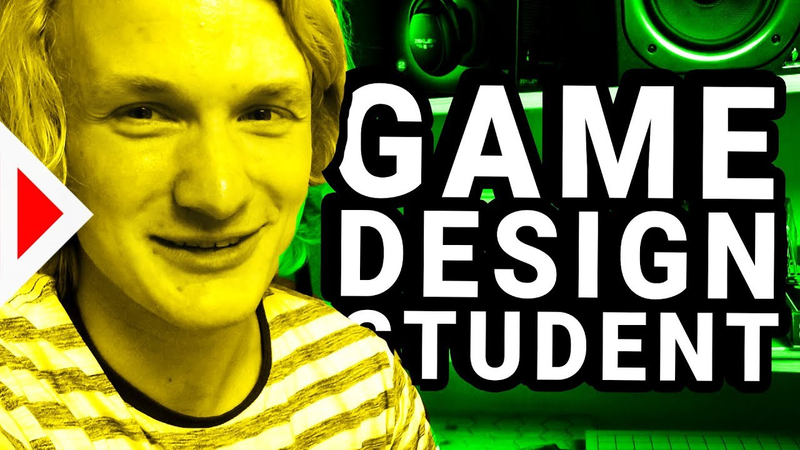
This Is How The Room Of a Game Design Student Looks Like...
This analysis examines the workspace and personal environment of a game design student based in Berlin, serving as a case study on how physical surroundings reflect professional identity and creative methodology.
- The student’s workspace functions as an integrated development environment, bridging formal university education with independent game production through a mix of technical hardware and design literature.
- Project documentation for titles like Cakeship and Upscore utilizes physical booklets to track iterative development, specifically focusing on character design, silhouette-based art, and core game mechanics.
- Professional methodology relies on a structured productivity framework that incorporates task-tracking systems and goal-setting to manage the balance between academic requirements and independent projects.

Starting The Next Chapter - Travel VLOG - (Bye bye!) - (Hi, Berlin!)
The transition to a new creative chapter in Berlin serves as a catalyst for refining the process of game development and content creation.
- Traditional search engine queries for specific game genres are declining, suggesting that integrated distribution platforms like Steam have become the primary discovery channels for players.
- Market validation for new game concepts is being conducted through a combination of social media polling and the analysis of search behavior data via Google Trends.
- Small-budget Google AdWords campaigns are being utilized to acquire technical knowledge of platform algorithms and audience targeting rather than to drive immediate commercial revenue.

Vlog - First Day of "Work"
Transitioning into self-employment requires a structured approach to administrative tasks, physical workspace optimization, and long-term strategic planning.
- On January 8, 2018, the transition to self-employment began with a focus on navigating municipal business registration requirements, utilizing local government offices for free regulatory guidance.
- Maintaining productivity as a solo operator requires a structured daily routine that integrates physical preparation, mental priming, and the use of visual planning tools.
- To prevent early-stage overwhelm, entrepreneurs should limit their daily output to three prioritized key tasks to ensure consistent, manageable progress.
Jahresbericht der Deutschen Games-Branche 2018
The German games industry experienced a transformative period in 2017 and early 2018, characterized by robust market expansion and a strategic consolidation of industry representation.
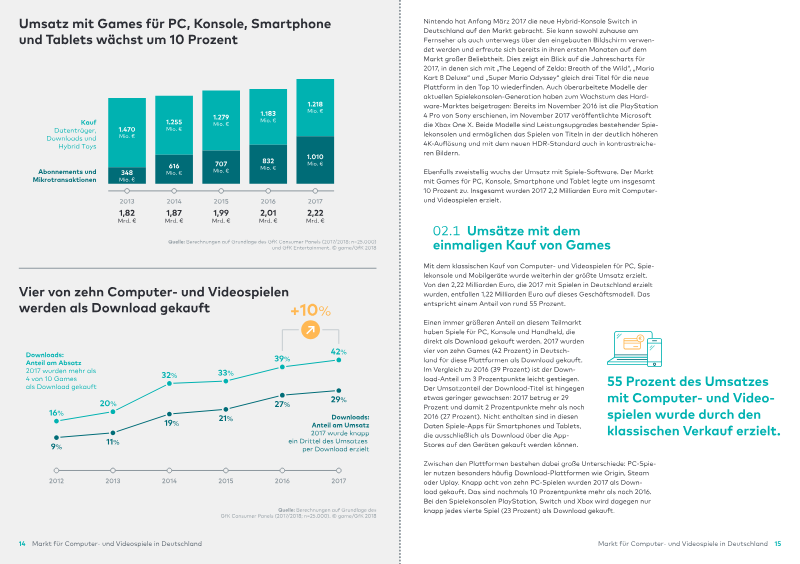
- The German games market generated 2.2 billion Euros in 2017, growing 10% from 2016. This growth was driven by a 21% increase in revenue from virtual goods and additional content (reaching 1.01 billion Euros) and a 57% increase in revenue from online network fees (reaching 179 million Euros).
- Smartphone gaming has surpassed PC as the most popular gaming platform in Germany, with 18.2 million smartphone gamers compared to 17.3 million PC gamers in 2017. Console gaming also saw significant engagement with 16 million players.
- The German games industry is largely mid-sized, with 90% of companies generating up to 5 million Euros in annual revenue. It also boasts a high export quota, with 46% of its revenue earned outside Germany, significantly higher than the music (9%) and film/TV (4%) industries.

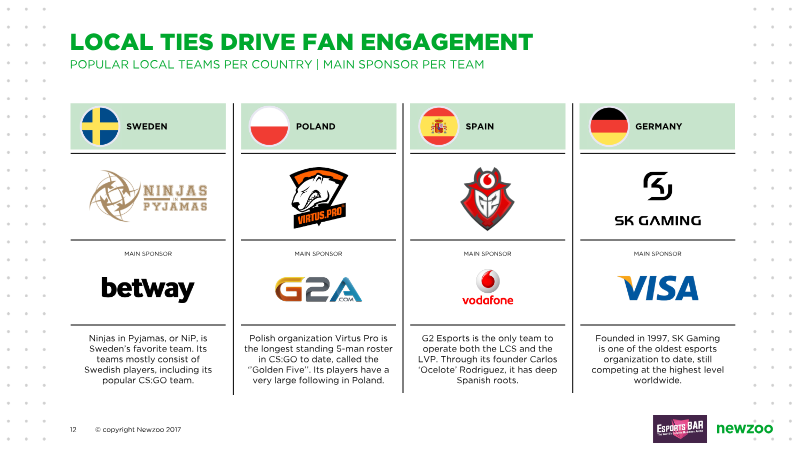
An Overview of Esports in Europe: December 2017
The European esports market is currently transitioning from an adolescent phase toward a mature, multi-billion-dollar industry.
- Europe is a major global esports hub, accounting for 32% of total global esports revenues and hosting over 70 million viewers in 2017.
- The European esports economy is growing rapidly, with total revenues projected to reach $403 million in 2017 and a CAGR of 32.3% expected between 2015 and 2020.
- Media rights revenue in Europe is a primary growth driver, forecasted to increase by more than 500% between 2016 and 2020.
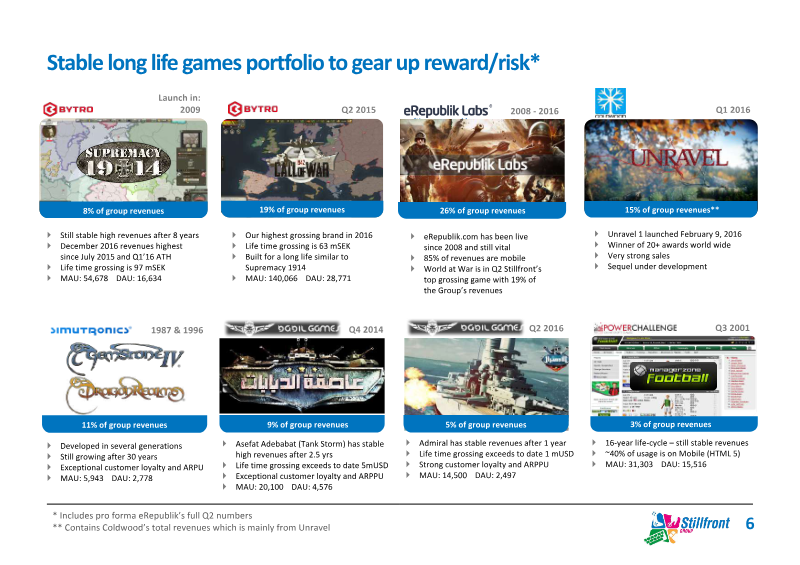
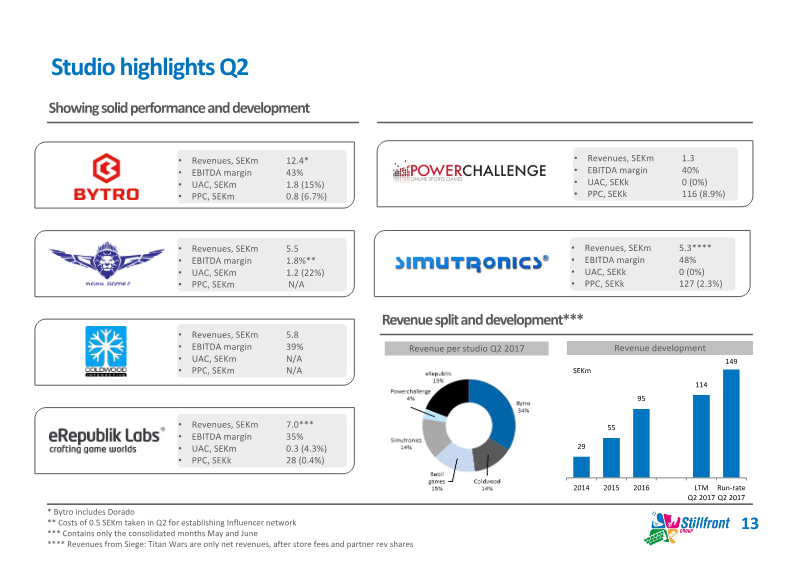
Stillfront Group Q2 2017 Presentation
Stillfront Group, a developer and publisher of free-to-play strategy games, aims to become a leading group of independent studios by combining the agility of small indie developers with the stability of a professional public structure.
- Stillfront Group achieved 37.3 million SEK in net revenue for Q2 2017, marking a 24% increase over the previous quarter.
- The company maintains a rolling 12-month EBITDA of 31 million SEK, with operational profitability consistently between 25% and 35%.
- Mobile platforms now account for 46% of run-rate revenues, contributing to a 53% CAGR recorded between 2012 and 2016.
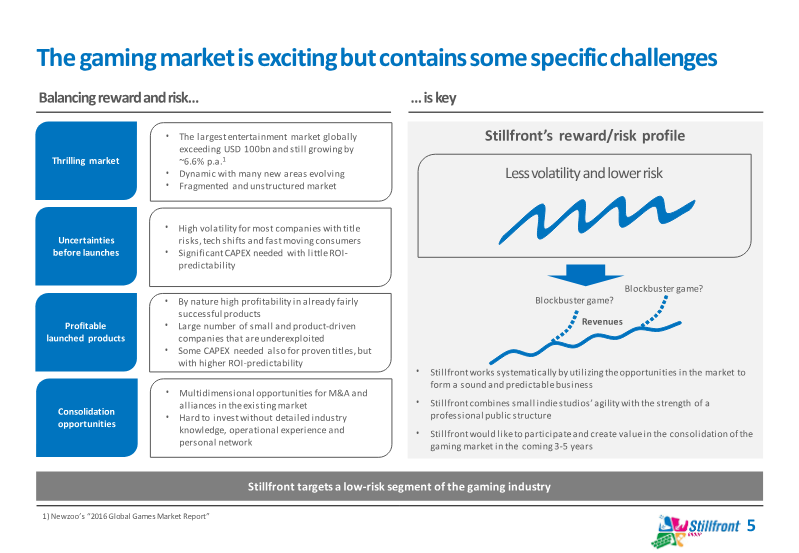
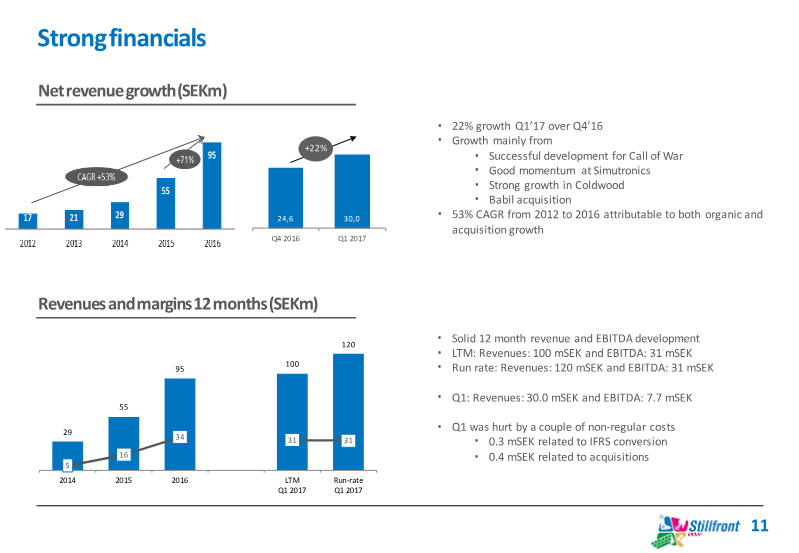

Stillfront Group Presentation: Q1 2017 Report
Stillfront Group’s Q1 2017 report outlines a business model centered on acquiring and managing a portfolio of small, independent gaming studios to achieve high-growth, low-risk profitability.
- Stillfront Group achieved a 53% compound annual growth rate between 2012 and 2016, maintaining EBITDA margins between 25% and 35% since listing.
- Q1 2017 net revenues reached 30 million SEK, marking a 22% increase over the previous quarter driven by acquisitions and existing title performance.
- The business model focuses on acquiring independent studios to manage a portfolio of long-lived, free-to-play strategy games, mitigating the volatility of blockbuster-driven development.

FTUE: Olympus Rising
Olympus Rising, a mobile title developed and published by the German studio Flaregames, represents a strategic evolution of the build-and-battle genre.
- Olympus Rising is a mobile build-and-battle title from German studio Flaregames, designed as a spiritual successor to their previous game, Royal Revolt 2.
- The game differentiates itself from its predecessor by shifting from a cartoonish aesthetic to a mature, photorealistic visual style based on ancient Greek mythology.
- Core gameplay centers on direct hero-led combat where players control a single character to lead waves of support units against enemy fortifications and towers.

FTUE: Futurama: Game of Drones
Futurama: Game of Drones, developed by Wooga, represents a strategic attempt to adapt a cult-classic animated intellectual property into the saturated mobile match-puzzle genre.
- Wooga differentiates Futurama: Game of Drones from the saturated match-three market by utilizing a core match-four puzzle mechanic.
- The game integrates the Futurama intellectual property by aligning progression and objectives with the show's intergalactic delivery company narrative.
- The user experience features a highly guided tutorial that introduces specialized power-ups, including line-clearing and bomb-drones.
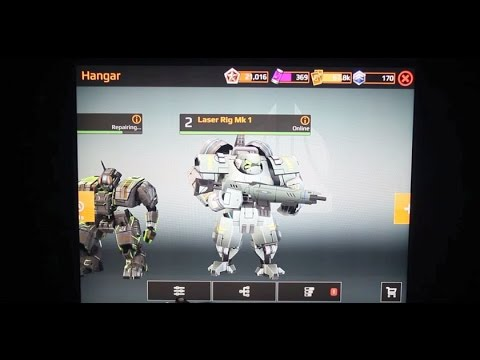
Monetizer: Dawn of Steel
Dawn of Steel, a mobile real-time strategy (RTS) game developed by Superweapon and published by Flaregames, represents a refined entry into the competitive mobile strategy genre.
- Dawn of Steel is a mobile real-time strategy game developed by Superweapon and published by Flaregames that differentiates itself from mass-rush competitors through granular, tactical unit control.
- The game utilizes a standard monetization model centered on 'influence,' a hard currency used to bypass time-based gating for building upgrades, unit repairs, and research tasks.
- To drive higher spending, the developers implemented a tiered pricing structure for hard currency that offers increased value for larger real-money purchases.