Game Development reports and market data
Documents

The Sad Truth Behind Netflix’s Rebel Moon Game
The recent announcement of a Netflix-exclusive co-op action RPG based on the Rebel Moon franchise highlights the precarious position of Super Evil Megacorp, a studio currently trapped in a state of startup stagnation.
- Super Evil Megacorp is struggling with 'startup stagnation' despite raising over $70 million in venture capital and achieving early success with the MOBA title Vainglory.
- The studio has shifted from an independent developer to a service provider for platforms like Apple Arcade and Netflix, a transition that highlights the risks of high-valuation startups failing to scale.
- The Rebel Moon co-op action RPG is likely a legacy commitment greenlit before Netflix’s recent internal restructuring and downsizing of its gaming division.
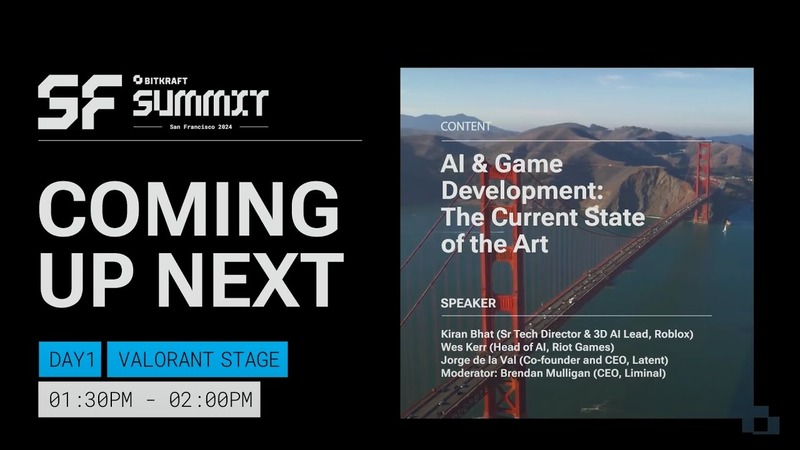
AI & Game Development: The Current State of the Art | BITKRAFT Summit 2024
Artificial intelligence in game development is shifting from a focus on technical novelty toward a strategic emphasis on product-market fit and tangible player value.
- The primary challenge in AI game development is not the underlying model technology, but rather the product-market fit and the ability to create compelling player experiences that enhance retention.
- Riot Games prioritizes AI integration that supports core gameplay and player retention, deliberately avoiding flashy, disruptive features that do not directly improve the player experience.
- Roblox is investing heavily in a foundational 3D model to simplify content creation, identifying 3D generation as a major, largely unexplored frontier compared to text and image modalities.
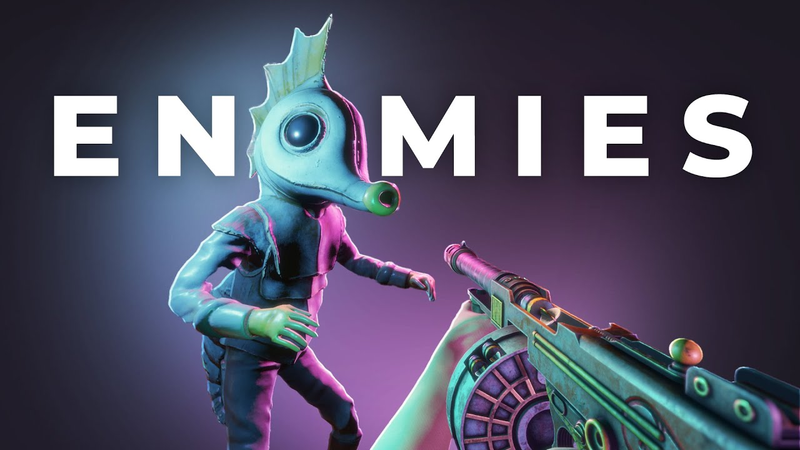
Adding Enemies That Are ACTUALLY FUN To My Indie Game (Devlog)
The primary objective of this development process is to create a unique, engaging enemy for an indie game by leveraging existing code structures rather than building from scratch.
- Efficiency in game development is maximized by using parent prefabs and modular logic to repurpose existing attack patterns and behaviors for new enemies.
- New enemy functionality can be created by swapping visual assets and animation controllers on established base code rather than building systems from scratch.
- Gameplay balance is achieved by implementing specific delay mechanisms that provide players with a fair reaction window to retreat from incoming attacks.

Kingdom Come: Deliverance 2 director hopes “AI revolution” will allow him to make games faster
The creative director and co-founder of Warhorse Studios, Daniel Vávra, discusses the successful launch of Kingdom Come: Deliverance 2, which achieved 2 million units sold within its first two weeks.
- Kingdom Come: Deliverance 2 sold 2 million units within its first two weeks, meeting internal projections based on pre-order data.
- Warhorse Studios scaled its team to 250 employees over a six-year development cycle that included navigating the COVID-19 pandemic.
- The studio attributes its commercial success to maintaining creative autonomy under Embracer Group, avoiding the trend-focused 'corporate product' model common in modern AAA development.
Marcher sur les platebandes des autres: Le processus de design d'environnement vidéoludique
Dave Hawey, a professor at the Université du Québec à Chicoutimi, reports an ethnographic case study published in the Kinephanos special issue on video game environments (March 2025).
- The author argues that the artist's design practice combines technical expertise with design skills, including social, ethical and relational knowledge that goes beyond technical expertise.
- The artist's proposal was a particle-based bee swarm, prototyped in the engine rather than as a static concept, since he wanted to communicate the design through a working mechanism.
- The artist's stakeholder strategy involved privately briefing the creative director, who then championed the proposal at the standup meeting, after which the team accepted it without needing further persuasion.
Identification et utilisation des métaphores dans le cadre du concept art d'environnements
This research-creation article by Stéphane Meury and Laureline Chiapello, published in the Kinephanos special issue on video game environments (March 2025), examines how metaphors arise and evolve in concept art for environment design.
- The authors state that metaphors are present in environment design by concept artists at all times, and that Schön's four steps make an otherwise opaque process explicit.
- The authors argue that a designer's repertoire means the same situation does not evoke the same clusters of ideas for each designer, so metaphors differ between people.
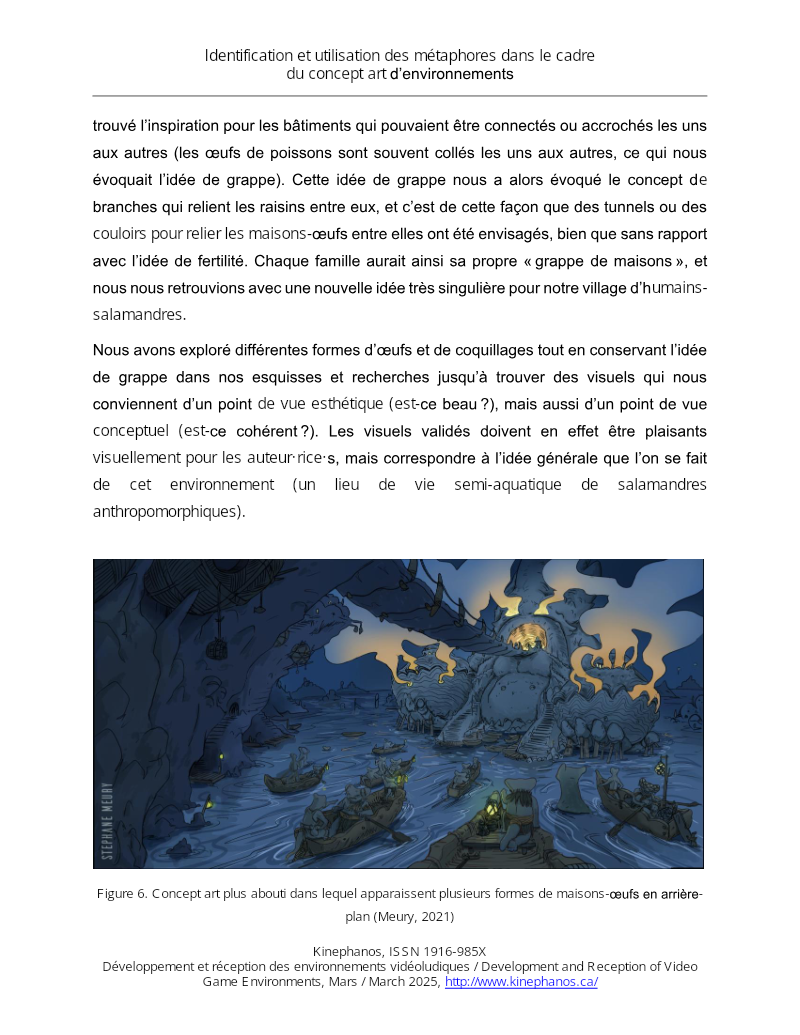
- The team first considered hen's eggs as a shape reference, but corrected the metaphor because hen's eggs do not suit a semi-aquatic environment.

The Secret Weapon Of Sound Design For Indie Games
Effective sound design serves as a critical tool for indie game developers to establish atmosphere, build immersion, and guide player perception.
- Use subtle, layered ambient sounds like reverb and pitch shifting to create depth and immersion, rather than relying on constant noise.
- Incorporate intermittent, low-frequency effects spaced minutes apart to build suspense and prevent players from identifying repetitive audio loops.
- Leverage audio to suggest complex environments and world-building, effectively compensating for visual limitations in resource-constrained indie projects.
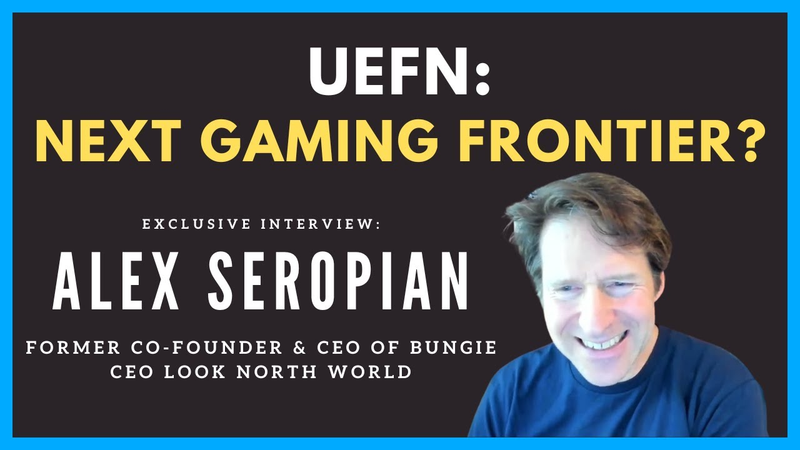
Halo Founder Thinks Fortnite UEFN is the Future of Gaming!
The Unreal Editor for Fortnite (UEFN) represents a transformative shift in game development, offering a viable alternative to the escalating costs and competitive saturation of the traditional AAA market.
- The UEFN platform currently lacks essential commercial infrastructure, such as robust deep linking, user attribution, and merchandising tools, which are standard on mature platforms like Roblox.
- Epic Games has not yet fully committed to transforming UEFN into a professional-grade commercial ecosystem, leaving developers in a 'wait and see' position regarding long-term business viability.
- New game releases are struggling for market share, as 70% of total gameplay time is currently spent in titles that are seven years or older, such as Fortnite and Roblox.
The Procedural Content Generation Benchmark: An Open-source Testbed for Generative Challenges in Games
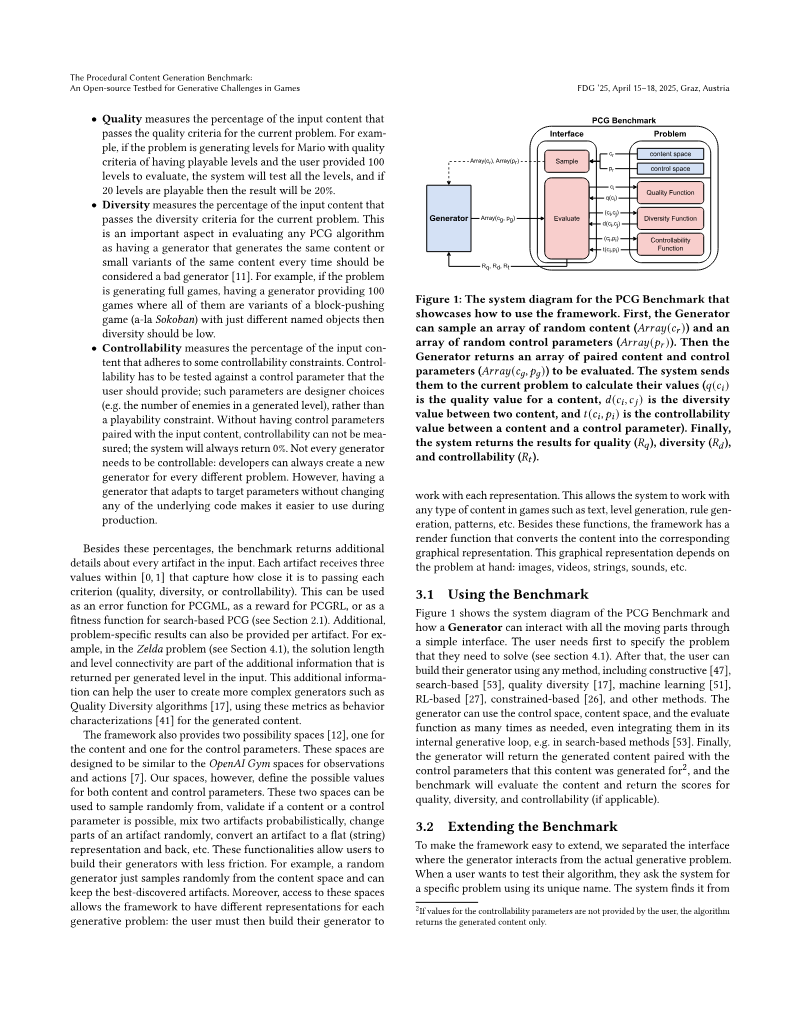
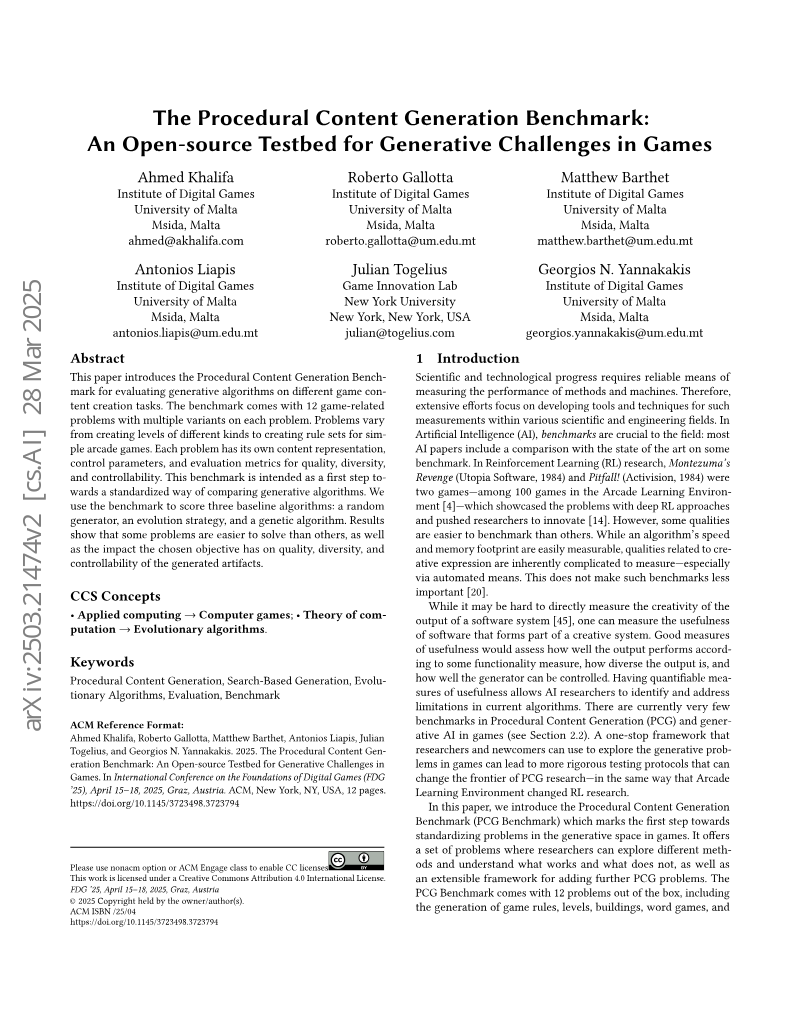
The Procedural Content Generation (PCG) Benchmark is an open-source framework from researchers at the University of Malta and New York University, designed to evaluate generative algorithms across 12 game-related problems, each with multiple variants.
- The benchmark ships with 12 problems, and the authors treat it as a first step toward standardized comparison of generative algorithms in games.
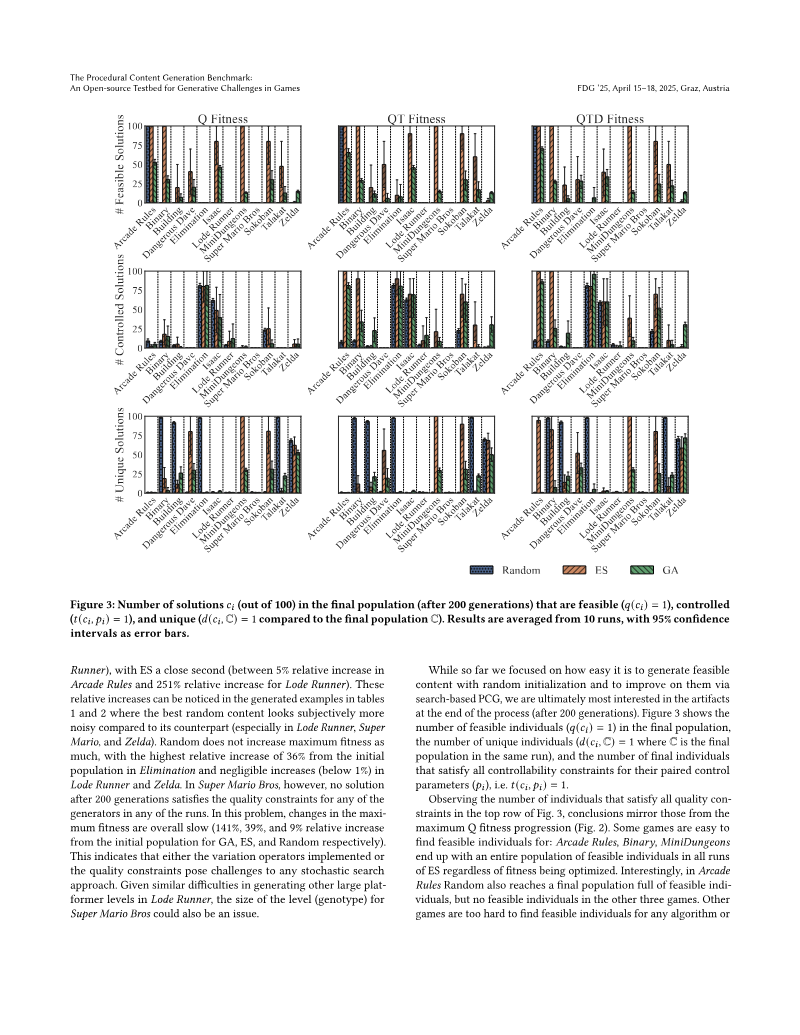
- Across all problems and fitness targets, the genetic algorithm reached feasible solutions in its final population in 224 of 360 runs, versus 191 for evolution strategy and 32 for random generation.
- No Super Mario Bros solution satisfied the quality constraints for any generator in any run after 200 generations.
Level the Level: Balancing Game Levels for Asymmetric Player Archetypes With Reinforcement Learning
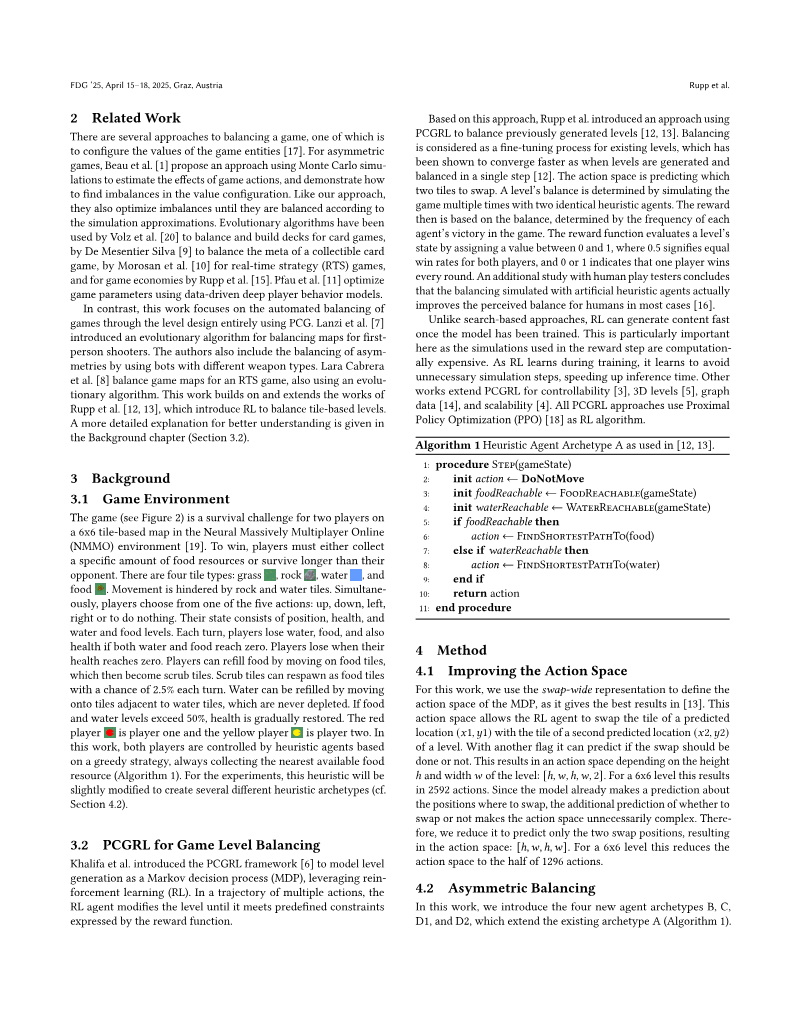
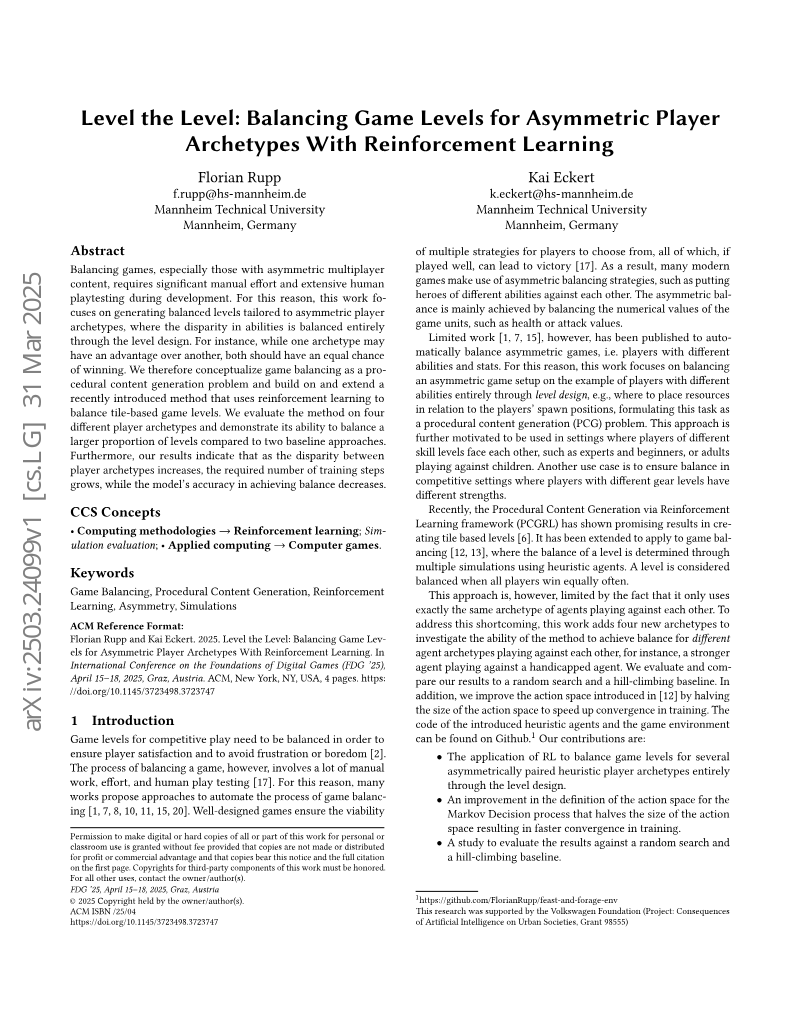
This research addresses the challenge of automating game balance for asymmetric player archetypes by utilizing reinforcement learning (RL) to modify tile-based level designs.
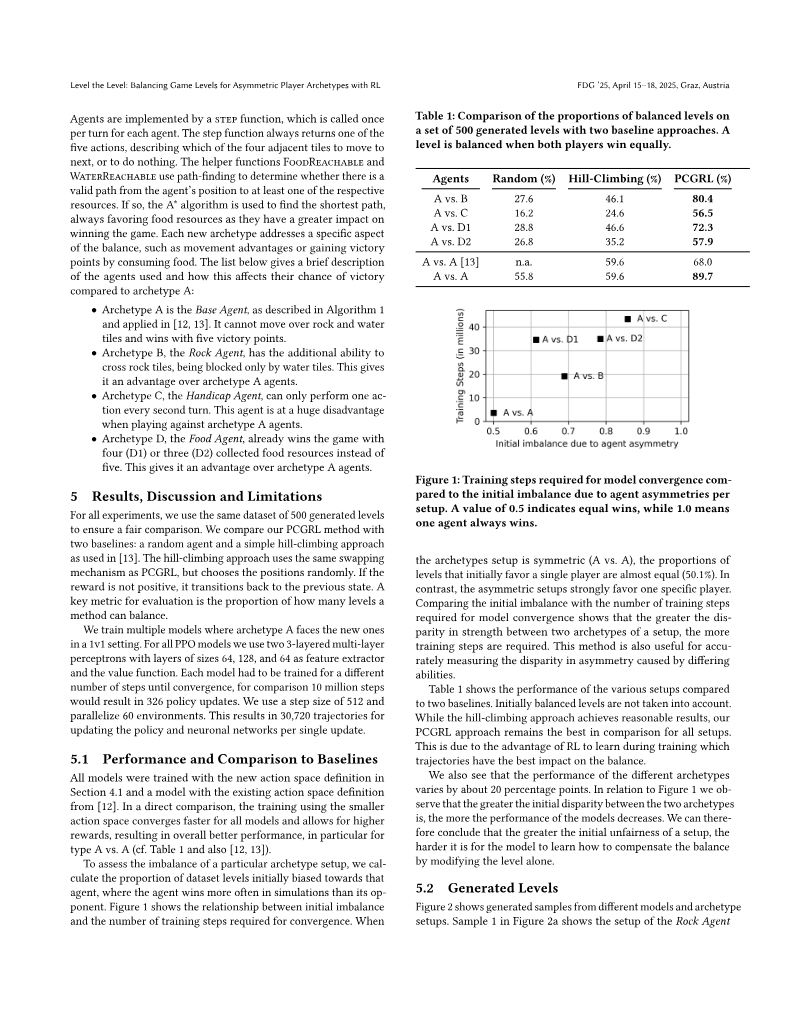
- Reinforcement learning (RL) models consistently outperform random search and hill-climbing baselines in balancing tile-based game levels for asymmetric player archetypes.
- The RL approach achieves balance by strategically placing resources and obstacles within the environment to equalize win rates between players with disparate abilities.
- Refining the action space within the Neural Massively Multiplayer Online (NMMO) environment significantly accelerates training convergence and improves overall efficiency.
Live Game Design: Prototyping at the Speed of Play
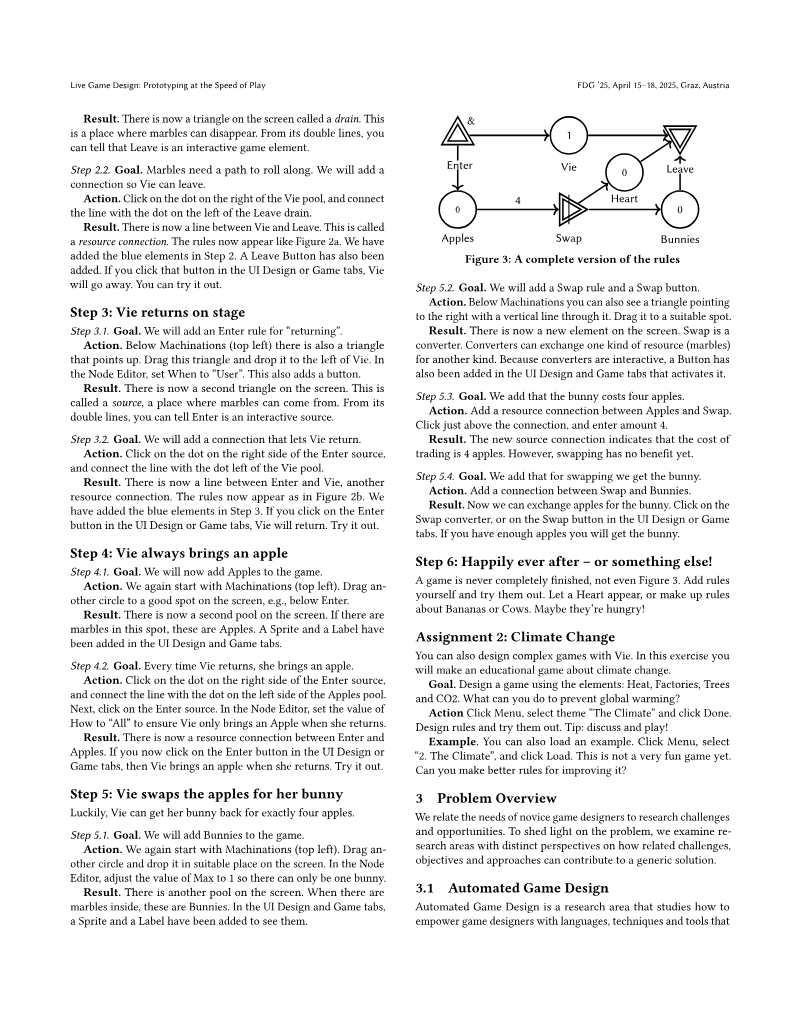
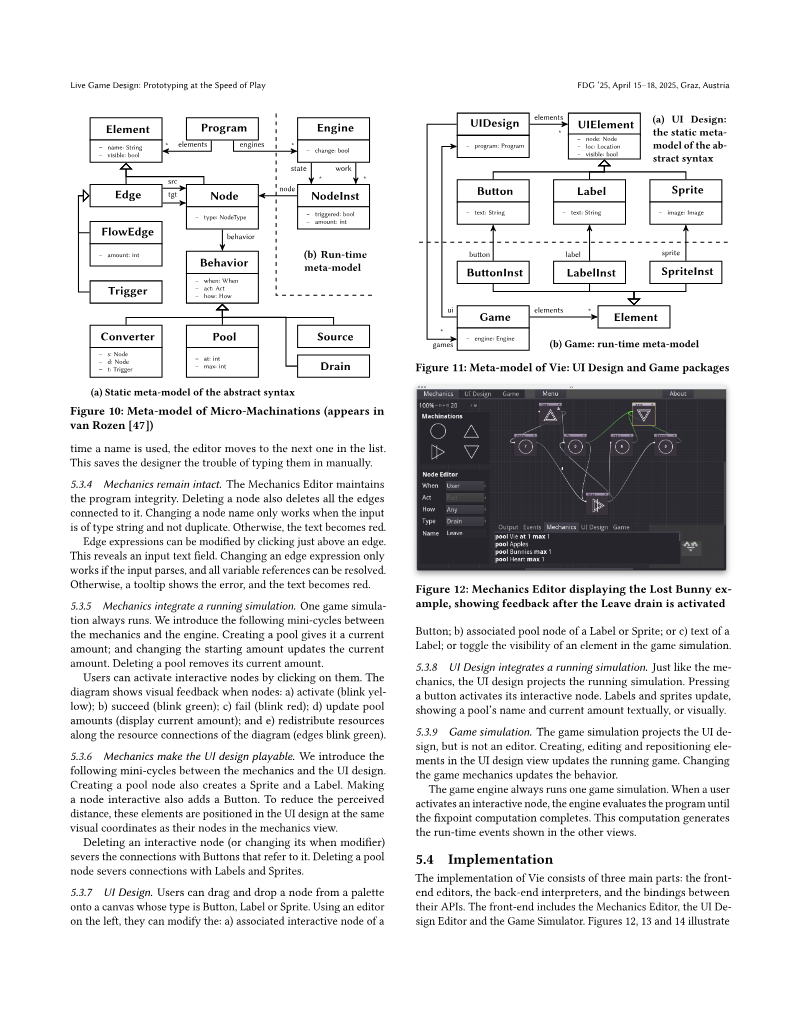
The paper by Riemer van Rozen, from the Centrum Wiskunde & Informatica in Amsterdam, presents Live Game Design, an approach that combines Automated Game Design with Live Programming so designers can prototype and playtest simultaneously.
- The authors identify the lack of continuous change as a problem: changing a running prototype's mechanisms is not possible, and many changes require a restart.
- In the workshops, most participants played for at least half an hour, and in three cases participants continued for several hours.
- Almost every participant frequently switched between views for prototyping and playtesting, which the authors interpret as a sign that these processes were seamless.
Analysis of Robustness of a Large Game Corpus
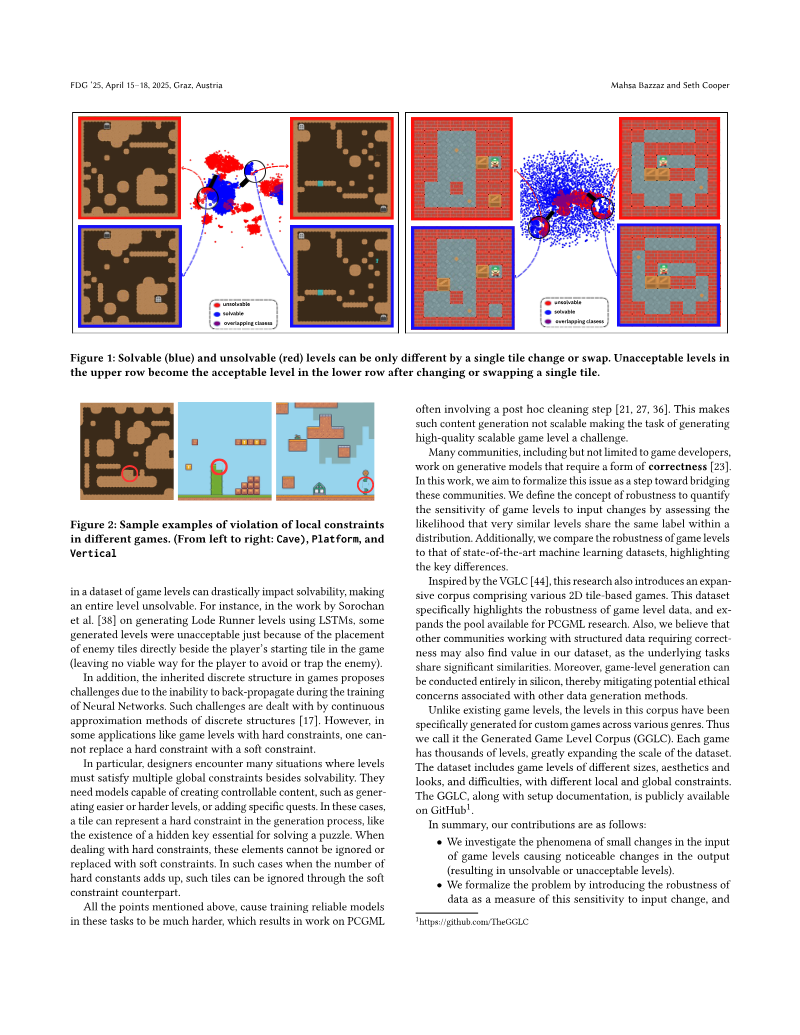
The paper by Mahsa Bazzaz and Seth Cooper of Northeastern University, presented at FDG '25, examines procedural content generation via machine learning (PCGML) for 2D tile-based game levels.
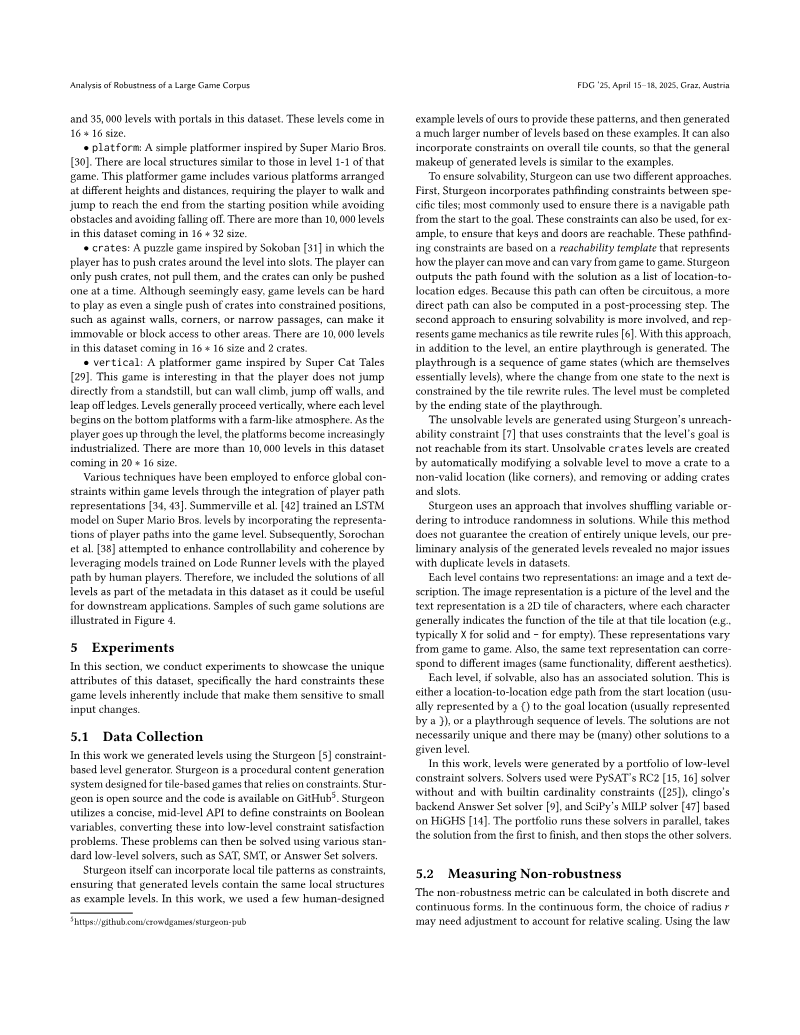
- In the authors' single-tile replacement test, changing one tile altered solvability most often in crates (78.9%).
- The authors state that crates shows the highest sensitivity, because small changes such as moving a crate into a corner often result in unsolvable levels.
- The paper reports that cave changes altered acceptability in 43.0% of single-tile replacements, close to its 43.1% solvability change rate.
Writers
Games and companies
Games