Game Development reports and market data
Documents
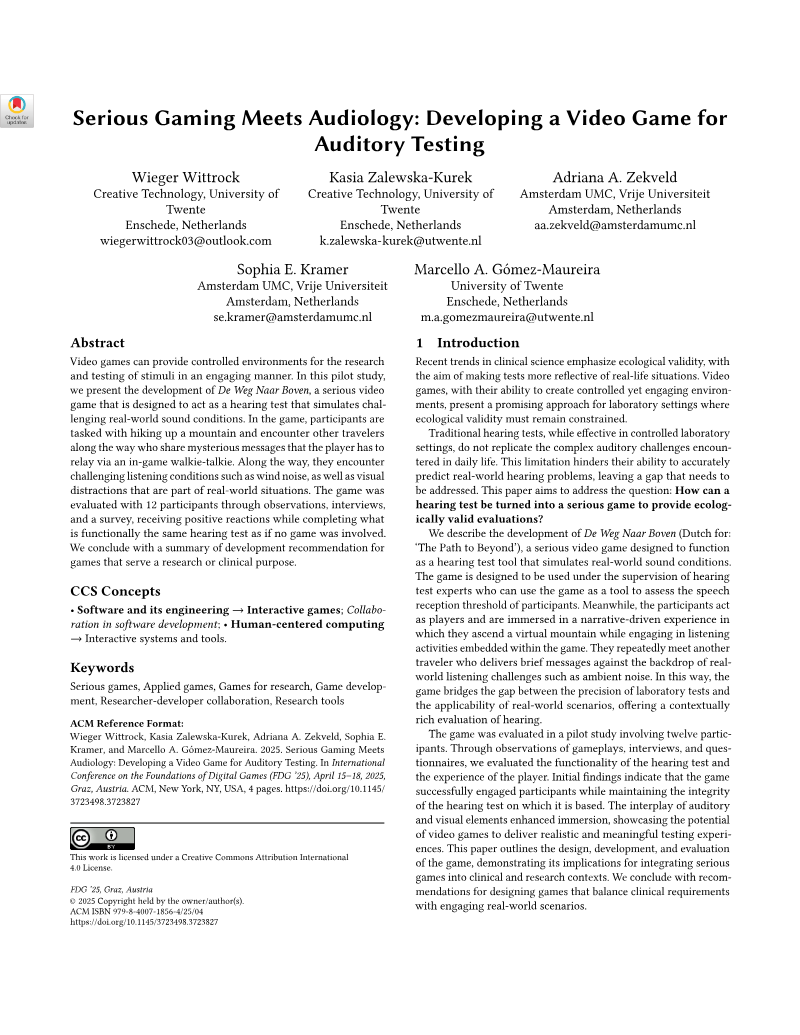
Serious Gaming Meets Audiology: Developing a Video Game for Auditory Testing
The primary objective of this research is to enhance the ecological validity of clinical hearing assessments by integrating them into a serious game environment.
- The serious game 'De Weg Naar Boven' successfully integrates clinical speech reception threshold tests into a narrative-driven hiking simulation to improve the ecological validity of hearing assessments.
- The game utilizes realistic background noise, such as wind and rustling leaves, to simulate real-world auditory challenges that traditional, controlled laboratory tests often lack.
- Pilot study results from twelve participants (average age 37) indicate high levels of usability and aesthetic appeal, confirming that users can successfully complete clinical auditory tasks within the game environment.
Level Generation with Constrained Expressive Range
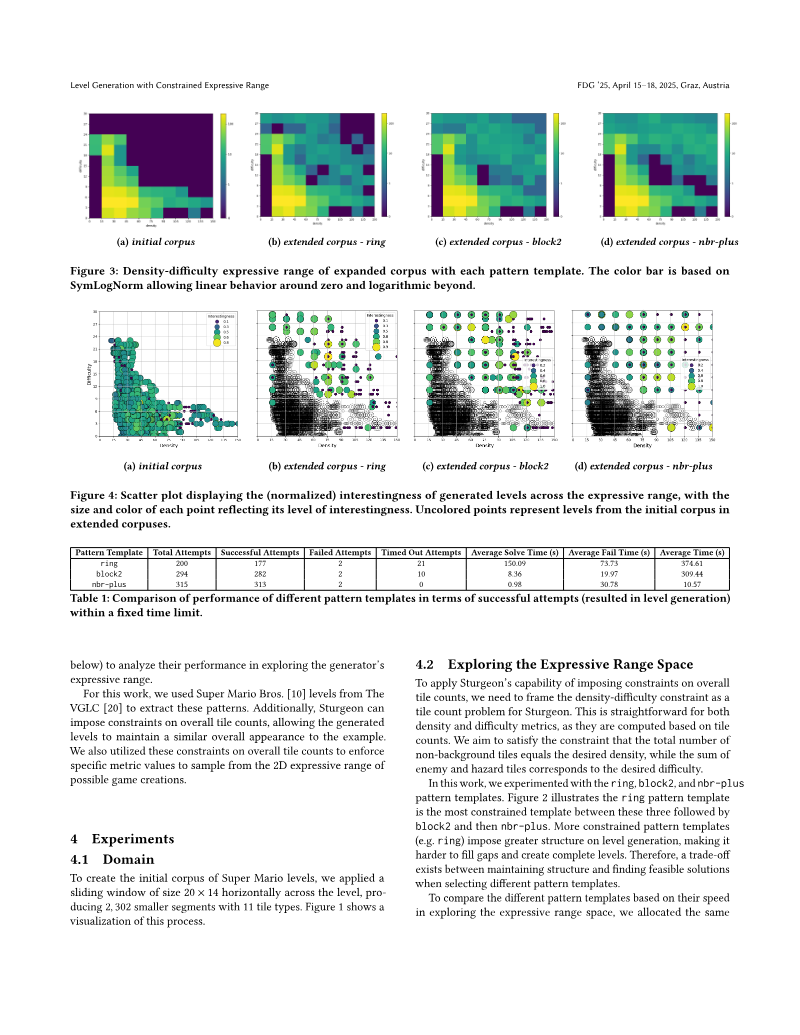
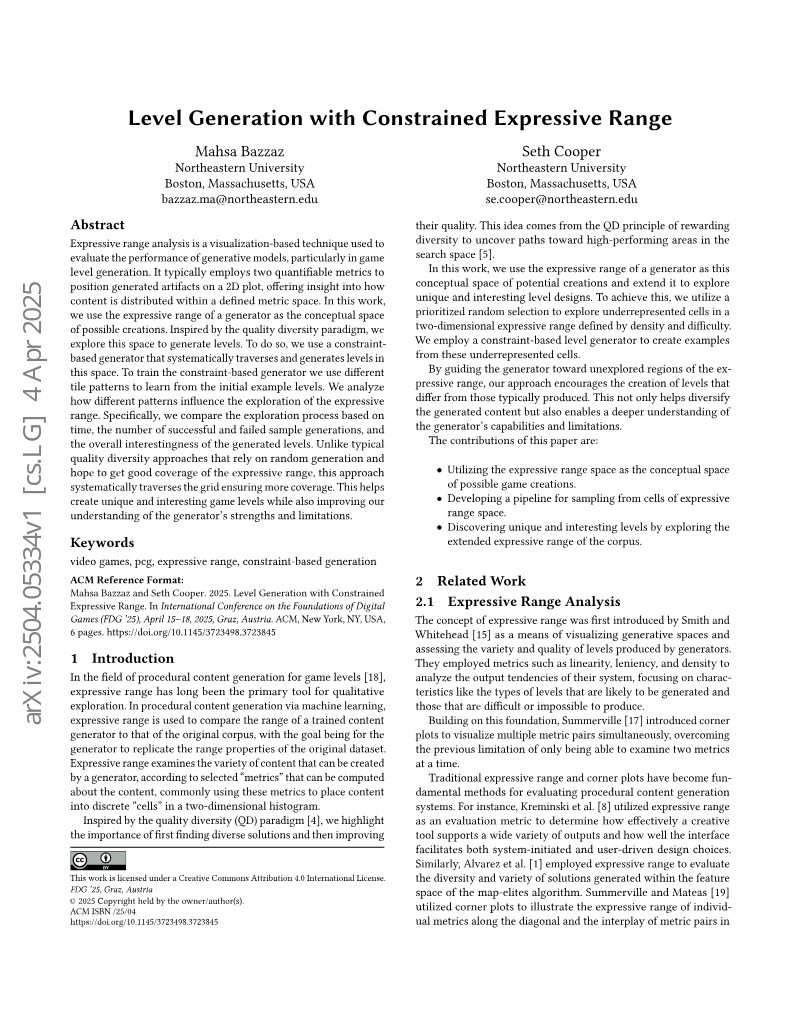
This research introduces a systematic approach to procedural content generation by utilizing expressive range analysis as a conceptual space for guiding level design.
- Systematic traversal of a defined metric space using quality diversity principles significantly outperforms purely random generation in uncovering unique, underrepresented level design variations.
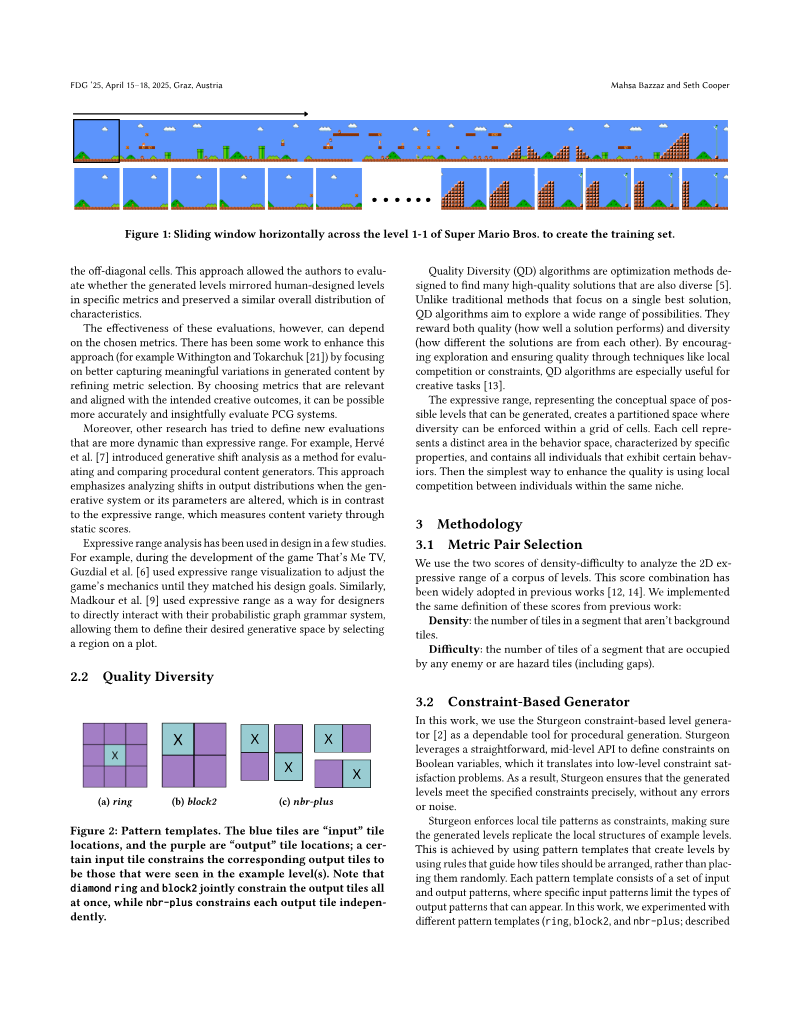
- The study utilized the Sturgeon constraint-based generator to process 2,302 segments from the Video Game Level Corpus to create Super Mario Bros. levels.
- There is a direct trade-off between structural constraint and generation efficiency: highly restrictive templates like 'ring' produce more structured levels but suffer from higher failure rates and longer solve times.
How To Make Games In 2025 (Jabrils) — Full Time Game Dev Podcast Ep. 041
The game development industry currently faces a critical inflection point regarding the integration of generative artificial intelligence.
- The game industry is shifting away from the generative AI hype cycle as the technology currently lacks the deep-task competence required to produce production-ready 3D assets.
- A significant disconnect exists between the massive capital investment in generative AI and the actual productivity gains realized in game development pipelines.
- Market dynamics are expected to bifurcate, with human-authored experiences likely increasing in value as consumers learn to distinguish them from mass-produced AI content.

Gaming Under Fire: U.S, China, Tariffs & More
The global gaming industry is currently navigating a period of significant volatility driven by macroeconomic instability, shifting international trade policies, and a challenging investment climate.
- The gaming industry is shifting from high-budget, multi-year production models to a 'survival mode' characterized by cost-efficiency, lean operations, and smaller, iterative development cycles.
- Western studios are losing their competitive advantage as global access to cloud software and high-end hardware allows Eastern studios to leverage lower labor costs and higher development efficiency.
- Investment in the sector has transitioned from a growth-oriented model to one of extreme risk aversion, making funding for new mobile and PC projects increasingly difficult to secure.
How Unity's Asset Store Changed The Game Industry | Design Club!
The rise of commercial game engines and integrated marketplaces like the Unity Asset Store has fundamentally transformed the economics of game development.
- The Unity Asset Store has shifted game development economics by allowing studios to purchase pre-built infrastructure rather than investing time and capital into proprietary engine development.
- By outsourcing foundational technical tasks like pathfinding and save architectures, developers can reallocate resources toward the final ten percent of development that defines a game's unique identity.
- The marketplace democratizes high-end production by providing small teams and individual creators access to professional-grade systems, such as cloth animation and visual effects, previously reserved for large, well-funded studios.

Steal This Strategy — The One Top Studios Use to Save Millions
Top-performing mobile game studios have shifted away from high-budget user acquisition strategies, moving instead toward a model defined by rigorous, multi-stage playtesting.
- Top-performing mobile studios treat playtesting as a continuous, iterative process throughout the entire production cycle—from MVP to hard launch—rather than a one-time event.
- Early-stage playtesting of the First Time User Experience (FTUE) can prevent costly development pivots, potentially saving studios six figures by identifying friction points months before a full launch.
- Successful developers now test their games for extended durations, ranging from two-hour sessions to a full week of content, to ensure long-term engagement and meta-game viability.

Is AI Going To Destroy Game Development?
The integration of artificial intelligence into game development has emerged as a significant ethical and practical dilemma for the industry.
- The game industry is bifurcating its AI adoption, widely accepting tools for technical tasks like debugging and boilerplate coding while maintaining strong resistance toward AI-generated visual art.
- Critics argue that AI-generated assets lack human intent and possess a recognizable, sterile aesthetic that devalues traditional craftsmanship.
- Market forces are expected to drive long-term adoption, potentially leading to a model where human-made content is marketed as a premium, certified category.

Why He Spent 8 Years On A Single Game (Adam Younis) — Full Time Game Dev Podcast Ep. 040
The development of independent games is increasingly defined by a tension between traditional marketing metrics and the cultivation of long-term community engagement.
- Live-streaming the creative process serves as a sustainable alternative to traditional marketing, fostering accountability and building a dedicated audience that values handcrafted development.
- Solo developers often rely on a hybrid financial model to maintain creative autonomy, combining personal savings, contract work, and government grants rather than seeking external funding that necessitates rigid deadlines.
- Human intentionality is a primary market differentiator, as AI-generated content lacks the cohesive, meaningful, and authentic experience that players seek in modern indie titles.

The EASIEST Way To Paint Your 3D Game Models (Adobe Substance 3D Painter Tutorial)
Adobe Substance 3D Painter serves as a primary industry tool for texturing and painting 3D game assets, ranging from weapons to complex character models.
- Substance 3D Painter is the industry-standard tool for texturing 3D assets, facilitating the transition from raw models to engine-ready textures for platforms like Unity and Unreal.
- The baking process is the foundational step for high-quality texturing, as it generates essential mesh maps like ambient occlusion and curvature that allow smart materials to respond dynamically to geometry.
- Smart materials utilize baked mesh data to automatically apply realistic effects such as dirt, wear, and depth to model crevices, significantly accelerating the texturing workflow.

What If Game Production Looked More Like A Film Set?
The gaming industry is undergoing a fundamental structural transformation, moving away from monolithic, overfunded studio models toward a flexible, just-in-time production framework inspired by Hollywood film sets.
- Game studios should transition to a 'creative as a service' model, utilizing external talent for specific project phases to reduce idle time and overhead costs, similar to the flexible staffing structure of film sets.
- The industry is shifting away from high-volume, low-quality asset production toward a 'less is better' approach, prioritizing high-quality CGI and playable content to maintain engagement in a post-IDFA market.
- Indie studios can improve discoverability and monetization by leveraging niche, non-traditional IP rather than competing for the same handful of mainstream licenses used by large free-to-play titles.
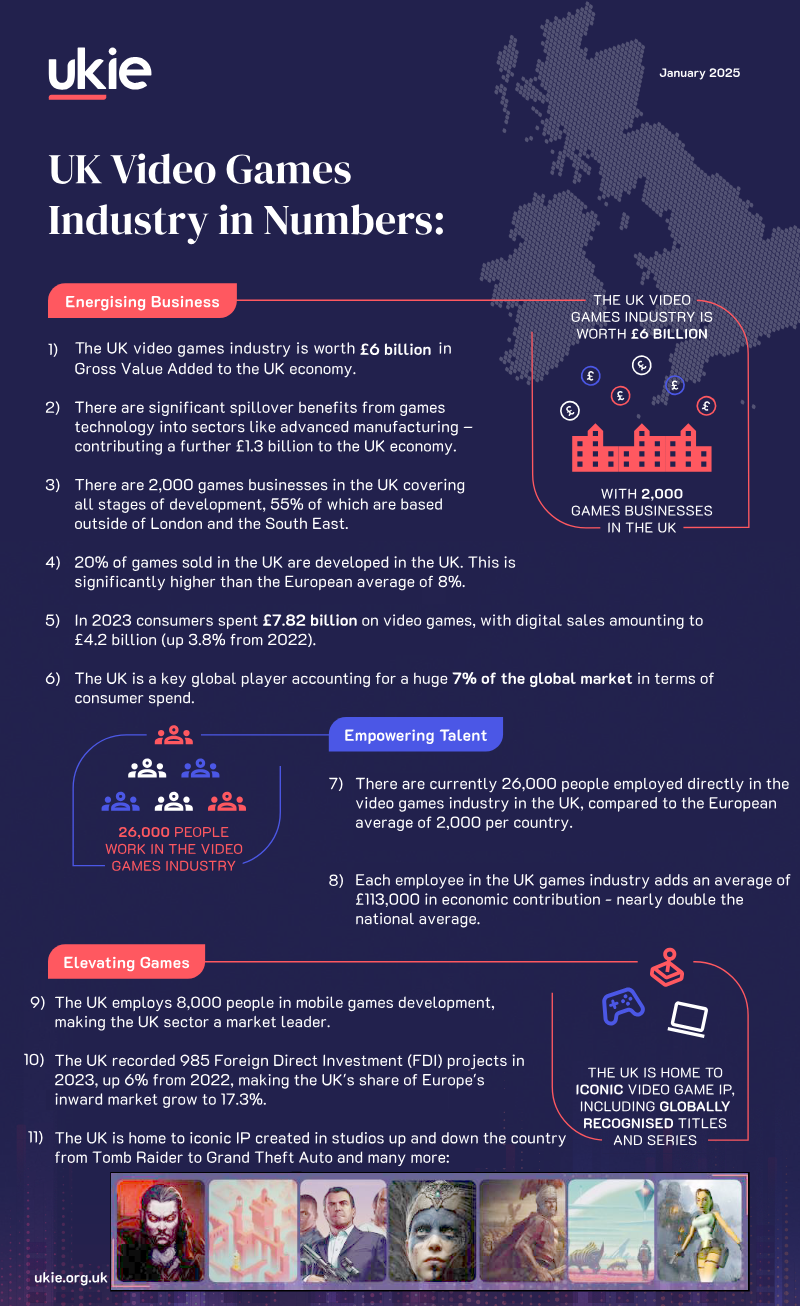
UK Video Games Industry in Numbers: Energising Business 2025
The UK video games industry contributes significantly to the national economy, generating £6 billion in Gross Value Added and an additional £1.3 billion through spillover benefits into sectors like advanced manufacturing.
- The UK video games industry generates £6 billion in direct Gross Value Added, with an additional £1.3 billion in economic spillover benefits to sectors like advanced manufacturing.
- Total consumer spending reached £7.82 billion in 2023, with digital sales accounting for £4.2 billion and reflecting a 3.8% year-over-year increase.
- The sector employs 26,000 people who contribute an average of £113,000 each to the economy, nearly double the national average productivity rate.
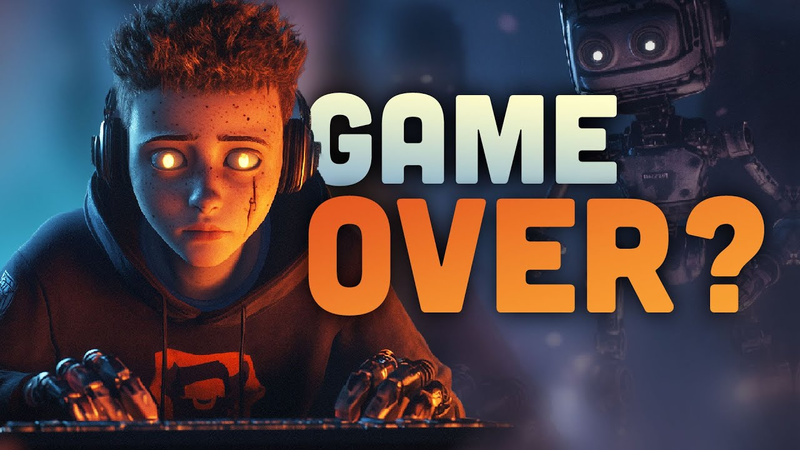
Is AI Going To Destroy The Indie Game Industry?
The discussion explores the existential and practical impact of artificial intelligence on the indie game industry, specifically addressing whether AI can replicate the human-driven, artisanal quality of independent titles.
- AI excels at synthesizing existing concepts, such as combining two genres to find a 'midpoint' of value, but struggles to generate truly original ideas that fall outside the bounds of its training data.
- The 'smell' of AI-generated content often stems from a lack of specific, intentional creative direction, as AI struggles to maintain the cohesive vision required for complex game elements like cutscenes.
- Game development involves thousands of granular creative decisions—such as camera framing, timing, and visual effects—that require a human director to ensure the final product is not aimless or 'mushy'.
Writers
Games and companies
Games