Game Development reports and market data
Documents
Level Design in a Day: Level Design Histories and Futures
Level design functions as a multifaceted discipline that bridges raw data, industrial manufacturing, architectural theory, and community-driven social practice.
- Level design is an inherently political practice where the creator's worldview and biases dictate the social inclusivity and intent of virtual spaces.
- The evolution of level design is inextricably linked to tool development, as software constraints—from early grid-based editors like DoomEd to modern 3D engines—directly define creative boundaries and designer workflows.
- AAA development has shifted toward a formalist orthodoxy that prioritizes functional grey-box prototyping and scalable geometry to manage the technical demands of modern production.
Library Not Found: The Disconnect between Gaming Research and Development
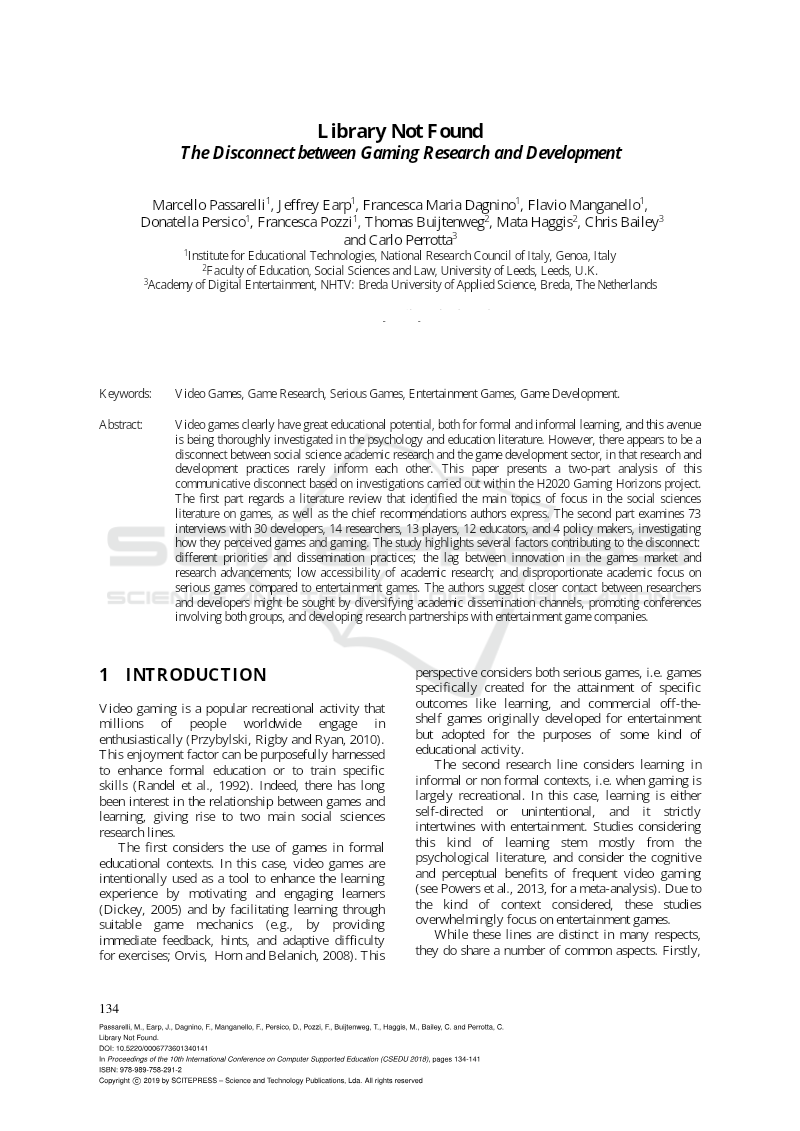
"Library Not Found: The Disconnect between Gaming Research and Development" reveals a substantial chasm between social science academic research and the commercial game development industry.
- Academic research on games has failed to reach developers: 46% of recommendations in the literature target researchers, while only 12% address developers, mirroring the distance reported by nearly every developer interviewed.
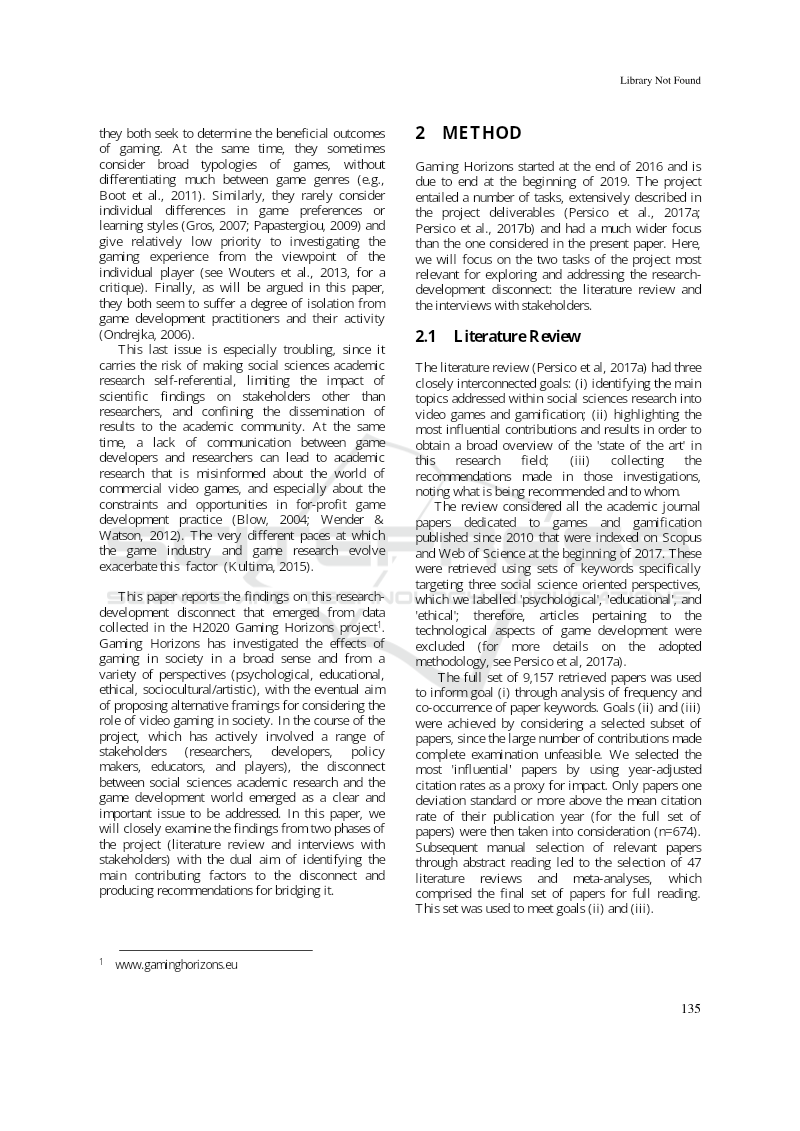
- The review drew on 9,157 retrieved papers, with 47 reviews and meta-analyses read in full, plus 73 stakeholder interviews with developers, educators, and players.
- Developers described academic research as tentative, inaccessible, outdated, and insufficiently attentive to market needs, citing dense jargon, difficulty locating papers, and a preference for industry venues such as the Game Developers Conference.
Spectating Development: Backer Perspective on Games Crowdfunding
This study investigates backer motivations for participating in games crowdfunding, moving beyond the simple acquisition of a product to explore deeper forms of value.
- Backers value games crowdfunding for far more than receiving a product: many enjoy following development through project updates, which they describe as enjoyable and educational.
- The study draws on an online survey of 426 respondents conducted in 2016, with qualitative analysis focused on 114 open-ended answers describing motivations in respondents' own words.
- Motivations identified include obtaining tailor-made or rare products, perceived good deals on quality, price, or early access, and feeling compelled to back campaigns to secure the most complete version of a game.
Indie as Usual: Localising Australian Videogame Development
The document examines the transformation of the Australian videogame industry, focusing on the prevalence of "indie" development in a context largely devoid of traditional "triple-A" studios.
- Australia's videogame industry shifted after the collapse of its traditional fee-for-service model, and indie development has become the conventional mode of business in a country without large triple-A studios.
- Employment in the Australian industry fell from 1,431 in 2007 to 581 in 2012, while studio numbers rose from 45 to 84, reflecting 'creative destruction' after the Global Financial Crisis and the US-Australian dollar parity.
- By 2018 employment had recovered to 928 while the studio count dropped to 63, which the authors read as smaller groups and individual developers stabilising and increasingly exporting original intellectual property for digital distribution platforms.
Implementing Intelligence: The Platform Culture of Intellivision
The document analyzes the "platform culture" of the Intellivision home game console, focusing on how the concept of "intelligence" was implemented and expressed throughout its design, marketing, and development.
- The paper argues that 'intelligence' was an aesthetic, pragmatic, and social principle underlying the Intellivision console (Mattel Electronics, late 1970s–early 1980s), not just a marketing slogan, despite the system lacking complex onboard AI.
- Intellivision's marketing used comparative framing and visual realism, with slogans urging consumers to 'compare' and positioning the system as the choice of sophisticated gamers, in contrast to rivals such as the Atari VCS.
- Mattel's modular, extensible design, including speech, keyboard, synthesizer, network, and cartridge-adapter peripherals, promoted an imaginary of augmented human intelligence.

Game Engines: Design, Labour, and Legality
This paper investigates the contemporary landscape of game engine utilization, focusing on how these proprietary structures and toolsets are reshaping game design, labor practices, and legal frameworks within the Australian context.
- The shift from proprietary in-house engines to a few third-party platforms such as Unity and Unreal is reshaping game design as a technical, labour, and economic practice in Australia.
- The study is a preliminary, work-in-progress extended abstract from DiGRA 2018, based on semi-structured interviews of 45 to 60 minutes with Australian designers, amateurs, students, and educators, with 15 of a planned 17 interviews completed at the time of writing.
- Participants described engines less as contained toolsets than as networks mediating between people, particularly via Unity's asset store and online support forums.

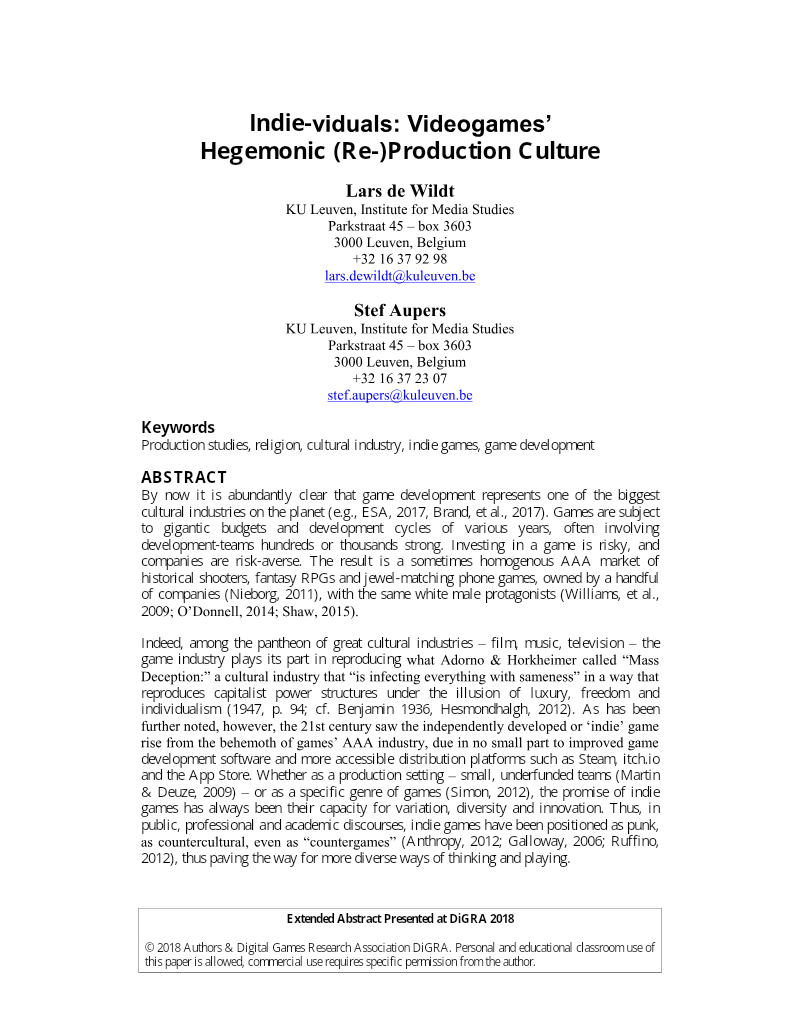
Indie-viduals: Videogames' Hegemonic (Re-)Production Culture
This DiGRA 2018 extended abstract, authored by Lars de Wildt and Stef Aupers of KU Leuven, examines whether independent game development escapes the commercial conformity of the AAA industry or instead reproduces its dominant conventions, with a particular focus on how religion is represented in games.
- Independent game development often reproduces rather than escapes the conventions of the commercial AAA industry, according to a qualitative study of 27 international developers by Lars de Wildt and Stef Aupers of KU Leuven.
- Non-religious developers tend to rely on stereotyped religious imagery, such as priests who heal simply because they are priests, as narrative shortcuts, while religious developers struggle to find room for their own convictions in their work.
- The authors argue that game design has become a universal language of tropes rooted in North American and Japanese development culture, which frames religion as commodity, conspiracy, or fantasy.
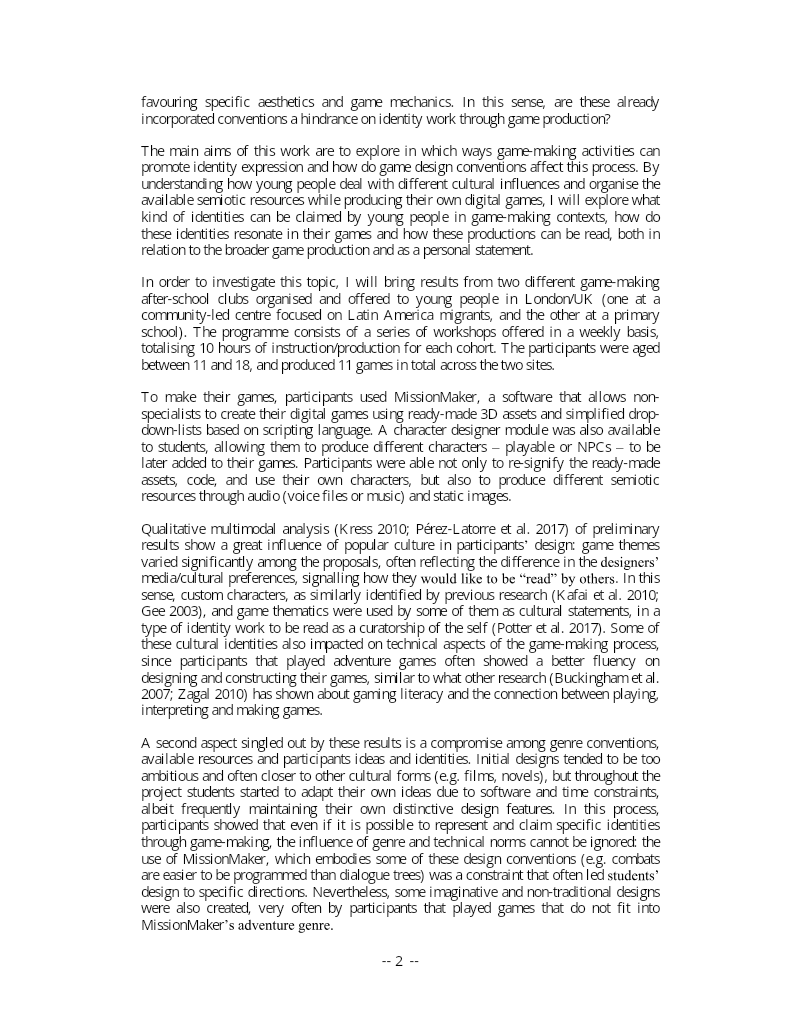

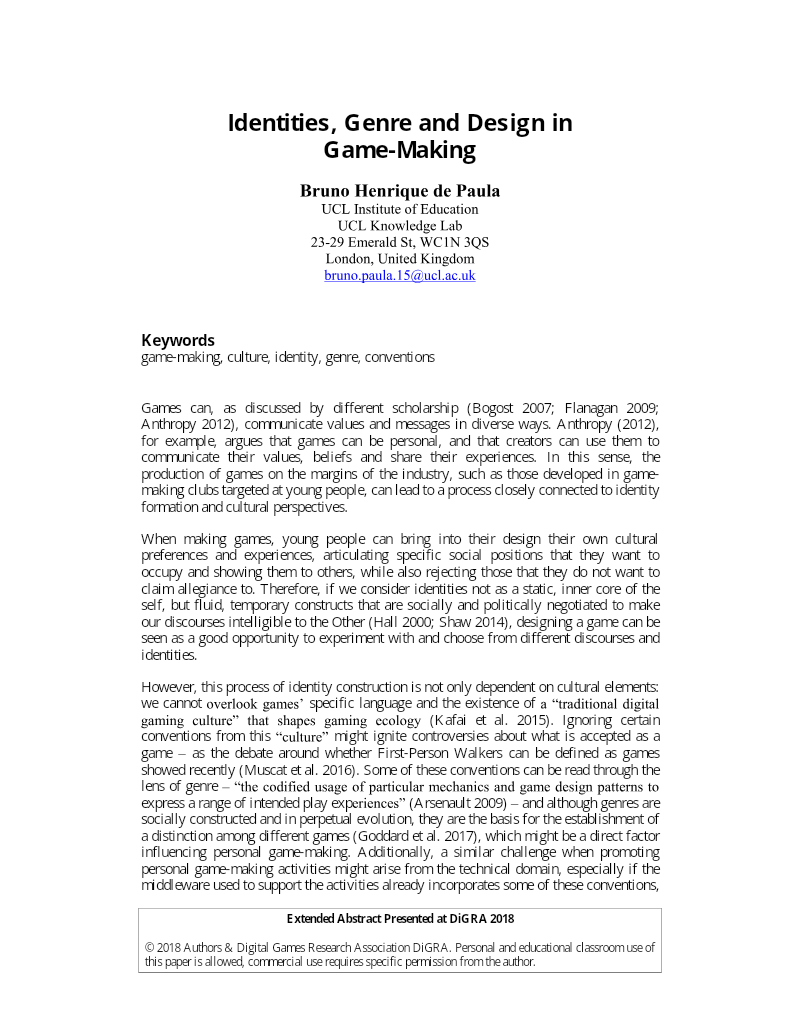
Identities, Genre and Design in Game-Making
This extended abstract explores how game-making activities facilitate identity expression among young people and the influence of game design conventions on this process.
- Young people use game-making to experiment with cultural preferences, claim social positions, and reject others, but this expression is negotiated rather than unconstrained, shaped by individual preferences, genre conventions, and technical limits.
- Popular culture strongly shaped the games: themes and custom characters functioned as deliberate cultural statements that participants used to signal how they wished to be read by others.
- Study of two London after-school clubs (a community centre serving Latin American migrants and a primary school), with about ten hours of weekly instruction, involved participants aged 11 to 18 who produced eleven games in MissionMaker, a platform for building 3D games from ready-made assets and simplified scripting.
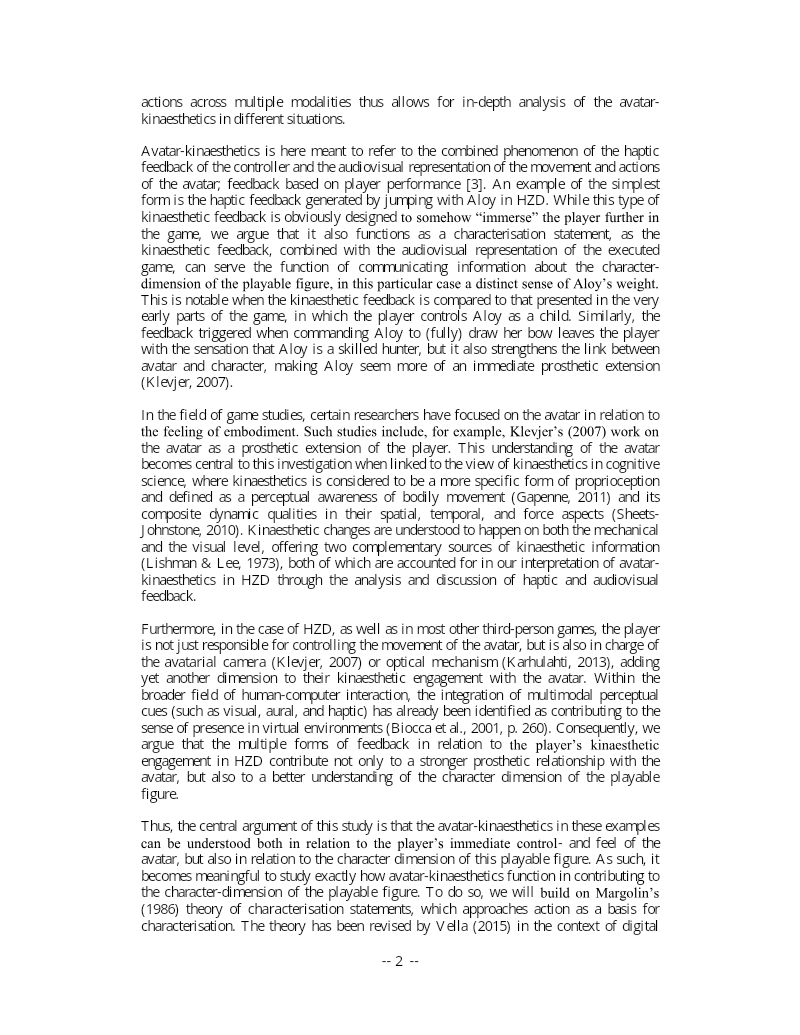
Avatar-Kinaesthetics as Characterisation Statements in Horizon: Zero Dawn
This study investigates how "avatar-kinaesthetics" function as characterization statements in digital games, using Horizon: Zero Dawn (HZD) as a specific case study.
- The paper proposes that avatar-kinaesthetics in Horizon: Zero Dawn (Guerrilla Games, 2017) act as characterisation statements, meaning controller haptics and avatar movement communicate character traits rather than serving only immersion.
- Specific traits conveyed through player-performed kinaesthetic feedback include Aloy's weight, the difference between her childhood and adult physicality, and her hunting skill, exemplified by fully drawing a bow.
- The authors argue that this kinaesthetic engagement strengthens the prosthetic relationship between player and avatar, drawing on Klevjer's 2007 account.
The Human Machine Art Interface: Arcade Port Aesthetics and Production Practices
This analysis investigates the aesthetic characteristics and production methodologies employed in arcade-to-home computer game ports during the 1980s and 1990s.
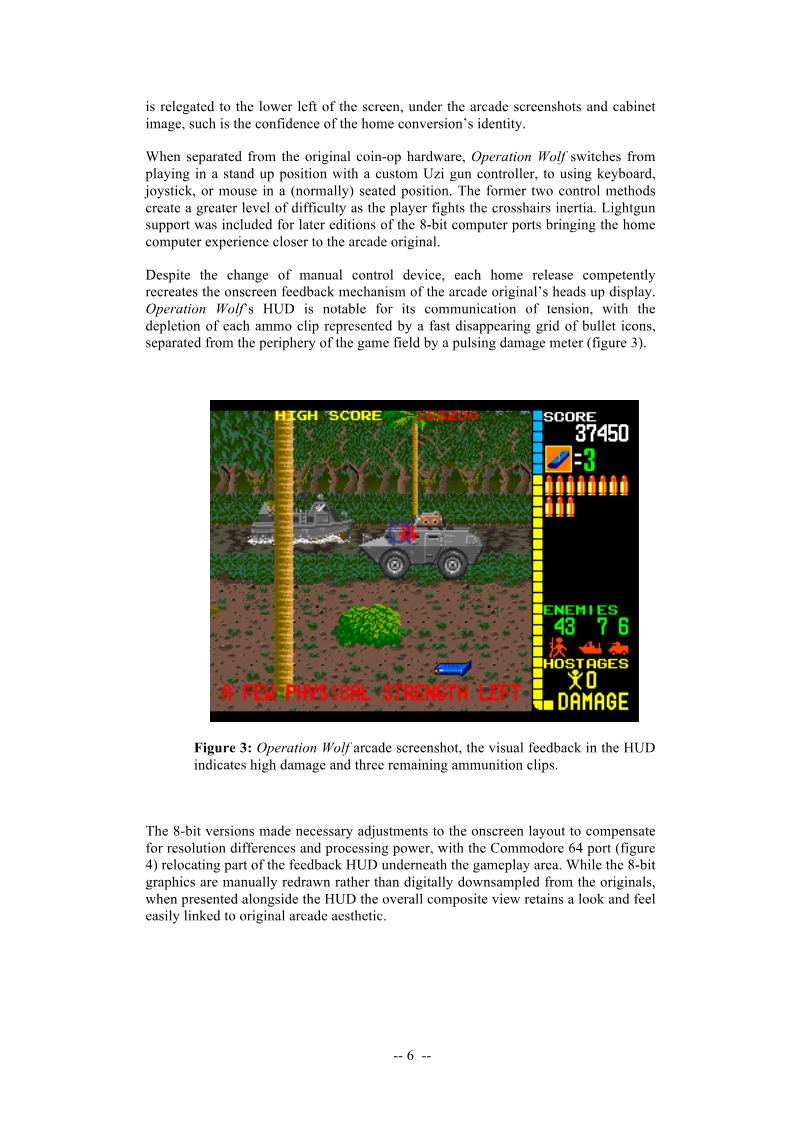
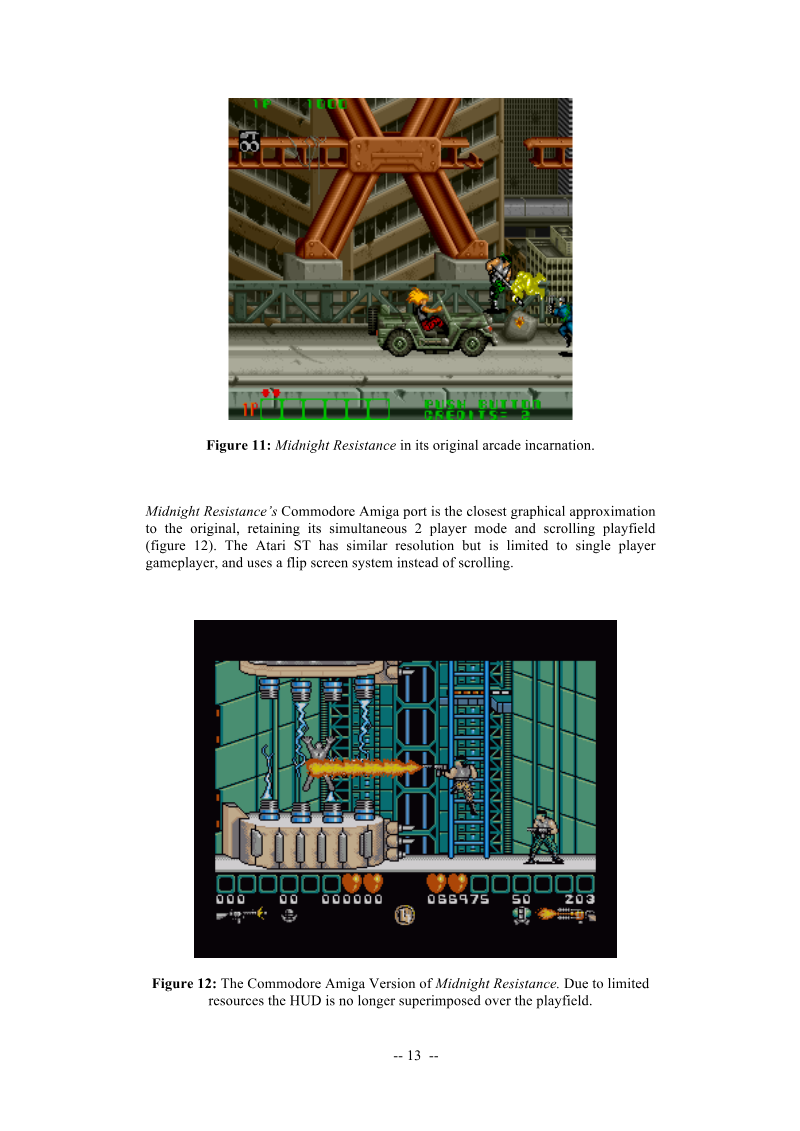
- British conversion teams typically reconstructed arcade graphics, music, and gameplay by capturing video from the cabinets and manually redrawing assets, rather than working from source files, which produced substantial aesthetic departures from the originals.
- The authors argue that these departures were shaped by individual teams' stylistic choices, not by platform constraints alone, reframing the ports as creative adaptations rather than duplications.
- Conversion teams including Arc, Graftgold, Special-FX, Ocean, and Tiertex relied on stippling to simulate extra colours within restricted palettes, custom converter tools to move assets between systems, and one-button joystick control schemes.
Indie Game: The Movie: The Paper - Documentary Films and the Subfield of Independent Games
This paper examines documentary films about independent game developers, arguing that such films play a significant role in constructing the cultural meaning of "indie" games, a term that remains ill-defined in both popular and academic discourse.
- The paper argues that documentary films about independent game developers play a significant role in constructing the cultural meaning of "indie" games, a term that remains ill-defined in both popular and academic discourse, drawing on Bourdieu's field theory and Fairclough's critical discourse analysis.
- The analysis rests on a corpus of four documentaries released between 2012 and 2017, selected for variety in subject matter, distribution, and release timing, and the author frames these films as contributing to the symbolic capital of independent developers and delimiting indie games as a space of heightened artistic value.
- The films consistently portray independent developers as passionate, creatively driven auteurs while casting major commercial studios in a negative light.
Preliminary Poetics of Procedural Generation in Games
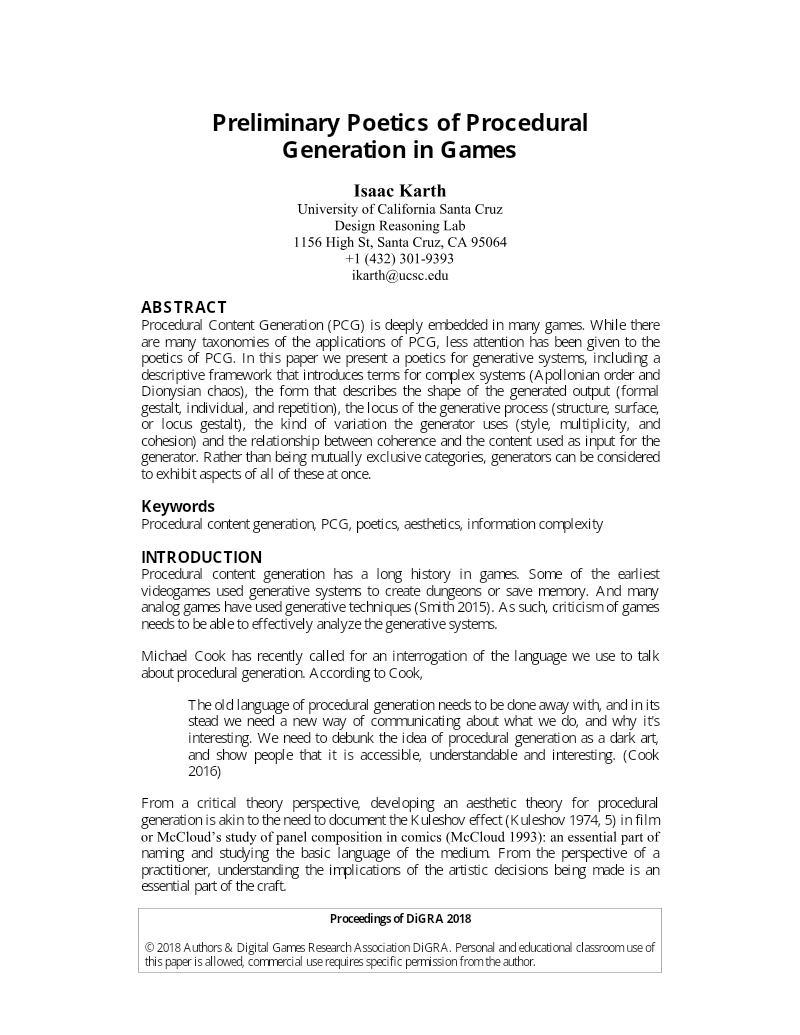
The document, "Preliminary Poetics of Procedural Generation in Games," establishes a critical framework for analyzing the aesthetic principles and player experiences derived from procedural content generation (PCG) in games.
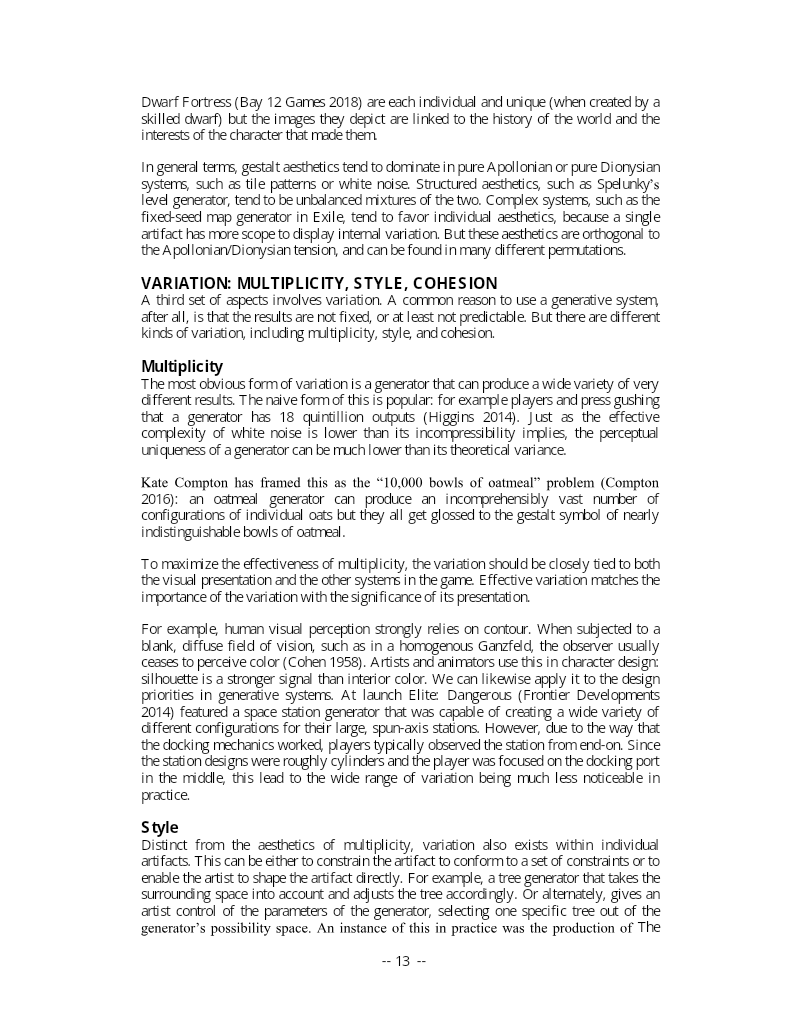
- The paper argues that existing taxonomies of procedural content generation describe how generators are built but not why they produce particular aesthetic effects, and proposes a poetics to fill that gap.
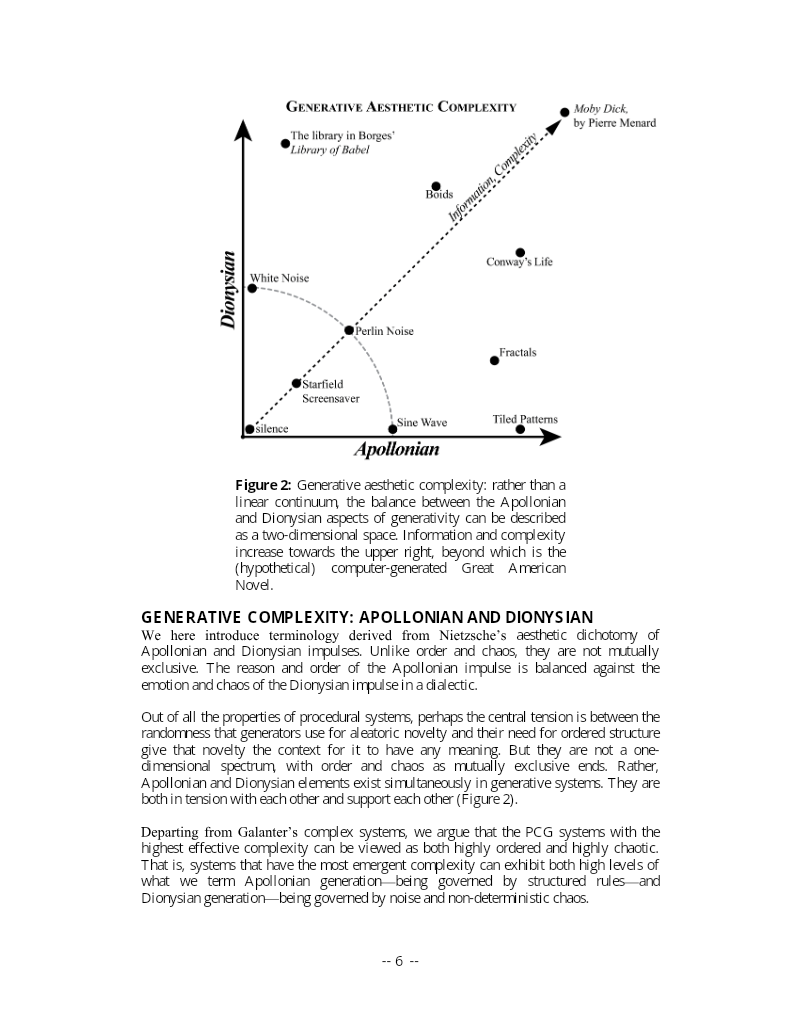
- It introduces the Apollonian (rule-governed coherence) and Dionysian (chaotic, noise-driven variation) as non-exclusive aesthetic qualities, so the most sophisticated generators can exhibit both at once within a multidimensional space rather than a single continuum.
- Aesthetic effects arise from the balance between randomness (Perlin noise, dice rolls, shuffles) and structural order (e.g., cellular automata like Conway's Life), with perception shaped by tension among repetition, gestalt, and individual artifacts.