Game Development reports and market data
Documents

Vlog - First Day of "Work"
Transitioning into self-employment requires a structured approach to administrative tasks, physical workspace optimization, and long-term strategic planning.
- On January 8, 2018, the transition to self-employment began with a focus on navigating municipal business registration requirements, utilizing local government offices for free regulatory guidance.
- Maintaining productivity as a solo operator requires a structured daily routine that integrates physical preparation, mental priming, and the use of visual planning tools.
- To prevent early-stage overwhelm, entrepreneurs should limit their daily output to three prioritized key tasks to ensure consistent, manageable progress.
Dynamic Storytelling in The Novelist
The Novelist explores the potential of system-driven narrative design, moving away from traditional branching paths to create a unique, non-prescribed storytelling experience.
- The Novelist replaces traditional branching narrative paths with a system-driven model that forces players to balance the competing needs of three family members.
- The game utilizes a hidden relationship scoring system to track long-term consequences, which are communicated to the player through human-readable feedback like diary entries and environmental changes.
- Systemic narrative design is significantly more labor-intensive than traditional scripting because it requires developers to account for a vast array of potential outcomes while maintaining narrative clarity.
Things I Don't Feel Comfortable Telling You About
The pursuit of transparency in content creation serves as a mechanism for personal growth and audience trust.
- Sustainable success in the creator economy requires balancing personal financial and ego-driven motivations with the delivery of genuine value to an audience.
- Radical transparency regarding personal flaws and limitations serves as a tool to dismantle the curated facade of perfection, fostering deeper trust with viewers.
- Audience satisfaction is the only viable mechanism for creators to achieve long-term personal freedom and financial independence.
Dev Log - Meet my Baby!
The core of this minimalist strategy project centers on a resource management mechanic where players control white creatures to combat red enemy units.
- The game utilizes a minimalist two-button control scheme where the left mouse button duplicates player units and the right mouse button triggers explosive attacks.
- Core gameplay centers on balancing exponential population growth against the strategic timing of detonations to clear levels before enemy difficulty scales.
- The prototype features varied enemy behaviors, including static targets and intelligent units that actively hunt player duplication points.
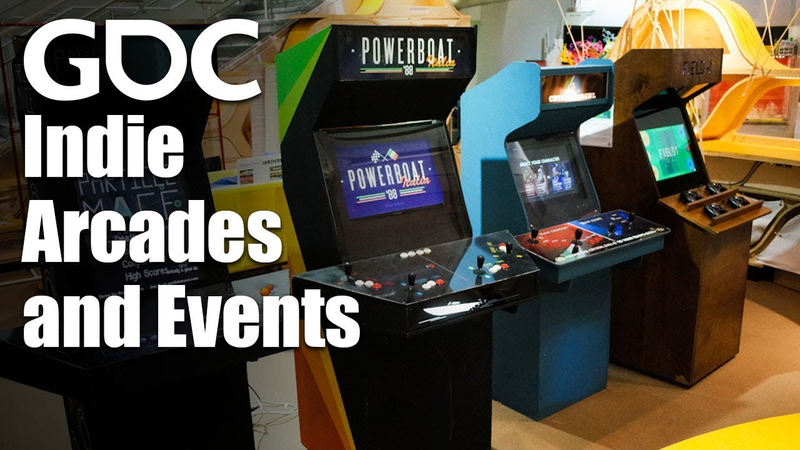
Pop-Up Arcade: Postmortems on Indie Arcades and Events
This session from GDC Europe 2013 explores the rise of pop-up indie game arcades and curated events as a means to foster community and reach audiences beyond the traditional gaming demographic.
- Physical, curated arcade installations transform digital games into performative, social experiences that attract audiences beyond traditional gaming demographics.
- Using unconventional hardware—such as repurposed furniture, baby strollers, or shipping pallets—creates a tangible gateway that invites participation from passersby who might feel alienated by standard gaming conventions.
- The success of pop-up arcades relies on the presence of a 'critical mass' of spectators, which turns local multiplayer gameplay into a shared event comparable to a concert or movie night.
The Journey to Becoming a Game Developer Begins!
The pursuit of solo game development and entrepreneurship serves as the primary focus for this initiative, which aims to document the transition from an aspiring creator to a professional developer.
- Solo game development requires a comprehensive lifecycle approach that integrates technical game design with the operational complexities of running a small business.
- The development process is best approached through iterative, real-time learning rather than relying solely on pre-existing industry expertise.
- Documenting failures and setbacks transparently serves as a practical tool for other developers to identify and bypass common professional pitfalls.
Unconventional Wisdom on Creating a Passionate Community
The primary objective of this presentation is to outline unconventional, effective strategies for cultivating a passionate and creative gaming community.
- Community management should be treated as a series of human-centric relationships rather than a transactional marketing function to drive long-term brand advocacy.
- Establishing a zero-tolerance policy for harassment and publicly defending community members against toxic behavior is essential for maintaining a culture of inclusivity.
- Providing a human face for the brand through initiatives like YouTube Q&As creates a 'Senpai noticed me' effect that significantly increases individual fan engagement.
Slavic Adaptation of Music in The Witcher 3: Wild Hunt
The musical identity of The Witcher 3: Wild Hunt centers on a deliberate synthesis of Slavic folklore and contemporary cinematic orchestration.
- The Witcher 3 soundtrack was designed to blend Slavic folk music with contemporary orchestral sounds, utilizing a vast database of regional folk music from countries including Poland, Ukraine, Hungary, and Germany.
- The composers incorporated authentic historical instruments, such as the Turkish-origin saz and a 12th-century replica of a Gdansk-based string instrument, to establish a unique, cohesive musical identity for the franchise.
- To ensure global accessibility, the team localized a key ballad into seven languages—Polish, English, German, Russian, French, Japanese, and Brazilian Portuguese—while maintaining syllable counts and rhythmic sync with the underlying music loop.
Headlander: Discovering Modern Methods in Sound via 70's Sci-Fi
The aesthetic foundation of Headlander rests on the deliberate recreation of 1970s dystopian science fiction, shifting the focus from conventional hero narratives toward themes of identity and existential doubt.
- The audio production for Headlander prioritized raw, analog textures over digital polish to replicate the atmospheric soundscapes of 1970s dystopian science fiction.
- Creative limitations, such as the prohibition of traditional percussion, forced the team to utilize sequencers, arpeggiators, and noise generators to build rhythm.
- The team employed a 'designing to memory' philosophy, blending vintage hardware sounds with modern layering and high-quality reverb to ensure accessibility for contemporary players.
Turing Tantrums 2017: AI Devs Rant
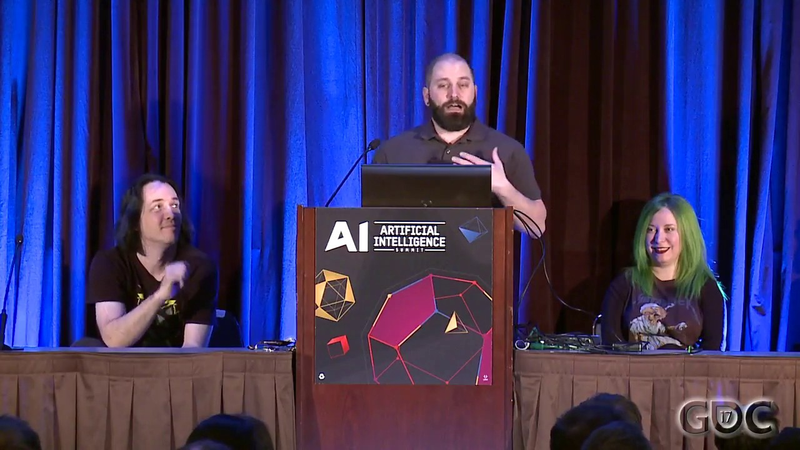
The game development industry currently suffers from a rigid, outdated professional classification system that stifles individual growth and team efficiency.
- The industry must transition from broad professional labels like 'programmer' or 'designer' to a granular, skill-based framework to improve team efficiency and individual growth.
- Artificial intelligence development is currently stagnant due to an over-reliance on legacy architectures like behavior trees and a preference for mundane solutions over innovation.
- Machine learning has failed to provide meaningful improvements to player experiences or secure increased resource allocation despite significant industry hype.

How FIFA Delivers Live Content to Users Fast
Transitioning to a Games-as-a-Service model requires decoupling live content delivery from core server and game updates.
- Decoupling live content delivery from core game updates allows developers to bypass lengthy certification processes and push continuous, high-volume updates to users.
- A centralized, browser-based portal enables a small team of producers to deploy localized content across 11 platforms in under an hour without requiring engineering intervention.
- The system is designed for rapid reaction to real-world sporting events, enabling the delivery of timely, value-driven promotions within minutes of an event occurring.
The Visual Effects of inFAMOUS: Second Son
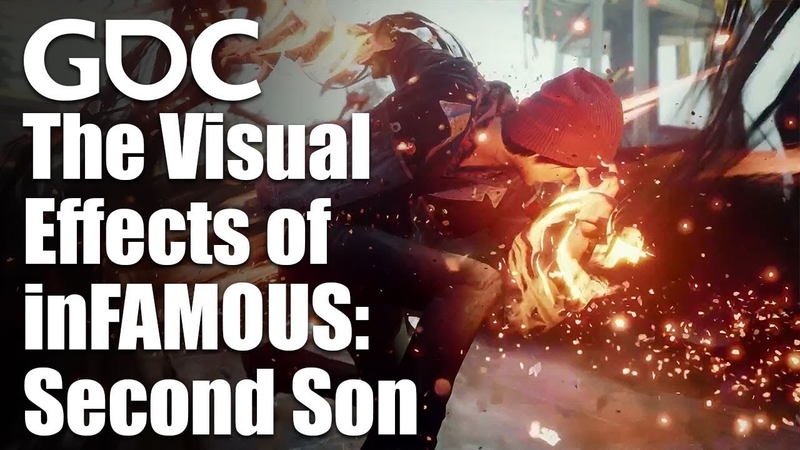
The visual effects strategy for inFAMOUS: Second Son centers on the pursuit of a believable, stylized aesthetic that prioritizes fluid traversal and dynamic power representation over strict photorealism.
- The development team replaced traditional, resource-heavy flipbooks with a custom, GPU-accelerated, expression-based particle system to achieve high-fidelity visual effects.
- Visual cohesion for power-based traversal and combat was maintained through advanced lighting integration, including particle-cast shadows, dynamic light emission, and spherical harmonic probes.
- The team utilized plasma-like waveforms and curl noise, a technique termed 'light writing,' to define the form and timing of character powers.