Game Development reports and market data
Documents
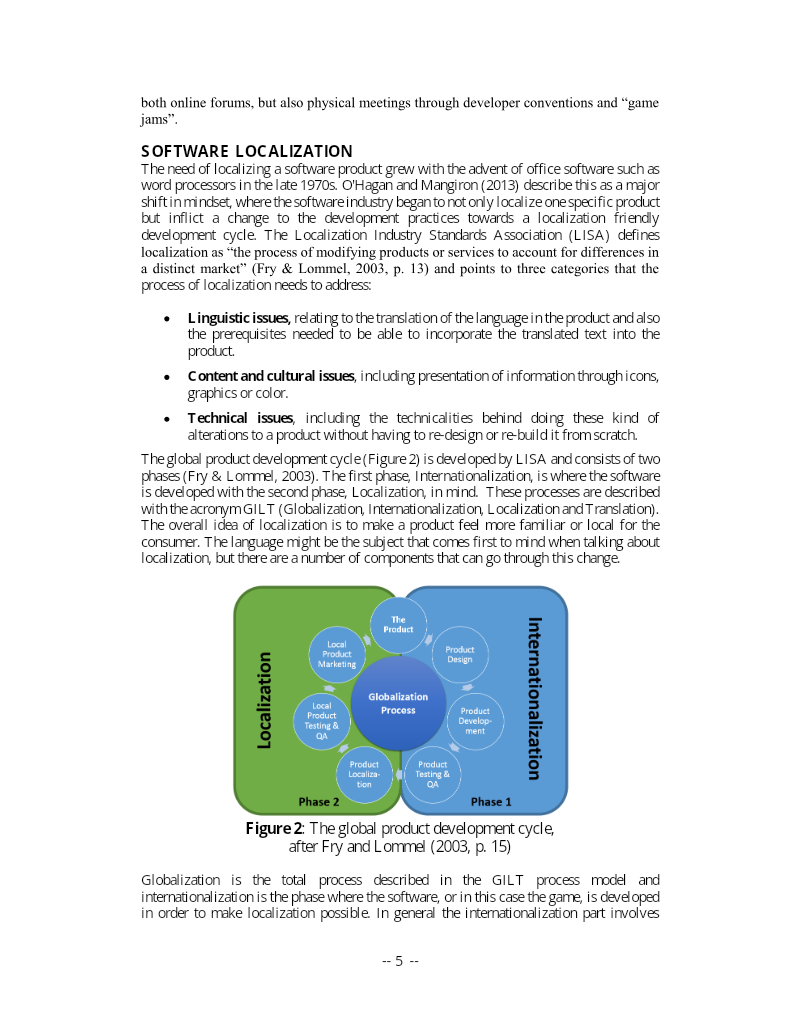


Localization from an Indie Game Production Perspective: Why, When and How?
This analysis explores the strategic approach to localization among independent game developers, examining the motivations, methodologies, and outcomes within resource-constrained environments.
- Steam's Simplified Chinese share rose from 8.97% in December 2016 to 63.9% in December 2017, a rapid market shift that motivated the study of how indie developers handle localization.
- Indie developers pursue localization chiefly to broaden audience reach rather than for immediate financial return, and resource constraints largely determine which localization decisions they make.
- Swedish developers often recognized localization's value only after early-access feedback revealed a global player base, and several said deferring it, due to assumptions about English proficiency or limited resources, led to later rework.


Good Game Feel: An Empirically Grounded Framework for Juicy Design
The document establishes an empirically grounded framework for "juicy design" and "good game feel" in video games, aiming to provide a more precise and actionable definition for these often vaguely understood concepts.
- The paper addresses the vague definition of "juicy design" by grounding it in a survey of 17 professional game developers, whose responses were organized via an affinity diagram into categories such as game characteristics, dimensions of experience, direct feedback, redundancy, and slickness.
- Developers stressed that juice must be integrated holistically with all game elements and matched to genre, since feedback alone is insufficient; effective feedback is exaggerated, multimodal, relevant, and non-overwhelming.
- The final analytical framework has three parts (Game Characteristics, Game State, and Direct Feedback) and 11 actionable questions, refined through two rounds of case analysis of Candy Crush Saga and Downwell.



Guide RGPD pour les Développeurs de Jeux Vidéo
Ce guide pratique vise à aider les créateurs, développeurs et éditeurs de jeux vidéo établis en France à se conformer au Règlement général sur la protection des données (RGPD), applicable depuis le 25 mai 2018 et articulé avec la loi Informatique et Libertés modifiée en 2019.
- The GDPR significantly increases potential penalties for non-compliance, with fines up to 20 Million Euros or 4% of annual global turnover, a substantial increase from the previous 3 Million Euros maximum under the 1978 French law.
- Data Protection Officers (DPOs) are not held responsible for GDPR non-compliance; the data controller or processor bears this responsibility. DPOs cannot be penalized for performing their duties due to their independence, though they can be dismissed for reasons unrelated to their DPO role.
- Consent under GDPR must be a free, specific, informed, and unambiguous indication of the data subject's wishes, given by a statement or clear affirmative action, and the data controller must be able to prove valid consent.

Three Statistical Tests Every Game Developer Should Know
Statistical analysis provides a rigorous framework for game developers to make data-driven design decisions, moving beyond subjective opinions to validate changes in game performance and player behavior.
- Statistical significance must be distinguished from practical significance by evaluating confidence intervals to ensure the magnitude of an improvement justifies the development cost.
- The Student’s t-test is the standard tool for comparing continuous, normally distributed data, using independent tests for distinct groups and paired tests to control for individual variance.
- The Mann-Whitney test is the preferred nonparametric alternative for skewed data or ordinal scales like player ratings, as it analyzes medians to prevent outliers from distorting results.
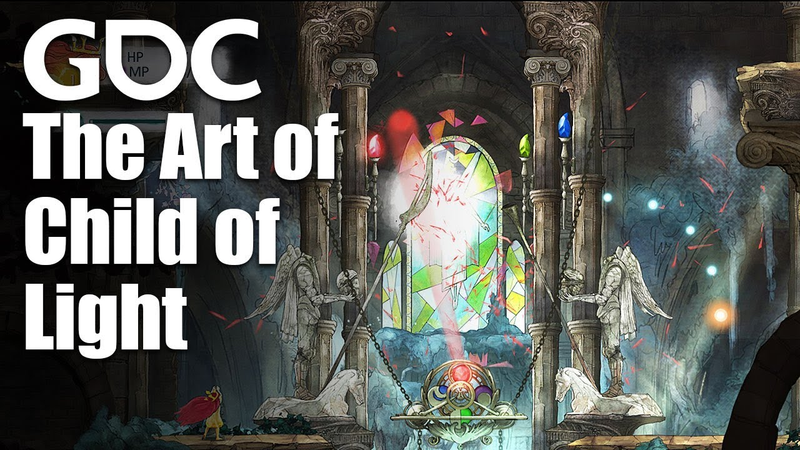
The Art of Child of Light
Child of Light serves as a creative exploration of how traditional fine art influences modern interactive media, specifically aiming to bridge the gap between fairy tale symbolism and Japanese role-playing game mechanics.
- The UbiArt Framework enabled the direct integration of hand-painted watercolor textures into the game engine, allowing the project to function as a playable painting.
- The development team utilized 3D character models projected as 2D films to maintain fluid animation while preserving the integrity of original hand-painted concept art.
- The visual direction was heavily influenced by the Golden Age of illustration, specifically drawing from the works of Arthur Rackham, John Bauer, and Yoshitaka Amano.

Math for Game Programmers: Understanding Homogeneous Coordinates
This analysis explores the mathematical foundations of homogeneous coordinates in game development, specifically focusing on how they facilitate 3D perspective and coordinate transformations.
- Homogeneous coordinates use a four-dimensional vector system to unify translation and rotation into a single matrix-based framework for efficient spatial manipulation.
- The W component distinguishes between positions and directions: a W value of 1 represents a position subject to translation, while a W value of 0 represents a direction invariant to translation.
- Perspective projection is achieved by storing depth information in the W component, which is then used in a hardware-accelerated 'W-divide' process to scale X, Y, and Z coordinates.
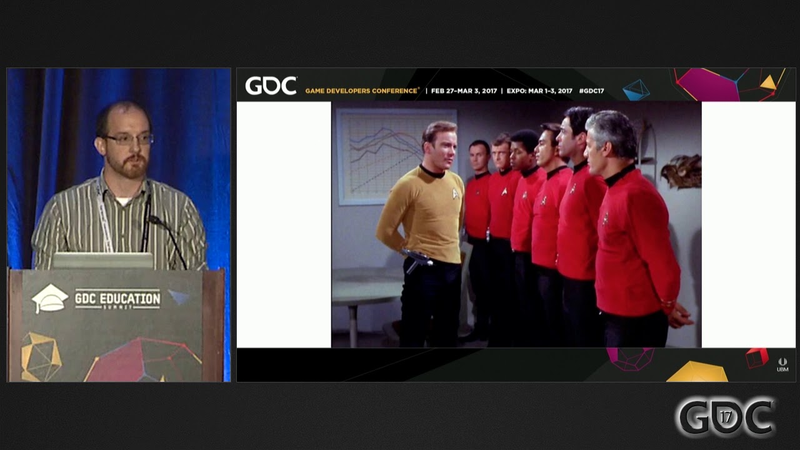
The 2017 Education Soapbox
Game education requires a fundamental shift from purely technical training toward a holistic model that prioritizes critical consciousness, artistic expression, and social responsibility.
- Game education must shift from purely technical training to a holistic model that integrates fine arts principles and critical theory to foster artistic expression and social responsibility.
- Curricula should be redesigned to move beyond replicating industry standards, encouraging students to challenge dominant cultural ideologies and the social contexts of their work.
- Professional success in the gaming industry increasingly relies on non-cognitive skills, specifically public presentation and storytelling abilities.
Open Production With Sunless Sea: Kickstarter, Early Access and After
Open production serves as a transformative strategy for independent game developers, enabling studios to transition from financial instability to long-term sustainability.
- Open production models like Kickstarter and Early Access provide financial stability and a diagnostic feedback loop that allows developers to refine design and marketing before full release.
- Developers must maintain final authority over creative vision, as relying too heavily on veteran player feedback can skew development toward niche preferences and alienate broader audiences.
- Sustainable financial planning requires that crowdfunding stretch goals remain low-cost and high-engagement to ensure early capital builds a foundation for future projects rather than serving as a temporary fix.
Capturing Reality: Gathering Reference for Forza Motorsport 5
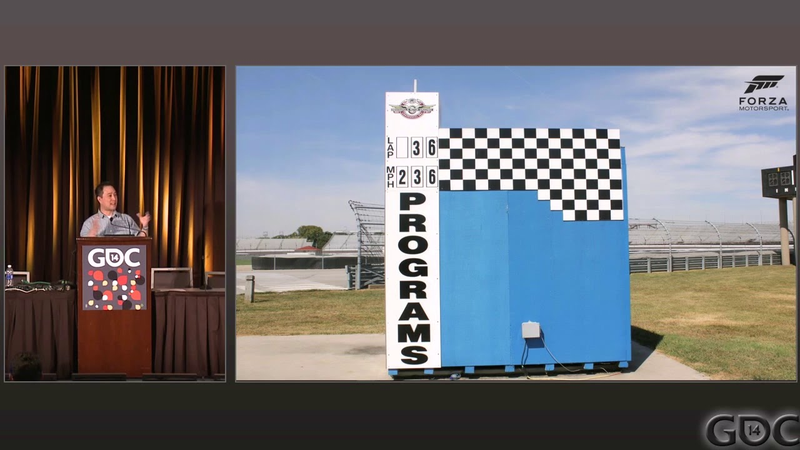
The development of Forza Motorsport 5 necessitated a fundamental shift in asset production, moving away from labor-intensive, disorganized manual data collection toward a highly technical, standardized pipeline.
- Integrating laser scanning and point cloud data directly into 3ds Max via Autodesk’s custom plugin allowed artists to vertex-snap models to real-world dimensions, significantly reducing design iterations and post-production quality bugs.
- Transitioning from disorganized photo folders to spherical panorama cameras (such as the Ladybug) and GPS-tracked site surveys eliminated the 'puzzle-solving' phase where artists previously struggled to contextualize reference images.
- Standardizing color and white balance during reference gathering using calibration charts and Adobe Bridge ensures that source material is compatible with physically-based rendering systems, maintaining consistency across assets.
Math for Game Programmers: Juicing Your Cameras With Math
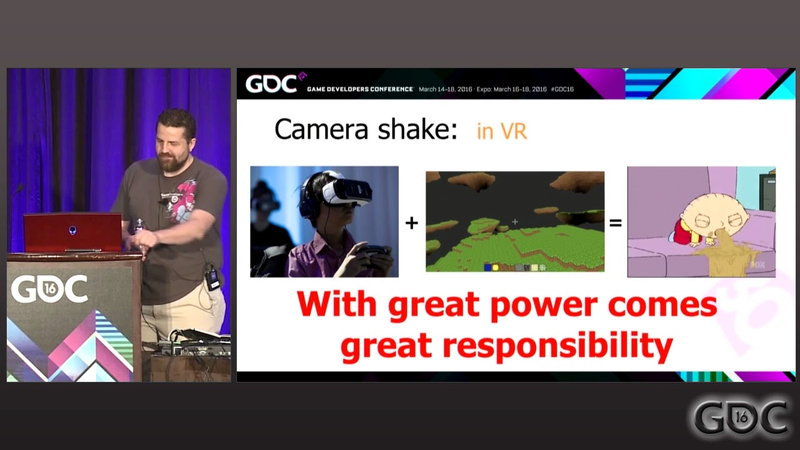
Effective camera systems rely on sophisticated mathematical frameworks to enhance player immersion and provide intuitive feedback.
- Implement a trauma-based shake system by using a persistent decay value mapped non-linearly—specifically by squaring or cubing the input—to differentiate between minor and major impact intensities.
- Utilize coherent noise, such as Perlin noise, for camera shake to ensure frame-rate independence and fluid motion, particularly during slow-motion sequences.
- Apply asymptotic averaging to camera movement to create a smooth, 'lazy' follow effect that avoids the rigidity of direct tracking.
Pursuing Interactive Suspension of Disbelief
The pursuit of interactive suspension of disbelief serves as the primary objective in narrative-driven game design, where the goal is to foster an emotional connection between the player and the game world.
- Interactive suspension of disbelief is the primary goal of narrative-driven design, aiming to transform players from passive observers into active participants in a human story.
- Developers must integrate writing directly into systems and level design to ensure that narrative content remains context-aware and responsive to player agency.
- Immersion is frequently broken by mechanical disruptions such as inconsistent QuickTime events, arbitrary mission structures, and unresponsive dialogue systems.

Running the Halo Multiplayer Experience at 60fps: A Technical Art Perspective
Achieving a consistent 60 frames per second for the Halo 2 Anniversary multiplayer experience on Xbox One required a fundamental shift in production philosophy, prioritizing performance as a core design constraint rather than a final optimization step.
- Performance was treated as a foundational design constraint rather than a final optimization step, ensuring a consistent 60fps for Halo 2 Anniversary on Xbox One.
- The development team enforced a strict 16.6ms frame budget, allocating 13.5ms to environments and 2.5ms to sandbox elements.
- Technical artists were embedded directly into map teams to provide real-time oversight, preventing the need to strip visual fidelity during the final production stages.