Game Development reports and market data
Documents
Applying Level Design to Dialogue in Subsurface Circular
Narrative design in Subsurface Circular functions by applying traditional level design principles to dialogue systems, effectively transforming static text trees into exploratory environments.
- Subsurface Circular treats dialogue topics as inventory items, using them as keys to unlock narrative progression in a manner analogous to spatial traversal in level design.
- The development team utilized a node-based, dungeon-like dialogue structure rather than complex branching paths to facilitate a rapid, iterative production pipeline.
- The game integrates quest-giving, objective tracking, and world-building directly into the dialogue system to bridge the gap between interactive fiction and traditional gameplay.
Eos is Alive: The AI Systems of Final Fantasy XV
Final Fantasy XV utilizes a sophisticated, multi-layered artificial intelligence architecture designed to create a cohesive, autonomous, and reactive open-world experience.
- Final Fantasy XV utilizes a three-tiered AI architecture consisting of a Meta AI (director), Character AI (individual intelligence), and Navigation AI (spatial positioning) to manage game progress and NPC behavior.
- The Character AI system employs a hierarchical 'AI Graph' that nests state machines within behavior trees, allowing game designers to create complex, scalable decision-making structures without deep programming knowledge.
- To maximize efficiency and reuse, the system uses an 'overriding' function that allows designers to customize specific common logic states for individual monsters or characters without rebuilding entire AI graphs.
GDC Plays GDCA Nominee Baba Is You with Arvi Teikari
Baba Is You represents a significant achievement in puzzle game design, centered on a rule-manipulation mechanic that allows players to redefine the logic of the game world at runtime.
- Baba Is You utilizes a rule-manipulation mechanic that allows players to redefine game logic at runtime, creating deep, emergent gameplay from a 2017 Nordic Game Jam prototype.
- The game balances high-level complexity with accessibility by implementing a progression structure that permits players to bypass difficult levels, preventing frustration.
- The technical architecture combines the Multimedia Fusion 2 engine with Lua scripting, demonstrating how creators can leverage accessible, no-code tools to bypass traditional programming barriers.
3D NPCs Please - Adding Depth to Character - Extra Credits
The primary objective of character design in video games is to move beyond one-dimensional archetypes by imbuing non-player characters (NPCs) with depth and agency.
- To create memorable NPCs, developers should apply Lajos Egri’s 1946 dramatic writing framework, which defines character depth through physiological, sociological, and psychological dimensions.
- Villains must be grounded in personal flaws or misguided moral convictions rather than simple malice to avoid becoming generic gameplay obstacles.
- Mentors and sidekicks require agendas and lives independent of the player to ensure they function as fully realized individuals rather than mere plot devices.
Integrating Narrative into Game Design: A Portal Post-Mortem
The development of Portal serves as a case study in how resource constraints and iterative design can foster innovative narrative integration.
- Integrating narrative directly into gameplay mechanics, such as using a disembodied AI voice to avoid character animation burdens, minimizes the gap between exposition and player action.
- Rapid prototyping and aggressive playtesting are essential for identifying and removing content that disrupts pacing or fails to resonate with the player experience.
- Emotional anchors, such as the Weighted Companion Cube, can effectively guide player behavior and increase narrative stakes without requiring complex mechanical systems.

Embracer Group Acquires Saber Interactive: Investor Presentation
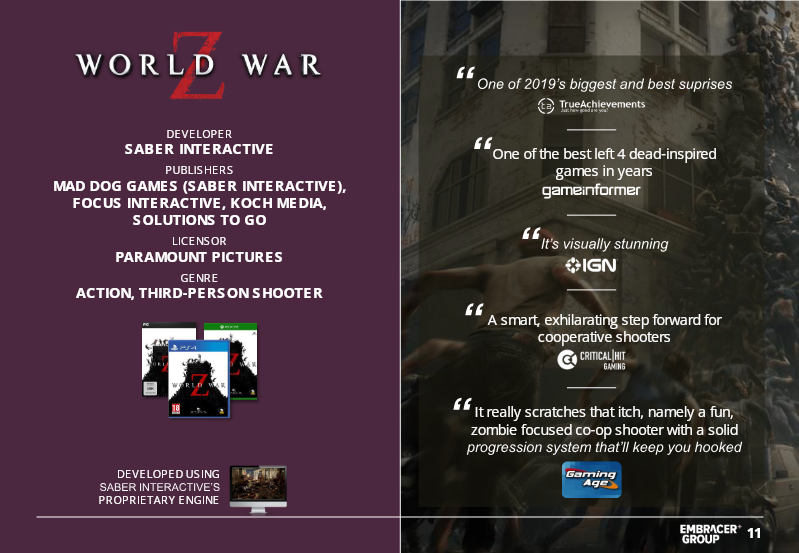
Embracer Group's investor presentation details its acquisition of Saber Interactive, a US-based game developer founded in 2001.
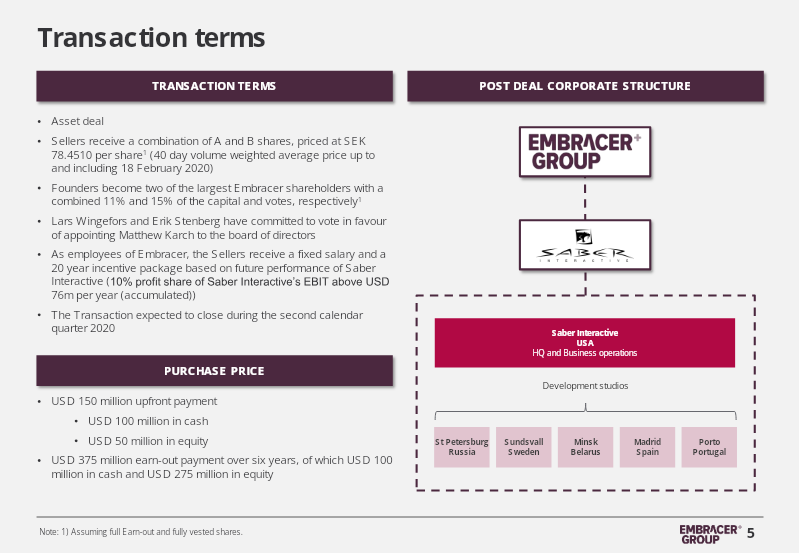
- Embracer Group acquired Saber Interactive for a total purchase price of $525 million, consisting of $150 million upfront and a $375 million earn-out structure over six years.
- Saber Interactive reported strong 2019 financial performance with $105 million in revenue and $62 million in EBIT.
- The acquisition adds 600 developers, 163 intellectual properties, and 31 internal studios to the Embracer Group portfolio.
Frag You, Pay Me: Getting Started with Salary Negotiation
Salary negotiation serves as a fundamental career competency, yet professionals in the game industry frequently undervalue their labor due to the pervasive "dream job" narrative.
- The 'dream job' narrative in the game industry often leads professionals to undervalue their labor, resulting in systemic pay inequality and significant lifetime earnings losses.
- Candidates should reframe salary negotiation as a proactive career-shaping tool rather than a hostile confrontation to overcome self-limiting beliefs like imposter syndrome.
- Hiring managers are highly motivated to fill vacancies to mitigate operational risk, which provides candidates with essential leverage to advocate for fair compensation.

The $0 Budget Marketing Guide with Victoria Tran | 215
Effective game marketing transcends simple awareness, requiring a comprehensive strategy that spans the entire player journey from initial consideration to post-purchase engagement.
- Successful marketing requires a comprehensive strategy covering the entire player journey, moving beyond simple awareness to focus on a unique hook that appeals to audiences outside the core gaming demographic.
- Developers should adopt the 80/20 rule for community engagement, ensuring they provide value to their audience through four parts of content for every one part of promotional asks.
- To mitigate the risks of subscription-based models that favor procedural gameplay over narrative, developers must prioritize building direct loyalty through owned channels like Discord and newsletters.
3 Huge Changes Coming to Unity (With Head of Tech Arvind Neelakantan)
Unity is undergoing a significant technological evolution centered on three core pillars: the Data-Oriented Technology Stack (DOTS), the Scriptable Rendering Pipeline (SRP), and a new multiplayer netcode solution.
- Unity is transitioning from object-oriented programming to the Data-Oriented Technology Stack (DOTS) to enable multi-threaded code execution that optimizes performance and battery efficiency on modern multi-core hardware.
- The new netcode architecture shifts from peer-to-peer to a dedicated server topology, allowing for the synchronization of hundreds of players and objects while improving latency and anti-cheat capabilities.
- The Scriptable Rendering Pipeline (SRP) now features a production-ready High Definition Render Pipeline (HDRP) for high-end ray tracing, alongside the Universal Render Pipeline (URP) for cross-platform visual parity.
Line Wobbler & Beasts of Balance: Two Routes to Custom Hardware Goodness
The creation of custom hardware games represents a burgeoning intersection of digital design and physical engineering, offering developers a unique path to differentiate their work in a crowded market.
- Custom hardware games differentiate products in crowded markets by bridging digital design with physical engineering through microcontrollers and 3D printing.
- Transitioning from prototypes to commercial products requires shifting from improvised testing to professional-grade manufacturing standards to ensure durability and scalability.
- Commercial success depends on navigating complex supply chains, where minor manufacturing details like material coatings can significantly alter profit margins.
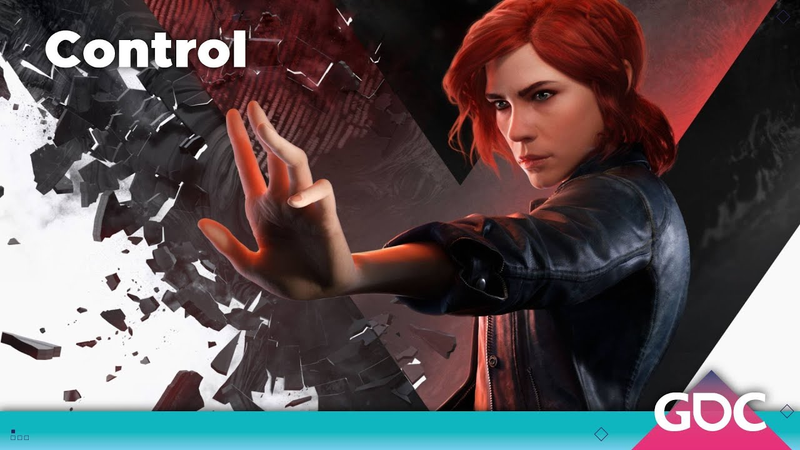
GDC Plays GDCA Nominee Control with Mikael Kasurinen and Brooke Maggs
The development of the action-adventure title Control represents a deliberate shift toward the New Weird genre, prioritizing environmental mystery and world-building over traditional, linear exposition.
- The development of Control utilized a sandbox model where leadership established strict thematic pillars and lore rules, enabling cross-departmental teams to contribute ideas while maintaining narrative consistency.
- Narrative designers functioned as essential bridges between art, level design, and writing to ensure environmental storytelling and collectibles remained coherent regardless of player exploration order.
- The design team prioritized the 'New Weird' genre by centering the game on the Oldest House, a Brutalist, shifting architectural space that fosters discovery through environmental mystery.
$0 to $1 Million: The Raw Numbers Behind Indie Success
Independent game development success relies on balancing creative vision with rigorous financial discipline, as there is no singular blueprint for studio longevity.
- Indie studios can adopt two distinct financial models: Kitfox Games utilizes a diversified portfolio approach with multiple concurrent projects to mitigate risk, while Clever Endeavour Games focuses on a single, long-term project (Ultimate Chicken Horse) to maximize depth and community engagement.
- Revenue streams for independent studios are heavily concentrated on PC platforms, with Kitfox Games reporting that approximately 91% of their total revenue is derived from Steam sales.
- Financial sustainability requires aggressive diversification of funding sources beyond initial game sales, including government grants, incubators like Execution Labs, Kickstarter campaigns, and work-for-hire contracts to cover lean periods.
Writers
Games and companies
Games