Game Development reports and market data
Documents
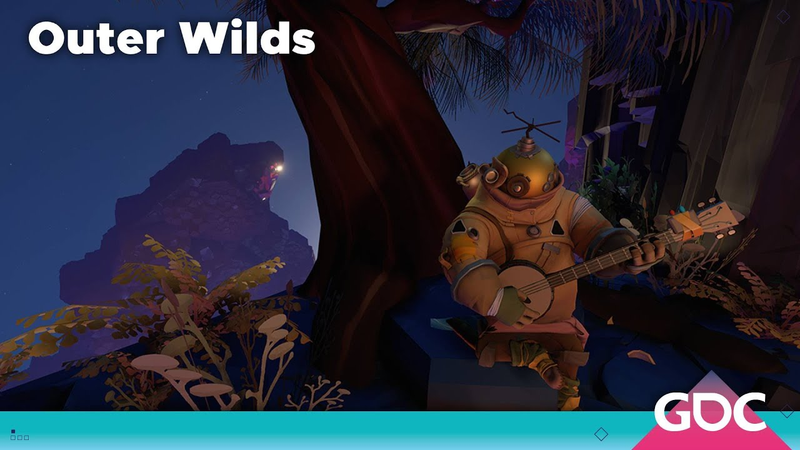
GDC Plays GDCA Nominee Outer Wilds with Loan Verneau and Wesley Martin
Outer Wilds centers on a design philosophy that prioritizes curiosity-driven exploration over conventional gaming tropes such as combat, character progression, or traditional collectibles.
- The developers intentionally removed traditional game rewards like upgrades and collectibles, ensuring that knowledge is the only currency players gain through exploration.
- The game's core design relies on a full-scale physics simulation where all celestial bodies and objects are constantly in motion, requiring the team to build custom internal tools to overcome limitations in standard 3D modeling software.
- The project originated as a student project in 2013 and gained early recognition by winning an award at the 2015 Independent Games Festival before being fully developed by Mobius Digital.
Writing and Narrative Design: A Relationship
The relationship between writing and narrative design is a critical, collaborative partnership that defines the quality of interactive storytelling.
- Writing and narrative design must function as equal, collaborative partners to balance character-driven storytelling with player-driven mechanics.
- Writers at Telltale Games focus on character development, dialogue, and thematic tone, while narrative designers manage player agency, choice-driven mechanics, and gameplay pacing.
- The 'stubbing' methodology, where designers map out structural nodes and choices before writing begins, prevents the 'blank page' problem and ensures mechanics are integrated into the narrative.

Roblox on Kids Safety (Laura Higgens Head of Digital Civility)
The primary objective of digital safety in gaming is to foster a secure, inclusive environment for younger users while balancing corporate growth with ethical responsibility.
- Safety must be integrated into the initial design phase of game development rather than retrofitted to ensure long-term platform success and parental trust.
- While 89% of parents fear online gaming risks, 88% acknowledge the platform's value in providing technical skills and career preparation for minors.
- Platforms mitigate risks through a multi-layered approach involving strict text filtering, human moderation, and parental control tools for curated experiences.

Crunch Culture, Google Stadia, Over Saturation of Games, and Virtual Reality | Roundtable News
The game industry currently faces a complex intersection of labor challenges, shifting distribution models, and evolving hardware paradigms.
- Crunch culture remains a systemic industry issue driven by poor management and scope creep, despite reports of marginal reductions in excessive work hours.
- Cloud gaming services that leverage existing user libraries, such as Nvidia GeForce Now, are better positioned for success than platforms like Google Stadia, which struggle due to restrictive pricing and a lack of exclusive content.
- Market saturation on digital storefronts like Steam requires independent studios to prioritize distinct brand identities and high-quality experiences over direct competition with AAA titles to remain viable.

Squeezing into the Industry: How a Couple African Kids Made a Video Game
The independent game development landscape presents formidable barriers to entry, particularly for creators operating outside traditional global hubs like North America or Europe.
- Emerging studios in isolated regions must prioritize long-term institutional survival and reputation building over the pursuit of immediate blockbuster success.
- Strategic survival requires aggressive scope management and maintaining a constant, demo-ready state to facilitate engagement with Western markets.
- Financial sustainability for first-time developers often necessitates a reliance on government grants and significant personal sacrifice to offset high development costs.

Indexing and Iterating Design Space Permutations
The design of complex game systems often involves managing vast state spaces that can be modeled as combinations or permutations.
- Perfect hash functions enable mapping complex game states directly to memory indices, eliminating the overhead associated with traditional hash table chaining.
- Mathematical ranking and unranking functions allow for the conversion of board configurations into unique integer indices by calculating the number of skipped states.
- Permutations can be mapped to numerical values using mixed radix representation, with efficient linear-time algorithms available to replace slower quadratic-time ranking methods.
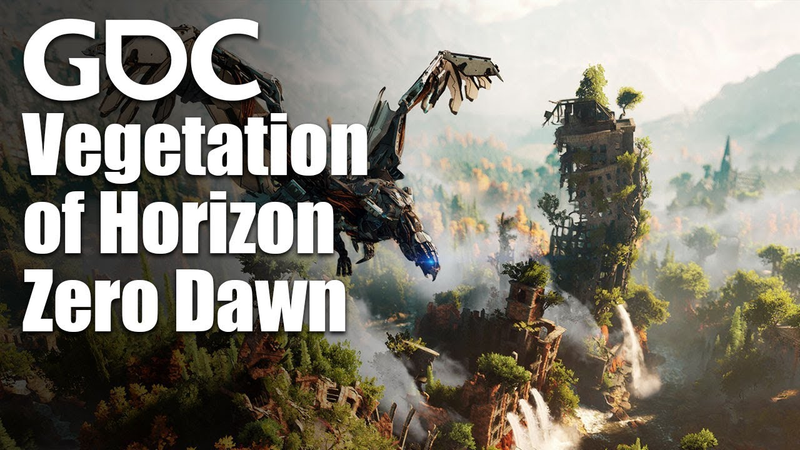
Between Tech and Art: The Vegetation of Horizon Zero Dawn
The development of Horizon Zero Dawn represents a sophisticated intersection of artistic intent and technical optimization, specifically regarding the creation of expansive, high-fidelity vegetation.
- The development team prioritized performance by inverting the asset pipeline, establishing the lowest level of detail first to ensure the game maintained a consistent 30 frames per second.
- Foliage movement was achieved through a global wind force field system that utilizes 3D textures and vertex-based animation.
- To manage rendering loads, the team implemented a two-pass system using depth-only passes for alpha testing and custom offline mip-chain generation for visual consistency.
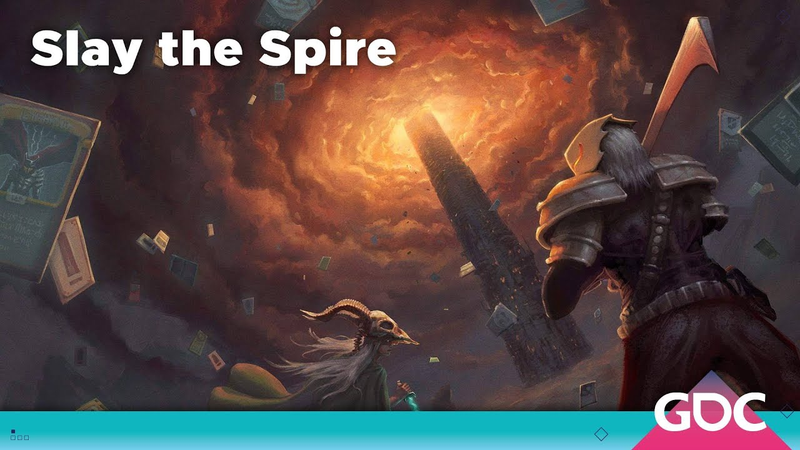
GDC Plays IGF Nominee Slay the Spire with Casey Yano
The success of Slay the Spire stems from a community-driven development philosophy that prioritizes player experience over rigid mathematical balance.
- Slay the Spire utilized Steam Early Access to gauge market interest, releasing with two of three planned characters to determine if the project warranted completion or should be scaled back.
- The developers leveraged gameplay data uploaded by the community to inform balance changes and identify which card mechanics were underperforming or confusing for players.
- The game's map system was inspired by FTL: Faster Than Light, shifting from a blind sequence of encounters to a visible, branching path that allows for strategic, long-term risk-reward decision-making.
Assassin's Creed Origins: Monitoring and Validation of World Design Data
The development of Assassin’s Creed Origins necessitated a sophisticated approach to quality assurance to manage the complexities of a 120-square-kilometer open world.
- To manage the 120-square-kilometer open world of Assassin’s Creed Origins, the team replaced manual quality assurance with an automated validation framework to address navigation mesh failures and AI pathing errors.
- The development team implemented a daily automated testing suite using C#-based scripts to query over 200,000 individual game objects for objective pass/fail evaluations.
- The integration of a visual interface called Atlas allowed developers to pinpoint specific coordinates of data conflicts, enabling the resolution of issues before they cascaded into systemic failures.
Why Forums Can Be Great for Indie Community and Discoverability
Building a sustainable community is a critical factor for the financial success and discoverability of indie games, with 96% of surveyed developers acknowledging its importance.
- 96% of surveyed indie developers identify building a sustainable community as a critical factor for both financial success and game discoverability.
- While Discord is the most popular hub for real-time chat, many studios struggle with the fragmentation caused by managing multiple channels across various social media and storefront platforms.
- Centralized, proprietary forums—using software like Invision—allow studios to consolidate community efforts, cross-promote multiple titles, and maintain long-term ownership of user data.

IP Licensing for Games with Jay Powell | GduX.me
Intellectual property licensing serves as a vital strategic tool for game developers seeking to overcome market saturation and enhance discoverability.
- Treat IP licensing as a strategic business partnership rather than a creative asset to ensure the licensor’s goals align with the studio’s development capabilities.
- Negotiate specific grant-of-license clauses to avoid overpaying for unnecessary rights, such as global territories or specific celebrity likenesses.
- Factor in a standard three-month lead time for approval processes, as licensed content requires more stringent oversight than traditional publishing.

Losing motivation for Game Dev...
Maintaining motivation in game development requires a dual-phase approach that shifts from internal creative obsession to external professional responsibility.
- Sustainable game development requires transitioning from internal creative obsession to a framework of professional responsibility once the initial novelty of a project fades.
- The development lifecycle should be viewed as a dual-phase process, shifting from an exploratory phase of defining core mechanics and aesthetics to a labor-intensive production phase.
- Relying on external incentives—such as financial stability, industry acclaim, and positive reviews—is a practical strategy for maintaining momentum during the tedious stages of production.
Writers
Games and companies
Games