China reports and market data
Documents


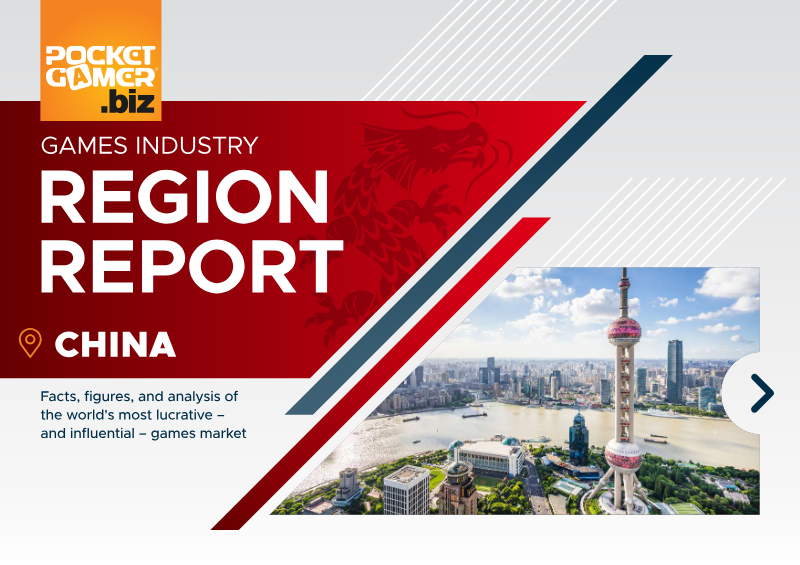
Games Industry Region Report China
The China Region Report provides a comprehensive analysis of the Chinese games market as of July 2025, positioning it as the most lucrative and influential territory in the global industry.
- The Chinese games market generated $48.7 billion in 2024, accounting for approximately 30% of total global industry revenue.
- Chinese entities now dominate the global landscape, owning or developing 14 of the top 30 highest-grossing games worldwide as of early 2025.
- The market supports a massive player base of over 701 million, with a significant shift occurring as domestic firms expand from mobile dominance into premium triple-A PC and console development.

🚨Lands Of Jail: Prison SIM meets 4X strategy. It's Frozen City + Whiteout + Toy Factory & scaling
Lands of Jail represents a significant evolution in mobile game design, successfully merging idle simulation mechanics with the high-stakes environment of 4X strategy.
- Lands of Jail generates approximately $200,000 in daily revenue by successfully merging idle simulation mechanics with 4X strategy gameplay.
- The game utilizes a hybrid-casual framework, transitioning players from casual resource management—such as operating a prison toy factory—into complex, map-based warfare.
- The development team at EWorld employs a user acquisition strategy that leverages AI-generated content and viral-style tropes to maintain low cost-per-install metrics.

Cross-Border Publishing: Lessons From Netease’s Once Human
The global expansion of Chinese game development is exemplified by the strategic launch of the survival title Once Human.
- NetEase achieved a peak of over 200,000 concurrent users for 'Once Human' by prioritizing a PC-first launch before expanding into a cross-platform mobile version.
- The studio opted for global self-publishing to maintain direct control over player relationships, brand messaging, and the ability to iterate rapidly based on community feedback.
- Monetization for the Western market was intentionally restrained, focusing on cosmetic items and engagement-driven systems rather than the more aggressive models often seen in mobile-first markets.

TWIG #328 The Hidden Cost of Celebrity Ads and the How Hollywood Doesn’t Get Games
The gaming industry currently faces a structural misalignment between venture capital expectations and the realities of game development.
- Large-scale venture capital funds in gaming face a structural misalignment where the pressure to deploy massive capital pools conflicts with the industry's limited exit opportunities.
- Many gaming startups are trapped in a state of perpetual existence, unable to achieve meaningful growth or acquisition but unwilling to shut down, often sustained by long-term hype.
- Mobile publishers are increasingly relying on high-budget celebrity advertising to counter performance marketing saturation, but these campaigns frequently result in low-retention installs and declining daily active users.

Gaming Under Fire: U.S, China, Tariffs & More
The global gaming industry is currently navigating a period of significant volatility driven by macroeconomic instability, shifting international trade policies, and a challenging investment climate.
- The gaming industry is shifting from high-budget, multi-year production models to a 'survival mode' characterized by cost-efficiency, lean operations, and smaller, iterative development cycles.
- Western studios are losing their competitive advantage as global access to cloud software and high-end hardware allows Eastern studios to leverage lower labor costs and higher development efficiency.
- Investment in the sector has transitioned from a growth-oriented model to one of extreme risk aversion, making funding for new mobile and PC projects increasingly difficult to secure.

Session: Bring Your Games to China With Unity – A Pathway for Games to Thrive in China - Junbo Zhang
The Chinese gaming market presents a unique, high-growth opportunity for international developers, despite significant regulatory and technical barriers.
- Unity China provides a localized, optimized version of the Unity engine (based on 2022 LTS) specifically designed to reduce runtime and loading times for the Chinese market, where Unity games now account for approximately 50% of WeChat Instant Game revenue.
- Unity China offers a comprehensive publishing service that handles regulatory compliance, ISBN filing, and technical integration across fragmented Android channels (e.g., Xiaomi, Oppo, Huawei) and emerging platforms like WeChat and Douyin.
- The Chinese gaming market is dominated by mobile gaming, which accounts for roughly 75% of the total market, with significant growth opportunities in the Instant Game sector and high-performance hardware like smart electric vehicles.

TWIG #315 TikTok Ban and Matthew Ball's State of the Market Report
The global gaming industry is transitioning into a mature phase characterized by slow, single-digit growth and heightened operational risks.
- The global gaming industry has entered a mature phase of slow, single-digit growth, shifting the focus from rapid expansion to incremental optimization and production efficiency.
- Chinese developers are currently the primary drivers of industry growth, accounting for 42% of global spending increases and successfully capturing market share in the West.
- Legislative uncertainty regarding a potential U.S. TikTok ban is forcing developers to diversify marketing spend away from platform-dependent strategies toward more stable ecosystems like Meta.

Tencent is a Military Company? | Roundtable News | 359
The global gaming industry is currently navigating a period of profound structural contraction, defined by widespread layoffs, studio closures, and a notable lack of innovation within the traditional AAA production model.
- The global gaming industry has undergone a significant contraction over the past two years, resulting in approximately 20,000 job losses due to the unsustainable costs of the traditional AAA production model.
- Major publishers are increasingly relying on risk-averse strategies, such as remaking established intellectual properties and integrating AI, to offset financial pressures and operational inefficiencies.
- Creative innovation is shifting away from large-scale corporate projects toward the indie sector, which utilizes more efficient development cycles to foster growth.
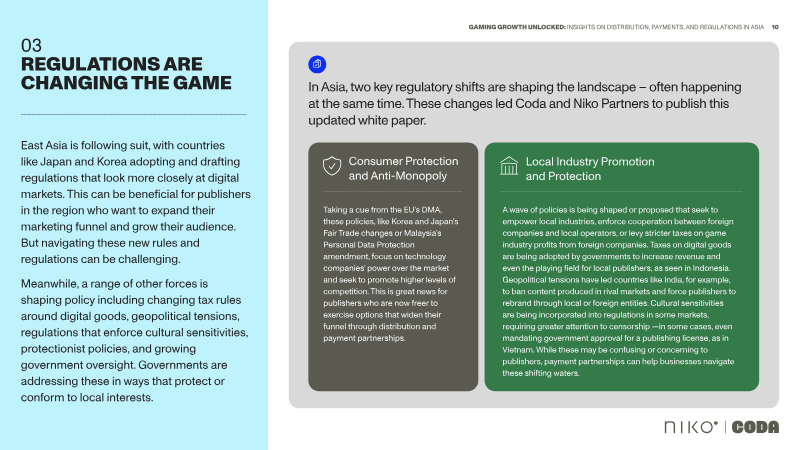
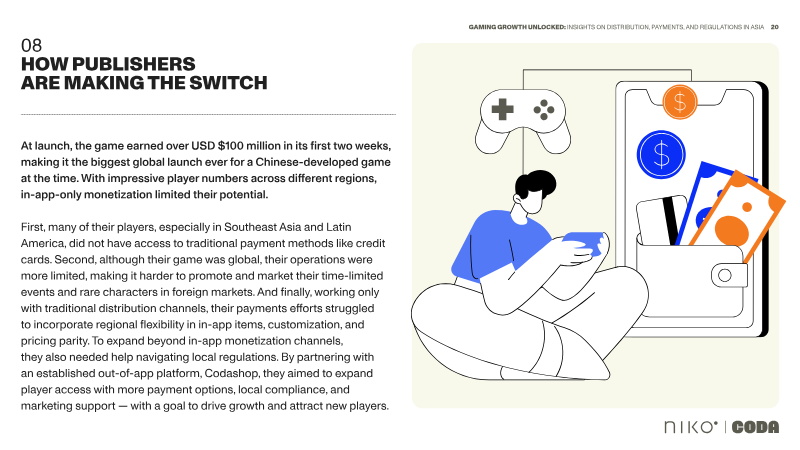
Gaming Growth Unlocked: Insights on Distribution, Payments, and Regulations in Asia
The mobile gaming landscape in Asia is undergoing a fundamental transformation as publishers increasingly pivot toward out-of-app distribution and alternative payment solutions.
- Alternative distribution channels generated $6 billion in Asian mobile gaming revenue in 2024, representing one-third of the region's total market.
- Publishers are shifting to web-based stores and alternative payment solutions to bypass high app store fees and address low credit card penetration.
- Direct-to-consumer strategies are being adopted to improve conversion rates and reach demographic segments underserved by traditional app store ecosystems.
Guide to Growing Chinese Gaming Apps Overseas
Chinese gaming developers are aggressively expanding their global footprint by leveraging sophisticated monetization models and high-volume, AI-driven marketing strategies.
- Video advertising is the most effective monetization channel for Chinese developers in mature markets, currently yielding a 21% Day 7 return on ad spend.
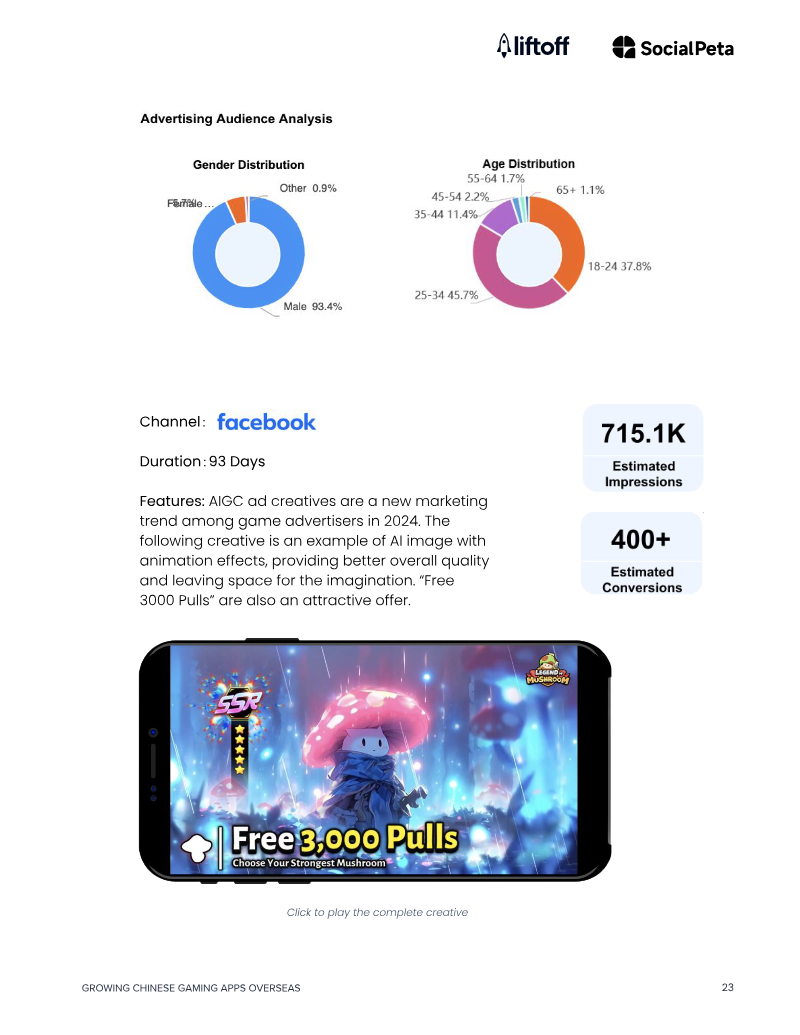
- Generative AI is being deployed at scale to automate the production of localized ad creatives, voice-overs, and performance-tested copy to reduce costs and speed up regional market entry.
- Long-term player retention is increasingly driven by integrating social hangout spaces, customizable home systems, and minigames into core gameplay loops.


China Game Industry Report 2025
The China Game Industry Report for 2025 presents a comprehensive assessment of the domestic and overseas gaming markets, highlighting sustained growth driven by youth protection initiatives, technological innovation, and cross-sector integration.
- Chinese self-developed mobile games generated US$20.455 billion in overseas revenue in 2025, marking a 10.23% year-on-year increase and the sixth consecutive year exceeding RMB 100 billion.
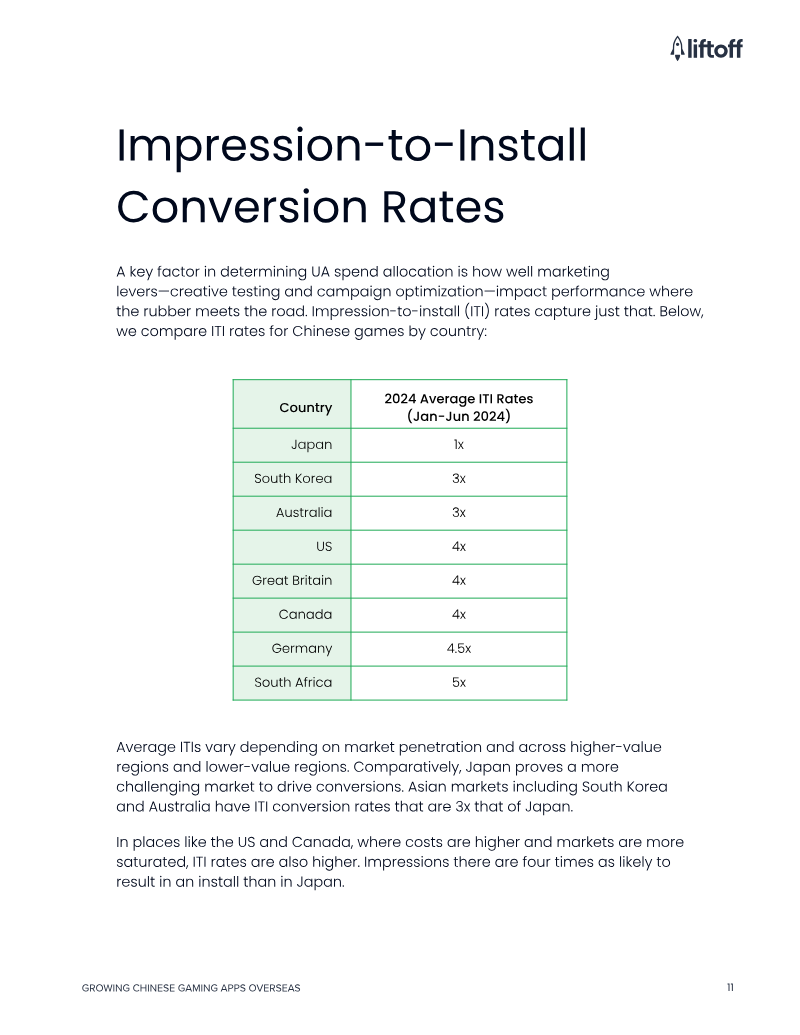
- The United States remains the primary overseas market for Chinese games, accounting for 32.31% of total export revenue, followed by Japan at 16.35% and South Korea at 9.15%.
- Strategy games (SLG) dominate the overseas market, capturing 49.97% of earnings, significantly outpacing shooters at 9.69% and RPGs at 9.39%.

Blossom Sort Game Review: Exploring the Future of casual games
Blossom Sort represents a significant evolution in the casual puzzle genre, demonstrating that high monetization efficiency can be achieved even with modest download volumes.
- Blossom Sort generates approximately $60,000 in daily in-app purchase revenue, achieving a revenue-per-download metric of $6 in the United States.
- The game demonstrates that high monetization efficiency is possible with modest download volumes by combining relaxing core sorting mechanics with sophisticated meta-game structures like battle passes and collection albums.
- The developer prioritizes initial in-app purchase revenue over immediate ad integration, though the title currently struggles with inefficient ad mediation and technical usability issues.