Asia reports and market data
Documents

How to engage with Asian mobile publishers (Tencent, Gamevil, Nexon)
Engaging with major Asian mobile publishers—such as Tencent, Gamevil, and Nexon—requires a strategic approach that prioritizes long-term relationship building, deep market research, and a sophisticated understanding of free-to-play mechanics.
- Asian publishers prioritize developers who demonstrate a deep understanding of free-to-play mechanics, as this is the primary monetization model in markets like China.
- Publishers look for unique, innovative concepts rather than clones of existing hits; for example, Tencent evaluated over 6,200 games in a year but only a small fraction met their criteria for publishing.
- When pitching, developers must provide concrete, honest data, such as retention rates (e.g., Day 1, Day 7) and payment rates, rather than relying on best-case scenarios or anecdotal success.

The Asian Games Market: Casual Games Sector Report 2016
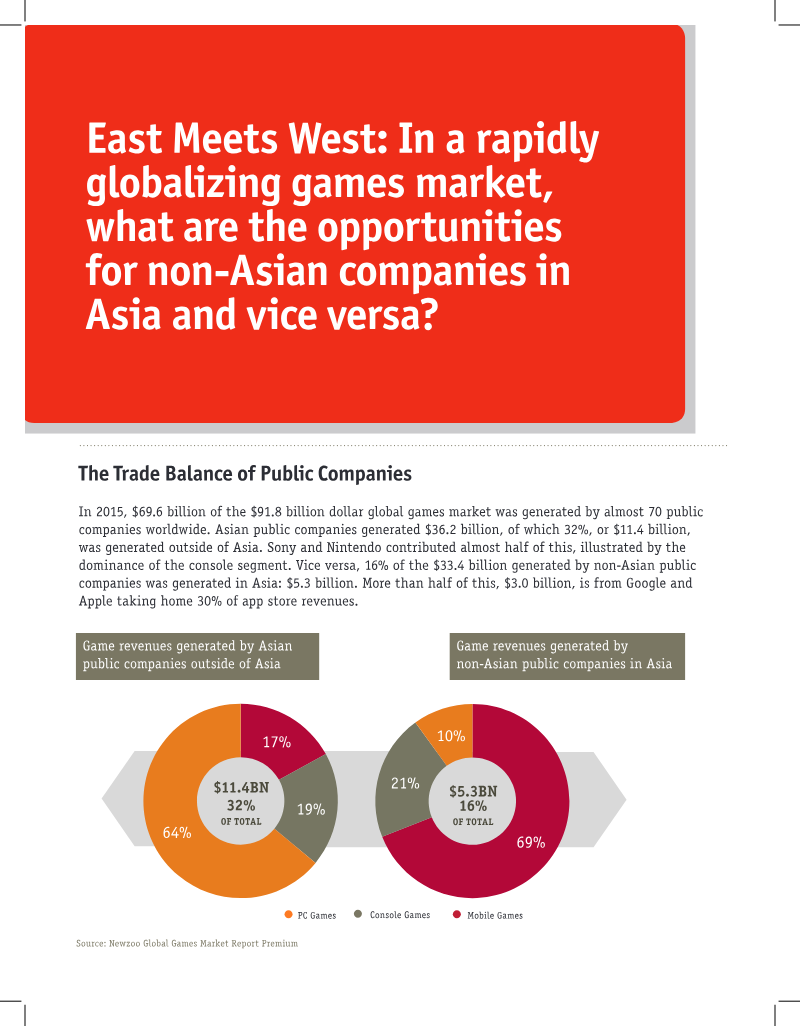
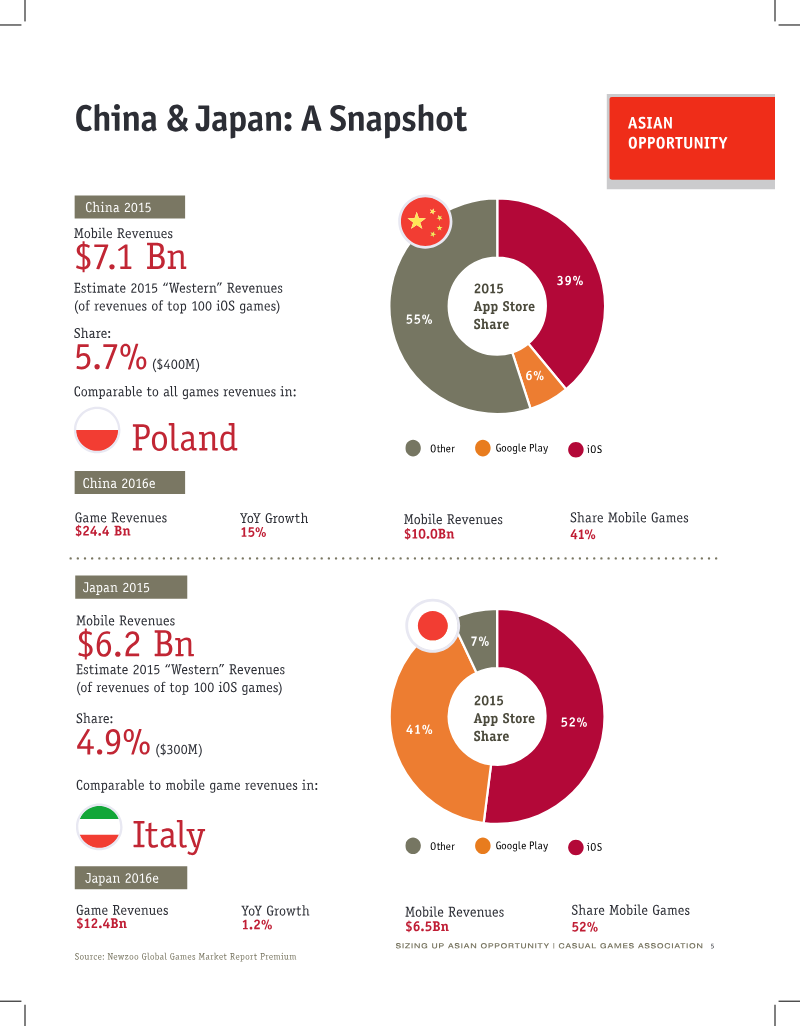
The 2016 Casual Games Sector Report provides a comprehensive analysis of the Asian gaming landscape, emphasizing its critical role in the global market.
- In 2016, the Asian gaming market (China, Japan, South Korea, and Southeast Asia) generated $45 billion in revenue, accounting for 45% of the total global market.
- Asia serves as the primary engine for the global mobile gaming sector, contributing 55% of all worldwide mobile game revenues.
- Mobile platforms command over 50% of the revenue share in Southeast Asia, while console gaming remains the dominant platform in Japan.

Why you should visit Korean game show G-Star
G-Star serves as a critical window into the distinct operational and cultural differences between the South Korean and Western gaming markets.
- Independent game development at G-Star reflects a universal artistic framework that mirrors the experimental sensibilities found at Western events like E3 and Gamescom.
- Large-scale Korean studios frequently struggle to penetrate Western markets because their attempts to adopt Western tropes, such as mafia-themed narratives, often lack cultural authenticity.
- The South Korean gaming market maintains a cautious, delayed approach to virtual reality technology, contrasting with the aggressive investment and adoption trends observed in the West.

Concept Art House CEO James Zhang on helping Supercell make its Super Bowl advert
Concept Art House provides high-end art, 3D animation, and pre-production services to the global gaming industry, contributing to approximately 500 games annually.
- Concept Art House supports approximately 500 games annually, providing high-end art and 3D animation services for major developers including Riot Games, Blizzard, and Hasbro.
- Mobile gaming is shifting toward console-quality graphics as developers utilize high-fidelity assets to differentiate products in a saturated market and justify rising production costs.
- The integration of established entertainment intellectual properties, such as Jurassic Park and The Hobbit, has become a primary strategy for securing top-grossing positions in mobile app stores.
English language games ignore two-thirds of global market says 6waves
The global mobile gaming market is significantly underserved by developers who focus exclusively on English-language releases, effectively ignoring two-thirds of the potential audience.
- Releasing games only in English ignores approximately two-thirds of the global market, as 82% of current industry growth originates from Asia.
- Asia accounts for 45% of the total global games market, with seven Asian countries ranking in the top 20 for iOS and Google Play revenue.
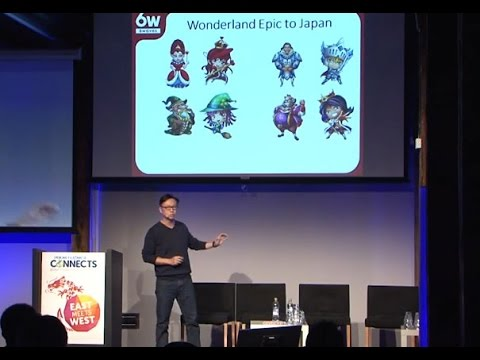
- Localized game versions can yield significant revenue growth; for example, Supercell’s 'Boom Beach' saw a 17% increase in downloads and a 4x revenue increase after launching a Japanese version.

King's Tommy Palm on heading east and tapping into the next generation
The mobile gaming industry is increasingly focused on global expansion, with a particular emphasis on Asian markets such as Japan, South Korea, and China.
- Casual games are the most effective vehicle for global expansion because their focus on immediate mechanics transcends the cultural and narrative barriers that often hinder RPGs.
- Successful entry into Asian markets requires abandoning the 'monolithic' view of the region in favor of hiring local experts to manage specific cultural, marketing, and technical nuances.
- Technical localization for Eastern markets necessitates careful management of character sets and font sizes to prevent excessive file bloat and ensure optimal performance.
Localisation isn't everything for Japanese success, says Metaps' McCarthy
Entering the Japanese and South Korean mobile gaming markets requires a strategic shift in focus from traditional localization to core gameplay quality and aggressive user acquisition.
- Prioritize core gameplay quality and effective monetization over perfect linguistic localization, as over-localizing can create an uncanny valley effect that alienates Japanese players.
- Success in Japan requires releasing a dedicated Android APK to fully leverage Google Play store features, alongside aggressive pre-registration and boost campaigns to acquire high-quality users.
- South Korean players exhibit high churn rates, making technical stability and performance optimization critical; even minor lag can lead to immediate user loss.

InnoGames CEO on growth, Asian markets and tax breaks
InnoGames maintains a strategy of sustainable, long-term growth by prioritizing high-quality talent acquisition and product iteration over rapid, speculative expansion.
- InnoGames prioritizes sustainable growth by ensuring revenue increases consistently outpace their annual headcount expansion of over 100 new employees.
- The company maintains a core focus on durable player-versus-player (PVP) strategy games, exemplified by the long-term performance of titles like Tribal Wars, which continues to see record results more than a decade after launch.
- InnoGames is actively diversifying its portfolio by incorporating role-playing and city-building mechanics into new titles to broaden its audience reach beyond traditional strategy games.
Trust is a big issue for Western developers in China
Western developers face significant structural and cultural hurdles when attempting to enter the Chinese mobile gaming market, primarily centered on the difficulty of establishing reliable business relationships.
- Building trust is the primary barrier to entry in the Chinese market, as Western developers often face communication breakdowns, sudden partner disappearances, and a lack of consistent feedback.
- Biodroid’s attempt to enter the Chinese market failed due to poor partner selection, whereas their efforts in Japan, Thailand, Indonesia, and Malaysia succeeded by securing partners who handled integration and device preloading.
- Western developers must be prepared to dedicate significant resources to support their Chinese partners, as slow delivery of marketing materials or code changes can terminate business relationships.
Successful use of ad networks is all about getting scale says InMobi
The Chinese mobile gaming market presents a highly fragmented landscape characterized by significant stratification across distribution, payment, and discovery channels.
- To achieve scale in the fragmented Chinese mobile market, developers must utilize large ad networks for user segmentation and high-volume downloads, as these networks outperform the organic reach of standard app stores.
- Market entry requires deep localization beyond language, specifically adopting cartoon-style aesthetics, lighter color schemes, and 2D perspectives favored by Chinese players.
- Gameplay design should prioritize simplicity, daily rewards, and social competition via leaderboards rather than focusing on individual player milestones.
How mobile will boost the games market to over $100 billion
The global games industry is projected to exceed $100 billion in revenue by 2017, a milestone driven primarily by the rapid expansion of the mobile sector and significant growth within Asian markets.
- The global games industry is projected to surpass $100 billion in revenue by 2017, fueled primarily by the mobile sector and rapid growth in Asian markets.
- Mobile games generate over 70% of total global application revenue, outperforming traditional console and subscription models in profitability and development efficiency.
- Multiplayer and player-versus-player mobile games generate up to 13 times the revenue of single-player titles due to superior engagement and retention metrics.

There's a huge opportunity in Asia reckons Applifier's Mika Kuusisto Applifier
The mobile gaming landscape in 2014 presents a significant expansion opportunity within Asian markets, serving as a primary strategic focus for developers and service providers alike.
- Asian mobile gaming markets represent the primary strategic expansion focus for developers and service providers in 2014 due to significant growth and user acquisition potential.
- Successful entry into Asian markets requires navigating complex, localized dynamics that necessitate careful planning and dedicated resource allocation.
- Gameplay recording services that enable users to share high scores and personal reactions on social media are essential tools for driving organic growth and community building.