CESA – Computer Entertainment Supplier's Association
Association16 documents
Japan's leading game industry association. Publishes annual Game Industry Reports, developer employment studies, and student game creator surveys.
Documents
Report6 pages
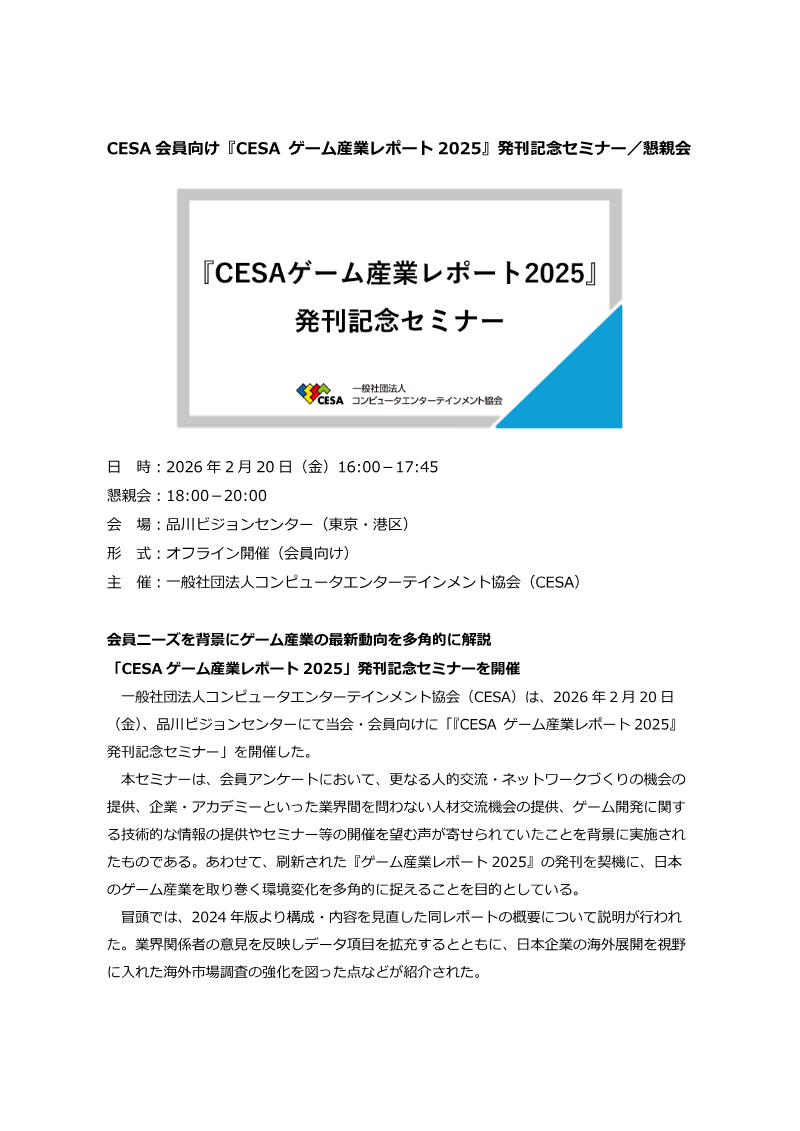
CESA Game Industry Report 2025: Launch Seminar Report
The CESA Game Industry Report 2025 Launch Seminar, held in Tokyo on February 20, 2026, served as a platform to analyze the evolving landscape of the Japanese gaming sector. The event introduced the updated 2025 industry report, which features expanded data sets and enhanced international market research to better support the global expansion of Japanese firms. The seminar aimed to address industry needs for technical knowledge sharing, talent development, and cross-sector networking among corporate and academic stakeholders.
Key findings highlight a significant shift toward the integration of generative AI, with approximately half of domestic game companies now utilizing these tools within their development pipelines. While internal production workflows show high adoption rates, industry experts noted a more cautious approach regarding AI-generated content visible to end-users. Legal discussions emphasized the importance of navigating copyright frameworks, specifically distinguishing between AI learning and generation phases, while balancing innovation with intellectual property risks.
Government representatives from the Ministry of Economy, Trade and Industry and the Agency for Cultural Affairs outlined strategic support for the content industry, targeting 20 trillion yen in overseas sales by 2033. Policy initiatives focus on multi-year funding, tax incentives, and robust talent development programs to ensure long-term competitiveness. Furthermore, legal experts underscored the increasing complexity of global regulatory environments, noting that Japanese companies must proactively manage diverse international requirements regarding data privacy, monetization, and rating systems. By synthesizing perspectives from government, legal, and development sectors, the seminar emphasized that strategic investment and regulatory compliance are essential for the sustainable growth of Japan’s gaming industry in a globalized market.
- The Japanese government has set a strategic target to reach 20 trillion yen in overseas content industry sales by 2033.
- Approximately 50% of domestic game companies have integrated generative AI into their internal development pipelines.
- Industry adoption of generative AI remains bifurcated, with high usage in production workflows but a cautious, risk-averse approach toward AI-generated content delivered to end-users.
- Legal frameworks are currently prioritizing the distinction between AI learning and generation phases to mitigate intellectual property risks while fostering innovation.
- Government policy initiatives to support industry competitiveness include multi-year funding, tax incentives, and dedicated talent development programs.
CESA – Computer Entertainment Supplier's Association
Report2 pages
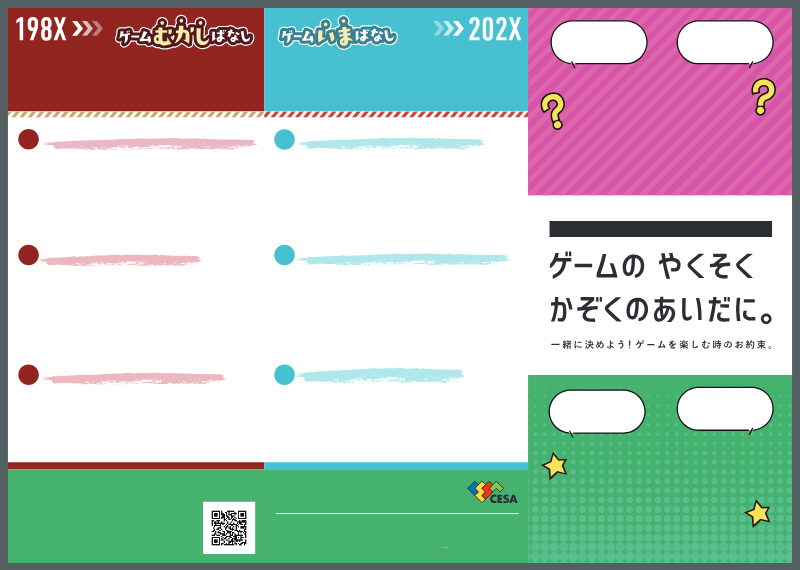
Game no Yakusoku Communication Book
The evolution of gaming from localized, offline experiences to global, interconnected online environments necessitates a modern approach to parental guidance and family communication. The primary purpose of this guide is to bridge the generational gap between parents and children by providing a framework for establishing mutually agreed-upon rules for safe and responsible gaming. It emphasizes that while the technology and accessibility of games have shifted from television-bound consoles to ubiquitous mobile and cross-platform devices, the fundamental need for trust and clear boundaries remains constant.
The analysis highlights significant shifts in the gaming landscape, noting that modern play is no longer restricted by age, geography, or hardware limitations. Because online environments allow for real-time interaction with diverse global participants, the risks and social dynamics have become more complex. To address this, the guide advocates for a collaborative rule-setting process that prioritizes the child’s developmental stage and specific gaming context. Effective agreements should be flexible, evolving alongside the child’s maturity, and should be rooted in open dialogue rather than rigid, top-down restrictions that may fail to account for the realities of online events or social gaming commitments.
Furthermore, the guide underscores the importance of digital literacy for parents, encouraging them to familiarize themselves with common gaming terminology and technical concepts such as in-app purchases, server stability, and online etiquette. By understanding these elements, parents can provide more informed advice regarding security, privacy, and behavior. Ultimately, the document concludes that gaming rules should function as a shared commitment to safety and mutual respect, ensuring that the gaming experience remains a positive and secure activity for children as they navigate increasingly sophisticated digital worlds.
- Modern gaming requires a shift from rigid, top-down restrictions to a collaborative rule-setting process that evolves alongside a child’s developmental maturity.
- The transition from localized, offline play to global, interconnected online environments has increased the complexity of social dynamics and safety risks for children.
- Effective family gaming agreements must be flexible enough to account for the realities of real-time online events and social gaming commitments.
- Parents should prioritize digital literacy by familiarizing themselves with technical concepts such as in-app purchases, server stability, and online etiquette to provide informed guidance.
- Establishing trust and clear boundaries remains the fundamental requirement for safe gaming, regardless of whether the platform is a console or a mobile device.
+1
CESA – Computer Entertainment Supplier's Association
Report3 pages
職員募集(契約職員・業務委託パートナー):人材育成
The Computer Entertainment Society (CESA) announces a recruitment drive for contract personnel and outsourced partners to support its expanding human‑resource development initiatives within Japan’s video‑game sector. The role centers on planning and operating creator training programs, facilitating the introduction of game‑based curricula in schools in collaboration with government bodies, and acting as a liaison for industry‑wide issues. Additional responsibilities include coordinating with public agencies, conducting research on the gaming industry, managing outreach and publicity, overseeing committee activities, and handling web, event, and social‑media communications tied to commissioned projects.
Candidates are expected to possess at least five years of professional experience, demonstrable negotiation and coordination skills, and a strong interest in gaming. Preferred backgrounds include prior interaction with governmental entities, experience driving contract‑based projects, and familiarity with educational or certification activities related to games. Basic PC proficiency in spreadsheet, word‑processing, and presentation software is required, while prior employment in game companies or teaching roles is advantageous.
Employment is offered either as a full‑time contract employee with a standard 9:00‑17:30 schedule in Shinjuku, Tokyo, or as an outsourced partnership negotiated according to individual expertise. Contract terms are annual, renewable up to three years, with an hourly wage starting at ¥1,800, subject to experience. Benefits encompass health, pension, unemployment, and workers’ compensation insurance, a complete two‑day weekend, and a smoke‑free office environment. Applications are to be submitted via the CESA inquiry form, followed by a two‑stage interview process conducted online and in person.
- The Computer Entertainment Society (CESA) is hiring contract personnel and outsourced partners to lead human-resource development and creator training programs within the Japanese video-game industry.
- Core responsibilities include facilitating game-based curricula in schools, managing government relations, conducting industry research, and overseeing communications for commissioned projects.
- Candidates must have at least five years of professional experience, with preference given to those with backgrounds in government liaison work, project management, or educational certification.
- Contract employees are based in Shinjuku, Tokyo, with a standard 9:00–17:30 schedule and an hourly wage starting at ¥1,800.
- Employment terms are annual and renewable for up to three years, with full benefits including health, pension, unemployment, and workers' compensation insurance.
+2
CESA – Computer Entertainment Supplier's AssociationFeb 2026
Report4 pages
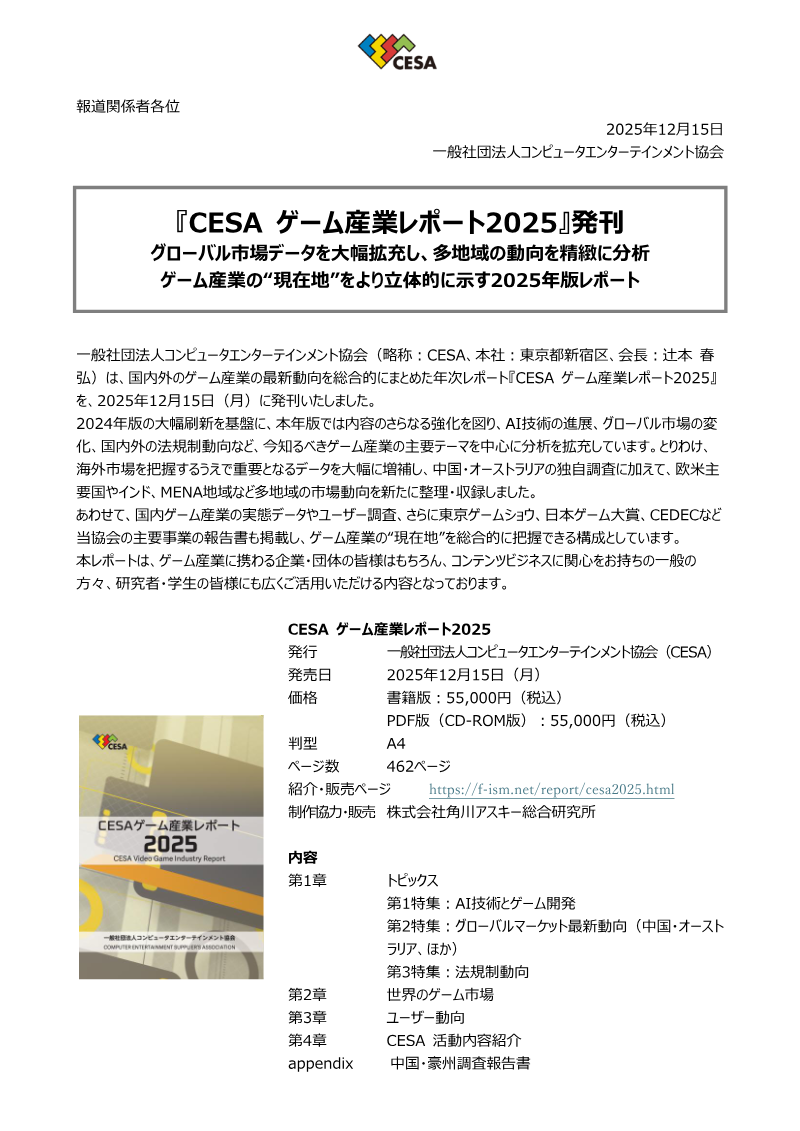
CESA Game Industry Report 2025
The 2025 CESA Game Industry Report presents a comprehensive assessment of the current state of the video‑game sector, emphasizing three strategic themes: the impact of artificial‑intelligence technologies on development, the latest dynamics of the global market, and emerging regulatory issues. By expanding data coverage to include China, Australia, major Western economies, India and the MENA region, the analysis offers a multidimensional view of both domestic and international trends.
Global game‑content revenue reached 31.042 trillion yen in 2024, marking a 5.0 % year‑on‑year increase. Mobile games accounted for 18.433 trillion yen, roughly 60 % of total sales, and grew 6.0 % versus the prior year. PC titles posted the strongest platform growth over the past four years, expanding 59.7 % and overtaking console share, while console revenue showed modest contraction. In Japan, the total gaming population stood at 5.475 million in 2024, a slight decline from 5.553 million; mobile users fell 1.8 %, PC users rose 0.5 %, and console users decreased 0.7 %, with expectations of a rebound following the anticipated Switch 2 launch.
Employment estimates indicate approximately 200 000 individuals work across the Japanese gaming ecosystem. Core developers, publishers and hardware manufacturers employ between 58 000 and 83 000 people, while ancillary sectors—such as visual production, middleware, peripherals, retail and media—constitute the remainder of the workforce.
The findings derive from CESA’s own surveys, expert interviews and user studies conducted in China and Australia, supplemented by industry‑wide data sources and event reports (Tokyo Game Show, Japan Game Awards, CEDEC). The methodology blends desk research with primary fieldwork to deliver a layered, data‑rich portrait of the industry’s structure, growth drivers and regulatory landscape.
- Global game content revenue reached 31.042 trillion yen in 2024, representing a 5.0% year-on-year increase.
- Mobile gaming remains the dominant sector, generating 18.433 trillion yen—roughly 60% of total global sales—with a 6.0% annual growth rate.
- PC gaming has experienced significant momentum, expanding 59.7% over the last four years to overtake console market share.
- Console revenue saw a modest contraction in 2024, though the Japanese market anticipates a rebound following the expected launch of the Switch 2.
- The Japanese gaming population experienced a slight decline to 5.475 million users in 2024, driven by a 1.8% drop in mobile users and a 0.7% decrease in console users.
+1
CESA – Computer Entertainment Supplier's AssociationDec 2025
Report4 pages
Top Game Creators Academy: 入学式/懇親会を開催しました
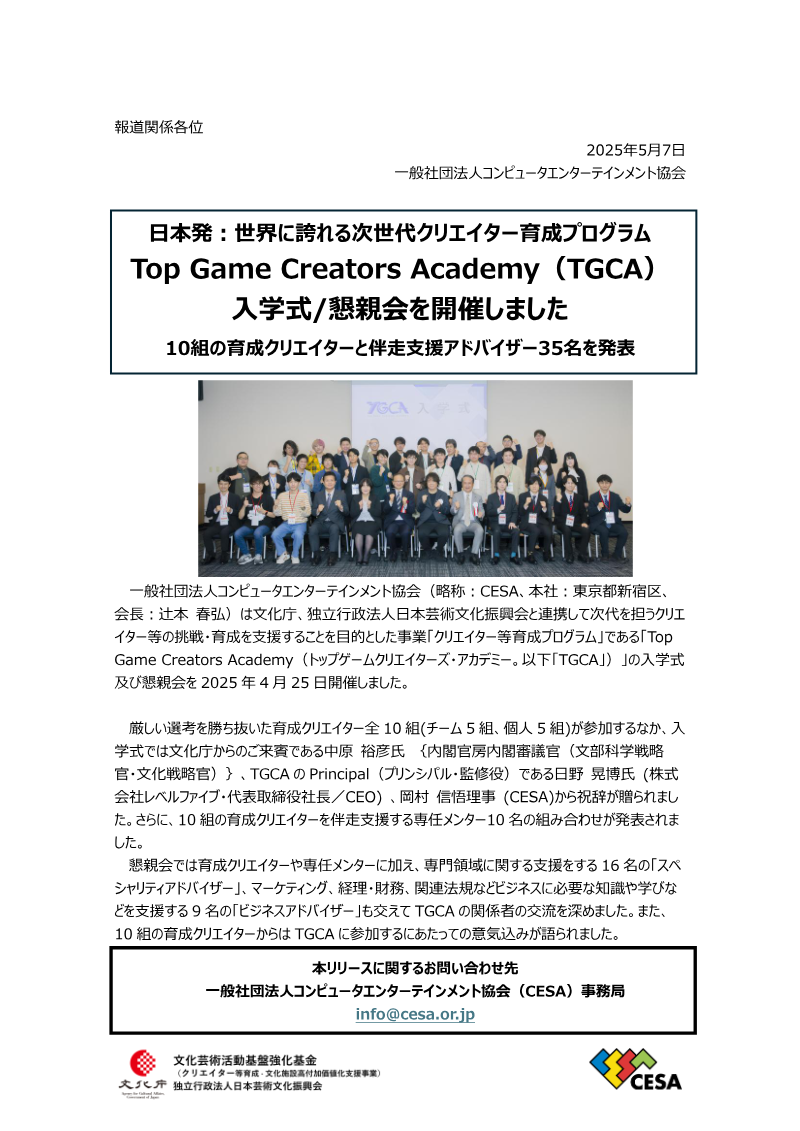
The Top Game Creators Academy (TGCA) was inaugurated on 25 April 2025 as a joint initiative of the Cultural Agency, the Japan Arts and Culture Promotion Agency, and the Computer Entertainment Association (CESA) to cultivate next‑generation game creators capable of delivering original IP that can compete globally. Ten selected teams—five groups and five individual creators—were formally admitted, accompanied by thirty‑five advisors who will provide ongoing mentorship, specialty guidance, and business support throughout a two‑year development cycle.
The program draws on the Cultural Arts Activity Strengthening Fund, allocating public resources to enable intensive, mentor‑driven training. Each creator cohort is paired with a dedicated mentor from leading studios such as Bandai Namco, Capcom, and Square Enix, while sixteen specialty advisors cover visual art, engineering, design, sound, and project management, and nine business advisors address marketing, finance, and legal matters. Progress meetings occur monthly, fostering collaborative feedback within multi‑person groups rather than one‑on‑one pairings.
Participants will showcase their work at major industry events, beginning with an online appearance at CEDEC in July 2025, a debut at Tokyo Game Show in September 2025, and subsequent exhibitions at the Taipei Game Show in January 2026, with potential expansion to international venues such as Gamescom in 2026. The cohort aims to graduate by March 2027, having refined both creative and commercial competencies to launch globally competitive titles.
- The Top Game Creators Academy (TGCA) launched on 25 April 2025 to develop globally competitive original IP through a two-year intensive mentorship program.
- The cohort consists of 10 teams—5 groups and 5 individuals—supported by a network of 35 advisors, including 16 specialty experts and 9 business consultants.
- Mentorship is provided by industry leaders from major studios, specifically Bandai Namco, Capcom, and Square Enix.
- The program is funded by the Cultural Arts Activity Strengthening Fund, a joint initiative involving the Cultural Agency, the Japan Arts and Culture Promotion Agency, and CESA.
- Participants will debut their projects at CEDEC in July 2025 and Tokyo Game Show in September 2025, followed by Taipei Game Show in January 2026.
+2
CESA – Computer Entertainment Supplier's AssociationMay 2025
Report4 pages
Top Game Creators Academy: Tokyo Game Show 2025 Exhibition
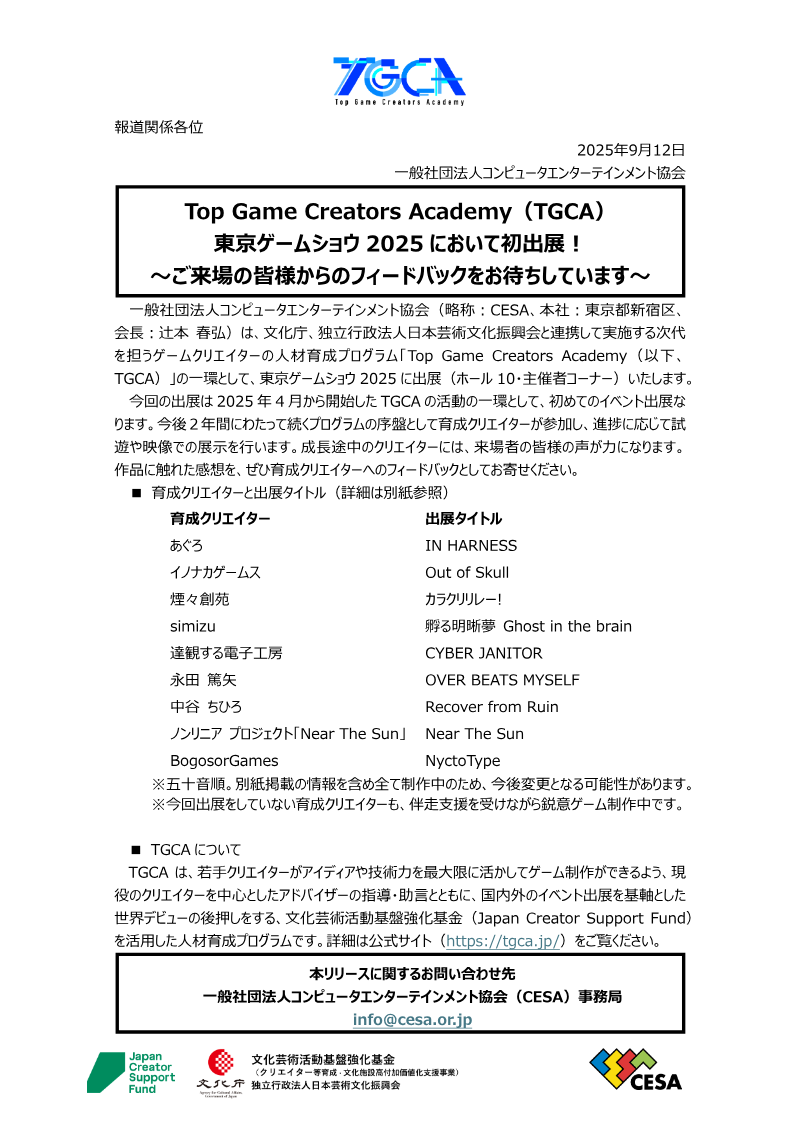
Top Game Creators Academy (TGCA) is being introduced to the public for the first time at the Tokyo Game Show 2025, where it will occupy Hall 10’s organizer’s corner. The initiative, run by the Computer Entertainment Association in partnership with the Agency for Cultural Affairs and the Japan Arts & Culture Promotion Agency, aims to accelerate the development of next‑generation game creators by pairing them with active industry advisors and providing exposure through domestic and international events. The exhibition showcases ten emerging developers, each presenting a work‑in‑progress title ranging from an online cooperative 3D jump‑action (IN HARNESS) to a 2D puzzle platformer (Out of Skull), a collaborative “game‑making relay” (カラクリリレー!), a first‑person horror action (Ghost in the brain), a formula‑driven shooter (CYBER JANITOR), a rhythm‑action experience (OVER BEATS MYSELF), an exploratory RPG (Recover from Ruin), a 2D stealth‑action novel (Near The Sun), and a competitive typing‑board hybrid (NyctoType). All projects remain under development and may evolve before final release.
The program, launched in April 2025, is structured as a two‑year pipeline in which creators receive ongoing mentorship and are encouraged to gather visitor impressions as direct feedback for iterative improvement. Although no quantitative metrics are provided, the breadth of genres and innovative mechanics underscores TGCA’s commitment to diversifying Japan’s game development talent pool and facilitating global market entry. The announcement concludes with a call for attendees to submit their reactions, positioning audience interaction as a core component of the creators’ growth trajectory.
- The Computer Entertainment Association, in partnership with the Agency for Cultural Affairs and the Japan Arts & Culture Promotion Agency, launched the Top Game Creators Academy (TGCA) in April 2025 to accelerate the development of next-generation talent.
- The TGCA program utilizes a two-year pipeline structure that pairs emerging developers with active industry advisors to facilitate professional growth and global market entry.
- Ten emerging developers are debuting work-in-progress titles at the Tokyo Game Show 2025 in Hall 10, representing diverse genres including 3D action, 2D puzzle platformers, horror, and rhythm-action.
- Audience interaction is a core component of the program, with creators actively soliciting visitor feedback at the Tokyo Game Show to drive iterative improvements for their projects.
- The initiative aims to diversify Japan’s game development talent pool by providing creators with exposure through both domestic and international industry events.
+3
CESA – Computer Entertainment Supplier's AssociationJan 2025
Report45 pages
Game Developer Employment: Career Formation of Student Game Creators 2019 Survey 2025
The 2025 Japanese survey of students’ career aspirations investigates how the role of “game creator” is perceived across gender, age, and educational level, aiming to gauge the pipeline of future talent for the domestic game development sector. It encompasses elementary, middle, high‑school, technical‑college and university respondents nationwide, providing a comprehensive snapshot of attitudes toward a profession that remains peripheral in the broader labor market.
Findings reveal a stark gender divide. Among male pupils in elementary and middle school, the game‑creator career ranks first overall and consistently appears within the top two choices for grades three through nine, indicating strong early enthusiasm. In contrast, female students place the same role far lower, with the position falling to nineteenth overall for females and remaining near the bottom of their preference lists at every age level. When respondents reach higher‑education stages, roughly eighty percent of those who still consider the occupation view it primarily as a professional pathway rather than a hobby or ancillary activity.
The data suggest that while the game‑creator profession enjoys robust appeal among young males, it fails to attract comparable interest from females, potentially limiting diversity in the future workforce. The pronounced early‑stage gender gap underscores the need for targeted outreach, curriculum development, and mentorship programs that can broaden awareness and appeal among female students, thereby strengthening the talent base for Japan’s evolving game industry.
- A significant gender divide exists in career aspirations, with game creator ranking as the top choice for male elementary and middle school students while placing nineteenth for females.
- The appeal of a game development career for males remains consistently high, appearing in the top two career choices for students from grade three through nine.
- Approximately 80% of higher-education students interested in game creation view the role as a professional career path rather than a hobby or secondary activity.
- The persistent lack of interest among female students across all age levels suggests a potential long-term bottleneck for diversity in the Japanese game industry workforce.
- The 2025 survey data indicates that the game creator profession remains a peripheral career choice within the broader Japanese labor market despite strong early enthusiasm from young males.
+1
CESA – Computer Entertainment Supplier's AssociationJan 2025
Report3 pages
CESA Game Industry Report 2024
CESA Game Industry Report 2024 – Executive Summary (English)
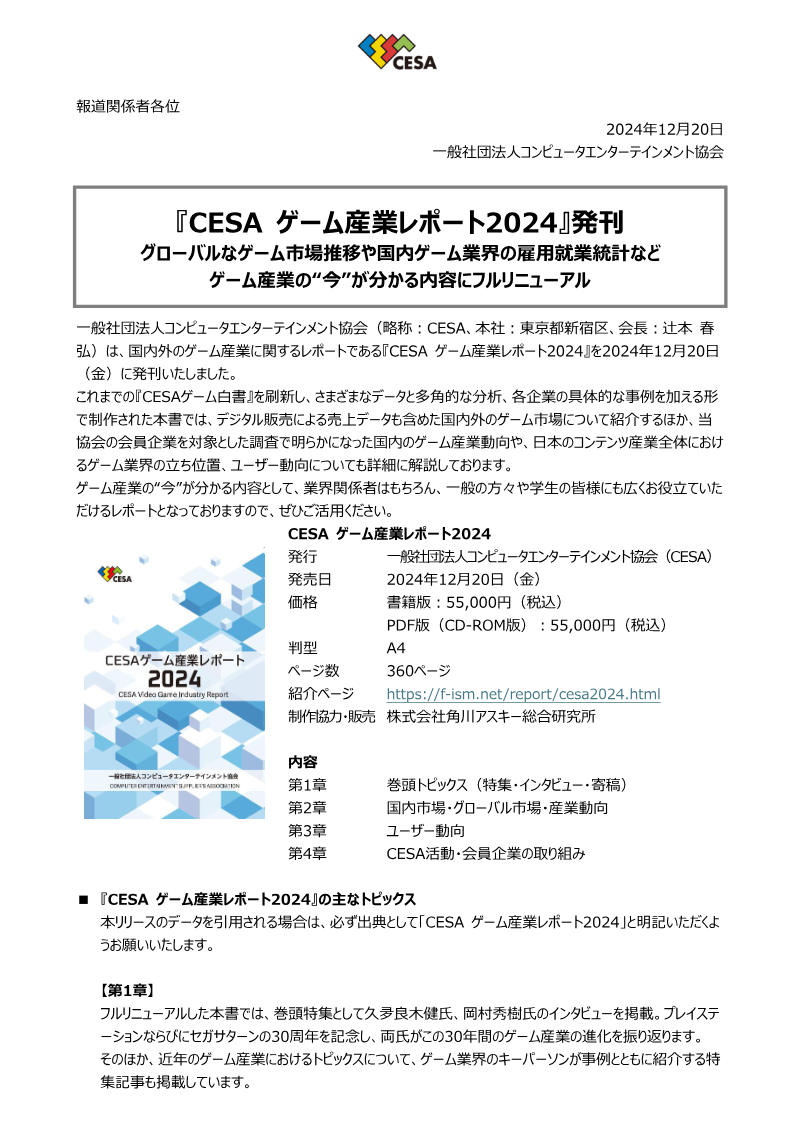
1. Publication Details | Item | Information | |------|--------------| | Title | CESA ゲーム産業レポート 2024 (CESA Game Industry Report 2024) | | Publisher | 一般社団法人コンピュータエンターテインメント協会 (Computer Entertainment Supplier’s Association, CESA) | | Release date | 20 December 2024 (Friday) | | Price | ¥55,000 (incl. tax) – both printed book and PDF/CD‑ROM versions | | Format | A4, 360 pages | | ISBN / Catalog | CESAJ‑LV‑ (internal code) | | Production partner | 株式会社角川アスキー総合研究所 (Kadokawa ASCII Research Institute) | | Official page | <https://f-ism.net/report/cesa2024.html> | | Contact | [email protected] |
> Citation note – When quoting any data from the report, cite it as “CESA ゲーム産業レポート 2024”.
2. Report Structure
| Chapter | Focus | |---------|-------| | Chapter 1 – Front‑matter (Topics, Interviews, Contributions) | Interviews with industry veterans (久夛良木健, 岡村秀樹) reflecting on 30 years of PlayStation & Sega Saturn; other key‑person case studies. | | Chapter 2 – Market & Industry Trends (Domestic & Global) | Macro‑level market size, platform breakdown, development costs, employment, cross‑media context. | | Chapter 3 – User Trends | Player demographics, platform usage, esports, multi‑platform activity. | | Chapter 4 – CESA Activities & Member Initiatives | Overview of CESA‑hosted events (Tokyo Game Show, CEDEC) and member‑company projects. |
3. Key Findings
3.1 Global Game‑Content Market Size (2020‑2024) – Approximately ¥30 trillion in 2024, nearly double the 2020 level (¥20 trillion). Growth drivers – Strong yen‑depreciation effect post‑2022, continued expansion of mobile gaming, and rising PC‑gaming share (thanks to Steam). Platform share (2024) – Mobile: dominant share (≈ 60 % of global revenue). Console: ~ 20 % of revenue. PC: ~ 20 % (growing steadily).
3.2 Japan’s Content Industry & Game Share Total overseas export of Japanese content: ¥4.7 trillion (on par with semiconductor & steel sectors). Games’ contribution: ≈ 60 % of that export value → games are the primary driver of foreign‑exchange earnings within the broader content sector.
3.3 Domestic Game‑Industry Employment & Compensation Total industry employment: ≈ 200,000 workers (including peripheral sectors). Average annual salary: ¥7.08 million – markedly higher than the average across
- The global game-content market reached approximately ¥30 trillion in 2024, nearly doubling from the ¥20 trillion recorded in 2020.
- Mobile gaming remains the dominant global platform, accounting for approximately 60% of total revenue, while console and PC sectors each hold roughly 20% shares.
- Japanese game exports generate approximately ¥2.82 trillion, representing about 60% of the country's total ¥4.7 trillion content industry exports.
- The Japanese game industry's export value is now on par with major industrial sectors such as semiconductors and steel.
- The domestic game industry employs approximately 200,000 workers, including those in peripheral sectors.
一般社団法人コンピュータエンターテインメント協会 (Computer Entertainment Supplier’s Association)Dec 2024
Report1 pages
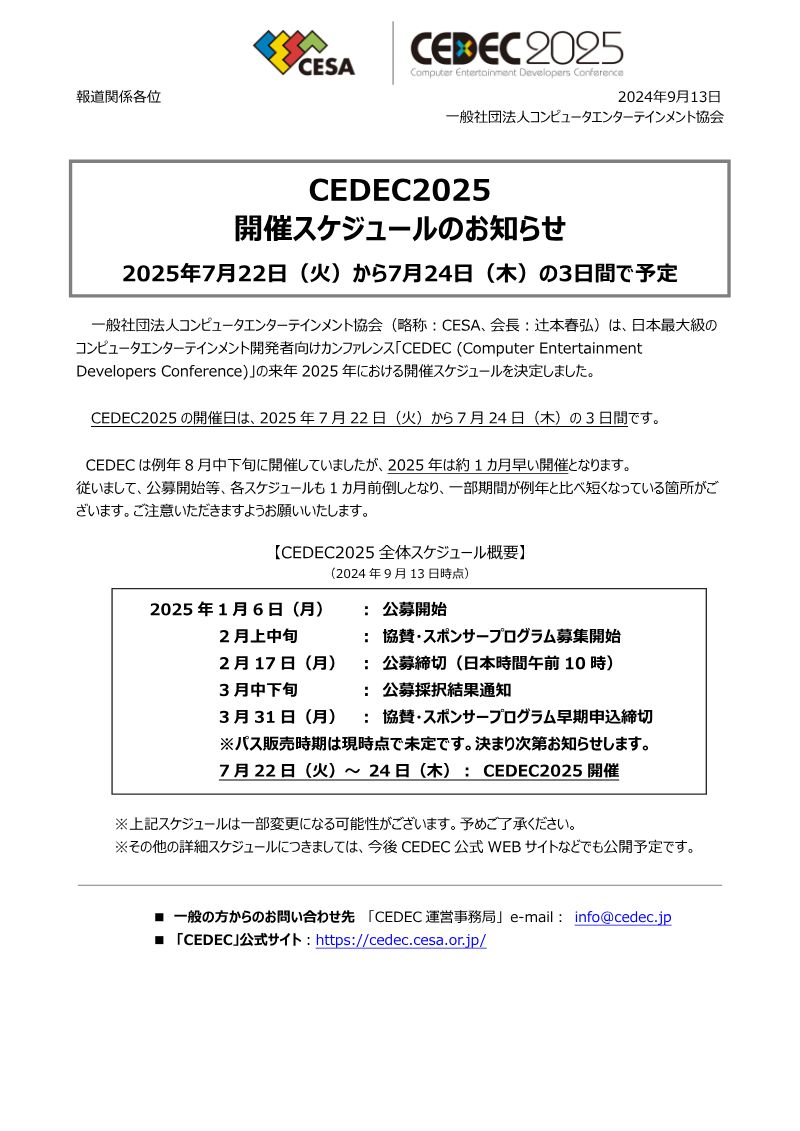
CEDEC 2025 Schedule Announcement
The announcement establishes the official timetable for CEDEC 2025, Japan’s premier three‑day conference for computer‑entertainment developers organized by the Computer Entertainment Developers Association (CESA). By moving the event to July 22‑24, 2025—approximately one month earlier than the traditional late‑August slot—the schedule compresses several preparatory phases, prompting participants to adjust their planning accordingly.
Key milestones are detailed: the public call for proposals opens on January 6, 2025, followed by the launch of sponsor and partnership programs in early‑to‑mid February. The final deadline for submissions is set for February 17 at 10 a.m. JST, with selection results communicated in late March. An early‑application deadline for sponsorships occurs on March 31, while ticket‑sale dates remain pending and will be announced later. The conference itself occupies three consecutive days, Tuesday through Thursday, in late July.
The scope is national, targeting Japanese developers, studios, and related stakeholders within the computer‑entertainment sector, and it outlines a timeline that spans from early January through late July 2025. Although the schedule is provisional and subject to minor adjustments, contact information for the CEDEC operations office and the official website are provided for inquiries and future updates.
- CEDEC 2025 will take place from July 22–24, 2025, shifting the conference approximately one month earlier than its traditional late-August schedule.
- The call for session proposals opens on January 6, 2025, with a strict submission deadline of February 17, 2025, at 10 a.m. JST.
- Selection results for proposed sessions will be communicated to applicants in late March 2025.
- Sponsorship and partnership programs launch in early-to-mid February 2025, with an early-application deadline for sponsors set for March 31, 2025.
- The conference is organized by the Computer Entertainment Developers Association (CESA) and targets Japanese developers, studios, and computer-entertainment stakeholders.
+1
Computer Entertainment Developers AssociationSept 2024
Report4 pages
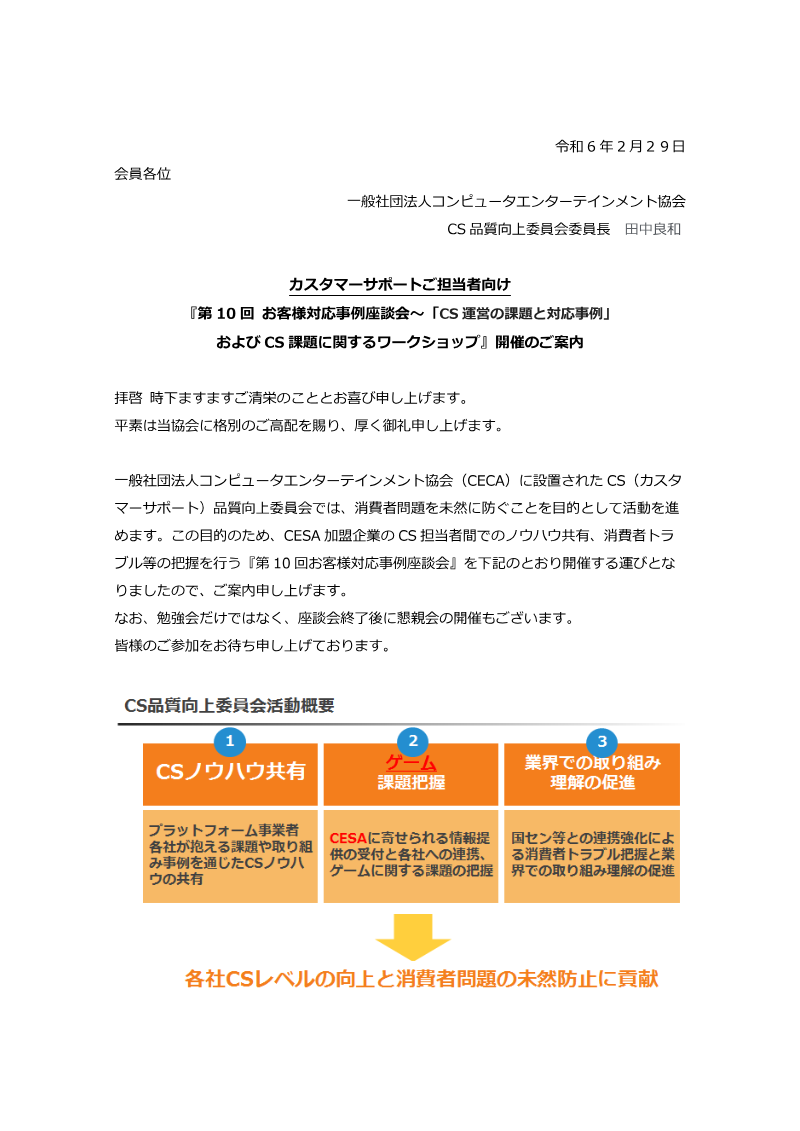
第10回 お客様対応事例座談会〜「CS運営の課題と対応事例」および CS課題に関するワークショップ
The announcement seeks to convene customer‑support managers from member firms of the Computer Entertainment Association (CECA) to exchange practical solutions for ongoing CS operational challenges. Its central aim is to foster preventive measures against consumer‑related issues by facilitating knowledge sharing on two focal topics: the integration of AI tools into support workflows and the management of customer harassment incidents.
The event is scheduled for March 19, 2024, running from 16:00 to 18:00, with a reception beginning at 15:30. It will be held simultaneously at the Shinjuku Sumitomo Sky Room in Tokyo and via Zoom, allowing both in‑person and online participation. Attendance is limited to CECA members, with pre‑registration required by March 8; excess demand may be redirected to the virtual format. The agenda includes opening remarks, case‑study presentations on AI adoption and harassment handling, and a workshop where groups of six to seven participants will discuss these issues in breakout rooms, followed by a plenary debrief. A networking reception follows, with an estimated fee of ¥5,000 per participant.
The scope is confined to the Japanese computer‑entertainment sector, targeting CS professionals active in 2024. While no empirical data are presented, the format emphasizes interactive discussion and peer‑learning rather than formal survey analysis, positioning the gathering as a practical forum for collective problem‑solving and the dissemination of best practices within the industry.
- The Computer Entertainment Association (CECA) is hosting a customer support forum on March 19, 2024, focused on AI integration and managing customer harassment.
- The event is restricted to CECA member firms, with a pre-registration deadline of March 8, 2024.
- The program features case-study presentations and small-group workshops of six to seven participants to facilitate peer-to-peer knowledge sharing.
- The session will be held in a hybrid format at the Shinjuku Sumitomo Sky Room in Tokyo and via Zoom, with a ¥5,000 fee for the networking reception.
- The forum aims to establish industry-wide preventive measures and best practices for CS operational challenges in the Japanese computer-entertainment sector.
CESA – Computer Entertainment Supplier's AssociationFeb 2024
Report9 pages
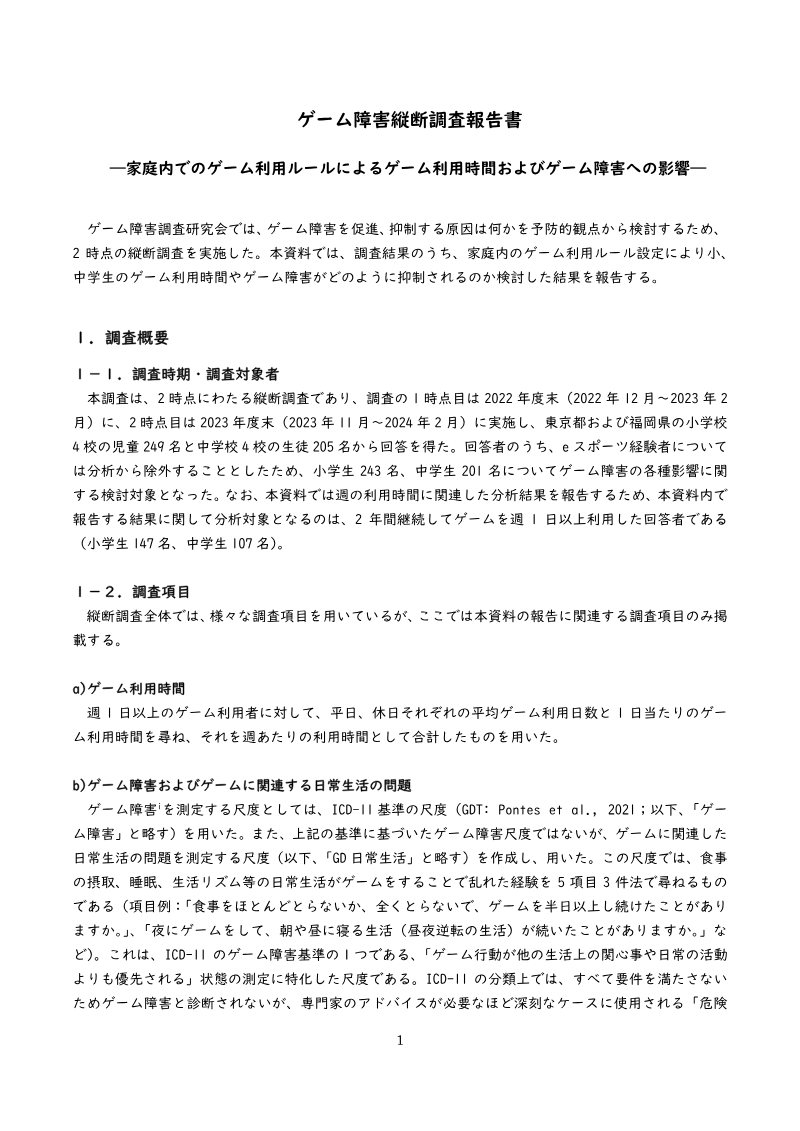
Longitudinal Survey Report on Gaming Disorder: Japan
The study investigates how household rules governing video‑game use influence weekly play time and the emergence of gaming disorder among Japanese elementary and middle‑school students. By tracking participants over two survey waves—late 2022 to early 2023 and late 2023 to early 2024—the research tests whether specifying permissible gaming periods or prohibiting certain times can curb excessive play and related daily‑life problems.
A longitudinal sample was drawn from four elementary schools and four middle schools in Tokyo and Fukuoka, yielding 243 elementary and 201 middle‑school respondents after excluding esports players. Analyses focused on the 147 elementary and 107 middle‑school students who reported gaming at least once per week across both waves. Weekly gaming hours were calculated from weekday and weekend use, while gaming disorder was measured with the ICD‑11‑based Gaming Disorder Test and a custom scale assessing disruptions to sleep, meals, and routine. The presence of two rule types—“allowed‑time” (e.g., one hour per day) and “prohibited‑time” (e.g., no gaming after midnight)—was recorded at each wave and examined using cross‑lagged models and mixed‑design ANOVAs.
Results show that higher weekly gaming hours predict later increases in gaming‑disorder scores for both age groups (standardized coefficients .12 for elementary and .11 for middle‑school students), while disorder does not feed back into later play time. Gaming hours and daily‑life problems mutually reinforce each other, forming a negative feedback
- Increased weekly gaming hours serve as a significant predictor for higher gaming disorder scores, with standardized coefficients of .12 for elementary students and .11 for middle-school students.
- Gaming hours and daily-life problems, such as disruptions to sleep and meals, create a negative feedback loop where each factor mutually reinforces the other.
- Gaming disorder symptoms do not appear to influence or increase future weekly play time, suggesting that excessive play is the primary driver of disorder rather than a consequence of it.
- The study tracked 254 total students—147 elementary and 107 middle-schoolers—who played games at least once per week across two survey waves between late 2022 and early 2024.
- Research methodology utilized the ICD-11-based Gaming Disorder Test and a custom scale to measure the impact of household rules, specifically 'allowed-time' limits and 'prohibited-time' restrictions.
+1
CESA – Computer Entertainment Supplier's AssociationJan 2024

Report42 pages
ゲーム開発者の就業とキャリア形成 2024
The 2024 Game Developer Survey for Japan provides a comprehensive snapshot of compensation trends among the nation’s game development workforce, focusing on individuals with formal vocational‑school or university education. By capturing responses from a broad cross‑section of developers, the study aims to assess whether recent industry growth translates into tangible financial benefits for skilled professionals.
Findings reveal that more than 80 % of educated respondents reported a salary increase over the preceding year, a pattern that holds consistently for full‑time employees, with roughly the same proportion experiencing any rise in earnings. This upward trajectory suggests that Japanese studios are increasingly rewarding qualified talent, reflecting both heightened competition for skilled labor and the sector’s expanding revenue streams. The data also underscore the importance of formal education as a predictor of wage growth, indicating that employers value academic credentials when allocating compensation adjustments.
Overall, the survey indicates a robust and positive compensation environment for Japan’s game development sector in 2024, highlighting sustained investment in human capital. The prevalence of salary gains among highly educated, full‑time developers points to a healthy labor market that may enhance talent retention and support continued industry innovation.
- Over 80% of game developers with formal vocational or university education in Japan received a salary increase in 2024.
- The trend of rising earnings is consistent among full-time employees, with approximately 80% reporting wage growth over the past year.
- Formal academic credentials serve as a significant predictor of wage growth, as employers prioritize these qualifications when determining compensation adjustments.
- The widespread salary growth reflects heightened competition for skilled labor and the overall expansion of revenue streams within the Japanese gaming sector.
- The 2024 data indicates a robust labor market characterized by sustained investment in human capital and improved talent retention strategies.
+1
CESA – Computer Entertainment Supplier's AssociationJan 2024