Asia reports and market data
126 game industry reports, presentations and talks about asia from writers such as PocketGamer.biz, Niko Partners and Newzoo, newest from 2026. Every document has a summary and key insights with the page they come from, and 1,604 charts and tables are extracted as data.
Key figures
East Asia remains the region with the highest ARPU, though 2025 revenue declined 3.17% to $28.2 billion due to Japanese market stagnation and macroeconomic conditions.
Niko Partners, 2026 · Market Model Reports: Asia & MENA, p. 2
The Asia-Pacific SLG market reached 106.97 million players by Q1 2023, with over 40% of the total player base actively spending to enhance their experience.
SocialPeta, 2023 · Mobile Game Trends White Paper: Simulation Games in Asia Pacific, p. 3
Asia remains a massive revenue engine, generating $12 billion in Q1 2021, even as China experienced a 44% year-over-year decline in installs alongside rising per-user spend.
Sensor Tower, 2021 · The State of Mobile Gaming: An Analysis of Mobile Gaming Market Trends and Top Titles in the U.S., Europe, and Asia, p. 33
The market is heavily concentrated in East Asia, with China, Japan, and South Korea accounting for over 70% of global RPG earnings.
Pangle, 2021 · Mobile Game Genre Report: Role-Playing Games 2021, p. 6
East Asian markets (China, Japan, and South Korea) drive RPG financial performance, accounting for 72% of the genre's total global earnings.
Newzoo, 2021 · Mobile Game Genre Report: Comparing & Contrasting Eastern and Western Markets, p. 6
Documents

Gamescom reaction, Clash Royale drama, Rovio's studio closure, Google's AI hypeman and more
The mobile games industry is currently experiencing a significant shift in market dominance, as evidenced by the recent Gamescom event in Cologne.
- Supercell’s internal review of Clash Royale revealed that aggressive changes, such as removing the season shop, caused significant community backlash due to poor communication and lack of transparency.
- Rovio is closing its Copenhagen studio and cancelling the hybrid card-action game Sonic Blitz, impacting approximately 20 employees.
- Gamescom 2024 was dominated by Chinese publishers like Tencent, Hoyoverse, and NetEase, who are successfully launching cross-platform titles on mobile, PC, and console simultaneously, while Western studios increasingly lag in mobile integration.

Panel: Bridging The Gap: Dissecting The East's & West's Ad Monetization Playbooks.
The panel discussion at the Pocket Gamer Connects Summit Shanghai 2026 explores the divergent ad monetization strategies between Eastern and Western gaming markets.
- Eastern publishers typically integrate ad monetization into their product strategy during the early development stages, whereas Western publishers tend to be more cautious and reactive.
- Enforcing strict ad quality to block malicious or deceptive content can lead to a long-term increase in ARPDAU, with data from partners like Voodoo showing an average 5% increase after an initial adjustment period.
- Eastern markets benefit from highly integrated digital ecosystems like WeChat, which allow developers to leverage comprehensive user data for targeted ad monetization, a model Western markets are still working to replicate.

Welcome & Introduction to Pocket Gamer Connects Summit Shanghai - Chris James, Steel Media Ltd.
The Pocket Gamer Connects Summit Shanghai 2026 serves as a global industry forum dedicated to connecting, celebrating, and supporting the games sector.
- The global games market reached approximately $263 billion in total value last year when accounting for hardware sales and mobile advertising, significantly higher than the $200 billion figure often cited in standard reports.
- Direct-to-consumer (DTC) web stores are becoming a major revenue stream, with companies like Stillfront, Playtika, and Huuuge reporting that they now generate nearly as much revenue through these channels as they do via traditional app stores.
- Mini-games are a massive growth sector, with WeChat mini-games alone generating over $7.6 billion in revenue last year, alongside emerging platforms like TikTok Minis and YouTube Playables.
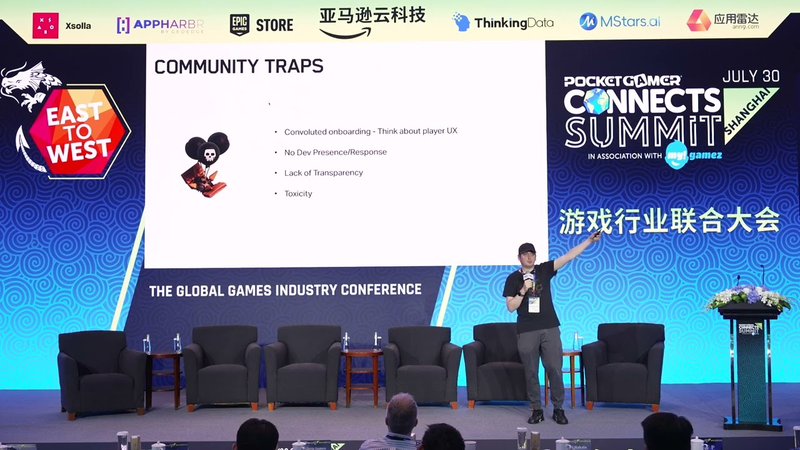
Supercell's Vladislav Perge talks Community Management In 2025
Community management in 2025 requires a shift from traditional, scripted PR approaches toward authentic, human-centric engagement.
- Effective community management in 2025 requires moving away from formal, PR-style communication like 'Dear players' in favor of authentic, human-to-human interaction.
- Community managers should prioritize identifying and nurturing passionate, grassroots content creators over those with high follower counts, as passion is a more reliable indicator of long-term community growth.
- Transparency is critical to preventing toxic speculation; if a game issue arises, developers should immediately acknowledge the problem and signal that it is being addressed, even if a final solution is not yet ready.
Market Model Reports: Asia & MENA
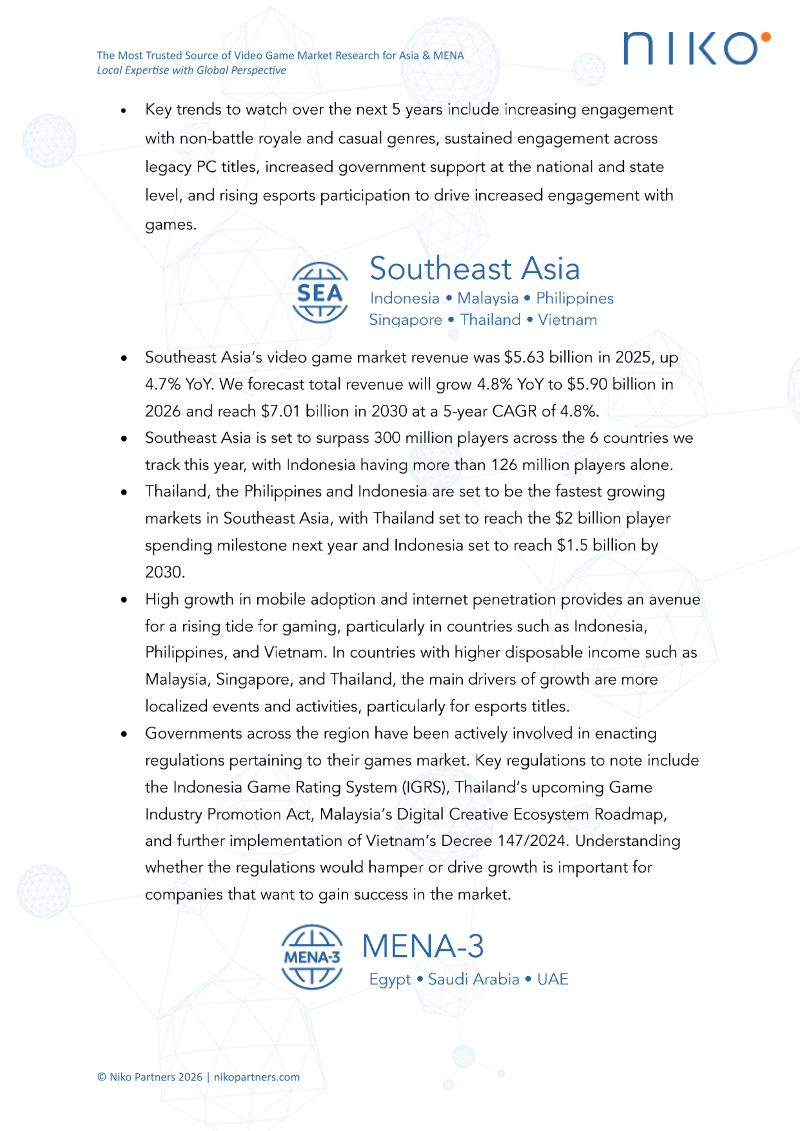
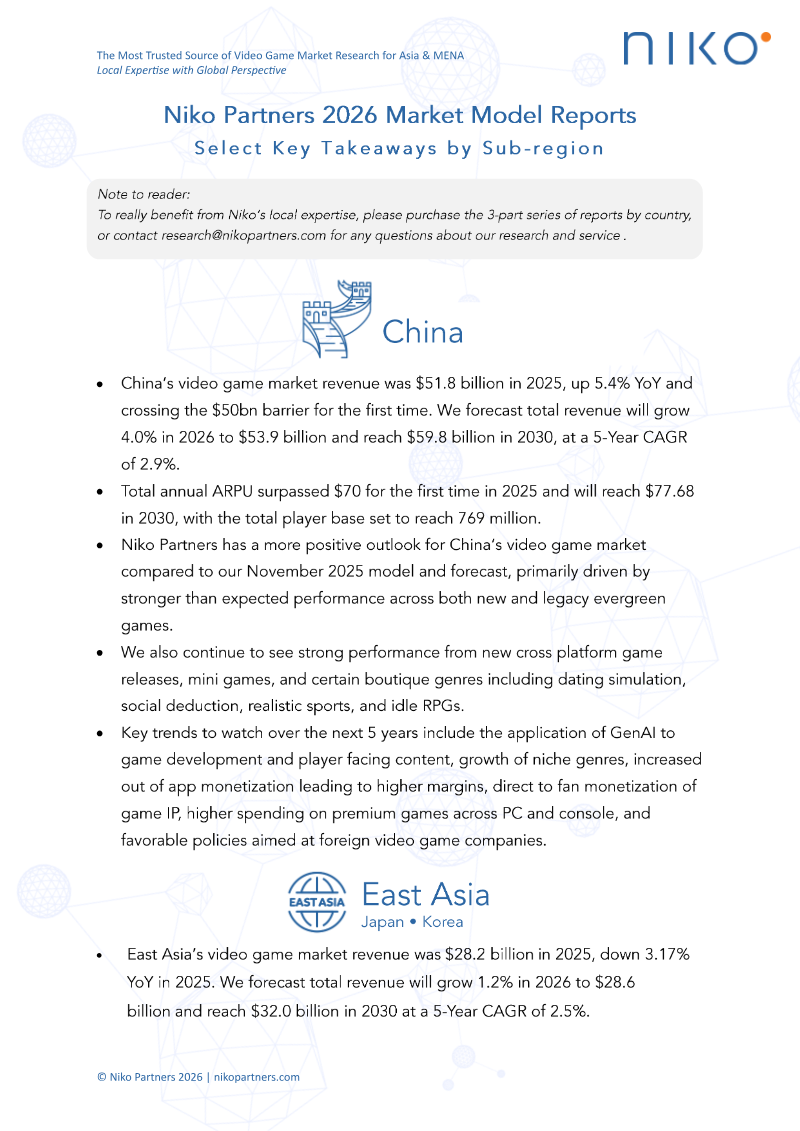
The 2026 Market Model Reports provide a comprehensive analysis of video game industry performance and growth projections across Asia and the Middle East and North Africa (MENA).
- China’s video game market reached $51.8 billion in 2025 and is projected to grow at a 2.9% CAGR to reach $59.8 billion by 2030.
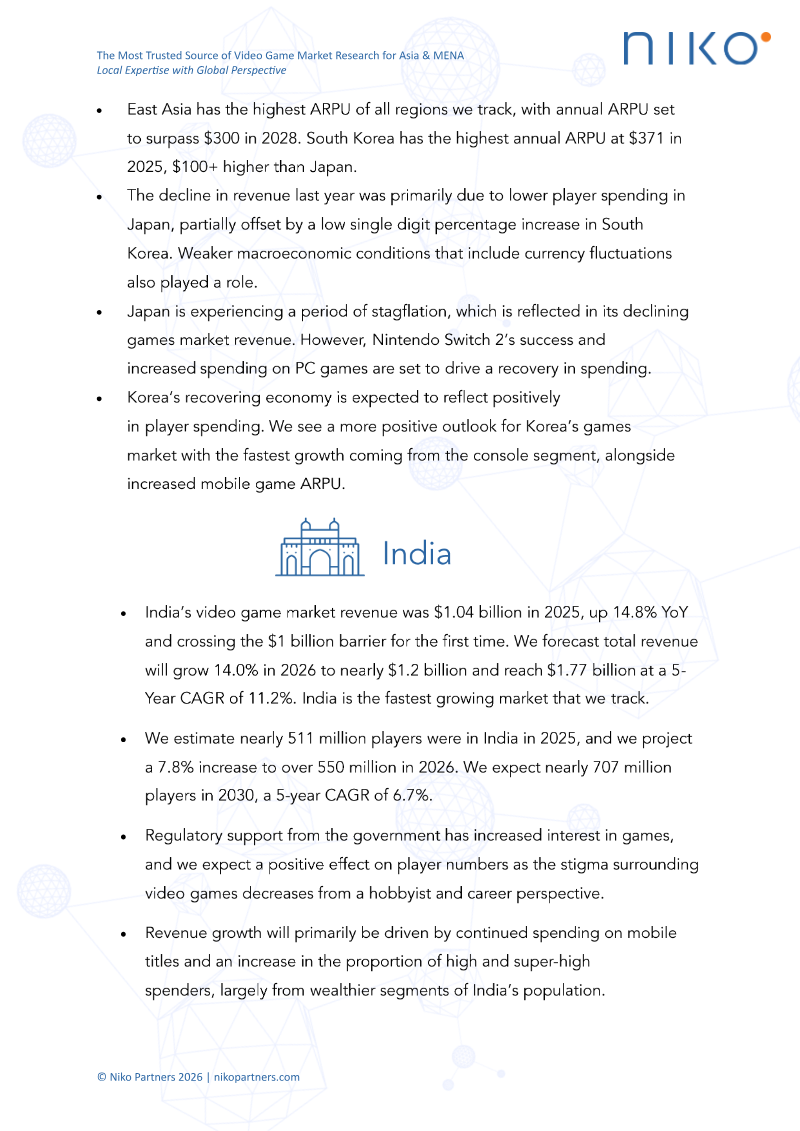
- India is the fastest-growing market tracked, with 2025 revenue of $1.04 billion and a projected 11.2% CAGR through 2030, supported by a player base expected to reach 707 million.
- East Asia remains the region with the highest ARPU, though 2025 revenue declined 3.17% to $28.2 billion due to Japanese market stagnation and macroeconomic conditions.

Cracking the Code: What Drives Korean Games Performance in Vietnam
The performance of Korean games in the Vietnamese market is defined by a strategic trade-off between audience scale and execution complexity.
- Long-term retention in the Vietnamese market depends on onboarding depth, device accessibility, and perceived monetization fairness rather than initial download volume driven by IP or visuals.
- Monetization models that create power gaps or undermine competitive fairness in PvP titles lead to significant player churn and loss of trust.
- Successful Korean games in Vietnam cluster into four specific archetypes: AAA grind-driven RPGs, nostalgia-driven MMORPGs, PvP-heavy MMOs, and niche strategy RPGs.

Cell Survivor Review: When UA creative meets hardcore spend depth!
Cell Survivor represents a significant evolution in the mobile survival genre, successfully scaling to approximately $300,000 in daily revenue by blending complex, hardcore progression systems with aggressive monetization tactics.
- Cell Survivor has achieved approximately $300,000 in daily revenue by targeting a hardcore audience with complex progression and aggressive monetization.
- The game currently holds the position of the second-largest title in the tower defense segment.
- User acquisition relies on high-intensity, diverse creative assets including medical-horror imagery, pop-culture crossovers, and AI-generated designs tailored to regional aesthetics.

Dragon traveler Review: The Waifu IDLE RPG doing $500k/day
Dragon Traveler has emerged as a dominant force in the mobile idle RPG sector, achieving consistent daily revenues between $300,000 and $500,000.
- Dragon Traveler generates $300,000 to $500,000 in daily revenue by targeting the global idle RPG market with high-fidelity anime aesthetics.
- The developer maintains a massive advertising footprint by deploying over 6,500 distinct creative assets across platforms including Facebook and Google.
- User acquisition strategies utilize anime tropes and cosplayer imagery, specifically curated and censored to meet Western platform compliance standards while retaining broad appeal.

Google’s Thomas Zybulski & Saejoon Oh on APAC’s New Wave: Data, Fintech & Vietnam’s Rising Talent
The Asia-Pacific (APAC) mobile app and gaming ecosystem is currently defined by a transition toward data-driven decision-making and the diversification of business models.
- APAC developers are increasingly adopting data-driven decision-making and scientific measurement to differentiate their apps in an oversaturated market.
- Non-gaming sectors, particularly fintech and finance companies, are aggressively entering the ad monetization space to better understand user behavior and maximize Lifetime Value (LTV).
- Rising user acquisition costs post-COVID are forcing developers to move beyond traditional models and innovate with new business models, genres, and service offerings.

GoldenEye and TimeSplitters creators return: “Maybe this isn’t what we should be doing”
The modern gaming industry is currently defined by a fundamental tension between the instability of large-scale production and the enduring dominance of legacy content.
- Over 50% of all current gaming activity is dedicated to titles that are at least six years old, highlighting the market's heavy reliance on legacy content.
- New game releases, excluding annualized sports franchises, are struggling to capture even 1% of the active player base.
- Major publishers are increasingly pivoting toward remakes and established live-service ecosystems to secure revenue as consumers prioritize massive backlogs over new, full-priced titles.

8 Trends That Will Redefine Gaming in Asia (and Beyond)
The gaming landscape across Asia and the Middle East is undergoing a profound transformation, driven by evolving regulatory frameworks, shifting consumer behaviors, and a move toward decentralized distribution models.
- India’s gaming market is projected to reach 750 million gamers by 2029, necessitating a shift from simple translation to deep hyper-localization and culturally resonant content.
- Alternative distribution channels now account for nearly 37% of mobile revenue in Southeast Asia, driven by lower transaction costs and the widespread use of localized digital wallets.
- China’s regulatory environment is becoming more supportive for international developers through government subsidies and new pilot programs, despite ongoing restrictions on youth gameplay.

Europe and Asia Game Industry is Booming! | Games ReCAP
The global video game industry is currently experiencing a significant geographic shift, characterized by a sharp decline in North American operations contrasted against robust growth in Europe and Asia.
- California is experiencing a disproportionate contraction, accounting for 54% of global industry job cuts despite representing only 25% of the total workforce.
- North American operations are under significant pressure, with 71% of the region's total job losses occurring between 2024 and 2025 due to high operational costs and remote work shifts.
- European and Asian markets are showing consistent growth, with annual revenue increasing by 3% to 4% and mobile gaming market share rising from 41% in 2023 to 44% in 2024.