World of Warcraft
Documents about World of Warcraft

The Games Industry's China Syndrome
The analysis examines the growing tension between the global expansion of the video game industry and the geopolitical realities of operating within the Chinese market.
- The 2019 suspension of Hearthstone player Ng 'blitzchung' Wai Chung by Activision Blizzard exemplifies the conflict between Western corporate values of free expression and the economic necessity of maintaining favor with Chinese regulators and partners like Tencent.
- China represents a critical market for the gaming industry, evidenced by the fact that approximately half of the global World of Warcraft player base resides within the country.
- The gaming industry is experiencing a maturation phase similar to Hollywood and the NBA, where companies can no longer maintain political neutrality while operating in polarized geopolitical environments.
Publishers Playing Politics
This analysis examines the intersection of corporate interests and political expression within the global video game industry, focusing on the 2019 controversy involving Activision Blizzard and the Hong Kong protests.
- Major video game publishers face a growing conflict between upholding Western democratic values and maintaining access to the lucrative, protectionist Chinese market.
- Activision Blizzard’s 2019 decision to ban professional player Ng 'blitzchung' Wai Chung for supporting Hong Kong protests highlights the prioritization of Chinese market stability over Western workforce and consumer values.
- Approximately 50% of the World of Warcraft player base resides in China, creating a significant financial dependency that influences corporate decision-making.
xCloud: Next's Move
This analysis examines the shifting landscape of the global gaming industry during late 2019, focusing on the transition toward cloud-based infrastructure, 5G integration, and the evolving business models of major publishers.
- Microsoft is positioning Project xCloud to dominate the cloud gaming sector by delivering console-quality experiences to mobile devices, supported by strategic partnerships with SK Telecom in the US, UK, and South Korea.
- The long-term success of cloud gaming platforms hinges on choosing between a high-end, curated content strategy or a high-volume, Netflix-style subscription model.
- Activision Blizzard saw a 223% monthly increase in subscription revenue following the launch of World of Warcraft Classic, though the franchise's year-to-date revenue remains down by approximately one-third.

Cloud Contenders Are Gathering Support: Team Up to Stand Out
The gaming and technology sectors are currently navigating a transition from unstructured growth toward a period of consolidation, regulatory scrutiny, and strategic alliances.
- The gaming industry is shifting toward strategic international alliances to manage high cloud infrastructure costs, exemplified by Tencent’s partnership with Razer and Microsoft’s 5G-focused collaboration with SK Telecom.
- Regulatory scrutiny is intensifying, highlighted by the FTC’s $170 million fine against Google for COPPA violations, signaling a broader industry challenge regarding data privacy and child safety.
- Macroeconomic headwinds, specifically US-China trade tensions and impending tariffs on electronics and consoles, are expected to significantly increase retail costs during the 2019 holiday season.
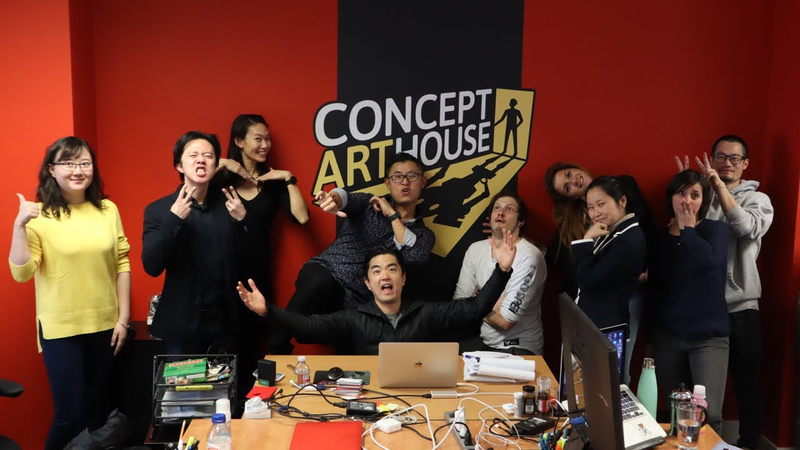
From Artist to CEO | Concept Art House Origin Story and Inside Tour
Concept Art House is a high-end art service provider for the gaming industry, specializing in concept art, illustration, 3D modeling, and marketing assets.
- Concept Art House, founded in 2006, has scaled from a six-person team to over 70 staff members, providing art services for major clients including Blizzard, EA, Sony, and Wizards of the Coast.
- The mobile gaming sector drives 70% of the company's output, with production budgets for individual mobile titles now reaching as high as $40 million.
- The studio operates a distributed business model with a San Francisco headquarters and significant production facilities in Shanghai, utilizing Jira, Shotgun, and Basecamp to manage international workflows.

Games You Might Not Have Tried - ep 20 - April 1st Edition! - Extra Credits
This presentation serves as a satirical April Fools' Day commentary on the gaming industry, framing well-known, mainstream titles as obscure "hidden gems."
- Modern game design frequently prioritizes player retention, microtransactions, and repetitive loops over traditional innovation.
- Mainstream titles like Madden NFL, World of Warcraft, Fortnite, and Apex Legends are often structured around cynical monetization strategies rather than novel gameplay experiences.
- The 'hidden gem' genre of gaming journalism is often used to recontextualize ubiquitous, commercially successful titles, highlighting the industry's reliance on established tropes.
Gamer Motivation Model: Updated Reference Sheets
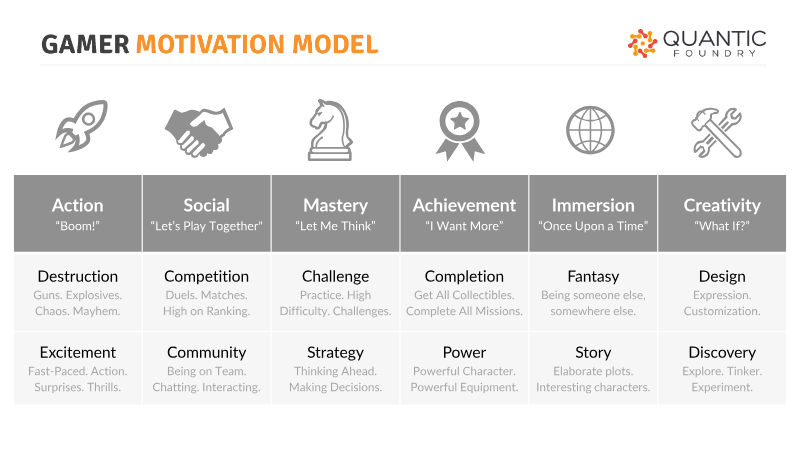
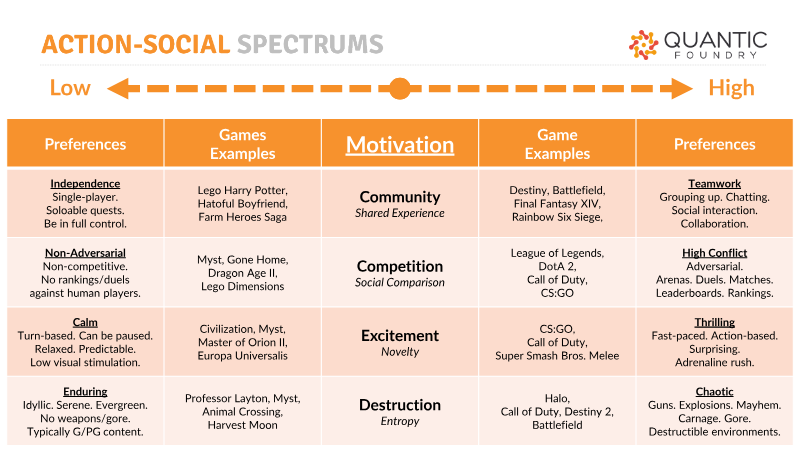
The Gamer Motivation Model provides a comprehensive framework for understanding player behavior by categorizing gaming preferences into three primary clusters: Action-Social, Mastery-Achievement, and Immersion-Creativity.
- The Gamer Motivation Model categorizes player behavior into three primary clusters: Action-Social (Bright), Mastery-Achievement (Tall), and Immersion-Creativity (Wide).
- Player preferences are defined by six core sub-categories—Action, Social, Mastery, Achievement, Immersion, and Creativity—which function as sliding scales rather than binary choices.
- The model uses specific spectrums, such as Destruction versus Excitement and Completion versus Power, to diagnose how individual game mechanics align with player psychological drivers.
World of Warcraft Epidemiology - The Corrupted Blood Plague (And Why It Matters) - Extra Credits
The 2005 Corrupted Blood incident in the massively multiplayer online game World of Warcraft serves as a significant case study in epidemiology and human behavior during a pandemic.
- The 2005 World of Warcraft 'Corrupted Blood' incident serves as a critical case study for epidemiologists because it provided rare, observable data on human social behavior during a large-scale contagion.
- The outbreak was triggered by a programming oversight in the Zul'Gurub raid zone, allowing a lethal contagion to escape containment via player pets and spread into major virtual population hubs.
- The simulation revealed a spectrum of human responses to pandemics, ranging from altruistic efforts like establishing healing stations and informal quarantines to malicious intentional spreading of the disease.
How an Outbreak in WoW is Helping Epidemiologists Create Better Disease Models
The 2005 Corrupted Blood plague in World of Warcraft serves as a foundational case study for modern epidemiological research, demonstrating how virtual environments can provide unique insights into human behavior during public health crises.
- The 2005 'Corrupted Blood' plague in World of Warcraft, caused by a design flaw in the Zul'Gurub raid, provided epidemiologists with a unique, real-world dataset to study human behavior during an infectious disease outbreak.
- Traditional epidemiological models often fail because they rely on static assumptions about human behavior, such as how individuals will react to quarantine orders or emergency information.
- Virtual environments like World of Warcraft allow researchers to observe diverse, unscripted human responses to a crisis, including altruism, curiosity-driven risk-taking, malicious griefing, and the spread of misinformation.
How World of Tanks and World of Warcraft went mobile
The transition of established PC gaming titles to the mobile platform requires a strategic balance between leveraging existing brand equity and adapting to the unique constraints of mobile consumption.
- Brand equity alone cannot compensate for poor synergy between game design and monetization; success requires tailoring both mechanics and revenue models specifically for mobile constraints.
- Successful mobile adaptations like Hearthstone expand reach by refining mechanics to attract both existing fans and new demographics simultaneously.
- World of Tanks Blitz demonstrates that maintaining core PC gameplay is viable on mobile if developers successfully optimize control schemes for touchscreen interfaces.

Legacy Play - Thoughts on the Vanilla WoW Server - Extra Credits
The tension between developer control over live-service software and consumer desires for historical preservation is a central conflict in the modern gaming industry.
- The conflict between developer control and historical preservation arises because live-service updates effectively overwrite original versions of games, rendering them inaccessible to consumers.
- Developers prioritize a single, current build to streamline customer support, ensure security, and maintain a unified community, while avoiding the technical burden of managing fragmented codebases.
- High engagement on unofficial legacy servers indicates a significant, untapped market demand for official, developer-sanctioned classic experiences.
Quest Design - I: Why Many MMOs Rely on Repetitive Grind Quests - Extra Credits
Modern massively multiplayer online (MMO) games frequently rely on a repetitive cycle of five core quest types: kill, fetch, FedEx, collect, and escort.
- Modern MMO quest design relies on a repetitive cycle of five core tasks—kill, fetch, FedEx, collect, and escort—which function primarily as navigational tools rather than engaging experiences.
- The current industry standard, popularized by World of Warcraft, prioritizes efficiency and standardized UI markers over the discovery-based exploration found in earlier titles like EverQuest.
- By treating quests as mechanical conduits for leveling and rewards, developers often reduce the player journey to a repetitive treadmill that lacks intrinsic enjoyment.