1 free read left. Create a free account for unlimited reading + AI research.
Create free account
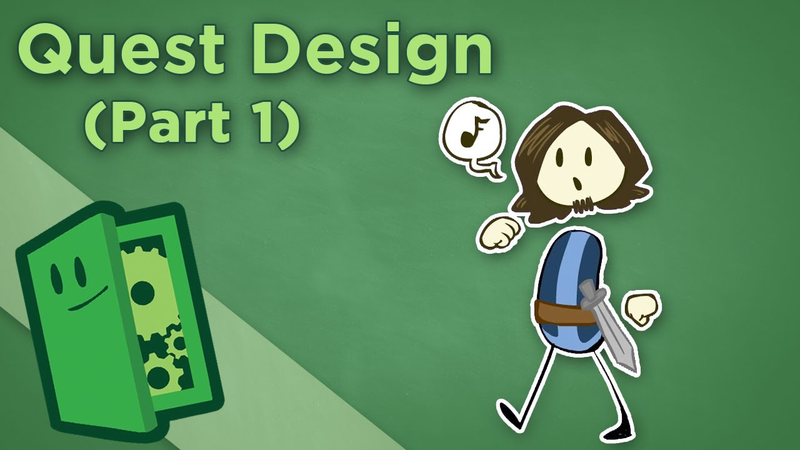
Quest Design - I: Why Many MMOs Rely on Repetitive Grind Quests - Extra Credits
Key insights
5 takeaways- 01Modern MMO quest design relies on a repetitive cycle of five core tasks—kill, fetch, FedEx, collect, and escort—which function primarily as navigational tools rather than engaging experiences.
- 02By treating quests as mechanical conduits for leveling and rewards, developers often reduce the player journey to a repetitive treadmill that lacks intrinsic enjoyment.
- 03The current industry standard, popularized by World of Warcraft, prioritizes efficiency and standardized UI markers over the discovery-based exploration found in earlier titles like EverQuest.
- 04Earlier MMO design philosophies encouraged players to engage with the environment through active inquiry and observation, treating quests as gateways to historical and mythological depth.
- 05Effective future quest design requires moving away from automated, task-oriented objectives to foster meaningful interactions that integrate lore and world-building into the core gameplay loop.
Ask AI about this video
Transcript
You know, we haven't talked about MMOs in a while, and I don't think we've ever really talked about quest design as a whole. So, today we're going to start tackling that subject. We'll probably be referencing The Secret World a lot in this episode, because even though it is woefully unpolished, horribly buggy, and it occasionally has UI design that hasn't been acceptable since the '80s, it is hands-down the best example of quest design that I have seen in an MMO. And it does more to deliver powerful narrative moments and immersive experiences than MMOs with far bigger budgets and far better graphics. We are going to try to keep this episode totally comprehensible without any prior knowledge of the game. But, if you're interested in quest design and you haven't played Secret World, I'd recommend it as an incredible opportunity to learn. All right, then. Let's start with the basics. Very often, quest design is limited to a few standard types of activities. One, kill quests, which are kill X number of critters. Two, fetch quests, or go and bring me this thing. Three, FedEx quests, or go and deliver this thing to
this place. Four, collect quests, which are go get X number of things. Although, usually this is just an arbitrary layer on top of the standard kill quest. And five, escort quests, which are really just a variant of the FedEx quest with an irritatingly slow-moving NPC that you have to keep alive. So, why? Why are there pretty much five types of quests that make up 90% of MMO quest design? It's because many designers conceptualize their games as only being about combat and traversal. And with only those two levers, there's a limited amount that you can really do. Moreover, there's a limited amount you have to teach your player to do. You see, most MMO quests are used to direct the player through the experience, rather than to be engaging in and of themselves. Kill quests direct you toward more appropriate mobs for you to be fighting at your level. FedEx quests direct you to the next zone you should be in. Fetch quests teach you the hubs you need to know about in the zone you're in, and so on. And therein lies the problem. If you see the quest system simply as a way to propel the player through the treadmill of leveling, if you see the quests primarily as a way to funnel players to the mobs they'll have to grind and through the places they'll have to pass to get to the max level, then you are doing it all wrong. The quests
themselves should be something that the player wants to do, inherently, not just for the reward. Historically, this type of thinking really only became the norm in the World of Warcraft era. Prior to WoW, MMOs were either largely undirected like Ultima Online or their quests were about exploration like in EverQuest. In EverQuest, you didn't have a quest log in the modern sense and you didn't simply click on an NPC with an exclamation point over their head in order to get a quest. Instead, you had to talk to the NPC. You would hail them in chat and if you said specific words to them, they would let you know about a quest. So, for example, you'd walk up to a barkeep and you'd say, "Hail." And he might say back, "Uh, fancy a bite to eat or are you here to deal with the rats?" And the word rats would be in brackets, see? And if you replied, "I'm here to deal with the rats." then he'd tell you that he'd give you two silver for every rat tail you brought him and hand you a key to the cellar. But where it really got interesting was in finding out the things that the game didn't draw attention to. Uh, for example, later in your journey, you fight your way down to the bottom of a gnoll cave. And you just happen to dive into the lake at the deepest level. At the bottom of the lake, there's just a ring sitting there, no explanation. The ring has okay stats,
I guess, but the item description has some flavor text that tells you, on the inside, the ring reads, "A promise for a lifetime." Hm, interesting. Maybe you decide to wear it for a while. Then, one day, you encounter someone in another town who tells you a story of a girl who threw herself off the gnoll cliffs after her husband was killed by the city guards. Without the game giving you any hints or prompting, you ask them about a ring in chat and he tells you that the deceased girl was the barkeep's daughter and she had a ring inscribed with "A promise for a lifetime" from her beloved. You then return to the barkeep and in the trade window, you give him the ring and he starts you on an adventure across continents to finally bring rest to his daughter's soul. It may be a little hyperbolic to say so, but the game was about understanding the world and using the lore to solve problems. It was about being inquisitive and about rewarding the player for being curious about the people and the places in this world. Objects weren't just about stat gain and quests weren't just about gear and leveling. The goal here was to change how the player thought about the world and to get them to engage with it as a living thing rather than a game object. It was also to
encourage curiosity. It was built to get the player not only searching out the world in terms of physical space, but also trying different interactions with NPCs in order to discover the historical or mythological space of this world. Alas, we have gotten James started writing about EverQuest, and now we haven't even started talking about The Secret World yet. Next week, we will give a few more examples of quest design that stray from the usual kill or FedEx variety. Which means we will be talking about The Secret World quite a lot. Additionally, we'll be talking about the problem that clumping up quests causes, as well as why allowing the player to carry dozens of quests at once is actually detrimental. I hope you didn't mind the EverQuest ramble, and I hope you stick with us for part two next week.
Summary
Modern massively multiplayer online (MMO) games frequently rely on a repetitive cycle of five core quest types: kill, fetch, FedEx, collect, and escort. This design paradigm treats quests primarily as navigational tools to funnel players through leveling zones and combat encounters, rather than as engaging, self-contained experiences. By conceptualizing the game world solely through the lenses of combat and traversal, developers often reduce the player’s journey to a mechanical treadmill where the quest itself is merely a vehicle for rewards rather than a source of intrinsic enjoyment.
This approach contrasts sharply with earlier MMO design philosophies, such as those found in EverQuest. In these older systems, quest discovery was not prompted by standardized UI markers like exclamation points, but by active player inquiry and interaction with the environment. Players were encouraged to explore, converse with non-player characters, and piece together narrative threads through observation and curiosity. In this model, items and quests served as gateways to historical and mythological depth, transforming the game world into a living, reactive space that rewarded inquisitive behavior rather than simple task completion.
The current industry standard, which gained prominence during the World of Warcraft era, prioritizes efficiency and direction over discovery. By automating the quest-giving process and standardizing objectives, developers have streamlined the player experience at the cost of immersion. Moving forward, effective quest design requires shifting the focus away from using quests as mere conduits for leveling and toward creating meaningful interactions that encourage players to engage with the world’s lore and history as an essential component of gameplay.
















Comments