1 free read left. Create a free account for unlimited reading + AI research.
Create free accountReport Quantic Foundry
1 free read left. Create a free account for unlimited reading + AI research.
Create free accountReportQuantic Foundry
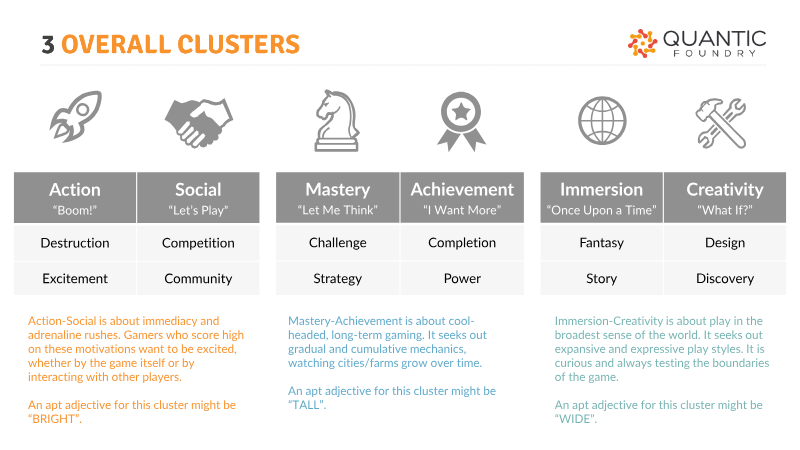
These clusters are Action-Social (Bright), Mastery-Achievement (Tall), and Immersion-Creativity (Wide). They represent distinct psychological drivers for engaging with games.
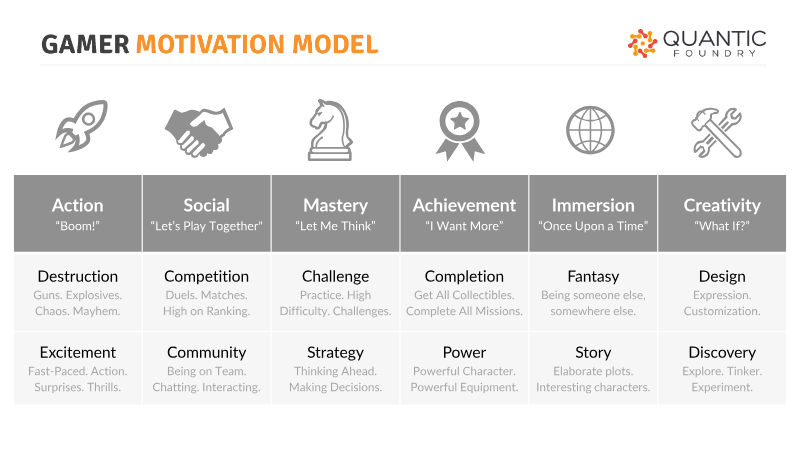
The Gamer Motivation Model provides a comprehensive framework for understanding player behavior by categorizing gaming preferences into three primary clusters: Action-Social, Mastery-Achievement, and Immersion-Creativity. These clusters represent distinct psychological drivers, ranging from the immediate adrenaline of competitive play to the long-term, contemplative satisfaction of strategic planning and world-building. By mapping these motivations, the model offers a structured approach to analyzing why players engage with specific game mechanics and how different design choices cater to varied player profiles.
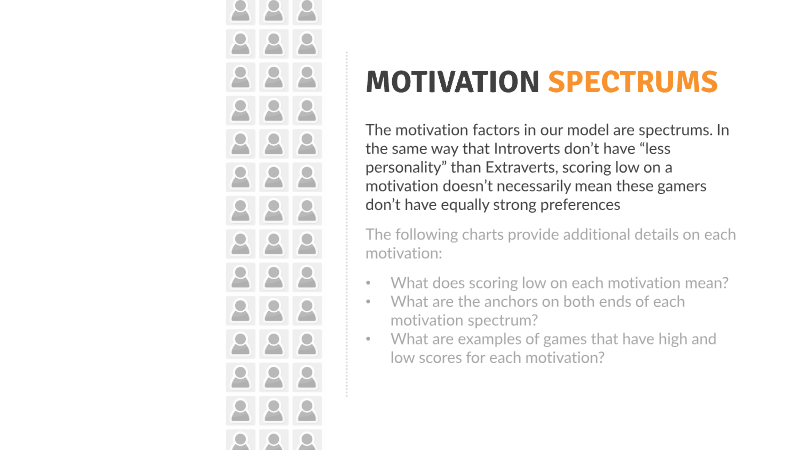
The model organizes these motivations into six core sub-categories: Action, Social, Mastery, Achievement, Immersion, and Creativity. Each category is further defined by specific spectrums, such as Destruction versus Excitement, or Completion versus Power. These spectrums demonstrate that player preferences are not binary; rather, they exist on a sliding scale where low scores in one area do not indicate a lack of engagement, but rather a preference for different gaming experiences. For instance, a player might prioritize the calm, non-adversarial nature of a simulation game over the high-conflict, fast-paced environment of a competitive shooter.
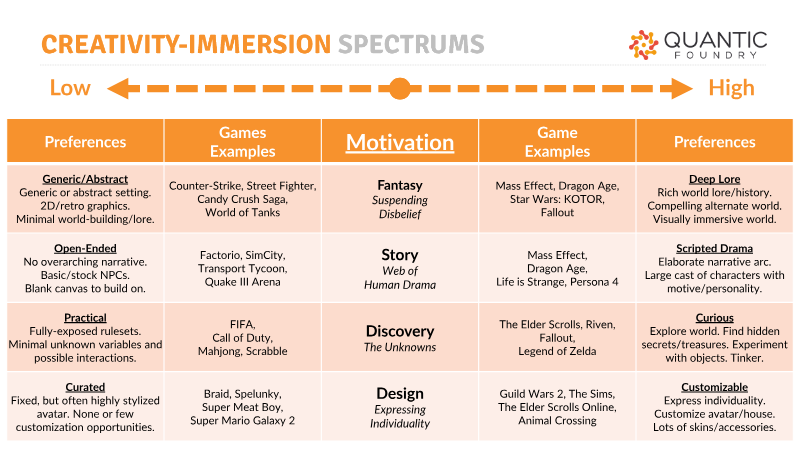
Methodologically, the model utilizes these spectrums to categorize a wide array of titles, ranging from indie games like Stardew Valley to major franchises like Call of Duty and World of Warcraft. By identifying the anchors on both ends of each spectrum, the framework serves as a diagnostic tool for developers and analysts to evaluate how game mechanics—such as progression systems, narrative depth, or social interaction—align with target audience motivations. Ultimately, the model characterizes the gaming landscape as a multifaceted ecosystem where "Bright" (Action-Social), "Tall" (Mastery-Achievement), and "Wide" (Immersion-Creativity) playstyles define the diverse ways individuals interact with digital worlds.
Quantic Foundry · 2026
Quantic Foundry · 2025
Quantic Foundry · 2025
Quantic Foundry · 2025
Quantic Foundry · 2025
Quantic Foundry · 2024
Quantic Foundry · 2023
Quantic Foundry · 2023
Quantic Foundry · 2023
Quantic Foundry · 2021
Quantic Foundry · 2021
Quantic Foundry · 2021