1 free read left. Create a free account for unlimited reading + AI research.
Create free account
World of Warcraft Epidemiology - The Corrupted Blood Plague (And Why It Matters) - Extra Credits
Key insights
6 takeaways- 01The outbreak was triggered by a programming oversight in the Zul'Gurub raid zone, allowing a lethal contagion to escape containment via player pets and spread into major virtual population hubs.
- 02The simulation revealed a spectrum of human responses to pandemics, ranging from altruistic efforts like establishing healing stations and informal quarantines to malicious intentional spreading of the disease.
- 03Researchers identified that the presence of asymptomatic NPC carriers significantly complicated containment efforts, mirroring the real-world challenge of tracking silent transmission.
- 04The 2005 World of Warcraft 'Corrupted Blood' incident serves as a critical case study for epidemiologists because it provided rare, observable data on human social behavior during a large-scale contagion.
- 05Despite the lack of permanent consequences in the game, the event demonstrated that virtual worlds function as unique, low-risk laboratories for modeling complex social variables during health crises.
- 06The study of this event helps academics refine public health strategies by providing data on human reactions to infection risks that are historically limited in real-world settings.
Ask AI about this video
Transcript
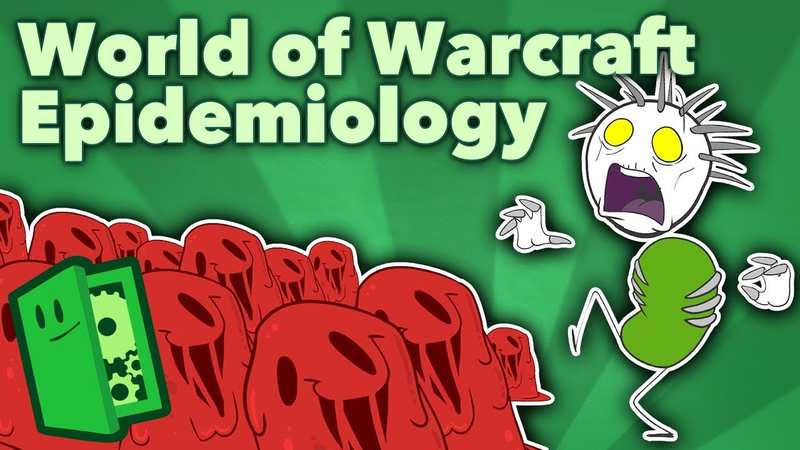
Welcome one and all to a nice fireside tale of death and epidemics. Now, since we've been covering a lot of real-life plagues on Extra History, we figured we'd cover a virtual one here. One that shook the largest game in the world to its core, and in the process, provided scientists with data that may help save actual lives in the future. Thanks so much to Squarespace for sponsoring this episode. Click the link in the description below to see just how perfect Squarespace is for your next online idea. Now, let's turn this way-back machine all the way back to September 13th, 2005. Far to the south, far from the halls of Stormwind or the furnaces of Ironforge, a group of adventurers find an ancient ruin deep in the jungles of Stranglethorn. It is a forgotten troll city, but one powerful troll priest has,
in secret, been using it as a ritual site to bring a dark god back from beyond. The adventurers fight their way through the abominations and overcome horrible traps to at last face this ancient evil. With a mighty cry, they engage the malignant deity. With their magics learned from a lifetime of study and their weapons scoured from the deepest delves, they strike at it. But one by one, they start to sicken. There is a corruption this god has brought into the world. But these are true heroes, champions of Azeroth. They battle through the sickness and at last overcome the ancient evil hiding in the jungle temple grounds. Their clerics, great healers all, cure the wretched contagion that has seized so many of their band. And world saved, they set out for home. But no one remembered to cure the hunter's pet. As is true so often in real life, the
pet was the carrier. When high-level groups raiding Zul'Gurub would return to use the bank or sell their loot in major cities, the pets and minions they brought with them would carry the disease, and vast outbreaks would occur. The disease was called corrupted blood, and it was intended only to affect groups within Zul'Gurub, one of the hardest zones at the time, meaning that it packed quite a punch. Not enough to kill off level-capped raid players, mind you, but certainly enough to obliterate low-level characters. Luckily, that wasn't something anyone at Blizzard had ever had to worry about because it was supposed to be contained to only an end-game zone. But due to the bug that let the pets carry it out of the zone, the moment the high-level players returned to the cities that plenty of low-level players passed through, it just decimated the population. Both Horde and Alliance capitals, Stormwind and Orgrimmar, were filled with the unburied dead. Corpses and skeletons littered the streets. And then
people acted, well, like people, which is what makes this event so interesting. This is what made scientists study the outbreak because even though it was just a game, so much real-world behavior occurred. Players started to flee the cities, to abandon them for fear of the plague. In doing so, they brought the plague with them, moving along travel routes to smaller and smaller outposts. Quarantines were set up, but one by one, the quarantines were breached. Sometimes by sick players trying to get out of the perpetual cycle of dying and respawning in affected areas, sometimes by players transporting pets they were unaware had the plague. Altruistic players worked together to set up healing stations, or even just rush in to try to cure low-level players that had contracted the plague. But especially in the less organized of these efforts, healers rushing in to save new players would often accidentally contract the disease themselves, and became a vector for the
very disease they were trying to stave. Other players decided that, sick or not, they still needed to make money. So, they did the equivalent of going to work. They'd send their plagued character to the auction house to try to get some transactions done, and ended up spreading the disease to everyone around them. Worse still, NPCs in the game functioned as asymptomatic carriers. An NPC could contract the disease, but they had enough health they wouldn't die. And the disease had no visible effects, meaning there was no way to tell they had the disease. Just like in real life, where sometimes people carry a disease without it actually affecting them. And because these NPCs were asymptomatic carriers, it meant that when someone went to work sick and walked up to one of those auctioneers, they'd infect that auctioneer. And someone coming into the auction house after them might contract the plague from the auctioneer without even knowing the NPC had it.
There was also an organized effort to have people flag themselves as infected if they caught the plague, in order to help with quarantines and allow new players for whom the disease would be fatal to avoid them. This system broke down, too, though, because some players would intentionally try to infect anyone without the disease, which led uninfected players to start flagging themselves as infected so people wouldn't intentionally try to make them sick, rendering the whole system useless. In the end, Blizzard had to do a hard reset on the servers and roll out some new patches, because unlike a disease in real life, in WoW, players respond. Meaning the disease could essentially go on forever, which is one place where studying things like this breaks down. Interestingly, though, we get another real-world analog here. If you think of high-level players, players who could survive the plague, as healthy adults, and low-level players as vulnerable populations such as children or the elderly. If players couldn't respawn, the plague
was so deadly that it would have burnt itself out rather quickly, though leaving quite the body count behind. Which brings us to the last point. This event has been the subject of a number of academic papers. Why? Because pandemics are, thankfully, rare. But that means we don't have a lot of data on them, especially how humanity behaves during them. Virtual environments like World of Warcraft provide a unique opportunity for scientists and researchers to get insight into an absolutely vital area of study without the immense real-world toll. And virtual studies will be, by their nature, imperfect. And every scientist talking about this mentions how clearly they recognize this going on. But given how the Warcraft community seemed to treat it like a real plague, even though the stakes were seemingly so low, there's data to be gained, and that's an incredible thing. I'd love to see an MMO company team up with researchers for something like this, because the more we know, the less
lives the next big outbreak will take. And considering none of us get real-life respawns, that's a quest I'm willing to be a part of. Until next time. Once again, thanks so much to Squarespace for sponsoring this episode. Not only do they make it easy for our team at Extra Credits to share updates and have a clean and professional-looking website, but I've been using Squarespace for my personal online endeavors for years. And because I truly know nothing about web design, their awesome templates have helped my ideas look way cooler than they actually are for a while now. Plus, I can attest to their great 24/7 customer support, as well. A few years ago, I was going in for an interview, and I needed to embed a piece of content to my site. I had no idea how to do it, and once I contacted them, we figured it out in like 10 minutes. And with domain transfers, online storefronts, and their all-in-one platform, which looks slick no matter where you view your content, there's no better place to make your next online dream a reality than Squarespace.
Summary
The 2005 Corrupted Blood incident in the massively multiplayer online game World of Warcraft serves as a significant case study in epidemiology and human behavior during a pandemic. The event originated as a programming oversight within the Zul'Gurub raid zone, where a contagion intended to be contained within a specific high-level area was inadvertently carried into major population hubs by players' pets. Because the disease was lethal to low-level characters and highly transmissible, it rapidly decimated the game's virtual population, creating a chaotic environment that mirrored real-world public health crises.
The outbreak provided researchers with valuable data regarding human social dynamics during a contagion. Players exhibited a wide range of behaviors, including altruistic efforts to establish healing stations, the formation of informal quarantines, and the abandonment of major cities. Conversely, the simulation also captured negative social responses, such as the intentional spreading of the disease by malicious actors and the continued pursuit of economic activities at auction houses despite the risk of infection. The presence of asymptomatic NPC carriers further complicated containment efforts, mirroring the challenges of tracking silent transmission in real-world epidemiology.
Academics have utilized this event to study pandemic modeling because real-world data on human behavior during large-scale outbreaks is historically limited. While the virtual environment differs from reality—most notably through the mechanics of player respawning and the lack of permanent consequences—the study highlights the utility of virtual simulations in predicting how populations react to health threats. By analyzing these digital interactions, researchers aim to refine public health strategies, suggesting that virtual worlds offer a unique, low-risk laboratory for understanding the complex social variables that influence the spread and management of infectious diseases.






















Comments