The Game
Game
Documents about The Game
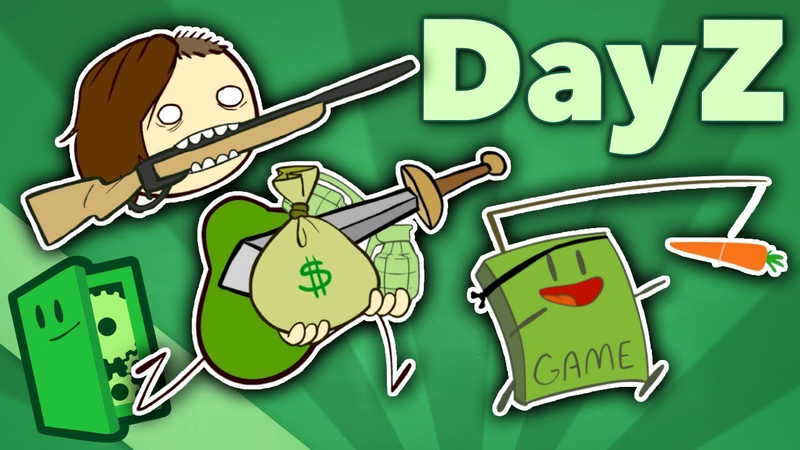
DayZ - Tragedy of the Commons: The Game - Extra Credits
The tragedy of the commons serves as a foundational economic and ecological theory, illustrating how individual self-interest often leads to the depletion of shared resources, ultimately harming the collective and the individual alike.
- The 'tragedy of the commons' occurs in multiplayer survival games like DayZ when individual mistrust and fear of scarcity lead players to hoard resources and attack others, ultimately destroying the collective environment.
- Multiplayer environments disrupt the long-term strategic resource management typically found in single-player games because players assume bad faith from others, triggering a self-fulfilling cycle of competition and waste.
- Traditional solutions to resource depletion, such as privatizing assets or implementing punitive enforcement, often fail to solve the problem efficiently due to high overhead costs and reduced system utility.

Raport Bieżący Nr 84/2017
The management of PlayWay S.A. outlines a strategic roadmap for game releases scheduled for the six-month period following November 2017.
- PlayWay S.A. is executing a multi-platform expansion strategy through mid-2018, targeting PC, Xbox One, PlayStation 4, and mobile markets.
- Key upcoming releases for the six-month period following November 2017 include Agony, House Flipper, Uboot, and Ultimate Fishing Simulator.
- The company is porting established titles, specifically 911 Operator and Gold Rush: The Game, to console platforms to diversify its distribution.

Raport Bieżący Nr 72/2017
PlayWay S.A. has expanded its strategic partnership with Koch Media GmbH through a formal amendment to their existing distribution agreement, originally established in September 2014.
- PlayWay S.A. has expanded its 2014 distribution agreement with Koch Media GmbH to grant the Austrian firm exclusive global rights for physical retail distribution of nine key titles.
- The agreement excludes Poland, the Czech Republic, Slovakia, and Hungary, where PlayWay maintains separate distribution arrangements.
- The nine titles included in the deal are Train Mechanic Simulator, Gold Rush: The Game, Demolish & Build 2018, House Flipper, UBOOT, Cooking Simulator, Farm Manager 2018, and both editions of 911 Operator.


Summary of Financial Results for Fiscal Year Ending December 31, 2016 (Japanese GAAP) (Consolidated)
KLab Inc. experienced a challenging fiscal year ending December 31, 2016, characterized by a transition from profitability to a consolidated net loss of 814 million yen.
- KLab Inc. reported a consolidated net loss of 814 million yen for the fiscal year ending December 31, 2016, marking a shift from previous profitability.
- Total revenue fell 6.3% year-over-year to 19.6 billion yen, while operating income declined 42% to 1.27 billion yen.
- The company incurred 1.3 billion yen in extraordinary losses due to asset impairments and the liquidation of offshore centers in the United States and the Philippines.
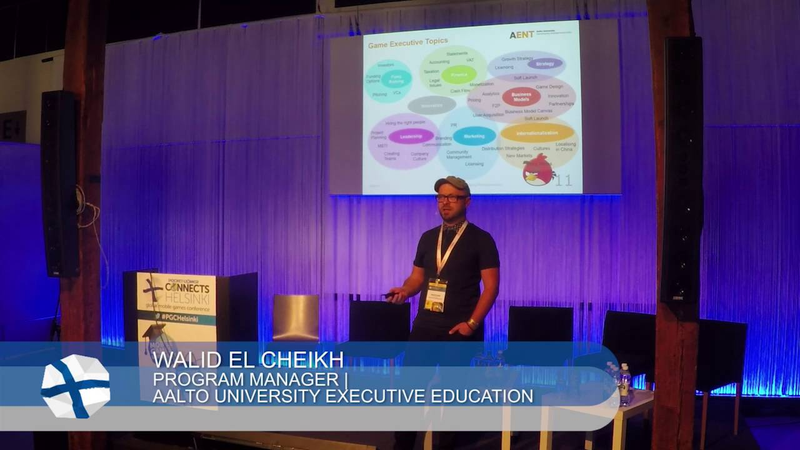
The importance of leadership and business know-how when creating a successful games company
The Game Executive program at Aalto University Executive Education aims to bridge the gap between creative game development and commercial success by providing leadership and business training to industry professionals.
- The Game Executive program at Aalto University Executive Education focuses exclusively on business and leadership training for mid-to-senior level game industry professionals, intentionally excluding technical design or programming instruction.
- Since its inception in 2014, the program has trained over 70 participants through cohorts of 20 to 25 executives, utilizing a network of more than 20 professors and 60 industry experts.
- The curriculum centers on five core business pillars: strategic planning, monetization models, financial decision-making, leadership development, and operational processes.
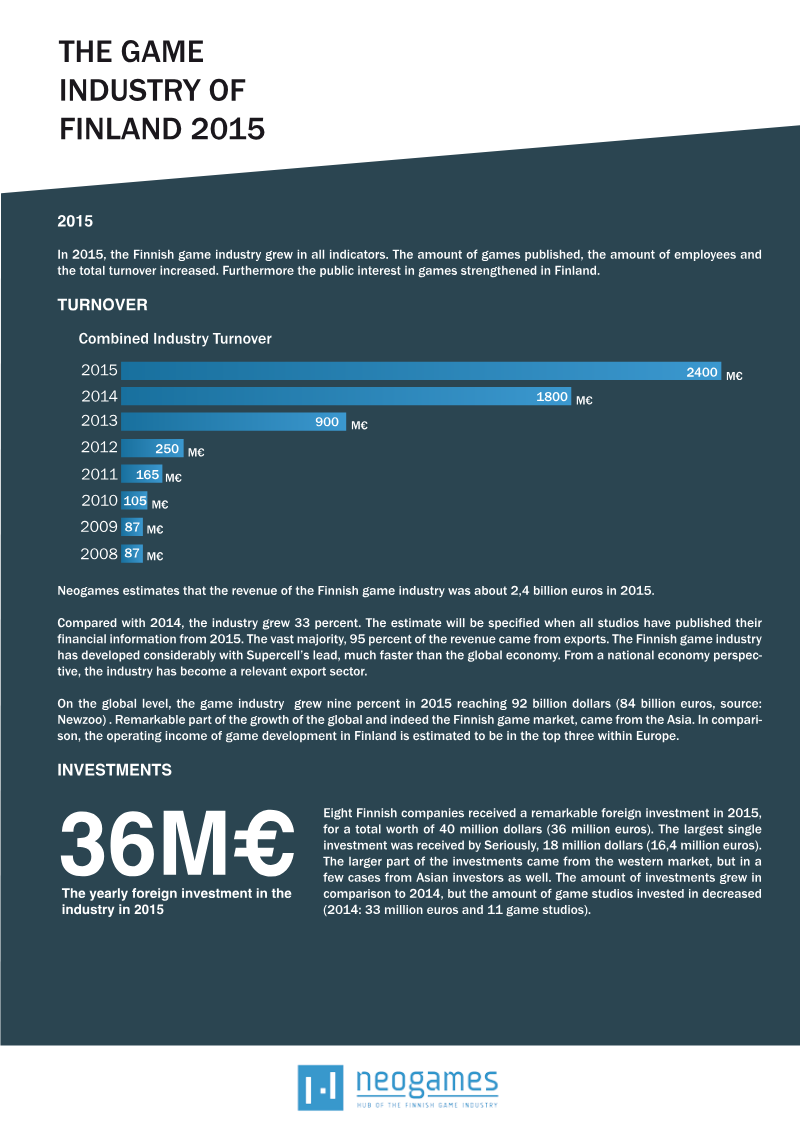
The Game Industry of Finland 2015
The Finnish game industry experienced significant expansion throughout 2015, characterized by robust growth in turnover, employment, and output.
- The Finnish game industry generated 2.4 billion euros in turnover in 2015, marking a 33 percent year-over-year growth that solidified the country as a top-three European hub for game development.
- Exports are the primary economic driver for the sector, accounting for 95 percent of total industry revenue.
- The industry employed 2,700 professionals across 290 active companies, with the majority of talent and operations concentrated in the Helsinki metropolitan area.
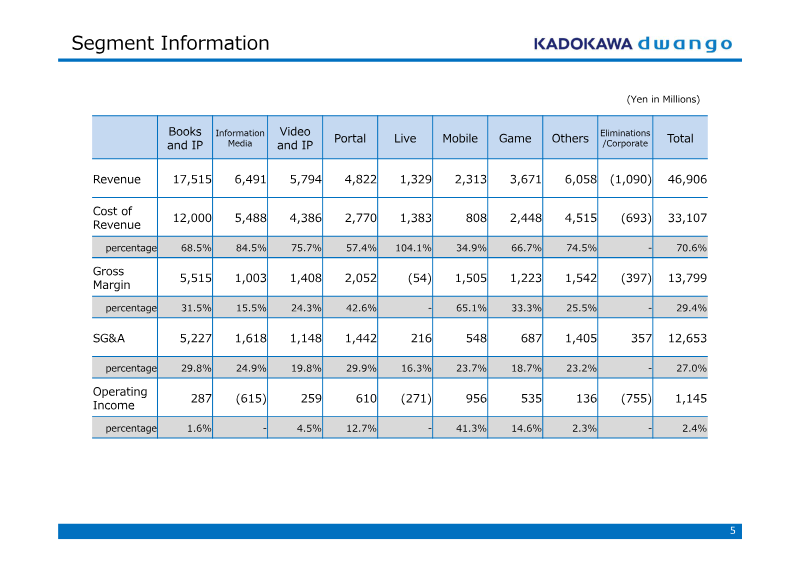
Kadokawa Dwango Financial Results for the First Quarter Ended June 30, 2015
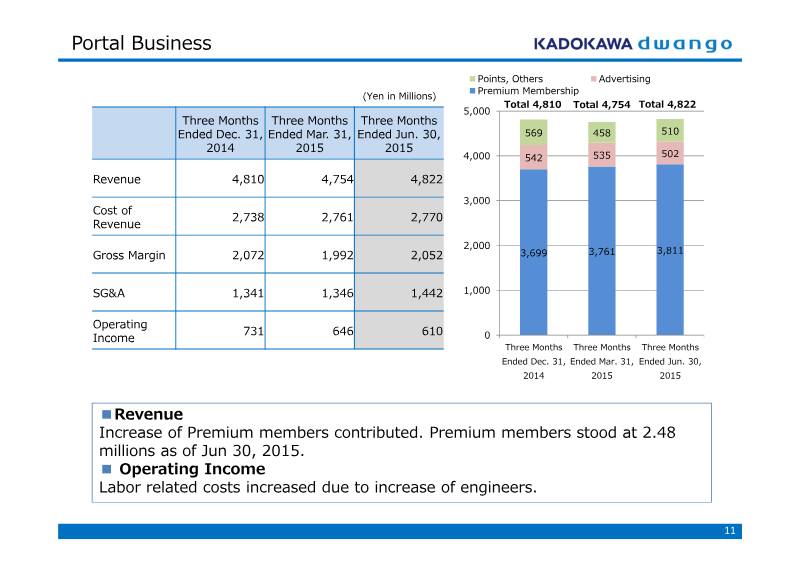
Kadokawa Dwango’s financial results for the first quarter ending June 30, 2015, reflect a period of mixed performance across its diversified business segments.
- Kadokawa Dwango reported revenue of 46,906 million yen and an operating income of 1,145 million yen for the first quarter ended June 30, 2015.
- The Game business returned to profitability with 535 million yen in operating income, driven by titles such as 'The Witcher: Wild Hunt', 'The Legend of Heroes -Sora no Kiseki-', 'Furai-no-Shiren 5 plus', and contingency fees from 'Bloodborne'.
- Profit attributable to owners of the parent fell to a loss of 220 million yen, primarily due to increased corporate taxes following the reversal of deferred tax assets related to previous restructuring expenses.
Kadokawa Dwango Financial Results for the First Quarter Ended December 31, 2014
Kadokawa Dwango’s financial results for the first quarter ended December 31, 2014, reflect a period of diversified performance across its various business segments.
- Kadokawa Dwango reported a net income of 26.078 billion yen for the quarter ending December 31, 2014, driven largely by 22.3 billion yen in extraordinary income from negative goodwill.
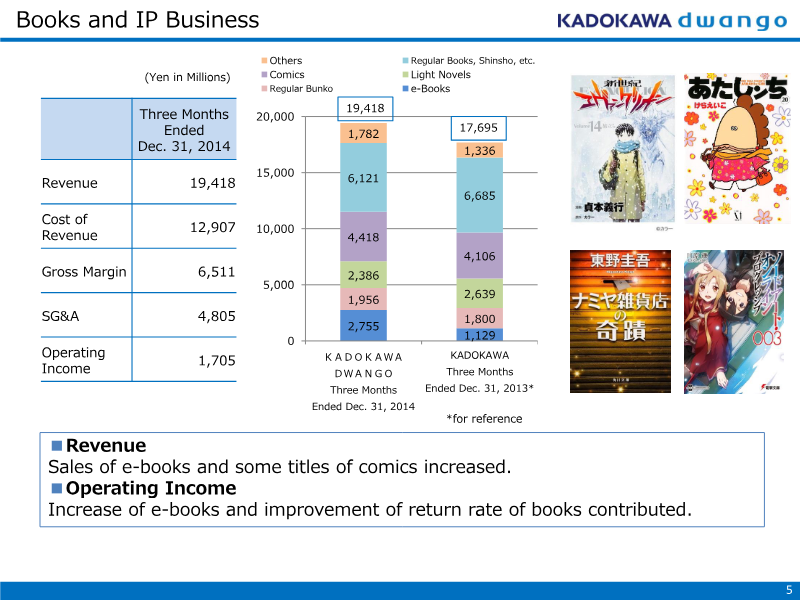
- Total quarterly revenue reached 49.715 billion yen, with the Books and IP business serving as the largest segment at 19.418 billion yen in revenue.
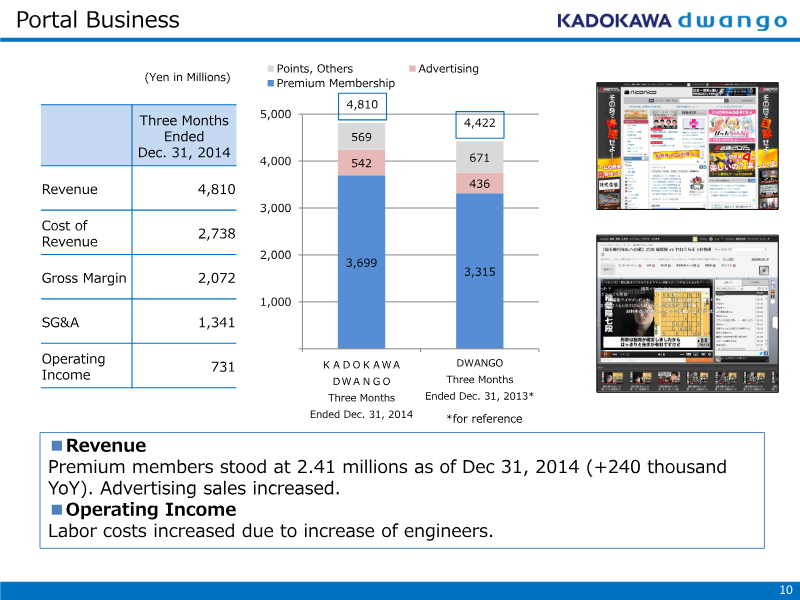
- The niconico portal business grew its premium membership base to 2.41 million users, an increase of 240,000 year-over-year, contributing to segment operating income of 731 million yen.



Fiscal Year Ending March 2016: 1st Half Financial Results
Koei Tecmo Holdings presents a financial analysis for the first half of the fiscal year ending March 2016, highlighting a period of strategic transition toward digital and global expansion.
- Koei Tecmo exceeded profit forecasts for the first half of fiscal year 2016, with operating profit reaching 2,477 million yen (45.7% above projections) and net income rising 3.4% to 4,061 million yen.
- Despite a 5.9% year-over-year decline in net sales to 15,159 million yen, profitability was bolstered by high-margin digital download sales and increased royalty revenue from collaboration titles.
- The Asian market emerged as a key growth driver, recording a 75.9% increase in sales and a 132.6% rise in unit volume, even as Japan remained the primary market at 74.9% of total sales.
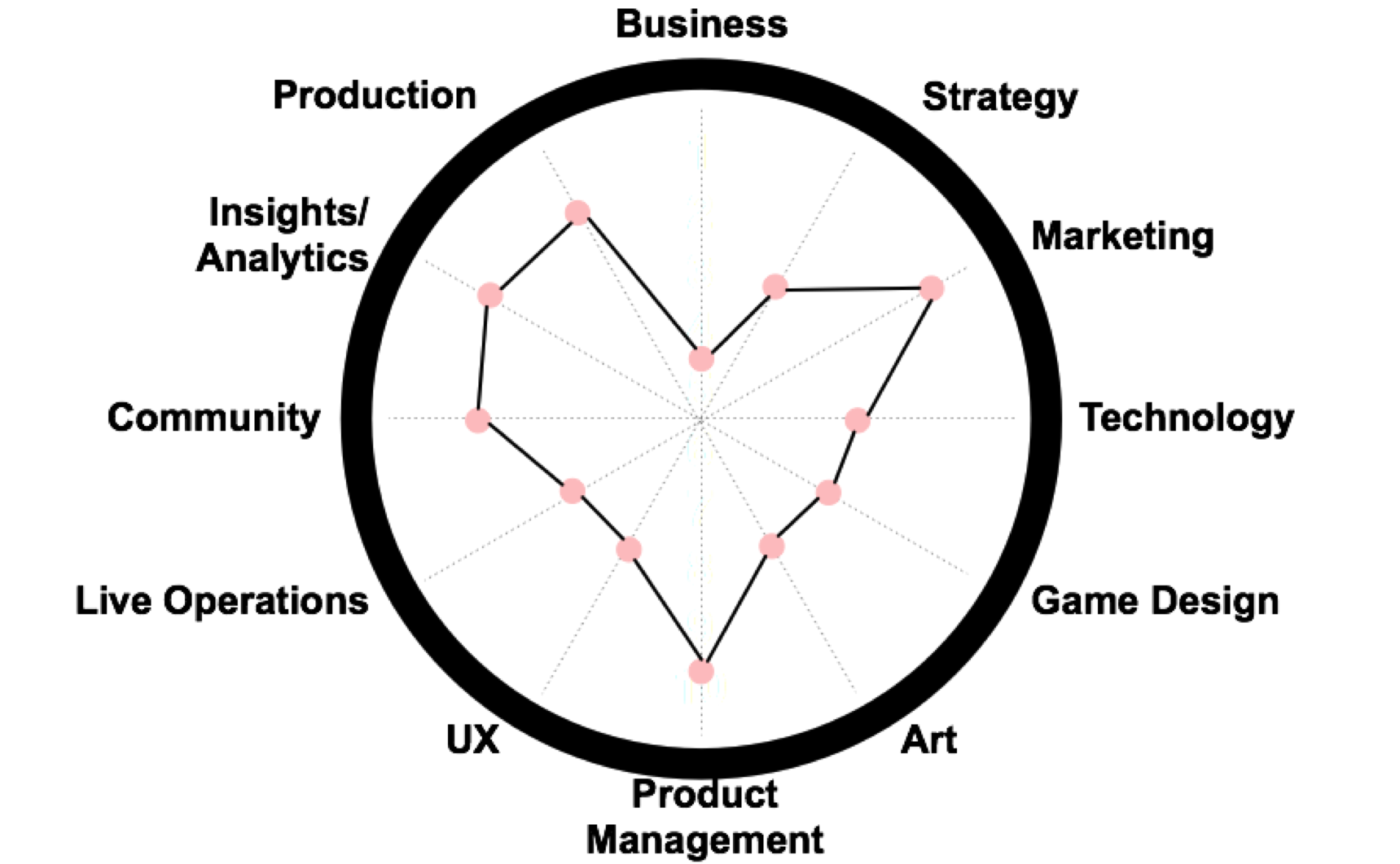
Analyzing Free-to-Play Games Development: The Game / Team Clock
The Game/Team Clock serves as a strategic framework for evaluating the viability and execution risks of free-to-play game development.
- The 'Game/Team Clock' framework assesses project viability by mapping 12 player-centric questions—ranging from initial discovery to monetization—against a team's specific areas of expertise.
- Success in free-to-play development requires minimizing the gap between a game's functional requirements and the team's actual execution capabilities across all 12 stages of the player lifecycle.
- Startups often prioritize the early lifecycle stages (Unique Value Proposition, Marketing, and Monetization), while indie developers typically focus on the middle stages (Gameplay, Content, and Platform).
The Game Industry of Finland: 2014
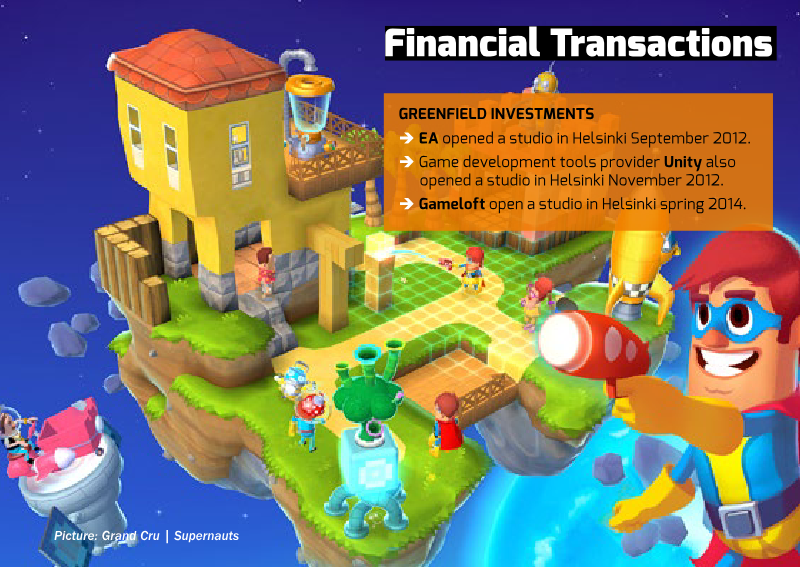
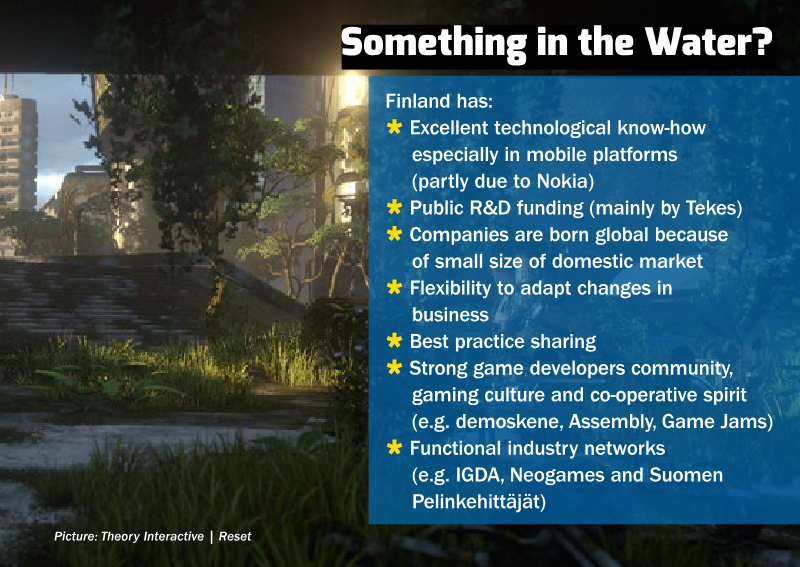
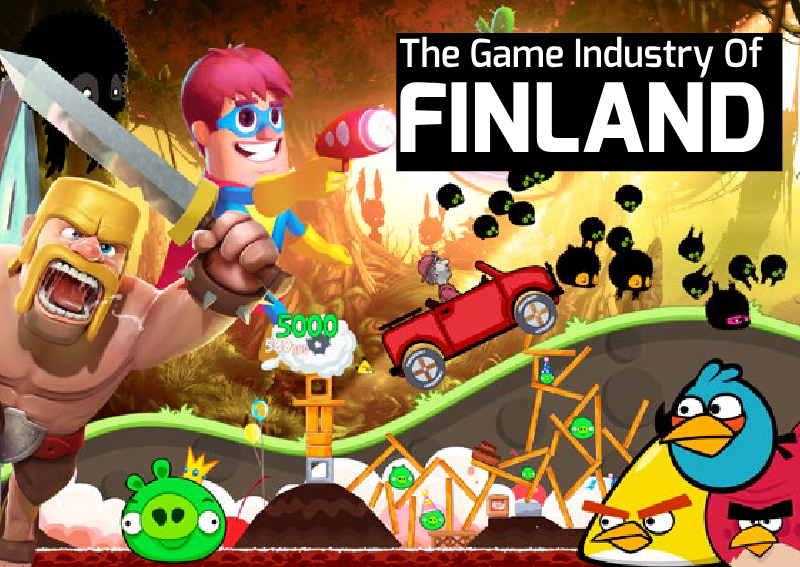
The Finnish game industry underwent a period of extraordinary expansion between 2008 and 2013, transforming into a cornerstone of the national economy.
- Between 2008 and 2013, the Finnish game industry's core development revenue grew from €87 million to an estimated €900 million, with a total economic impact exceeding €2 billion.
- Finland has established itself as a premier global hub for mobile game development, characterized by a highly scalable digital product ecosystem and a focus on high-growth export markets.
- The industry is supported by a network of over 200 companies, including major international players such as Rovio and Remedy alongside a robust community of independent studios.
Financial Highlights for the First Half of the Fiscal Year Ending March 2014 (FY2013)
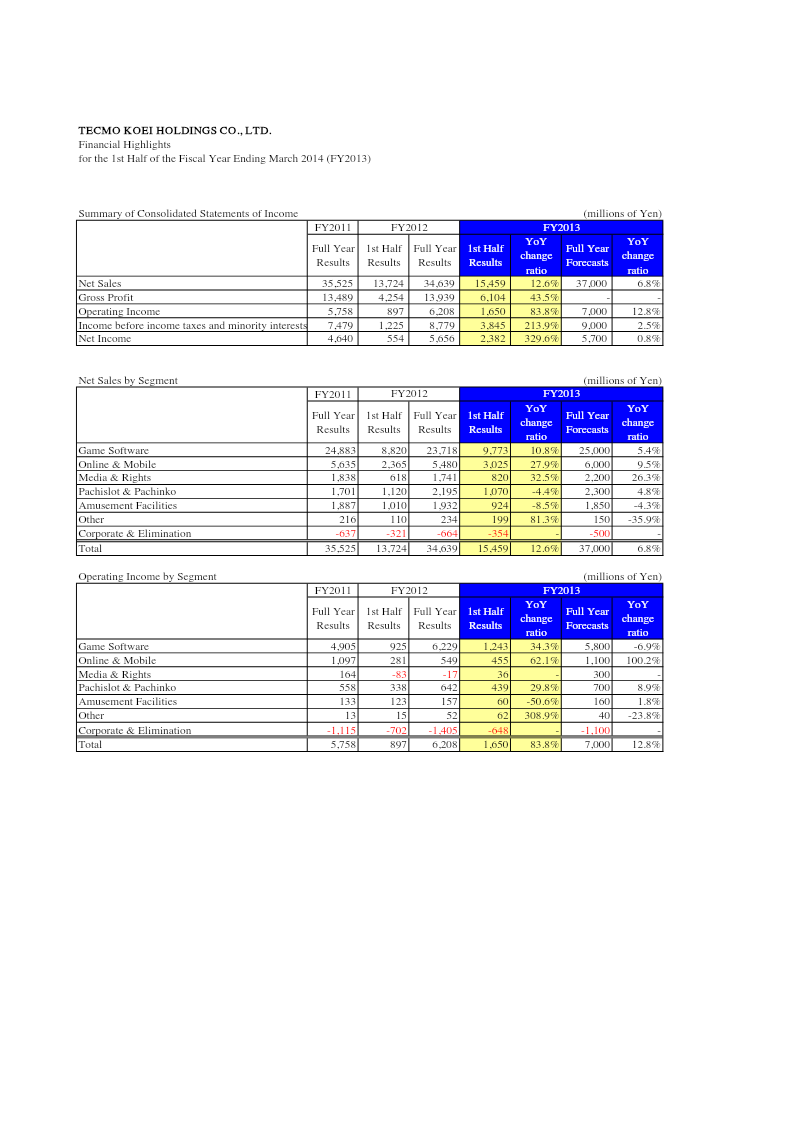
Tecmo Koei Holdings reported significant growth across all major profitability metrics for the first half of the fiscal year ending March 2014.
- Tecmo Koei Holdings reported a 329.6% year-over-year increase in net income to 2.38 billion yen for the first half of FY2013, ending September 30, 2013.
- Operating income surged 83.8% to 1.65 billion yen, while net sales grew 12.6% to 15.46 billion yen compared to the same period in the previous year.
- The Online & Mobile segment showed strong momentum with a 27.9% increase in sales and a 62.1% rise in operating income to 455 million yen.