GREE
Game Co.192 documents
Documents
Financial76 pages
Full-Year (Fourth Quarter) FY2026 Financial Results: GREE
Full-Year (Fourth Quarter) FY2026 Financial Results Business Presentation Update to Reflect Progress Made Under the (1)Renamed to better reflect the businesses: Each business has been given a broader name to reflect its current scope (2)Consolidation into the AI Business: The DX Business and the Engineering Business (commercialization of the Group's shared technology functions) have been consolidated into a single category, the AI Business (3)Strengthened investment in growth areas: Divested fro...
- GREE reported full-year FY26 net sales of ¥48.7 billion and an operating profit of ¥4.7 billion, representing a 9% and 10% year-over-year decline, respectively.
- The company is restructuring its business segments to focus on high-growth areas, consolidating DX and Engineering into an 'AI Business' and reclassifying the Investment Business to non-operating income/expenses.
- FY27 consolidated earnings forecasts project a 5% year-over-year increase in sales to ¥51.0 billion, but an 18% decline in operating profit to ¥3.9 billion due to the delayed launch of a major third-party IP title in the Game Business.
- The Live Entertainment segment (REALITY, Inc.) achieved record-high operating profit in Q4 FY26, with an operating margin of 34.2% and a 46% year-over-year profit increase.
- GREE increased its FY26 dividend to ¥22.0 per share, up ¥7.5 year-over-year, and plans to transition to semiannual dividend payments starting in FY27 while maintaining a dividend-on-equity (DOE) ratio of approximately 4%.
+1
GREE
Financial2 pages
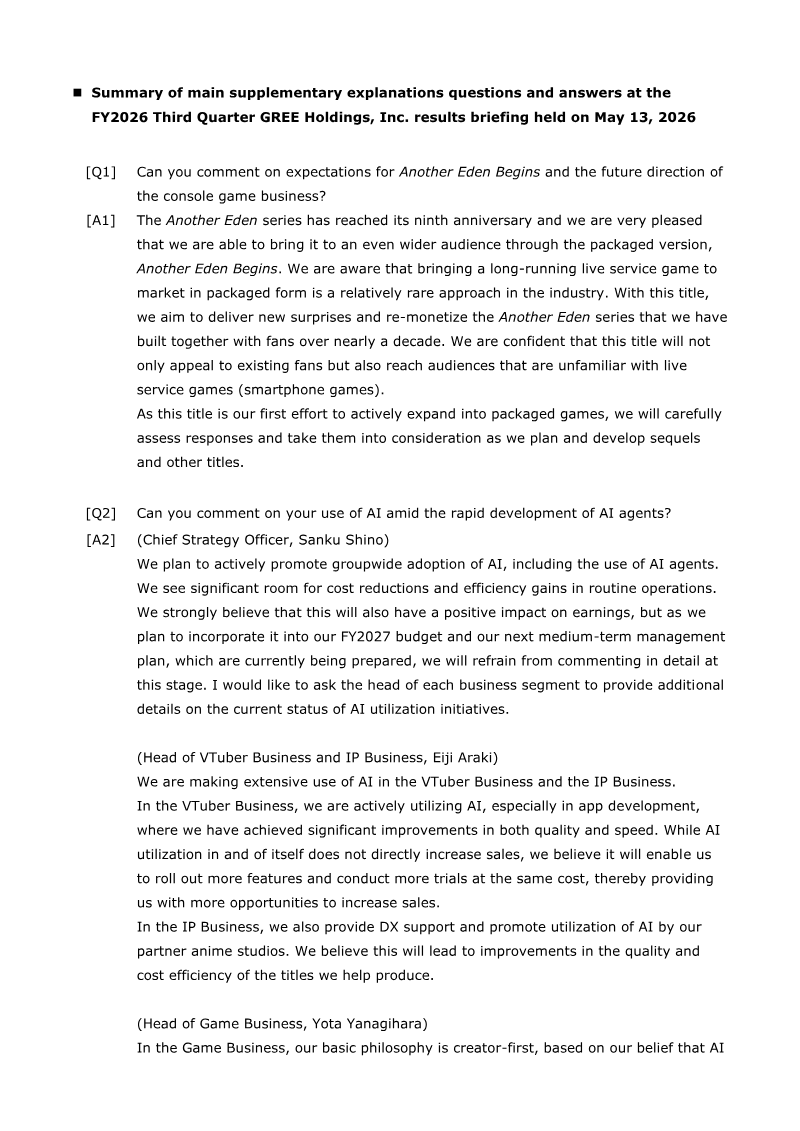
Summary of Main Supplementary Explanations Questions and Answers: FY2026 Third Quarter Results Briefing
The FY2026 third-quarter results briefing for GREE Holdings, Inc. outlines the company’s strategic pivot toward console-based gaming and the systematic integration of artificial intelligence across its diverse business segments. The primary objective is to leverage established intellectual property for new market segments while enhancing operational efficiency through technological adoption.
A central development is the launch of Another Eden Begins, a packaged console version of the long-running live service title. This initiative represents a strategic effort to reach audiences unfamiliar with smartphone-based gaming and serves as a pilot program to inform future console development and sequel planning. Simultaneously, the company is deepening its commitment to the VTuber market through additional investments in Brave group, reflecting a broader strategy to capture market share by balancing internal production with collaborative partnerships.
Regarding AI, the company maintains a creator-first philosophy, positioning AI as a productivity tool rather than a replacement for human talent. While AI has yielded significant time savings in specific tasks—such as app development and coding—it has not yet fundamentally shortened overall game development cycles due to the increasing sophistication of assets. Current protocols mandate strict human oversight, including manual code review and quality control, to mitigate security and intellectual property risks.
Looking toward FY2027, the company plans to formalize its AI strategy within its next medium-term management plan. Current efforts focus on scaling successful AI implementations from the VTuber and IP businesses to the DX and game development divisions, with the ultimate goal of improving cost efficiency and increasing the frequency of content trials to drive long-term earnings growth.
- GREE Holdings is pivoting toward console gaming, starting with the launch of 'Another Eden Begins' to reach non-smartphone audiences and inform future sequel development.
- The company is scaling its AI integration strategy, with plans to formalize a comprehensive framework in the upcoming FY2027 medium-term management plan.
- AI is currently utilized as a productivity tool for coding and app development, though it has not yet reduced total development cycles due to the increasing complexity of game assets.
- To mitigate security and intellectual property risks, GREE mandates strict human oversight, including manual code reviews and quality control, for all AI-assisted tasks.
- The company is expanding its presence in the VTuber market through additional investments in Brave group, balancing internal production with external partnerships.
+2
GREE
Financial77 pages
Third Quarter FY2026 Financial Results
The third quarter of fiscal year 2026 reflects a period of robust financial performance and strategic realignment, characterized by consolidated net sales of ¥13.0 billion and an operating profit of ¥1.0 billion. This success, marked by a 166% quarter-over-quarter surge in operating profit, was primarily fueled by high-performing anniversary campaigns within the core gaming segment. Bolstered by these results, the company has raised its full-year operating profit forecast to ¥4.4 billion and increased its dividend forecast to ¥21.5 per share, signaling a commitment to a 4% dividend on equity target.
Operational growth remains diversified across several key industry segments. The digital transformation consulting business emerged as a standout performer, achieving an 18% year-over-year sales increase and a 53% quarterly rise in operating profit, driven by a successful transition to a recurring-earnings model. While the VTuber and IP segments experienced temporary earnings shortfalls due to upfront investments and business ramp-up periods, the company is actively securing its future through strategic moves, such as becoming the largest shareholder of Brave group and prioritizing long-term anime production and licensing revenue.
Looking toward fiscal year 2027, the firm is balancing immediate cost management with a focus on a high-potential pipeline of new RPG titles and structural efficiency. Although the investment business reported a quarterly loss due to valuation fluctuations, the company maintains a strong financial foundation with an equity ratio of 75% and an unrealized portfolio value of approximately ¥41.0 billion. By prioritizing these long-term initiatives alongside disciplined fiscal management, the organization is positioning itself to establish a stable, sustainable earnings base that supports its medium-term growth objectives.
- Q3 FY2026 operating profit surged 166% quarter-over-quarter to ¥1.0 billion on ¥13.0 billion in net sales, driven by successful gaming anniversary campaigns.
- Full-year operating profit forecasts have been raised to ¥4.4 billion, with dividend forecasts increased to ¥21.5 per share to meet a 4% dividend on equity target.
- The digital transformation consulting segment achieved 18% year-over-year sales growth and a 53% quarterly rise in operating profit, supported by a shift to a recurring-earnings model.
- The company maintains a strong financial position with a 75% equity ratio and an unrealized portfolio value of approximately ¥41.0 billion, despite a quarterly loss in the investment business due to valuation fluctuations.
- Strategic expansion includes becoming the largest shareholder of Brave group and prioritizing long-term anime production and licensing to offset temporary earnings shortfalls in the VTuber and IP segments.
GREE
Financial7 pages
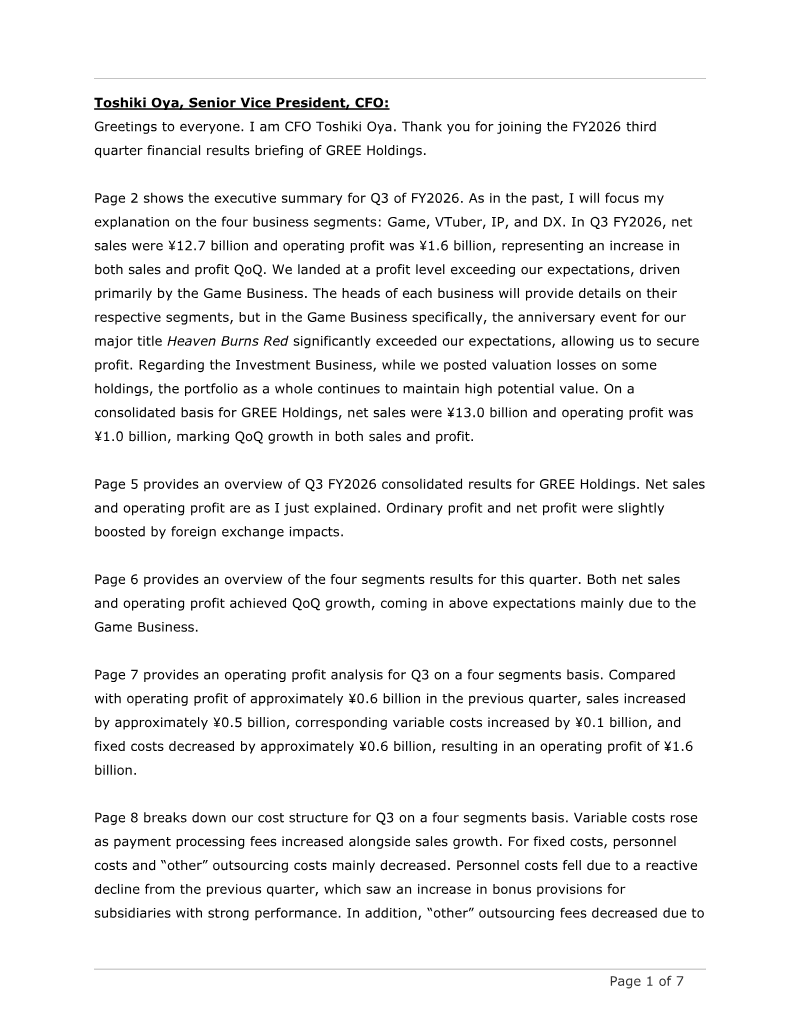
FY2026 3Q Financial Results Briefing: GREE Holdings
GREE Holdings’ third-quarter financial results for fiscal year 2026 demonstrate a period of growth, with consolidated net sales reaching ¥12.7 billion and operating profit totaling ¥1.6 billion. This performance exceeded internal expectations, largely driven by the strong results of the Game Business, where anniversary events for major titles significantly outperformed projections. While the company recorded valuation losses in its Investment Business, the overall portfolio remains high-potential. Consequently, the company has revised its full-year operating profit forecast upward to ¥4.4 billion, surpassing the initial estimate of ¥3.6 billion.
The company operates across four primary segments: Game, VTuber, IP, and DX. The Game Business remains a long-term investment focus, with ongoing development of console titles and new live service games. The VTuber segment achieved record-high sales despite a challenging market, bolstered by a strategic capital alliance with Brave group, which positions GREE as its largest shareholder. The IP and DX segments are currently focused on structural strengthening and the accumulation of recurring revenue, though the DX segment noted that planned M&A activities have been delayed, impacting its original fiscal year outlook.
Reflecting a commitment to shareholder returns, GREE Holdings has updated its dividend policy. The company is increasing its target Dividend on Equity (DOE) ratio from approximately 3% to 4% while maintaining a minimum payout ratio of 30% and removing the previous 70% cap. This policy shift aims to improve capital efficiency and provide stable returns during a transition period characterized by profit volatility as the company invests in long-term growth. Management identifies fiscal year 2026 as an earnings bottom, with a strategic focus on driving consistent growth across its continuous business segments in the coming periods.
- GREE Holdings revised its FY2026 full-year operating profit forecast upward to ¥4.4 billion, exceeding the initial estimate of ¥3.6 billion.
- Third-quarter consolidated net sales reached ¥12.7 billion with an operating profit of ¥1.6 billion, driven by strong performance in anniversary events for major game titles.
- The company increased its target Dividend on Equity (DOE) ratio from 3% to 4% and removed the 70% payout ratio cap to enhance shareholder returns.
- The VTuber segment achieved record-high sales, supported by a strategic capital alliance that established GREE as the largest shareholder of Brave group.
- Management identifies FY2026 as an earnings bottom and is focusing on long-term growth through console title development and new live service games.
+2
GREE
Financial24 pages
Financial Results for the Second Quarter: Fiscal Year Ending June 30, 2012
GREE, Inc. reported a robust second‑quarter performance for the fiscal year ending June 30 2012, driven by accelerated global expansion and monetization of its social‑gaming platform. Net sales rose 36 % to ¥41,529 million, marking a record high and reflecting a 39.2 % quarter‑on‑quarter increase in paid‑service sales alongside a 10.5 % rise in advertising revenue. Operating profit climbed 35 % to ¥22,535 million, and net income grew 35 % to ¥12,740 million, both surpassing the previous year’s figures by 225–250 %. The company achieved a consolidated registered user base of approximately 190 million worldwide, with Japanese users representing 15.3 %. Strategic initiatives included the launch of a unified global platform, integration with OpenFeint, and opening nine international offices to strengthen development and carrier partnerships. Monetization efforts expanded through the release of seven in‑house smartphone games, about 700 partner titles, and new payment methods such as PayPal and prepaid cards. Operating expenses increased in line with growth, particularly in rental charges (14 % QoQ) and advertising spend (54 % QoQ), yet sales growth outpaced cost escalation. Forecast revisions for FY2012 raised net‑sales expectations to ¥160 billion and operating profit to ¥80 billion, underscoring confidence in continued global market penetration and diversified revenue streams.
- GREE, Inc. achieved record-high net sales of ¥41,529 million in Q2 FY2012, representing a 36% year-on-year increase.
- Operating profit and net income both grew by 35% quarter-on-quarter, with year-on-year growth for both metrics exceeding 225%.
- The company reached a global registered user base of approximately 190 million, with Japanese users accounting for 15.3% of the total.
- Revenue growth was driven by a 39.2% quarter-on-quarter increase in paid-service sales and a 10.5% rise in advertising revenue.
- Strategic expansion included the integration of OpenFeint, the opening of nine international offices, and the release of seven in-house smartphone games alongside 700 partner titles.
+2
GREE
Financial21 pages
Financial Results for the First Quarter: Fiscal Year Ended June 30, 2011
GREE, Inc. reported first‑quarter financial results for the fiscal year ending June 30 2011, showing a 13 % rise in net sales to ¥12.41 billion versus the prior quarter and an 18 % increase in operating profit to ¥6.22 billion. Net income climbed 19 % to ¥3.70 billion, driven by higher paid‑service and advertisement revenues linked to new first‑party titles such as “Pirate Kingdom Columbus” and the launch of a monthly fee plan for “Hacöniwa.” The company’s user base reached 22.46 million members by September 2010, with 46 % aged over 30, and mobile traffic accounted for a growing share of page views.
Operating expenses rose modestly; cost of sales increased by 25 % mainly due to higher rental charges, while advertising spend grew 22 %. Labor costs and SG&A expenses also rose, reflecting continued investment in development and marketing. Cash flow from operations turned negative for the quarter, offset by a significant inflow of ¥8.78 billion from investment activities and a reduction in financing cash outflows.
GREE expanded its platform by opening the “GREE Platform” to third‑party developers, partnering with hosting and customer‑support firms, and launching a mobile service on smartphones. Geographic outreach plans include opening offices in Asia and North America and partnering with Project Goth, Inc. to tap emerging‑market mobile SNSs. The company maintained a robust safety framework through its GREE Patrol system and age‑restriction policies, reinforcing user protection amid rapid growth.
- GREE reported strong quarterly growth with net sales rising 13% to ¥12.41 billion, operating profit increasing 18% to ¥6.22 billion, and net income climbing 19% to ¥3.70 billion.
- Revenue growth was primarily driven by the success of first-party titles like 'Pirate Kingdom Columbus' and the introduction of a monthly fee model for 'Hacöniwa'.
- The company reached 22.46 million members by September 2010, with a demographic profile where 46% of the user base is aged 30 or older.
- Operating expenses increased across the board, with cost of sales rising 25% due to higher rental charges and advertising spend growing by 22%.
- GREE is aggressively expanding its ecosystem by opening its platform to third-party developers and launching mobile services for smartphones.
+3
GREE
Financial28 pages
Financial Results for the Third Quarter of the Fiscal Year Ending on June 30, 2011: Japan
GREE, Inc. reported robust financial and operational performance for the third quarter of fiscal year 2011 (ending June 30, 2011). Net sales rose 14% to ¥16.4 billion from the prior quarter and 77% year‑over‑year, driven by continued growth in paid services from its flagship social networking platform and expanding advertising revenue. Operating profit increased 18% to ¥8.2 billion, maintaining a high margin of roughly 50%. The company’s cash position strengthened, with operating cash flow at ¥4.2 billion and total assets growing 15% to ¥46.4 billion, while retained earnings surged 20% year‑over‑year.
User metrics underscored the platform’s dominance: registered members exceeded 25 million, with a stable demographic profile—48% of users in their 30s and 40s, a group with higher average spend. Geographic distribution remained concentrated in Japan, but strategic initiatives aimed at international expansion were highlighted, notably the planned acquisition of OpenFeint (75 million users) and partnerships with Tencent to tap a 650‑million user base.
Operationally, GREE expanded its mobile ecosystem through the “GREE Platform for Smartphone,” launching partner and original apps across web, iOS, and Android with multiple payment options. Monetization efforts included a new ad program targeting partner apps and the introduction of “GREE Ad Program” to broaden advertising revenue streams.
The company also addressed external shocks, noting minimal impact from the Tohoku earthquake on paid‑service income and launching a donation portal that raised ¥188 million from members, supplemented by a corporate contribution of ¥100 million. Safety and security measures were reinforced through enhanced content monitoring, age verification protocols, and educational outreach.
Strategically, GREE outlined a multi‑pronged growth plan: intensifying original game development, expanding the smartphone platform and monetization base, accelerating international platform deployment via acquisitions and partnerships, and scaling advertising operations. These initiatives aim to consolidate GREE’s position as Japan’s leading social networking service while positioning it for global leadership in the social game and platform markets.
- GREE reported strong Q3 fiscal 2011 growth with net sales reaching ¥16.4 billion, a 14% increase quarter-over-quarter and 77% year-over-year.
- Operating profit grew 18% to ¥8.2 billion, maintaining a high profit margin of approximately 50%.
- The platform reached over 25 million registered members, with 48% of the user base in the 30s and 40s demographic, which correlates with higher average spending.
- International expansion is being prioritized through the acquisition of OpenFeint, which brings 75 million users, and a strategic partnership with Tencent to access a 650-million user base.
- The company is aggressively shifting toward a mobile-first ecosystem by launching the 'GREE Platform for Smartphone' across web, iOS, and Android with new integrated advertising and payment programs.
+1
GREE
Financial25 pages
Financial Results for the Fourth Quarter of FY2011
GREE, Inc. reported a robust fourth‑quarter performance for the fiscal year ending June 30 2011, driven by rapid user growth and expanding monetization across its global platform. Net sales rose 29 % to ¥21,093 million, while operating profit increased 19 % to ¥9,789 million; both figures represent the largest quarterly gains of FY2011. The company’s consolidated user base reached 123.6 million worldwide, with 26.4 million in Japan and a growing presence in the United States, Europe, China, and other Asian markets. The acquisition of OpenFeint added 50 million users and broadened GREE’s reach in emerging mobile markets.
Revenue diversification is evident: paid‑service sales grew to ¥18,387 million, and advertising revenue climbed to ¥3,000 million. The company launched “GREE Market,” a pre‑installed app store on KDDI’s Android platform, and expanded its in‑app billing to web, Android, and iOS. Operating expenses rose 37 % YoY, largely due to increased advertising spend (27 %) and rental fees for data‑center decentralization.
Strategic initiatives include standardizing smartphone platform specifications with mig33, partnering with Tencent and SK Telecom, and establishing a Beijing office to support development in China. Forecasts for FY2012 target net sales of ¥90–100 billion, operating profit of ¥40–50 billion, and net income of ¥22–28 billion, reflecting continued emphasis on user acquisition, platform expansion, and diversified revenue streams.
- GREE reported its strongest quarterly performance of FY2011, with net sales rising 29% to ¥21,093 million and operating profit increasing 19% to ¥9,789 million.
- The company’s global user base reached 123.6 million, bolstered significantly by the acquisition of OpenFeint, which added 50 million users to the platform.
- Revenue streams showed strong diversification, with paid-service sales reaching ¥18,387 million and advertising revenue growing to ¥3,000 million.
- Operating expenses increased 37% year-over-year, driven primarily by a 27% rise in advertising spend and costs associated with data-center decentralization.
- Strategic expansion efforts included the launch of the 'GREE Market' app store on KDDI’s Android platform and new partnerships with Tencent and SK Telecom.
+3
GREE
Financial39 pages
Financial Results for the Third Quarter: Fiscal Year Ending June 30, 2012
Financial Results for the Third Quarter of the Fiscal Year Ending June 30, 2012 Initiatives to Improve User Environment FY2012 Third Quarter Business Results Initiatives to Improve User Environment Making the world a better place through the power of the Internet Provide a wide range of useful Internet services to people around the world Encourage more people around the world to use GREE Services that enrich communication Ongoing initiatives to create a safer between GREE users ...
- GREE's global expansion is accelerating, with worldwide members reaching 230 million as of March 2012. The company is investing in global data center infrastructure and hiring.
- GREE launched its first social game targeting the global market, "Zombie Jombie," which exceeded one million downloads and ranked high in the App Store. Two other global titles, "Alien Family" and "Dino Life," were also released.
- GREE's consolidated paid services sales grew significantly, reaching 42,882 million yen in Q3 FY2012, up from 18,387 million yen in Q3 FY2011. Advertisement sales also increased, reaching 3,306 million yen in Q3 FY2012.
- GREE is expanding partnerships, including a comprehensive business alliance with Level-5 Inc. and agreements for Ubisoft and Gameloft to offer popular titles on the GREE Platform.
- GREE's current assets increased by 150% year-over-year to 102,657 million yen in Q3 FY2012, with cash and cash equivalents growing 123% to 51,662 million yen.
+2
GREE
Financial23 pages
FY2013 Second Quarter Financial Results
The quarterly financial release outlines a mixed performance for FY2013 second quarter, with net sales rising 4 % QoQ to ¥39.4 billion but falling 5 % YoY, while EBITDA and operating profit declined sharply by 6 % and 9 %, respectively. Net profit remained flat QoQ at ¥9.0 billion but dropped 29 % YoY, reflecting higher costs and a one‑time currency gain. Consolidation of Pokelabo in October contributed to the QoQ sales growth, and the company noted a 35 % increase in cost of sales driven by higher labor and advertising expenses, alongside a 60 % rise in depreciation.
Geographically, Japan remains the core market; coin consumption grew QoQ by 600 million coins, with strong performance in native titles such as “Driland” and IP‑based releases. Overseas coin consumption has been rising monthly since October, with new in‑house and co‑branded games expected to contribute from Q3 onward. The company plans aggressive smartphone investments in H2, targeting hit titles across new genres (MMO, FPS) and leveraging efficient marketing to balance lifetime value against cost per install.
The revised FY2013 forecast reflects a downward revision of net sales to ¥170 billion (−17.9 % from prior forecast) and operating profit to ¥60 billion (−32.4 %). The outlook hinges on postponed releases in H2 and continued hiring to support smartphone growth, with anticipated increases in customer‑support and compliance costs. Overall, the report signals a strategic pivot toward diversified game genres and international expansion while managing cost pressures in a competitive mobile gaming landscape.
- The company significantly downgraded its FY2013 outlook, cutting net sales forecasts by 17.9% to ¥170 billion and operating profit by 32.4% to ¥60 billion.
- Net profit fell 29% year-over-year to ¥9.0 billion, driven by a 35% increase in cost of sales—specifically labor and advertising—and a 60% rise in depreciation.
- While net sales rose 4% quarter-over-quarter to ¥39.4 billion due to the Pokelabo consolidation, overall performance declined with a 5% year-over-year sales drop and a 9% decrease in operating profit.
- Japan remains the primary revenue driver, with coin consumption increasing by 600 million coins quarter-over-quarter, supported by strong performance from titles like 'Driland'.
- Management is shifting strategy toward aggressive smartphone investment in H2, targeting new genres such as MMO and FPS to drive growth.
+3
GREE
Financial35 pages
FY2014 Third Quarter Financial Results
FY2014 Third Quarter Financial Results & Net sales of ¥31.07 billion; operating income of ¥9.95 billion Financial ⁃ Net sales declined as we were unable to maintain through March the recovery trend results seen toward the end of 2013 and start of 2014 overview ⁃ Despite the negative factor of a decline in net sales, we achieved a ¥0.8 billion increase in operating income through cost-cutting initiatives & Achieved qu...
- The company achieved net sales of ¥31.07 billion and operating income of ¥9.95 billion in FY14 3Q, with operating income increasing by ¥0.8 billion despite a decline in net sales, primarily due to cost-cutting initiatives.
- Overall costs were cut by ¥2.35 billion (10.0% QoQ) to ¥21.12 billion, including a ¥1.78 billion (12.6% QoQ) reduction in fixed costs and a ¥0.42 billion decrease in advertising costs due to revised release schedules and increased efficiency.
- Overseas operations (U.S., Canada, and South Korea studios) achieved quarterly profitability, with firm sales from their titles, although Japan studio titles for overseas markets weakened.
- The full-year FY14 forecast projects net sales of ¥129.0 billion and operating income of ¥38.0 billion, with the projected timing for a turnaround revised to FY2015 from the initial estimate of 4Q.
- Coin consumption on smartphones declined approximately 3% QoQ, but smartphones now account for approximately 71% of total coin consumption, with first-party titles like Monster Planet and Kaizoku Oukoku Columbus showing growth through UI/UX improvements.
+3
GREE
Financial30 pages
FY2015 Third Quarter Financial Results
The quarterly report presents FY2015 third‑quarter results for a Japanese mobile gaming and platform company, highlighting a net sales decline of ¥22.0 billion (‑9.1 % YoY) driven by softer web‑game revenue, while operating income rose to ¥4.9 billion (up 3.8 % QoQ) through aggressive cost control, notably a ¥1.10 billion cut in advertising spend and a ¥0.92 billion reduction in fixed costs. EBITDA fell modestly to ¥6.01 billion, yet the operating margin improved by 2.7 percentage points to 22.3 %. The company maintains a robust balance sheet, with cash and equivalents at ¥74.6 billion and net debt reduced to ¥4.27 billion.
A revised full‑year forecast projects net sales of ¥93.5 billion and operating income of ¥20.0 billion, reflecting expected stability in Q4 sales at ¥22.0 billion and continued investment in native‑game development while keeping advertising costs disciplined. The report details a strategic pivot toward native games, expanding Japan operations to 600 staff and 20 development lines, with new titles such as “LINE TOWER RISING” and “POITTO HERO” slated for Q4 releases. Overseas expansion plans include localized versions of long‑running U.S. titles in Europe and China.
Operational metrics show a 10 % drop in overall coin consumption to 31.3 billion, with smartphone web‑game usage rising to 77 % of total consumption. Native‑game coin consumption fell 9 % to 9.5 billion, while web‑game consumption declined 11 % to 21.7 billion, largely due to weaker legacy titles. The company continues to leverage IP collaborations and event initiatives to sustain user engagement across its game portfolio.
The document covers Japan, U.S., Europe, and China markets over FY2015, employing quarterly financial statements, cost‑structure analysis, headcount data, and KPI charts to support its performance narrative.
- The company reported a 9.1% year-over-year decline in net sales to ¥22.0 billion, primarily driven by underperforming legacy web-game titles.
- Operating income rose 3.8% quarter-over-quarter to ¥4.9 billion, achieved through aggressive cost-cutting measures including a ¥1.10 billion reduction in advertising and a ¥0.92 billion cut in fixed costs.
- The firm is executing a strategic pivot toward native-game development, supported by a 600-person Japanese workforce across 20 development lines and upcoming Q4 releases like 'LINE TOWER RISING' and 'POITTO HERO'.
- Operating margins improved by 2.7 percentage points to 22.3%, even as EBITDA saw a modest decline to ¥6.01 billion.
- Overall coin consumption fell 10% to 31.3 billion, with web-game usage accounting for 77% of total consumption despite an 11% decline in that segment.
+2
GREE