
RimWorld
GameBy Ludeon Studios · Released Oct 17, 2018
A sci-fi colony sim driven by an intelligent AI storyteller. Generates stories by simulating psychology, ecology, gunplay, melee combat, climate, biomes, diplomacy, interpersonal relationships, art, medicine, trade, and more.
Connections
Each row is a game or company named alongside RimWorld, each column a document, oldest first. A mark means that document names it. Select a row to see those documents.
About the game
- Released
- Oct 17, 2018
- Developer
- Ludeon Studios
- Genres
- Real Time Strategy (RTS), Simulator, Strategy, Indie
- Platforms
- Linux, PC (Microsoft Windows), Mac
- Links
- Official site, Wikipedia
Game data from IGDB.com
Documents about RimWorld

What Other Devices Do PC Game Fans Play On?
The analysis challenges the perception of the monolithic PC gamer by examining the multi-platform habits of core Steam users.
- Among dedicated Steam users, 42.4% play exclusively on PC, while 57.6% engage in a multi-platform mix of PC, console, and mobile gaming.
- Approximately 15.6% of surveyed Steam players are 'platform agnostic,' playing on PC, console, and mobile devices at least one hour per month.
- PC and mobile is the most common cross-platform combination, representing 22% of the surveyed Steam player base.
A Class on Narrative Frames (and Advanced Murder): What 'Fire Emblem: Three Houses' Knows About Casting the Player's Role
This article examines how the player's narrative role relative to the characters on their team shapes the emotional bonds that develop between them.
- Narrative framing of the player's role strongly shapes emotional bonds with team characters: games that cast the player as a responsible figure, like the professor in Fire Emblem: Three Houses, align the player's incentives with nurturing those characters.
- The article's central thesis is that pairing great power over a crew with a strong sense of responsibility can pre-load the emotional experience a designer intends, with incentive alignment between player and characters as the key variable.
- Games are contrasted by player position: RimWorld casts the player as an external force with supernatural influence but no social identity, while XCOM 2 and Darkest Dungeon create commander responsibilities, with Darkest Dungeon deliberately undermining them through an employer-employee dynamic built on disposability.
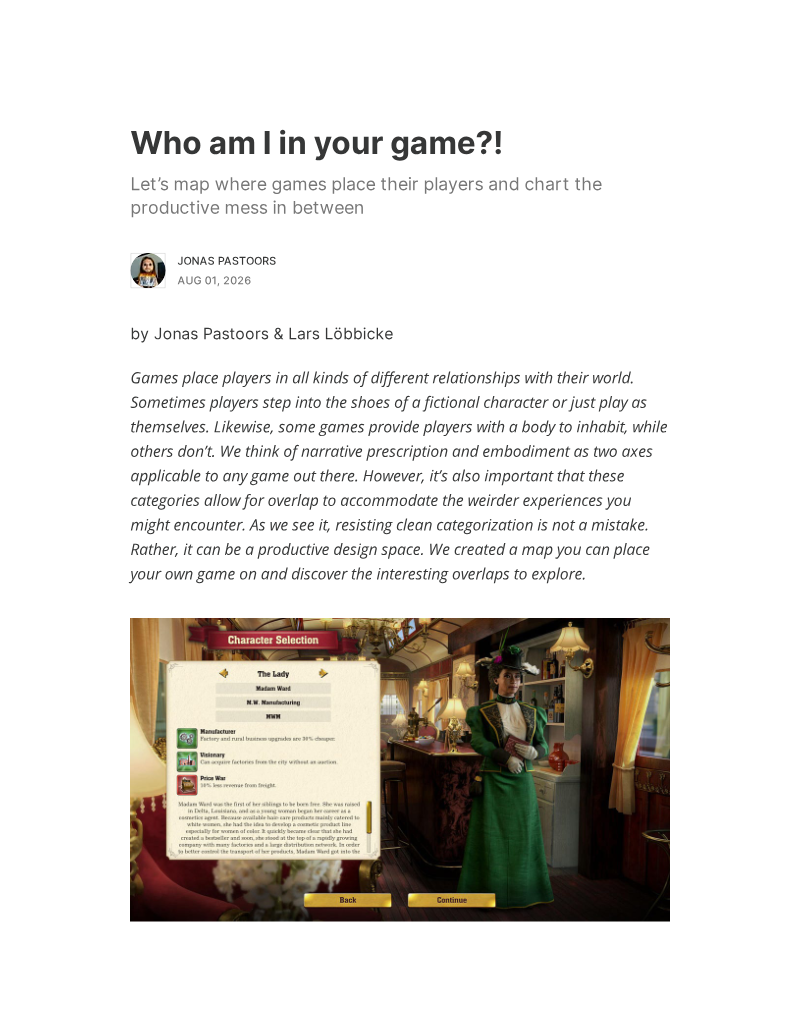
Who Am I in Your Game?! Let's Map Where Games Place Their Players and Chart the Productive Mess in Between
This article proposes a two-axis framework for classifying the relationship between players and their characters in games.
- The article proposes a two-axis framework for player-character relationships: narratively prescribed versus unprescribed roles, crossed with embodied versus abstract characters, yielding four buckets.
- Its central thesis is that overlapping boundaries between these categories are a productive design space rather than an inconsistency, since blurred categories can produce effects that clean categorization cannot.
- Crusader Kings III is cited as a case where the player acts as an all-seeing ruler who must also inhabit mortal successive bodies, creating incentive alignment that mirrors medieval monarchs' concerns.
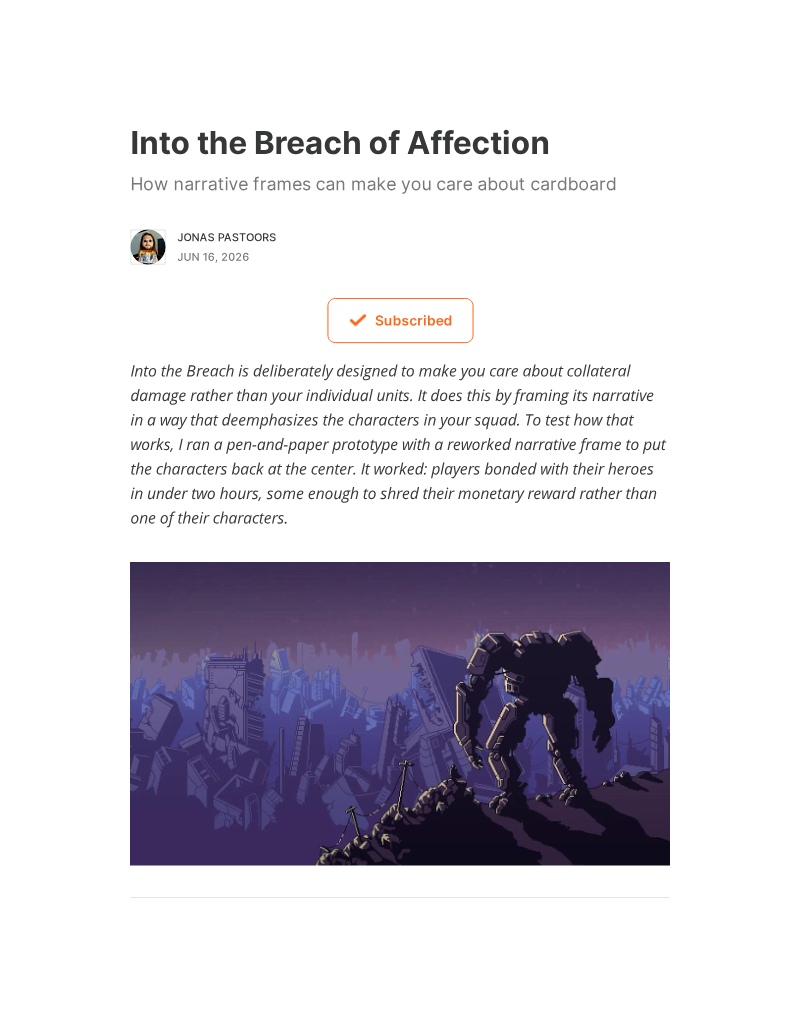
Into the Breach of Affection: How Narrative Frames Can Make You Care About Cardboard
This essay by game designer Jonas Pastoors examines how narrative framing shapes player attachment, using the tactical roguelike Into the Breach as its central case.
- Into the Breach deliberately deemphasizes its pilots: players lose their characters after each run, and pilots mainly serve as a bonus-delivery mechanism while the mechs do the visible fighting.
- Pastoors argues these choices stem from a narrative frame centered on collateral damage, and that the same mechanics could foster bonding if the frame were reversed.
- To test this, the author ran a small, informal pen-and-paper prototype based on Bury Me in the Rift, recasting mechs and pilots as heroes and magical artifacts defending a monastery from demons, with books at stake instead of civilians.
In Mem(e)ory of Uuugggg: Mod-Users' Use of RimWorld's Steam Workshop as a Memorial Site
This extended abstract examines how players of the single-player game RimWorld used the Steam Workshop as a space for collective mourning after the unexpected death of Uuugggg (also known as AlexTD), the creator of the popular mod "Replace Stuff."
- The study is a single-case qualitative analysis of how RimWorld players used the Steam Workshop comments section to mourn Uuugggg (AlexTD), creator of the mod "Replace Stuff," after his death on June 29, 2025, so its findings are interpretive rather than generalizable.
- The central thesis is that mod-users and modders share parasocial bonds that extend beyond a consumer-producer relationship, and that these bonds are otherwise hidden in single-player game communities.
- The "o7" salute, borrowed from multiplayer science fiction games, took on a memorial meaning in the comments, functioning as a form of "RIP-ing" that expressed parasocial grief.
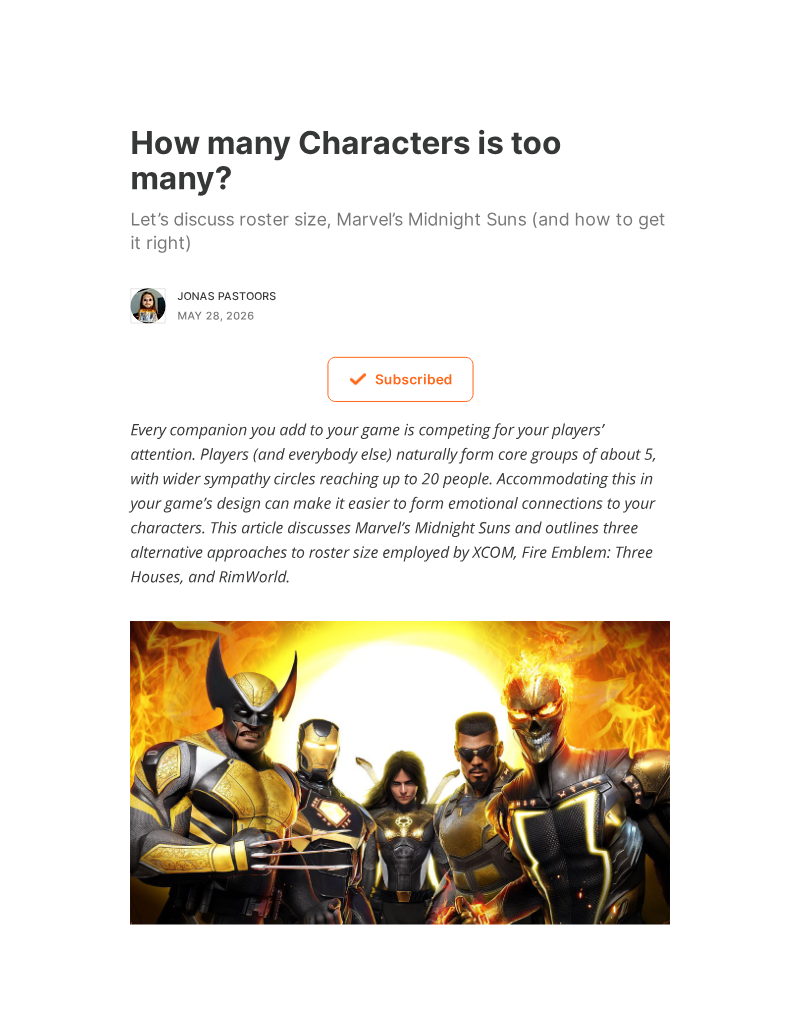
How Many Characters Is Too Many? Let's Discuss Roster Size, Marvel's Midnight Suns (and How to Get It Right)
This essay examines how the number of companion characters in a game affects player attention and emotional attachment, using Marvel's Midnight Suns as its central case study.
- Dunbar's Number suggests people maintain a close 'support clique' of about five people and a wider 'sympathy group' of roughly 10 to 20, and the author argues game rosters should respect these social limits because an oversized cast dilutes emotional attachment to individual characters.
- Marvel's Midnight Suns has 13 fully voiced heroes in its base game and 17 with DLC, a total the author considers within the sympathy group range, yet the game lacks a mechanism for players to naturally form a core group of regulars.
- In Midnight Suns, a three-hero combat team limit and friendship progress gating legendary abilities and cosmetics force players to either narrow their focus to two or three favorites and forfeit content, or spread attention across the whole roster, which makes attachment to any single character difficult.
Between Chaos and Story: How to Combine the Author's Idea and Algorithmic Randomness in Modern Narrative Design
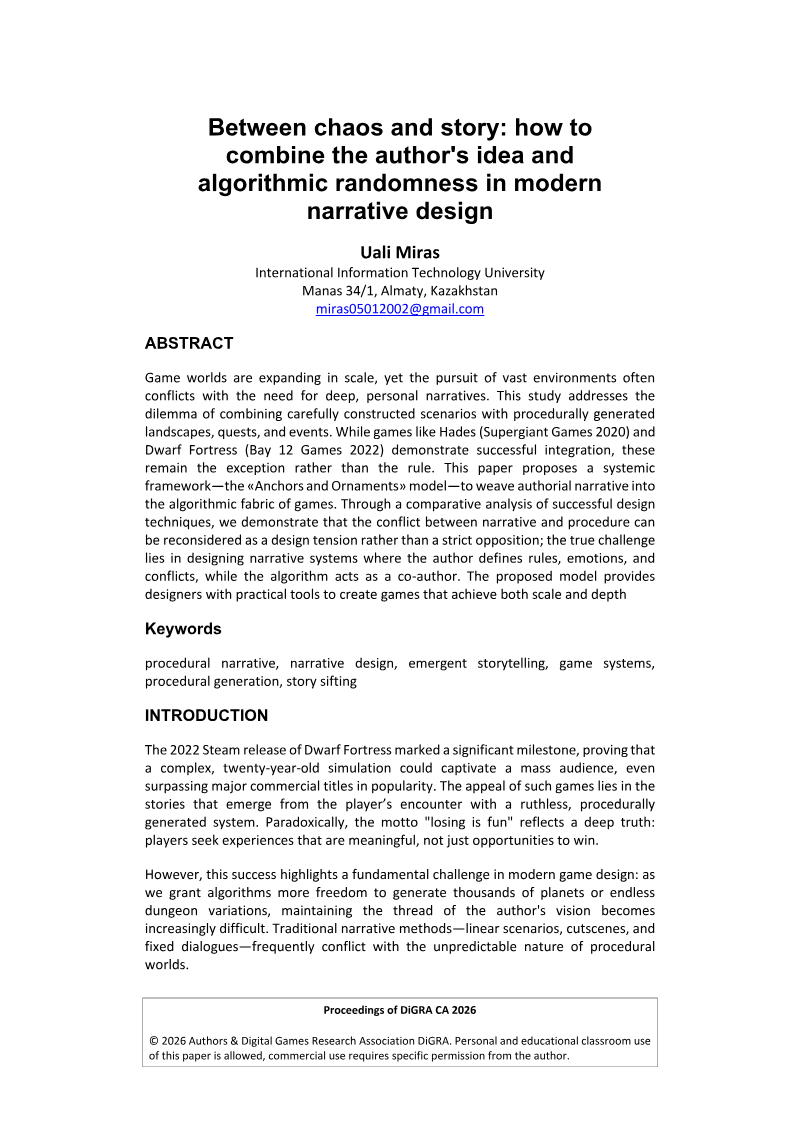
This paper examines how to reconcile carefully authored narrative with procedurally generated game worlds, treating the apparent conflict between authorial control and algorithmic randomness as a design tension rather than a strict opposition.
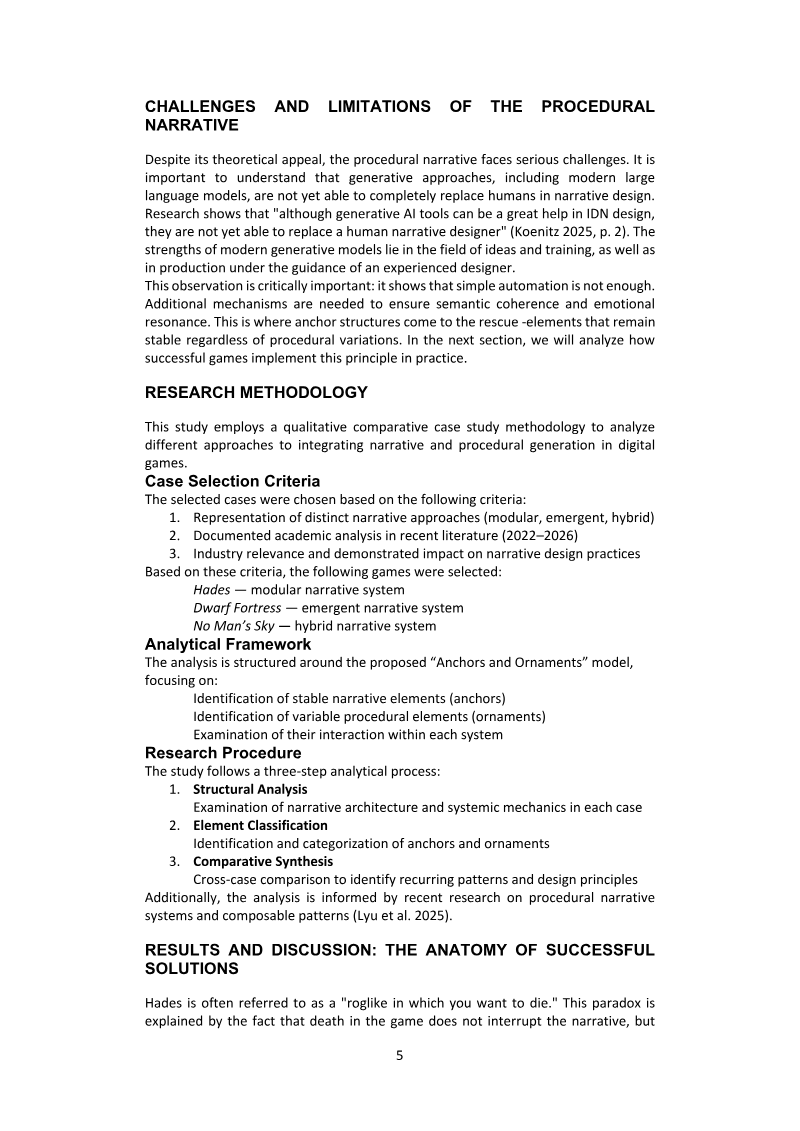
- The paper proposes the "Anchors and Ornaments" model, separating stable, author-defined elements (central characters, key plot twists, emotional climaxes, relational dynamics) from variable, system-generated content, and frames the designer's role as architecting rule systems and selection criteria rather than writing fixed stories.
- The paper treats the tension between authorial control and algorithmic randomness as a design tension to be balanced rather than a strict opposition, tying the approach to concepts such as procedural authorship and "story sifting."
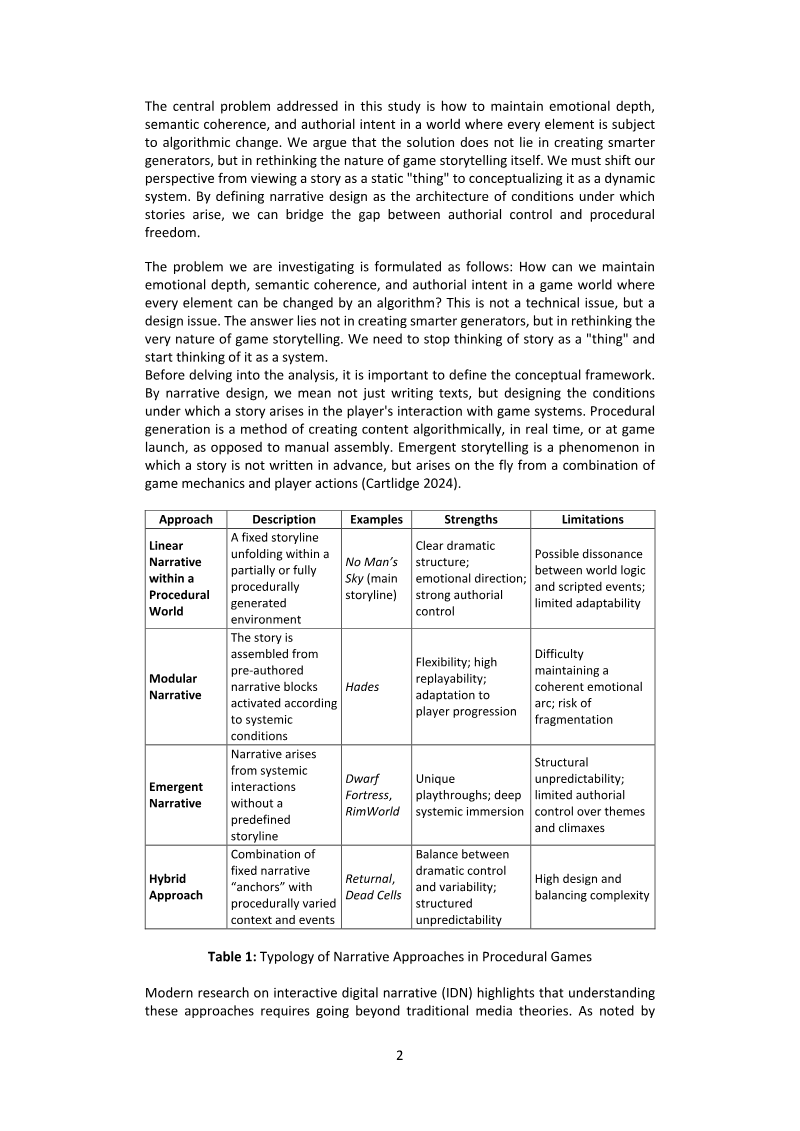
- The analysis is qualitative and comparative, examining three games representing distinct approaches: Hades (modular system), Dwarf Fortress (emergent system), and No Man's Sky (hybrid), and organizing the field with a typology of narrative approaches.
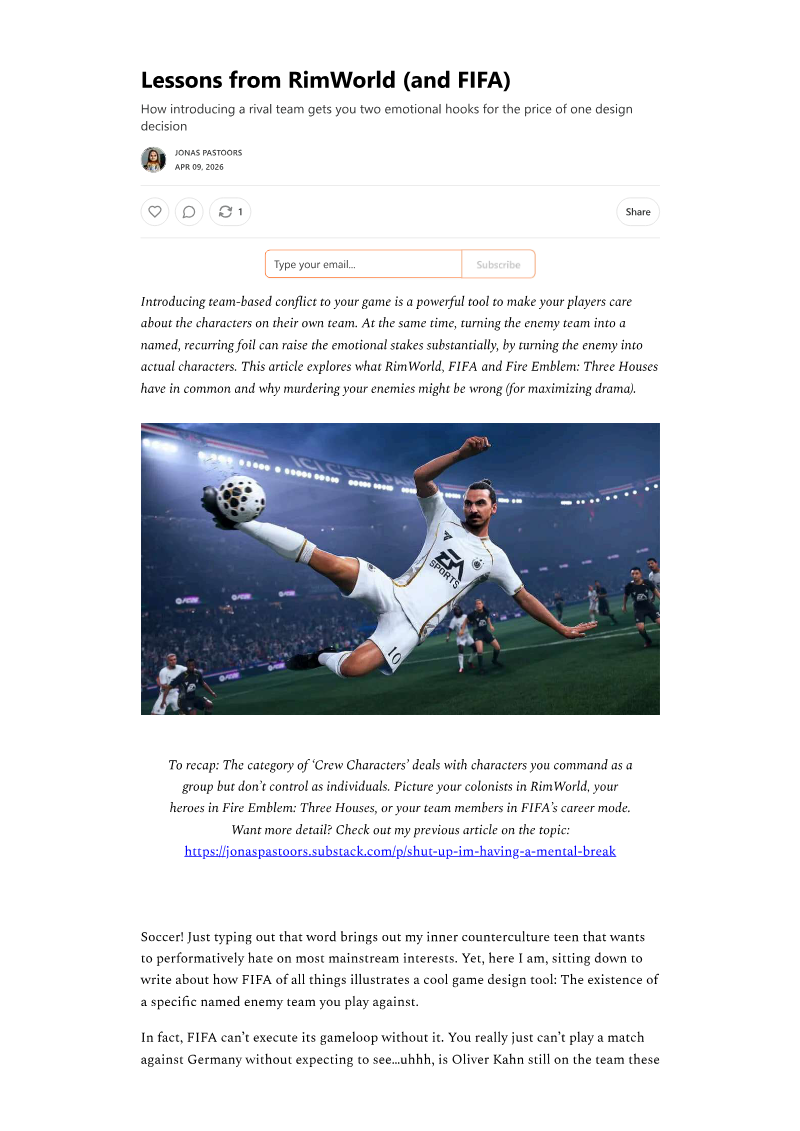
Lessons from RimWorld (and FIFA): How Introducing a Rival Team Gets You Two Emotional Hooks for the Price of One Design Decision
Jonas Pastoors argues that introducing a named rival team into a game creates two emotional hooks from a single design decision: players bond more quickly with their own team, and they develop a personal grudge against recurring enemy characters.
- Introducing a named rival team creates two emotional hooks from one design decision: faster bonding with the player's own team and a personal grudge against recurring enemy characters, drawing on intergroup empathy bias.
- In the author's small study, in-group empathy and out-group counter-empathy appeared almost immediately after participants were assigned to a competing team, and the bias strengthened as play continued.
- The intergroup bias was strongest when the contest was close and the rival posed a real threat, and weakened when the player easily dominated the opposition, suggesting challenging flow states heighten the effect.
"Shut Up, I'm Having a Mental Break!": The Strange Design Space of Characters You Command but Don't Control
This essay argues that video game characters such as RimWorld's colonists, XCOM's soldiers, and Baldur's Gate 3's companions occupy a distinct design category that sits between player characters and non-player characters.
- The essay proposes "crew characters" as a distinct design category: entities the player directs and develops but does not fully control, sitting between NPCs (differing in gameplay role) and player characters (differing in autonomy and individuality).
- Crew characters are placed on a spectrum running from bots and avatars through NPCs and crew to fully independent player characters, illustrated with examples such as Kratos, GLaDOS, and Doomguy.
- Designing for a community of characters rather than a single scripted protagonist creates a fundamentally different challenge, and the author argues designers who recognize crew-character properties can build stronger emotional bonds with them.
Why the Low-Profile Necesse Hit a Big 1.0 Release and 2m Sales
Necesse, a sandbox colony-builder from Fair Games, has sold 2 million copies on Steam since its December 2019 debut and hit 29,500 concurrent users at its 1.0 release in October 2025, more than double its prior peak.
- Necesse achieved 2 million units sold and a peak of 29,500 concurrent users upon its 1.0 release in late 2025.
- The game successfully targeted the audience of established genre staples, evidenced by an 86.5% overlap in ownership with Terraria players.
- A major visual overhaul in 2024 significantly boosted market appeal and conversion rates as the game transitioned out of Early Access.
How RimWorld's Latest DLC Was Its Biggest So Far
The sci-fi colony simulator RimWorld continues to demonstrate significant commercial longevity, with its latest expansion, Odyssey, marking the most successful DLC launch in the franchise’s history.
- RimWorld's latest expansion, Odyssey, achieved the franchise's most successful launch to date, generating record-breaking revenue within its first two weeks.
- The release of Odyssey drove a surge in peak concurrent players on Steam, increasing from 62,000 to nearly 100,000.
- Odyssey outperformed the previous expansion, Anomaly, by approximately 45,000 wishlists at the time of launch.
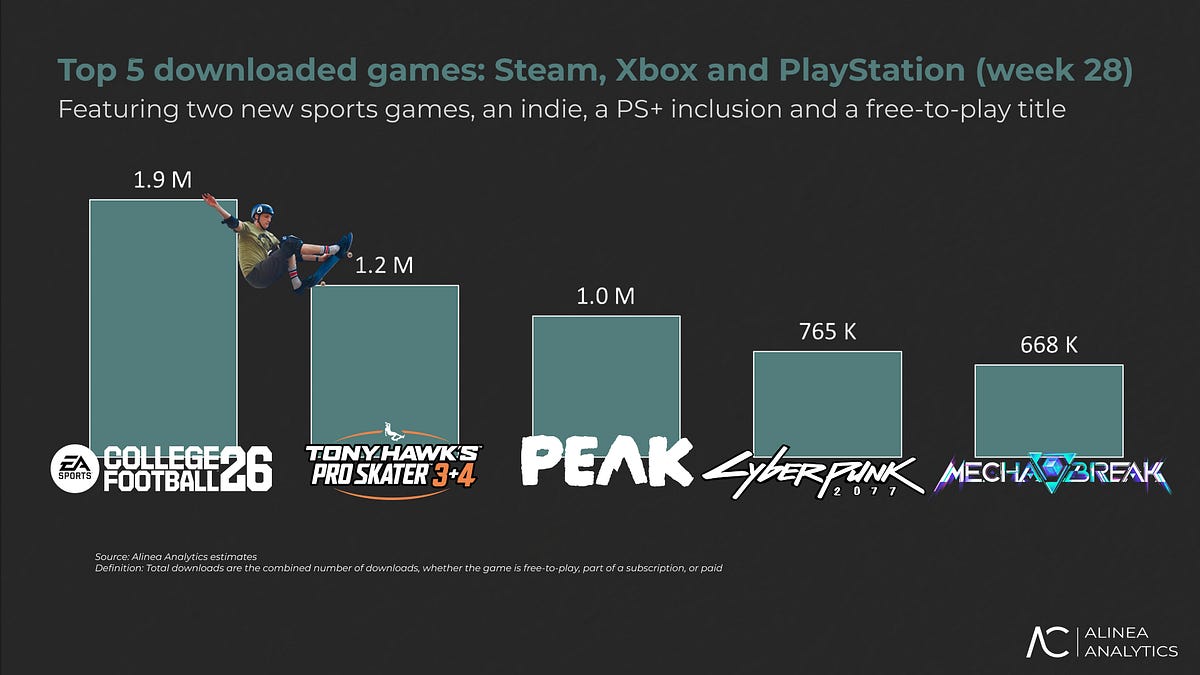
Steam, PlayStation, and Xbox’s Most Downloaded Games (Week 28)
This analysis examines gaming industry download and sales performance for week 28 of 2025 across the Steam, PlayStation, and Xbox platforms.
- Tony Hawk’s Pro Skater 3+4 generated 1.2 million downloads in its launch week, with 1.7 million Xbox players accessing the title primarily through Game Pass Ultimate.
- The co-op climbing game PEAK sold 1 million copies on Steam last week, bringing its total lifetime sales to over 5.6 million units and $31 million in revenue.
- RimWorld’s new Odyssey DLC sold 206,000 copies in its launch week, helping the base game reach a record-high concurrent player count of nearly 95,000 on Steam.
Companies behind it
As the documents state it.