
RimWorld
GameBy Ludeon Studios · Released Oct 17, 2018
Documents about RimWorld
Whitepaper9 pages
Between Chaos and Story: How to Combine the Author's Idea and Algorithmic Randomness in Modern Narrative Design
This paper examines how to reconcile carefully authored narrative with procedurally generated game worlds, treating the apparent conflict between authorial control and algorithmic randomness as a design tension rather than a strict opposition.
- The paper proposes the "Anchors and Ornaments" model, separating stable, author-defined elements (central characters, key plot twists, emotional climaxes, relational dynamics) from variable, system-generated content, and frames the designer's role as architecting rule systems and selection criteria rather than writing fixed stories.
- The paper treats the tension between authorial control and algorithmic randomness as a design tension to be balanced rather than a strict opposition, tying the approach to concepts such as procedural authorship and "story sifting."
- The analysis is qualitative and comparative, examining three games representing distinct approaches: Hades (modular system), Dwarf Fortress (emergent system), and No Man's Sky (hybrid), and organizing the field with a typology of narrative approaches.
DiGRAApr 2026
Whitepaper19 pages
Can Games Be AI Explanations? An Exploratory Study of Simulation Games
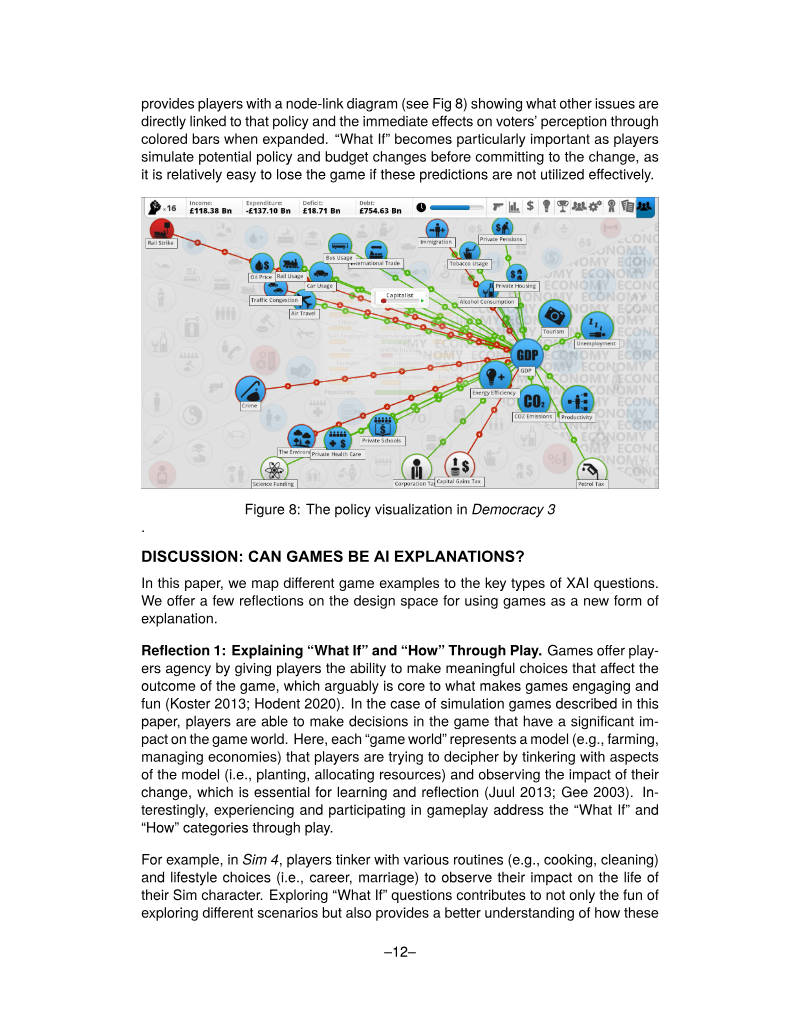
This exploratory study asks whether simulation games such as Farming Simulator 19, Civilization, RimWorld, The Sims 4, Crusader Kings 3, and Democracy 3 can function as explainable AI interfaces.
- Simulation games such as Farming Simulator 19, Civilization, RimWorld, The Sims 4, Crusader Kings 3, and Democracy 3 are examined as possible explainable AI (XAI) interfaces, using a qualitative affordance analysis mapped onto Liao et al.'s XAI Question Bank.
- The study finds simulation games can support most XAI question types but not equally well, with "What If" and "How" questions most naturally addressed because gameplay centres on manipulating inputs and observing outputs.
- Players build understanding through agency and trial-and-error experimentation rather than passive presentation, with games delivering explanation via visualizations, predictive screens, and interactive menus.
DiGRASep 2024
Companies behind it
As the documents state it.