1 free read left. Create a free account for unlimited reading + AI research.
Create free accountArticle Breda University of Applied Sciences
1 free read left. Create a free account for unlimited reading + AI research.
Create free accountArticleBreda University of Applied Sciences
The article argues that pairing great power over a crew with a strong sense of responsibility can shape the bonds players form. The key variable it identifies is incentive alignment between player and characters.
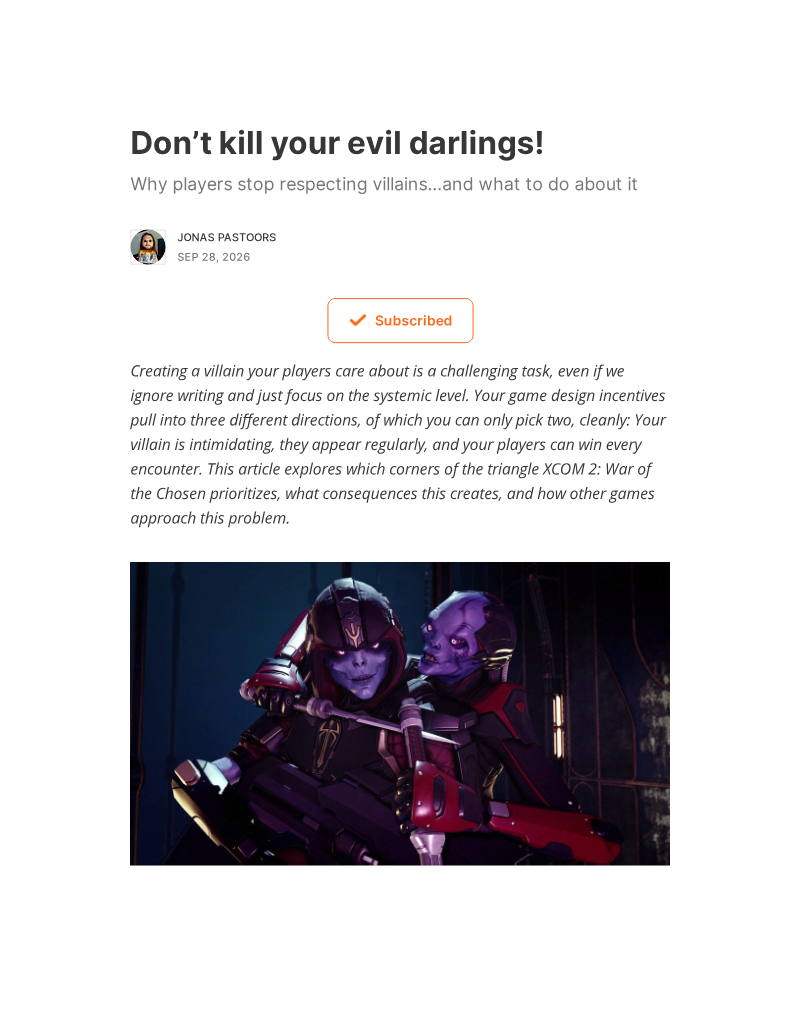
This article examines how the player's narrative role relative to the characters on their team shapes the emotional bonds that develop between them. Drawing on research into parasocial relationships, the author argues that games which explicitly frame the player's position, such as Fire Emblem: Three Houses, where the player is a professor responsible for students, align the player's incentives with nurturing their characters. The piece contrasts this approach with RimWorld, where the player acts as an external force with supernatural influence but no social identity, and with XCOM 2 and Darkest Dungeon, where the commander role creates responsibilities that the latter game deliberately undermines through an employer-employee dynamic built on disposability.
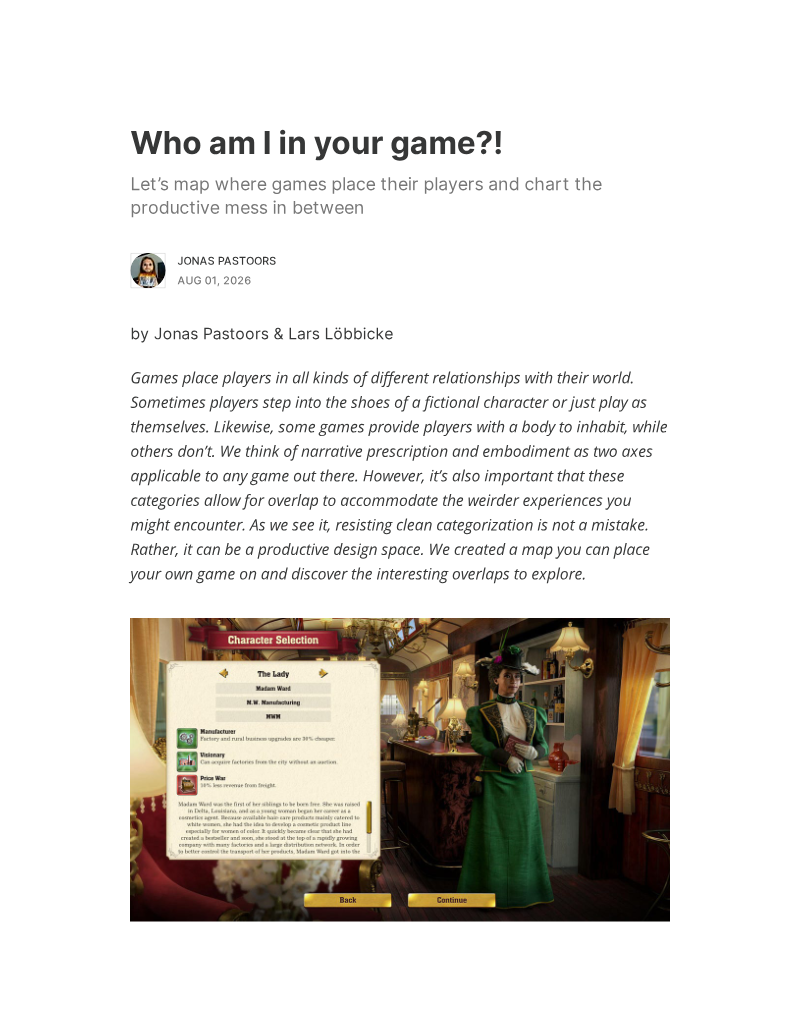
The central thesis is that a narrative frame pairing great power over a crew with a strong sense of responsibility can pre-load the emotional experience a designer wants, and that the key variable is incentive alignment between the player and their characters. The author illustrates this with a demo of Media Circus, in which the player acts as a newspaper editor whose reporters' growth and wellbeing serve the player's goals. The article also reports on an experiment run over the past year, in which some participants, lacking an inhabitable role, invented their own framings, such as a field commander or a guardian spirit, while others experienced the characters from a detached, parasocial position similar to watching a film or television.
The analysis draws on the 1956 work of Horton and Wohl, which first described parasocial interaction through talk show hosts who simulated direct address to audiences. The author uses this to distinguish games that involve the player as a participant from those that position them as observers, and offers practical guidance for designers: identifying how the player is incentivised to treat their team and which mechanics can make nurturing explicit. The discussion remains primarily qualitative and anecdotal, with the experiment's sample size and methodology described only briefly.



Breda University of Applied Sciences · 2026
DiGRA · 2026