1 free read left. Create a free account for unlimited reading + AI research.
Create free accountArticle Breda University of Applied Sciences
1 free read left. Create a free account for unlimited reading + AI research.
Create free accountArticleBreda University of Applied Sciences
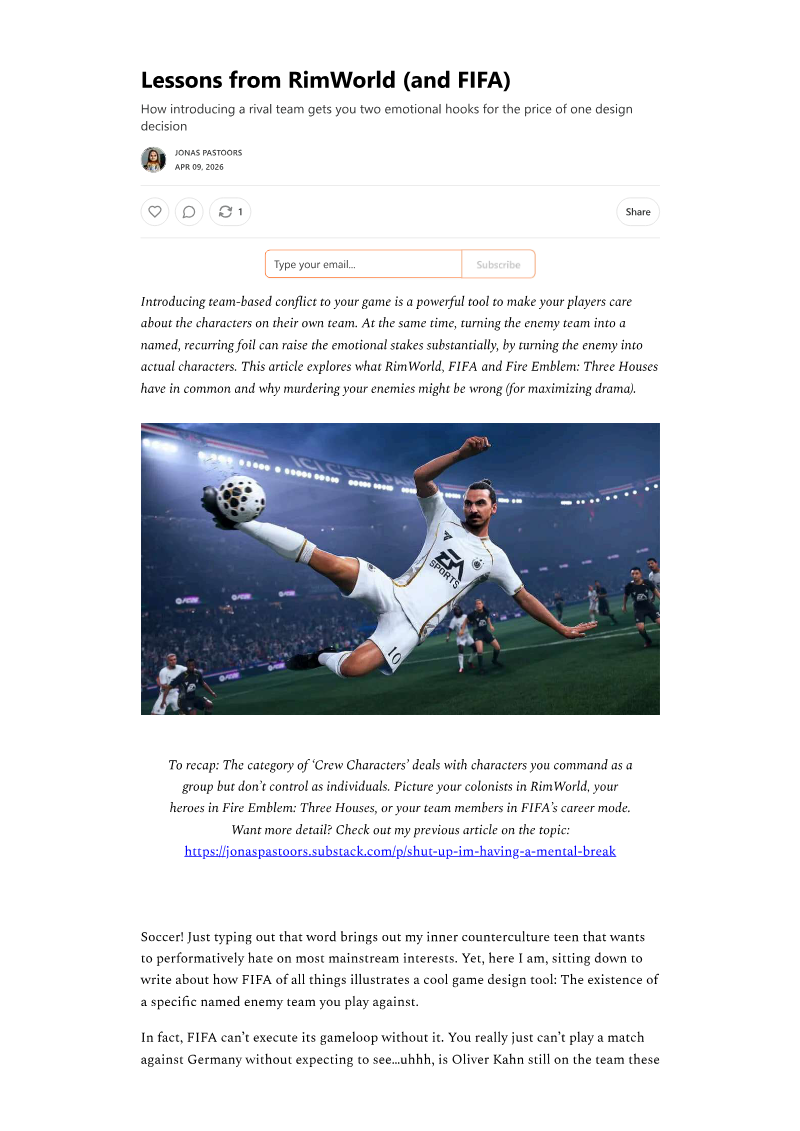
This essay by game designer Jonas Pastoors examines how narrative framing shapes player attachment, using the tactical roguelike Into the Breach as its central case. The author argues that the game deliberately deemphasizes its pilots: players lose their characters after each run, and the pilots function mainly as a bonus-delivery mechanism while the mechs do the visible fighting. Pastoors contends that these choices follow from a narrative frame centered on collateral damage, and that the same mechanics could instead foster bonding if the frame were reversed.
To test this, the author ran a pen-and-paper prototype based on the board game Bury Me in the Rift, recasting the mechs and pilots as heroes and magical artifacts defending a monastery against demons, with books at stake rather than civilians. Participants played a single run, which avoided the continuity break of the original game. The study was small and informal, with a handful of players, and the author himself acknowledges its limited scope. Attachment was measured by whether players would shred one of their characters or a 5-euro voucher, followed by questions about their feelings.
Results were mixed but meaningful: some participants showed little connection, while a notable number forgave the chance at a reward to protect their characters, and one player's comments reflected strong emotional investment after roughly 1.5 hours of play. Pastoors concludes that the narrative layer is a powerful and flexible design lever, able to determine whether players care about collateral damage or about their own characters, independent of underlying mechanics.
Each row is a game or company this document names, each column a document, oldest first. A mark means that document names it. Select a row to see those documents.
Breda University of Applied Sciences · 2026
Breda University of Applied Sciences · 2026
Breda University of Applied Sciences · 2026
DiGRA · 2026