
Boom Beach
GameBy Supercell · Released Mar 26, 2014
Documents about Boom Beach

10 Tips for Monetizing with a Mobile Game in 2017
Mobile game monetization in 2017 is framed as an underexploited opportunity: a market projected at $40.6 billion in revenue by year-end was driven by fewer than 1.9% of players, up just 0.4 points from 2014.
- As of January 2016, less than 1.9% of the total mobile player base generated the entirety of game revenue, highlighting the critical need to optimize conversion for non-paying users.
- High-priced virtual items can trigger high churn rates, as evidenced by the 75% average churn rate for new players within 30 days; developers should instead use lower entry-level price points and personalized offers for engaged users.
- Successful monetization relies on long-term retention, which is driven by frequent content updates, such as the strategy used by King with Candy Crush, which features over 2,680 levels.
Why Is Supercell Worth Billions? They’re Better Than Everyone Else
Supercell's rumored sale to Tencent, in which SoftBank would divest its 73% stake at a valuation above $9 billion, frames this June 2016 guest post by mobile marketing executive Michael Velkes.
- Supercell achieved a valuation of approximately $9 billion in 2016, driven by the success of titles like Boom Beach and Clash Royale, representing a $6 billion increase in enterprise value in under three years.
- In 2015, Supercell generated $2.3 billion in revenue and nearly $1 billion in EBIT with a workforce of fewer than 200 employees.
- The company utilizes a 'cell' organizational structure, which decentralizes roles into small, autonomous teams to foster rapid experimentation and the ability to quickly terminate underperforming projects.
iOS Gaming Leaders: January 2016
Global iOS game downloads rose 12.61 percent in January 2016 over December 2015, climbing from an estimated 614 million to 692 million installs.
- Global iOS game downloads reached 692 million in January 2016, a 12.61% increase over the 614 million installs recorded in December 2015.
- Worldwide iOS gaming revenue totaled $969 million in January 2016, representing a 2.91% decline from the $998 million generated in the previous month.
- Machine Zone's 'Mobile Strike' entered the U.S. revenue top 10 for the first time, placing eighth and marking the publisher's second title to reach that milestone alongside 'Game of War - Fire Age'.

2016 Predictions for Mobile Gaming
Mobile gaming analyst Eric Seufert's end-of-2015 outlook argues that 2016 will be shaped by three trends from the prior year: app marketplace saturation making downloads harder to win, a resulting emphasis on cross promotion as a defensive tool for retaining users, and video advertising making light, viral "gimmick" apps…
- The increasing reliance on video advertising will obscure traditional 'Top Grossing' chart rankings, as apps with lower chart positions may generate more revenue than higher-ranked peers through superior ad monetization.
- Non-gaming apps, such as streaming and lifestyle services like Spotify, Pandora, and YouTube, are increasingly likely to displace games from the Top 5 Grossing positions in Western markets.
- Established 'perennial' top-grossing titles like Candy Crush Saga, Game of War, and Clash of Clans face a high risk of permanently exiting the Top 10 as their own developers cannibalize their user bases with 'spiritual successor' sequels.
iOS Gaming Leaders: November 2015
Ketchapp's endless-style arcade game Twist emerged as the surprise leader of November 2015 iOS gaming charts, topping both U.S. and worldwide downloads.
- Ketchapp’s game 'Twist' became the most downloaded iOS game globally and in the U.S. in November 2015, significantly outperforming new releases from major publishers like King and Machine Zone.
- Machine Zone’s 'Game of War' maintained the top position for global and U.S. revenue, while Supercell’s 'Clash of Clans' experienced negative month-over-month revenue growth for the second consecutive time.
- The top 10 revenue-generating games showed a stagnant trend, with half of the titles experiencing month-over-month revenue declines and no new entries appearing on the top 10 lists.

Biz Daily: Will Supercell ever release another game?
Supercell maintains a rigorous development philosophy characterized by the willingness to cancel projects that fail to meet exceptionally high internal performance standards.
- Supercell maintains a lean workforce of approximately 130 employees while generating over $1 billion in annual revenue.
- The company employs a rigorous 'kill-your-darlings' strategy, intentionally canceling underperforming projects during soft-launch phases to avoid the long-term operational costs of non-profitable games.
- Supercell’s portfolio, anchored by Clash of Clans, Boom Beach, and Hay Day, prioritizes high-performance metrics over the volume of new releases.

Analysing the monetization of Fallout Shelter
This analysis examines the monetization strategy and technical performance of Bethesda’s Fallout Shelter, contrasting its economic model with industry standards set by titles like Marvel: Contest of Champions and Boom Beach.
- Fallout Shelter achieves commercial success by prioritizing brand engagement and gameplay loops over the high-frequency, high-spend monetization models typical of mobile industry leaders like Marvel: Contest of Champions and Boom Beach.
- The game’s monetization strategy is notably conservative, capping its maximum in-app purchase at $20 and maintaining an average purchase price under $10, diverging from the industry-standard $100 price ceiling.
- Monetization relies on the sale of 'lunch boxes' rather than direct hard currency, creating a unique economic loop that lacks traditional reciprocity metrics found in competing titles.
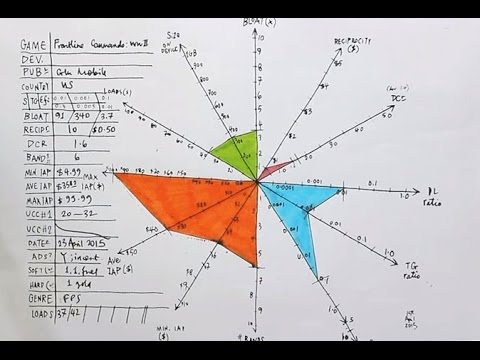
A visual representation of F2P mobile game economics
A multi-axis graphical framework provides a standardized method for visualizing and comparing the economic and technical performance of free-to-play (F2P) mobile games.
- A multi-axis graphical framework allows for the standardized comparison of F2P mobile games by plotting technical performance, monetization structures, and market success onto a single visual diagnostic.
- The framework evaluates games across four specific dimensions: technical efficiency (load times and install size), reciprocity (currency grants and discount ratios), commercial success (app store rankings), and IAP structure (price band variety).
- Technical efficiency metrics focus on barriers to user retention by measuring load times and the discrepancy between advertised and actual installation sizes.

Monetizer: Compass Point: West
Compass Point: West, a mobile strategy title developed by the Finnish startup Next Games, serves as a case study in hybridizing established genre mechanics.
- Next Games developed Compass Point: West as a hybrid mobile strategy title that merges Clash of Clans-style base-building with card-collection mechanics for unit management.
- The game replaces traditional unit training with a card system where players collect, upgrade, and merge cards to improve combat effectiveness.
- Monetization relies on a dual-currency model using gold/goods as soft currency and diamonds as hard currency to accelerate timers, bypass wait times, and purchase card-draw boosters.

Implications of Supercell's $1.7 billion 2014 revenue
Supercell’s 2014 financial performance serves as a primary indicator of the current state of the mobile gaming industry, characterized by extreme market concentration and high barriers to entry.
- Supercell generated $1.7 billion in 2014 revenue with $580 million in profit, marking a threefold increase over their 2013 performance.
- The mobile gaming market is characterized by extreme concentration, where a small group of elite firms including Supercell, King, Machine Zone, and Gung-Ho dominate the top of the charts.
- Top-tier developers maintain their market position by reinvesting 20% to 30% of their revenue into aggressive user acquisition and high-profile marketing campaigns.

Top 50 Developers of 2015: #1 Supercell
Supercell secures the top position in the 2015 list of mobile developers, marking a return to the number one spot it previously held in 2013.
- Supercell reclaimed the number one spot in the 2015 mobile developer rankings, driven by the sustained financial performance of its core portfolio.
- Clash of Clans remains the studio's primary revenue driver, generating an estimated $1.8 billion in 2014.
- The company successfully expanded its market reach with Boom Beach by positioning it as a less competitive companion to Clash of Clans, avoiding user base cannibalization.

Portfolio Dynamics for Mobile Games
Eric Seufert's 2015 analysis responds to an App Annie study of three mobile game portfolio strategies: franchise-focused (a single IP across genres, as with Rovio's Angry Birds), genre-focused (a narrow set of genres with flexible IP, as with King's match-3 titles), and diversified (broad IP and genre coverage, as with Zynga).
- A 2014 study of 100 mobile gaming companies by App Annie identified three primary portfolio strategies: franchise-focused (e.g., Rovio), genre-focused (e.g., King), and diversified (e.g., Zynga).
- Empirical data from 2014 indicated that the genre-focused strategy outperformed both franchise-focused and diversified approaches in the mobile gaming market.
- The success of genre-focused leaders like King and Supercell in 2014 was driven by effective cross-promotion tactics, leveraging popular titles to drive traffic to new releases within the same genre.
Companies behind it


As the documents state it.