1 free read left. Create a free account for unlimited reading + AI research.
Create free account
A visual representation of F2P mobile game economics
Key insights
6 takeaways- 01A multi-axis graphical framework allows for the standardized comparison of F2P mobile games by plotting technical performance, monetization structures, and market success onto a single visual diagnostic.
- 02Technical efficiency metrics focus on barriers to user retention by measuring load times and the discrepancy between advertised and actual installation sizes.
- 03The reciprocity quadrant quantifies developer generosity by analyzing initial currency grants and the discount ratios applied to bulk in-app purchases.
- 04Comparative analysis of diverse titles, such as Mortal Kombat X and Pirate Kings, reveals that successful games like Boom Beach maintain high technical efficiency alongside balanced monetization models.
- 05The IAP structure quadrant maps the static economy of a game by evaluating the number of available price bands and the range between minimum and maximum purchase options.
- 06The framework evaluates games across four specific dimensions: technical efficiency (load times and install size), reciprocity (currency grants and discount ratios), commercial success (app store rankings), and IAP structure (price band variety).
Ask AI about this video
Transcript
hello and welcome to pocket gaming not business business monetizer so um monetization is a process we've been um kind of refining for the last couple of years um to look at how free to play games um really obviously how they monetize um we also look at kind of their their kind of um their user experience and social aspects and things like that but in this case this is kind of a kind of a a weirder part maybe of the monetization process so over the years i've been kind of working on um kind of tracking different analytics and or different numbers at least that are generated by kind of playing some of these games and just tracking i mean some of them are very straightforward you know what the most expensive in-app purchases um what the kind of ratios of buying hard currency different kind of values are and things like that and something i've said over really over two years but certainly over the last um
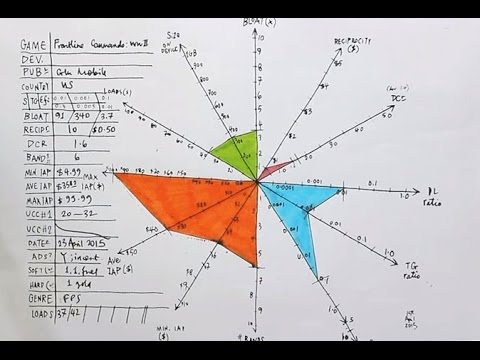
six months i've been kind of accelerating to just try to come up with maybe something that's a bit easier to see the numbers so this is this is my attempt it is a graph as you can see it's a bit of an odd graph got lots of axes um but i kind of thought maybe it'd be worth trying to explain kind of some of the um the process of my thinking really and just kind of give you some examples of some games so we can get an idea of um hey can i get start to categorize categorize different games based on um let's say these are all fairly simple numbers once you know what you're doing um um anyone can do this so anyway so this is um this is our basic monetizer graph um he's gone through a couple of evolutions to get to this stage but um this is what it looks like so this game we're looking at actually and this is the graph for frontline commando world war two from glue mobile um so a game that came out fairly recently a a um kind of uh first person or third-person shooter game so we'll take the different colored kind of quadrants um in turn so we look if we look at the start here we have this green quadrant
now this line here um look up here is the load time so it's very straight straightforward to do that basically i just kind of load up the game with a stopwatch and take an average of of how long it takes to load in this case about 40 seconds so that gives us our first mark there so this second line here is the size of the game when installed on the device so again fairly straightforward you install the game um obviously you tend to play games longer they tend to install more stuff they do updates they tend to get bigger so you know none of these are kind of kind of i guess totally objective numbers it just happens to be you know i try to do things quite early when games are released so before they've got too um too bloated um so in this this case the game was 340 megabytes um installed so that gives us our point here and this line here is the bloke line so the bloke line is um pretty straightforward it's a ratio so when you look on on the app store in this case i'm working off of an ipad so look at the apple app store and it says
frontline commander world war ii is 91 megabytes but when i install it it's 340 megabytes so the the ratio um what i call the bloke ratio is 3.7 so there we can see that's kind of encapsulating um something and i kind of look at this area here this green arrow look at the kind of um look at it as the kind of kind of like the code efficiency or kind of how well the developer has kind of thought about how big the game's going to be how big it's going to kind of install when it's all kind of um all been expanded and i think personally maybe personal thing for me i kind of think um load times are pretty important i kind of kind of think once you get to certainly when you get to 40 seconds that's becomes a bit of a barrier and certainly there are some games that take every minute um to load um to me that suggests the developer's not thought very very um properly about the kind of user experience so we have this little area here that's that's the green bit so and we have these two axes here so this is this little pink area here you can't see very very um not very big in this particular game there so this line here
is reciprocity so the reciprocity is when you load a game normally you get some free currency um so reciprocity is you do something nice for someone and they then normally do something nice to you i'll have a nice feeling towards you so this is the sense that the game has given you currency i'm expecting you to spend it and hopefully you're going to spend some of some real money as well so in this case it's just just um the game gave me 10 hard currency units that's worth half a dollar so very small down there this goes up to five which is some games give you more but um most give you less and this this line here is what i call the um discount home currency ratio and that's the difference if you spend the um if you buy the cheapest in that purchase in this case um five dollars how much in game currency you get and that compared to if you spend the most in this in this case a hundred dollars so the ratio here is um 1.6 so you get 1.6 um more hard currency per dollar if you spend a hundred dollars again this is fairly straightforward um concept most games do this normally about 1.4 1.6
something like that normally under two so very small area here so this is like a generous an idea of this is a generosity how generous is the game towards me if i'm spending money um they're not massively generous this blue one down here um this is what i kind of look at um kind of app store rating so this just these very simple ratios so this is a download ratio and this is a top grossing ratio radiation this is just um the ratio of how many um top ten how many countries the game's on top ten um download or top grossing uh a ratio compared to that how many it's gone top 100 so the ratio of one will be for all the gate of all the countries it's gone top 100 and it's also got top 10 so that means it's very successful and then i and i ratio that again compared to the us market the us market tends to be a bit of a bellwether it's not not that's not the case in every game sometimes to say the japanese market might be more important all three market for games in those territories but in general for the western market i use the us as a baseline so these numbers
could be a maximum of one as we can see here these are nowhere near one and this is actually complicated in a way this is like a um not quite an ex exponential scale but a little bit like an exponential kelp so so so you i um so this is actually looks like it's halfway along the graph actually this is quite this has been exaggerated here so we can just see it but it's basically this game um has not been particularly successful in terms of downloads or in terms of top grossing and this one here is um i guess the most controversial kind of number i use this is like an efficiency my area of efficiency so this is basically looking at for the downloads it had for the ranking on downloads how well the top grows um it just gives you an idea really kind of how the monetization is working it changes a bit you know the more the more popular a game is um the harder it is to kind of um kind of monetize all its users so you have to be careful with that but it just gives me an idea the whole point of this is i draw you know i create a graph this graph for games and i can compare them it's not that each individual number is some sort of kind of set it's set in stone silver bullet
mixing my metaphors um so this is an idea of success the blue area and final one the most obvious one the most easy one really conceptually is the orange area so the orange area is just like this is the line of how many um in-app purchase options there are so called bands in this case there's six different options so they range from 499 to 99.99 six options um most games are five or six occasionally you get something eight occasionally i mean i don't often get a lot less than that this line here is the minimum in-app purchase in this case as in pretty much every game it's 4.99 five dollars um this line here is the maximum um again pretty much in every game it's 100 in some games some games it's 50 but in most games 100 and then this axis here is the average um again in a standard setup the average can depend a little bit on whether you're five or six bands but in this case it's 59.82 so this just gives an idea of kind of the static in-app um economy of
the game so that's the basic setup so we've seen that we've seen them frontline commandos too so let's look at some other games okay so let's look at this one you see pretty different let's see a lot more spiky in this one so this one is um a game from kabam called spirit lords and this is like a really big rpg their console style rpg um so what can we see let's let's go around the graph so our efficiency kind of idea 40 seconds to load it's quite a big game um so not particularly fast but not not terribly slow either but when we look at size on device so this is like pretty much a gig a gigabyte um to download um although it says on the app store it says it's 600 meg so you should be massively surprised so the on device you've got big spike here because it's so big as a gigabyte which i think is too big for mobile games but there we go but the bloat is only it's under two because it's you know it's not expanded it says it's a big game so should be too surprised okay another big spikey reciprocity so in the game i get 650 um units of hard currency that's five five dollars so you know kabam
is giving us a lot you know giving us a lot up front um to spend and that's something we've been kind of playing around with a little bit so it's kind of interesting to see they weren't always this generous um in terms of the um the uh the dcr ratio the the the currency discount ratio fairly standard 1.4 so that's that's what we expect so we look at the um success one here i've kind of altered this a little bit i've looked at it iphone and ipad but in both cases it's not had a lot of downloads perhaps it's a large file size download it's not had a lot of top grossing either so it's efficiency ratio is actually um for the for the iphone is is pretty high so efficiency range is actually over two um but that's a little bit of a product of the fact that it's not had many downloads and it's top pricing is just slightly better than downloads it had so so in terms of i guess you could say this the economy is set up well if you just got more downloads it would would be generating money it's just not got enough downloads um and here we see i mean this is the affair this is fairly standard you can see this is exactly the same so it's six bands five dollars
minimum 100 maximum so so you can just see immediately there's something different going on there but certainly in this in these two areas so let's have another one another big game another say a console triple a type mobile game so this is mortal kombat x again another massive spike this is another game this is actually 1.2 gigabytes on device again the bloat is small because it says it says it's 700 make when you're in the app store um restaurant is not so big um it's only a dollar you get here and the um for the discount currency ratio there's actually two of them because it actually has two card currencies which is very unusual now um to have two hard currencies but it does that so you have um so one of them normally ones we call a kind of hard hard hard currency and one's a software currency so the hard hard currency has ratio of um 1.6 which is what we oh no sorry um where are we had two uh and then the softer one has a ratio of three points three point seven so that's the kind of hash line when it comes to efficiency actually
this is kind of a sorry a success download-wise been really strong um particularly on ipad it's almost um it's retro 0.9 which is very very good for downloads when it comes to how well it's monetized not particularly well so um so you can see um the efficiency has not been particularly good um potentially this is because i think this this kind of two to currency setup is is just old-fashioned now um another interesting thing we look at here is there's a big kind of hole here compared to um the other ones we saw so this is because um it has six uh six band i o in that purchase system but the cheapest one is three dollars so that's why the difference there is maximum 100 so so again i'm getting a different idea let's have a look at what else we've got um two um let's look at two different games so this game here is very different um this is called pirate kings it's a very simple arcade game um from a company coming called jelly button i mean super simple
um arcade game so you can see here efficiency um the green area super small so it's really fast to download under 20 seconds to download pretty small on device under 300 okay just lost it there um so in terms of the downloads here um uh it's not done particularly well but but the kind of efficiency is actually quite good so um but you can see everything kind of here is smaller and particularly i guess this is the reason um that's kind of potentially most interesting is it's got um five bands but it's but the cheapest um in that purchase is a dollar which very few games have anymore so obviously the average is smaller and the most expensive one is 50 so we just see everything compared to kind of these big spikes things yeah this is a very much smaller game a smaller arcade game everything's compacted it hasn't actually had changed the success very much um but immediately i can i can see you can or you can see from these graphs this is a different it's describing a different type of game um very quickly let's look at one last game so this is um i guess a good example of a classic kind of a really successful game this is boom
beach from from supercell so we can see here the efficiency like super efficient and it's really small game 135 meg loads pretty fast loads but 20 seconds rest process is not amazing um the the uh the dcr discounted error currency ratio it's pretty standard 1.4 reciprocity um difficult i had been playing this game for a long time um but it was about two um that i had um so not necessarily generous but generous enough um looking down the successor we're pretty much not quite a one but um pretty much we're at this end of the scale so downloads um it's done really well top grossing obviously it's massively top closing game it's not it's not actually at once actually about 0.2 um and and the efficiency is um so the efficiency of generating revenue from each user is pretty good it's actually at um so we're looking so getting one for like point five or one so and that's probably because it's had a lot of download so that's really good so you can just see the successes is here um and then in terms of the in-app purchase
there's five bands four dollars is the minimum tens of that ten hundred dollars maximum so um you know this this is not giving you not telling you why this game's successful particularly but um maybe there's kind of things you can draw off of maybe to do with the efficiency or maybe the reciprocity you know there's something else to come out of it but i think just we can see from looking at these games some very different games um immediately you can kind of get an idea about what's going on with them and let's just say that's really the idea of of the monetizer the monetizer it's a processor it's not coming to an end you know if you want to buy the hard figures of what games you're doing you buy fanny or there's lots of these analytic companies that can provide you this kind of data this isn't trying a bit of a fun way to kind of look at games um and try and kind of think a bit more deeply about kind of what's going on with them and some i guess the static things like what's the pricing and some are a bit more kind of um kind of i guess creative about how fast things load um and that's just really what we're trying to do on monetizer so um keep following us uh keep reading the articles
Summary
A multi-axis graphical framework provides a standardized method for visualizing and comparing the economic and technical performance of free-to-play (F2P) mobile games. By plotting disparate metrics—including load times, installation size, in-app purchase (IAP) structures, and market performance—onto a single visual representation, analysts can identify the specific strengths and weaknesses of a game’s monetization strategy and user experience. This approach categorizes games based on their technical efficiency, generosity toward players, and commercial success, offering a qualitative snapshot that complements traditional quantitative analytics.
The framework evaluates games across four primary dimensions. The efficiency quadrant measures technical performance, such as load times and the ratio between advertised and actual installation size, highlighting potential barriers to user retention. The reciprocity quadrant assesses developer generosity by tracking initial currency grants and the discount ratios applied to bulk currency purchases. The success quadrant uses app store rankings to determine how effectively a game converts downloads into revenue, while the IAP structure quadrant maps the static economy, including the number of price bands and the range of minimum to maximum purchase options.
Data for this analysis is derived from direct observation of mobile titles on iOS devices, focusing on Western markets with the United States serving as a primary baseline. By applying this consistent methodology to diverse titles—ranging from high-fidelity console-style RPGs like Mortal Kombat X to simpler arcade games like Pirate Kings—the framework reveals distinct economic profiles. These visualizations demonstrate that while successful titles like Boom Beach exhibit high efficiency and balanced monetization, others may struggle with excessive file sizes or outdated currency models. Ultimately, this tool serves as a diagnostic aid for understanding the underlying mechanics that drive F2P mobile game economies.























Comments