Finland reports and market data
317 game industry reports, presentations and talks about finland from writers such as PocketGamer.biz, Neogames Finland and Deconstructor of Fun, newest from 2026. Every document has a summary and key insights with the page they come from, and 559 charts and tables are extracted as data.
Key figures
Consumer spending in Finland is shifting toward consoles, which now capture 49 percent of the market, followed by mobile at 35 percent and PC at 16 percent.
PocketGamer.biz, 2025 · Finland Games Industry Report 2025, p. 7
The sector comprises 232 active studios and 4,100 employees, supported by a robust funding ecosystem that includes over €300 million in private investment and significant public R&D backing from Business Finland.
Suomen Pelinkehittäjät ry, 2023 · The Game Industry of Finland Report: 2022, p. 40
Key policy recommendations include allocating 100 million euros to address the talent shortage, making Finland an attractive place for digital development, and advocating for Europe to drive global regulation of digital markets.
Neogames Finland, 2019 · Game Industry Policy Recommendations for 2019‑2024: Finland, p. 2
Finland leads the region in academic efficiency with a 60 percent graduation rate, significantly outperforming the broader Nordic average of 40 percent.
Dataspelsbranschen, 2016 · Nordic Game Education Index: 2015, p. 33
Documents

Colossal Order's Mariina Hallikainen on leaving Paradox and life after Cities: Skylines
Colossal Order CEO Mariina Hallikainen reflects on the studio’s 17-year history, its recent departure from long-term publisher Paradox Interactive in November 2025, and the company’s future trajectory.
- Colossal Order ended its 15-year partnership with publisher Paradox Interactive in November 2025 after releasing four games, including the Cities: Skylines franchise.
- The studio is now self-sufficient and no longer requires publisher funding, allowing them to explore self-publishing or alternative partnerships that prioritize trust and open communication.
- Colossal Order is currently developing a new, unannounced simulation title, maintaining its long-standing focus on the PC simulation genre.

Session: AAA Game Development: A Peek Behind The Curtain - Ari Arnbjörnsson, Epic Games,
This presentation provides an insider’s perspective on the realities of AAA game development, drawing on the speaker’s 18-year career, including roles at Housemarque and Epic Games.
- AAA game development is defined by large team sizes and significant budgets, often resulting in projects held together by 'scaffolding'—vestigial code and features from previous iterations that remain because they are too deeply integrated to remove.
- Imposter syndrome is prevalent in the industry, but it should not prevent professionals from asking questions, as the complexity of AAA development means no single individual can possess all the answers.
- Internationalization is a major technical hurdle, as languages like German or Russian can be 30% to 50% longer than English, requiring UI systems that can handle significant text overflow and complex grammatical rules like gendered nouns and multiple pluralization forms.
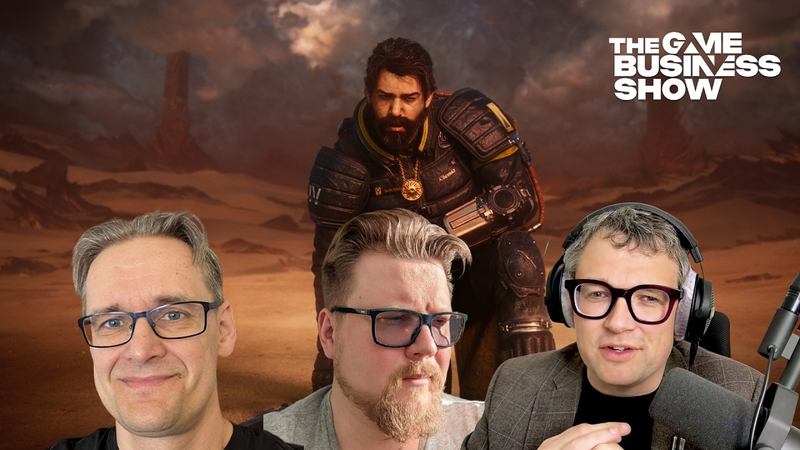
Can PlayStation’s Housemarque repeat the FromSoftware story?
Housemarque is currently navigating a strategic evolution as a first-party PlayStation studio, aiming to elevate its historically niche, arcade-inspired design philosophy into the realm of major, top-tier gaming franchises.
- Housemarque is transitioning from a niche arcade developer to a major first-party PlayStation studio by scaling its high-intensity, flow-state gameplay for a broader, mainstream audience.
- The studio currently employs approximately 120 people and is leveraging Sony’s internal resources, user testing, and collaborative infrastructure to support this growth.
- Housemarque aims to replicate the success trajectories of established studios like Naughty Dog and Insomniac Games by treating new intellectual properties as long-term foundations for player engagement.
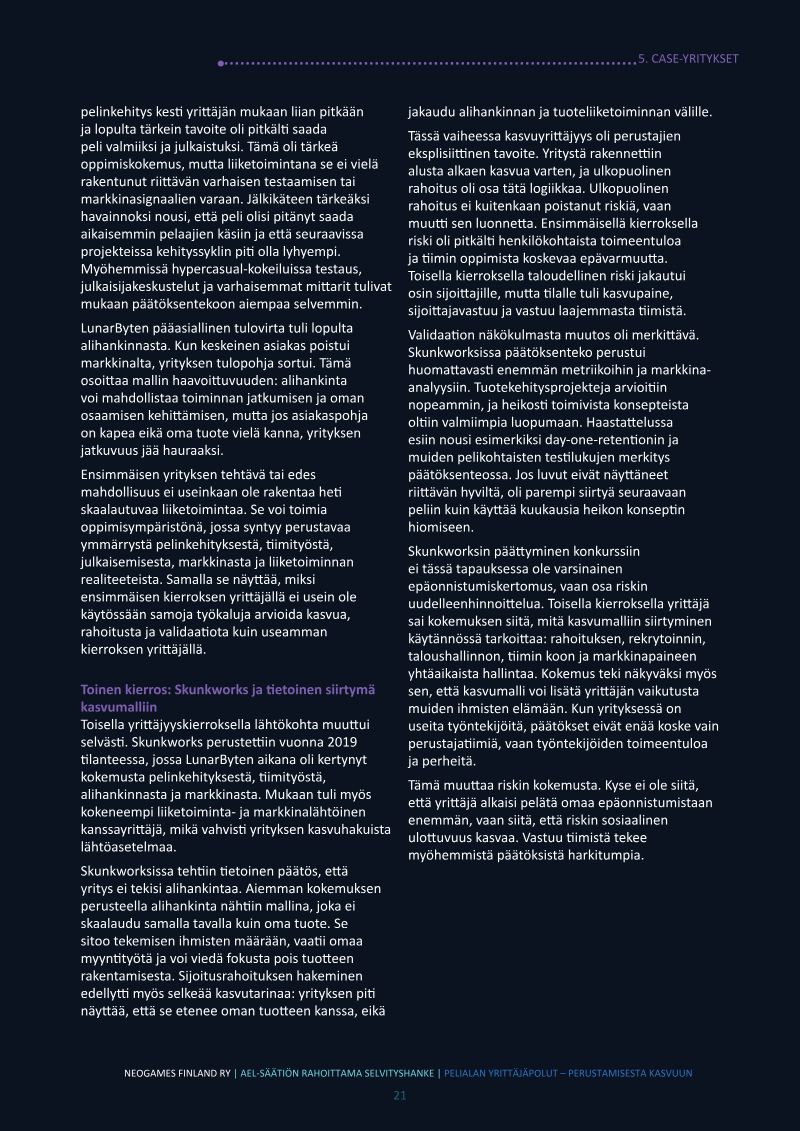
Pelialan Yrittäjäpolut: Perustamisesta Kasvuun
The Finnish game industry is currently navigating a significant structural shift characterized by the saturation of mobile markets and intensified global competition.
- The Finnish game industry has shifted from a singular focus on hypergrowth to three distinct business archetypes: scalable growth-oriented companies, sustainably profitable studios, and indie-led developers prioritizing creative autonomy.
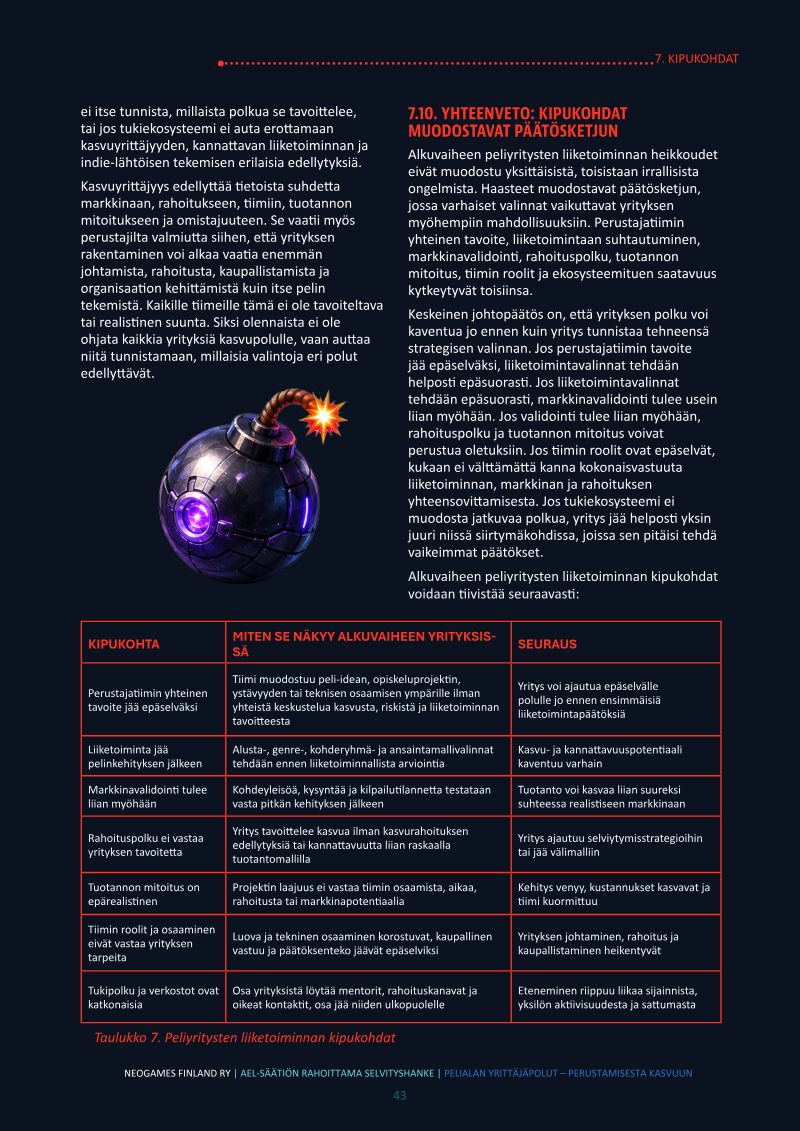
- Strategic misalignment and operational instability frequently occur when studios fail to align their funding, team structure, and market validation strategies with their chosen business archetype early in their lifecycle.
- Many early-stage studios struggle due to a lack of commercial understanding and delayed market validation, despite the availability of robust support networks including incubators, mentors, and diverse funding sources.
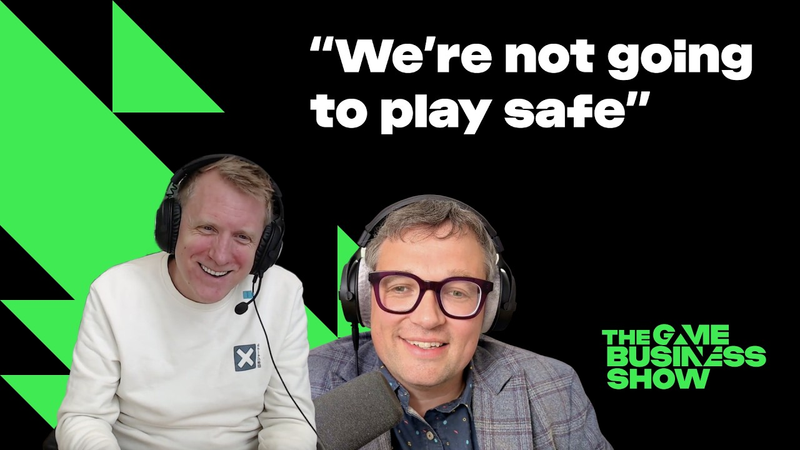
Exclusive interview with Remedy’s new CEO: “Alan Wake and Control should have sold more"
Remedy Entertainment is undergoing a strategic pivot aimed at bridging the gap between its long-standing critical acclaim and its historical commercial performance.
- Remedy Entertainment is transitioning to a self-publishing model to gain autonomy and better align its business operations with its creative identity.
- The studio is pivoting away from volatile segments like mobile gaming and live-service models to focus exclusively on scaling its existing intellectual property.
- Remedy aims to improve the commercial performance of its franchises, such as Alan Wake and Control, which historically underperformed relative to their critical acclaim.
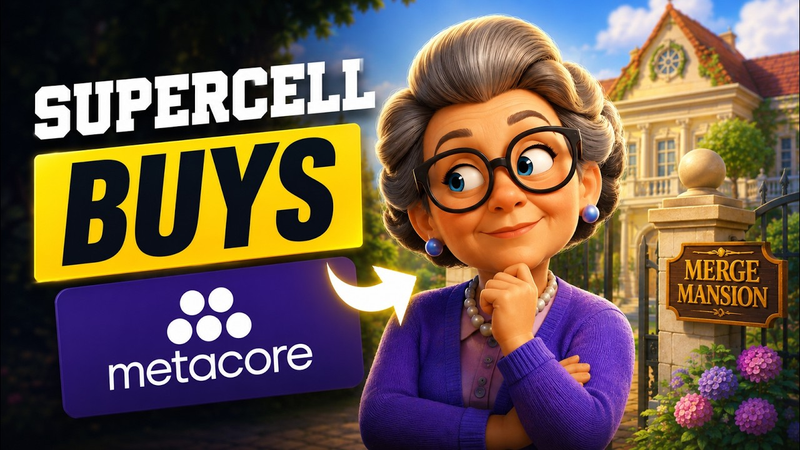
The Truth Behind Supercell’s Metacore Deal
Supercell’s full acquisition of Metacore, the Finnish studio behind the hit title Merge Mansion, marks a significant shift in mobile gaming strategy, transitioning from a growth-oriented venture to a focus on long-term, predictable cash flow.
- Supercell has fully acquired Metacore, the developer of Merge Mansion, to transition the studio from a growth-oriented venture into a model focused on long-term, predictable cash flow.
- The acquisition involves significant restructuring, with up to 70% of Metacore’s 230-person workforce facing layoffs to prioritize profitability and operational efficiency.
- Despite generating approximately $150 million in annual revenue, Metacore struggled with mounting debt and declining revenue-per-head metrics by 2024.
Why Snapchat is the antidote to social media | Sara Antonelli from Snap
Snapchat has evolved from a niche messaging tool into a foundational social ecosystem that prioritizes intimate, private connections over the public, engagement-driven models of traditional social media.
- Snapchat has shifted its core demographic as its original user base has matured, with the average user now approximately 35 years old.
- Snapchat Plus has become a primary growth driver for the company, reaching 15 million paid subscribers as of Q1 2025.
- The company is moving toward a tiered subscription model that will offer users additional customization and the ability to opt out of advertisements in specific areas like chat feeds.
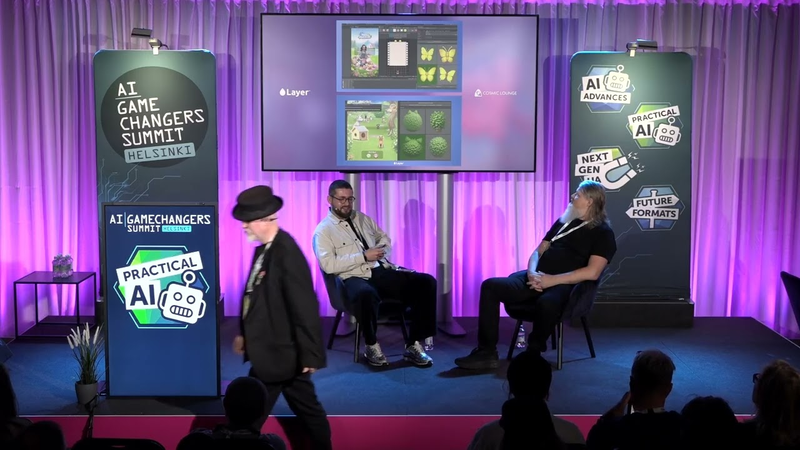
Session: Studio Speaks: The Reality of AI Adoption in Games - Ilya Kuznetsov & Tomi Huttula.
The integration of artificial intelligence into game development serves primarily as a tool to augment human expertise rather than replace it.
- Cosmic Lounge utilizes an internal 'puzzle engine' built on Unity that stores game logic in data formats, allowing designers to rapidly prototype and test new mechanics without manual coding.
- AI is used to scale content production for puzzle games, which can require over 20,000 levels, by automating asset generation while maintaining consistent art styles through custom-trained models (LoRAs).
- AI does not possess creative 'taste' or an understanding of game logic, meaning human experts remain essential for defining artistic vision and ensuring gameplay mechanics function correctly.
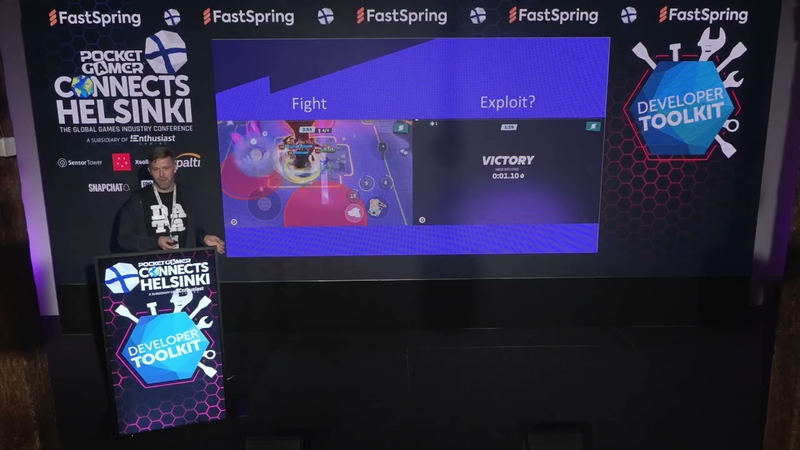
Session: Balancing Player Experience Without Players At Supercell: Case mo.co - Markus Ojala.
Supercell employs reinforcement learning (RL) to balance game mechanics for its multiplayer title, mo.co, specifically addressing the challenge of tuning game balance before a live player base exists.
- Supercell utilized reinforcement learning (RL) to balance the game mo.co during development, allowing designers to test items and gear combinations before the game had a live player base.
- The development team used a headless client integrated with C++ and Python to run approximately 1,000 parallel game simulations on a single GPU, enabling rapid iteration on balance changes every one to two weeks.
- Reinforcement learning agents were trained using Proximal Policy Optimization (PPO), where bots received incremental rewards for actions like staying alive, hitting monsters, and completing dungeons to learn optimal gameplay strategies.
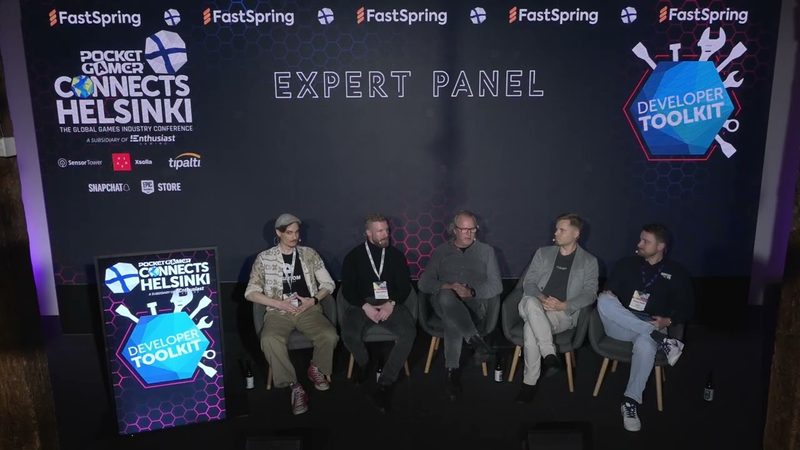
Panel: How To Ship A Top-Tier Game Without A Top-Tier Budget: Practical Tips For Cost-Effective.....
Achieving high-quality game production with limited capital requires a disciplined, lean operational strategy that prioritizes agility and long-term efficiency over traditional large-scale development models.
- Prioritize 'buy' over 'build' for core infrastructure, as small teams lack the resources to maintain custom tech stacks, which are only cost-effective for massive companies like Supercell that require specific competitive advantages like millisecond-level load time optimizations.
- Avoid over-funding in early stages; raising the minimum necessary capital forces a disciplined, lean mindset and prevents the common pitfall of hiring too many people before achieving product-market fit.
- When selecting third-party services, prioritize providers that offer access to source code or clear exit strategies to avoid vendor lock-in, as seen when the sudden shutdown of analytics platforms like Omniata forced studios to rebuild their entire tech stack.
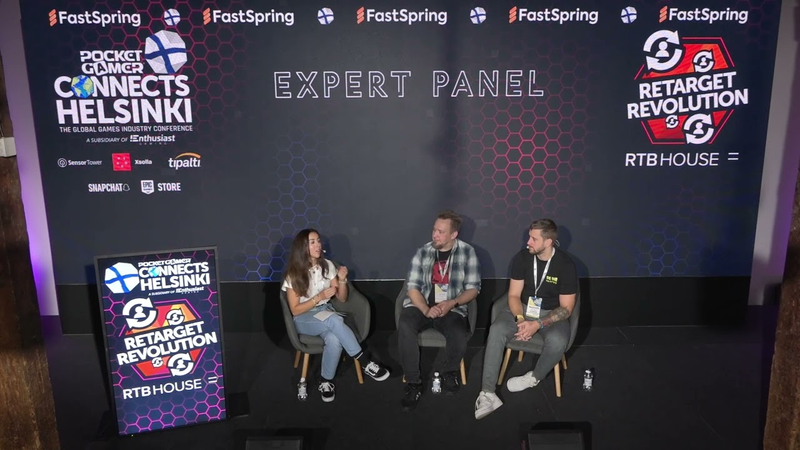
Panel: Future Of Retargeting - Hopes & Expectations.
Retargeting in the mobile gaming industry has evolved into a complex, non-evergreen strategy necessitated by increasing audience fragmentation and stringent privacy regulations.
- Retargeting strategy has shifted from broad outreach to granular, data-driven engagement that leverages in-game monetization metrics to identify and target high-value users.
- Industry focus is moving away from simple Return on Ad Spend (ROAS) toward measuring true incrementality to validate retargeting as a cost-effective alternative to rising user acquisition costs.
- Artificial intelligence is now essential for scaling re-engagement, specifically for automating audience segmentation and predicting individual player preferences in privacy-restricted environments.
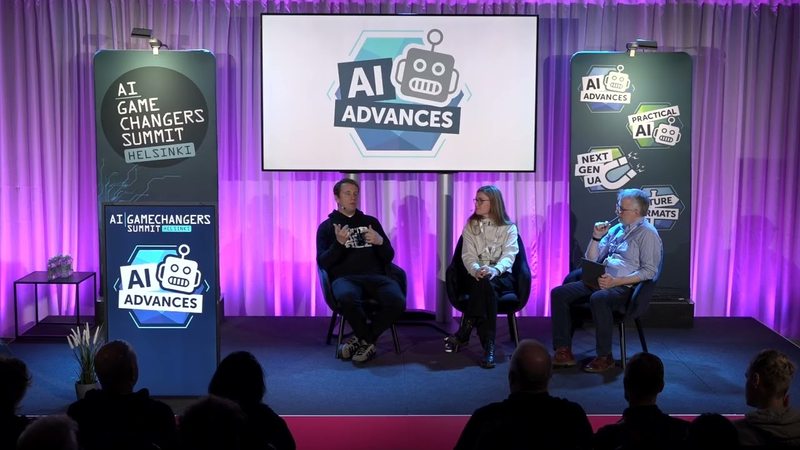
Panel: Beyond The Algorithm - Will AI Redefine Player Experiences?
Artificial intelligence is fundamentally shifting the game development paradigm from static, hardcoded systems toward dynamic, AI-native experiences.
- The primary barrier to AI integration in mobile free-to-play games is the high cost of inference when using large foundation models, which can threaten the viability of existing business models.
- Developers should prioritize smaller, domain-specific, or distilled models over massive general-purpose models to optimize resource usage and reduce inference costs.
- Future AI architecture in gaming will likely rely on a 'mixture of experts' approach, where specialized models are fine-tuned for specific tasks rather than relying on a single, generalized foundation model.