Time
Company
Documents about Time
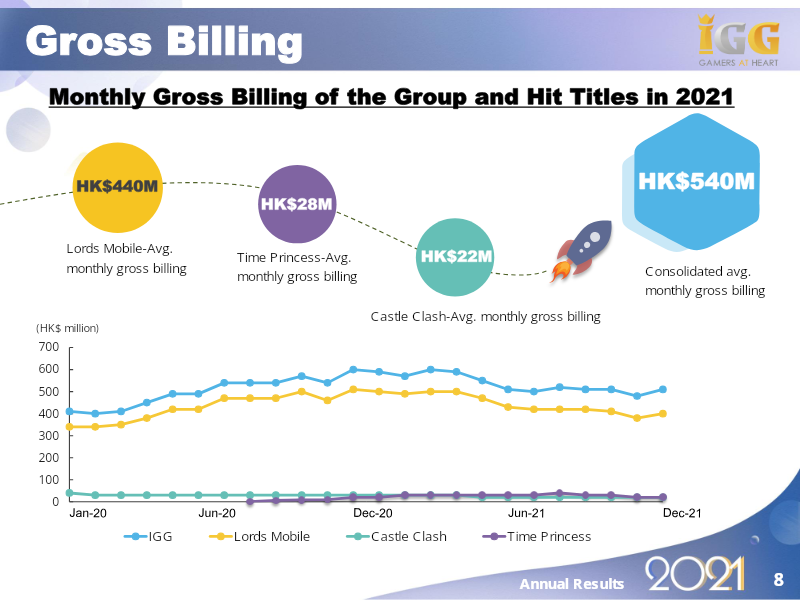
IGG 2021 Annual Results
The 2021 annual results for IGG, a global mobile game developer and publisher, detail a year of strategic transition characterized by increased investment in research and development alongside a significant decline in net profit.
- IGG reported a 11% increase in annual revenue to HK$6.05 billion, driven by the performance of flagship title Lords Mobile and newer games like Time Princess.
- Net profit plummeted 82% to HK$369.6 million, primarily due to an 82% surge in R&D spending and a 36% increase in selling and distribution expenses.
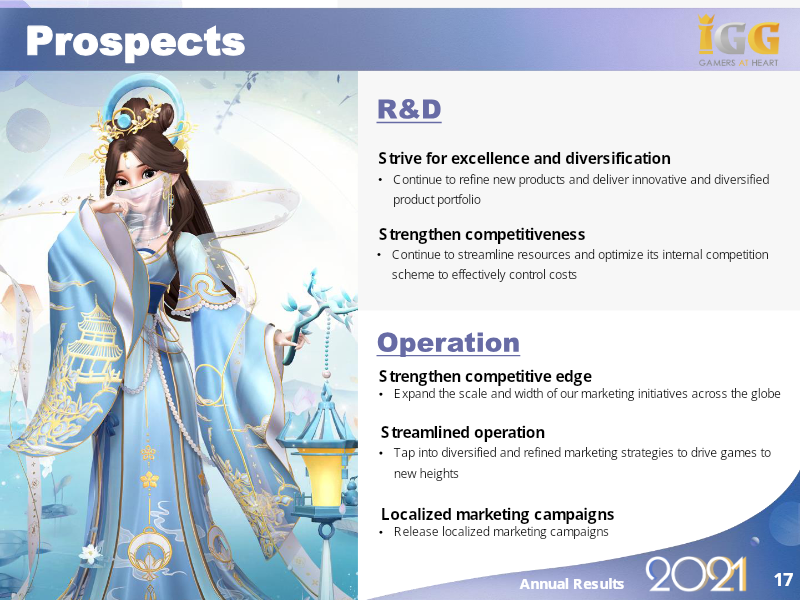
- The company is aggressively expanding its development capabilities, with over two-thirds of its 3,000-person workforce now dedicated to R&D in Shanghai and Chengdu.
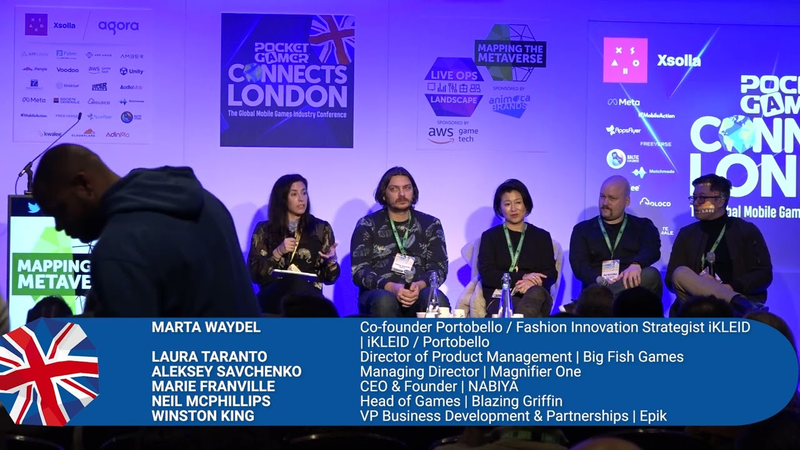
Panel: Living the Dream: How will the Metaverse Look in ten Years Time?
The metaverse is currently a nascent, multi-faceted concept rather than a singular destination, poised to evolve over the next decade into an intuitive, interconnected ecosystem.
- The metaverse is expected to evolve over the next decade from fragmented, proprietary platforms into a decentralized, interoperable ecosystem similar to the transformative impact of the smartphone.
- Market evolution is being driven by consumer demand for seamless cross-platform experiences and true digital ownership rather than top-down corporate mandates.
- Future technological development will likely shift beyond current virtual reality hardware to incorporate advanced neural interfaces for more immersive engagement.
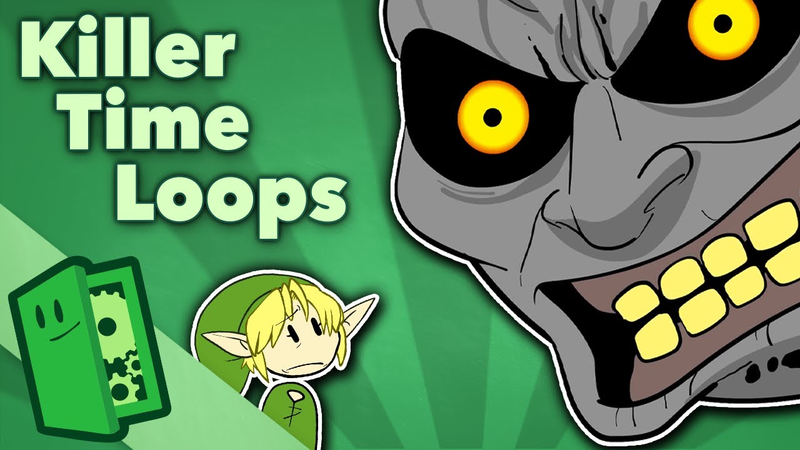
Why Time Loops Work Best in Video Games - Extra Credits
Video games provide a uniquely effective medium for time loop narratives because they align the player’s experience of trial and error with the protagonist’s in-game reality.
- Time loops uniquely align the player’s real-world trial-and-error process with the protagonist’s in-game experience, turning failure into a narrative-integrated tool for discovery.
- Unlike traditional games where death is a disconnected failure state, time loop mechanics transform repeated resets into a core pillar of character growth and progression.
- The genre fosters deep world mastery by requiring players to learn schedules and character behaviors, as demonstrated in titles like Majora’s Mask, Elsinore, and Outer Wilds.
FY2022 Second Quarter Financial Results Briefing
The briefing presents GREE Inc.’s financial performance for FY2022 second quarter, highlighting a net sales figure of ¥19.5 billion and operating income of ¥2.5 billion, both up markedly from the prior quarter largely due to a new title launch.
- GREE Inc. reported FY2022 Q2 net sales of ¥19.5 billion and operating income of ¥2.5 billion, driven primarily by the successful launch of 'That Time I Got Reincarnated as Slime: ISEKAI Memories'.
- The 'ISEKAI Memories' title reached over two million downloads in two months and achieved a top-four global sales ranking, significantly boosting quarterly performance.
- Total operating costs rose to ¥17 billion, an increase of ¥4.9 billion quarter-on-quarter, due to higher advertising spend, increased commission fees, and bonus provisions.


FY2022 Second Quarter Financial Results
GREE’s financial results for the second quarter of fiscal year 2022 reflect significant growth driven by the successful launch of new intellectual property and strategic expansions in the metaverse and SaaS sectors.
- GREE reported Q2 FY2022 net sales of ¥19.5 billion and an operating income of ¥2.5 billion, driven by strong performance in its Internet and Entertainment Business.
- The mobile game 'That Time I Got Reincarnated as a Slime: ISEKAI Memories' was a primary growth driver, achieving over 2 million downloads within two months of its October 2021 release.
- GREE executed a significant capital management strategy by completing a ¥32.7 billion stock repurchase program and cancelling approximately 25.8% of its issued shares.
Consumer Insights: Games and Esports 2022
The Consumer Insights: Games and Esports 2022 report provides a comprehensive analysis of global gaming behaviors, motivations, and market engagement.
- The research is based on a global dataset of over 75,000 consumers across 36 international markets, covering North America, Europe, Latin America, the Middle East, and the Asia-Pacific region.
- Consumer spending is primarily driven by three factors: price sensitivity, the desire for exclusive content, and the need for social connectivity.
- Gaming engagement is categorized into distinct personas, with 'Time Fillers' and 'Mainstream Gamers' identified as the most prevalent segments.


Key Insights Into German Gamers
Germany represents a significant pillar of the global gaming industry, ranking as the largest games market in the European Union and the fifth largest worldwide by revenue.
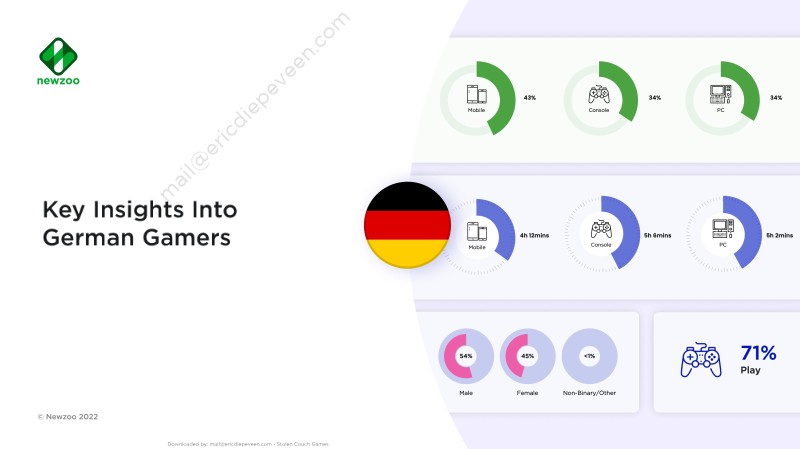
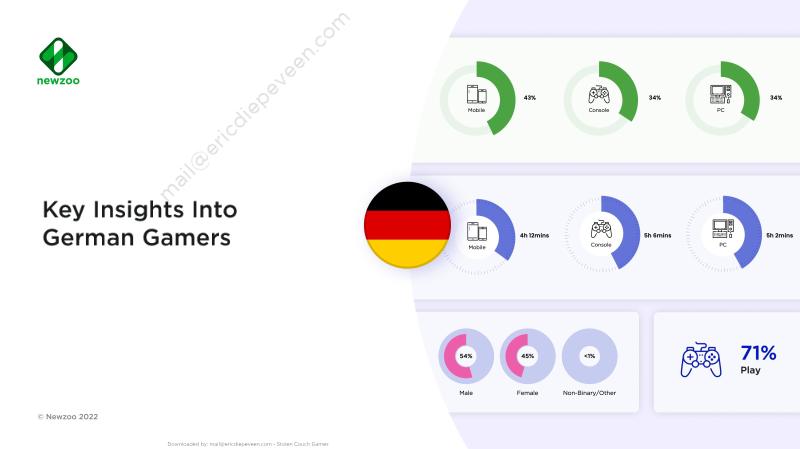
- Germany is the largest gaming market in the EU and the fifth largest globally, with 71% of the online population aged 10 to 65 identifying as game enthusiasts as of 2022.
- Mobile gaming has the highest market reach at 43%, though PC and console players demonstrate higher engagement with average weekly play times exceeding five hours.
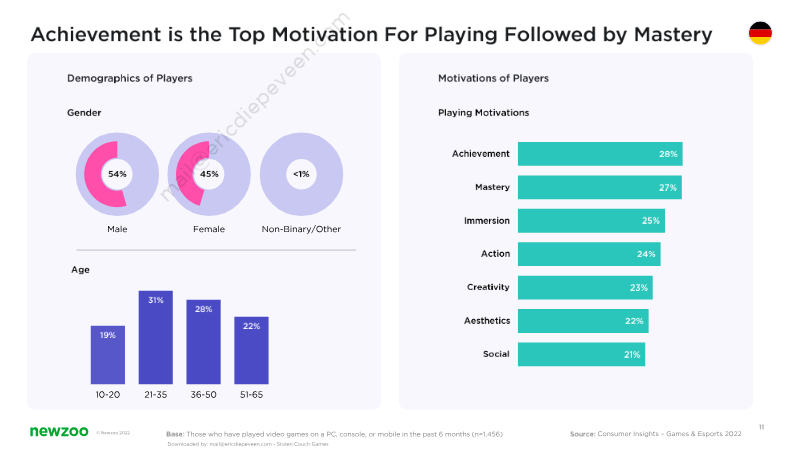
- The German gaming demographic is nearly gender-balanced at 52% male and 48% female, with the 21-35 age bracket serving as the largest segment at 31%.


Newzoo’s Global Gamer Study 2022
Gaming has evolved into a multi-dimensional entertainment ecosystem that extends far beyond traditional play, encompassing viewing, socializing, and content creation.
- Gaming has become a primary entertainment ecosystem for 79% of the global online population, with Gen Alpha prioritizing gaming over social media and streaming.
- The gaming sector reached a projected consumer spend exceeding $200 billion in 2023, with approximately 50% of Millennials, Gen Z, and Gen Alpha actively spending money on games.
- Gaming is increasingly used as a social platform, as 75% of players engage in game worlds for social interaction rather than playing the primary game mechanics.
The State of Mobile Gaming 2022: Market Trends and Top Titles in the U.S., Europe, and Asia
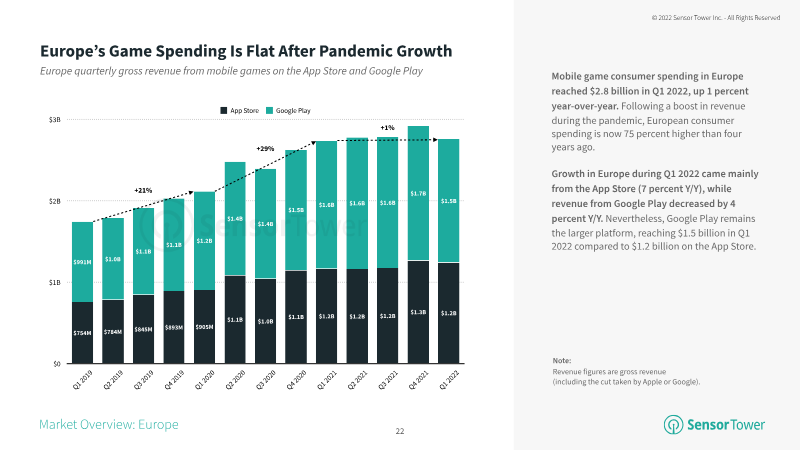
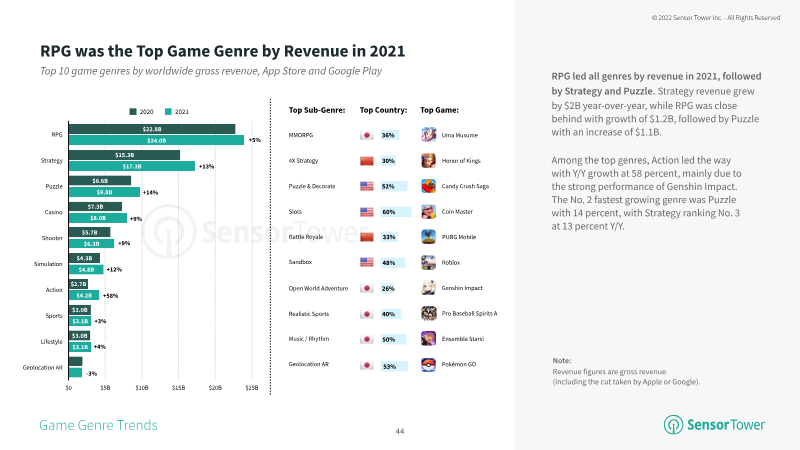
Global mobile gaming revenue experienced its first historical year-over-year decline in the first quarter of 2022, falling 6% to $21.2 billion.
- Global mobile gaming revenue declined 6% year-over-year in Q1 2022 to $21.2 billion, ending a period of pandemic-driven growth due to market stabilization and inflation.
- Consumer spending dropped 10% in the U.S. and 7% in Asia, while Google Play saw a 22% decrease in spending despite global downloads remaining resilient at 14 billion.
- Emerging markets are driving growth, led by India’s 73% increase in consumer spending and Turkey’s 36% revenue surge, which established it as Europe’s fastest-growing market.
Key Insights Into UK Gamers
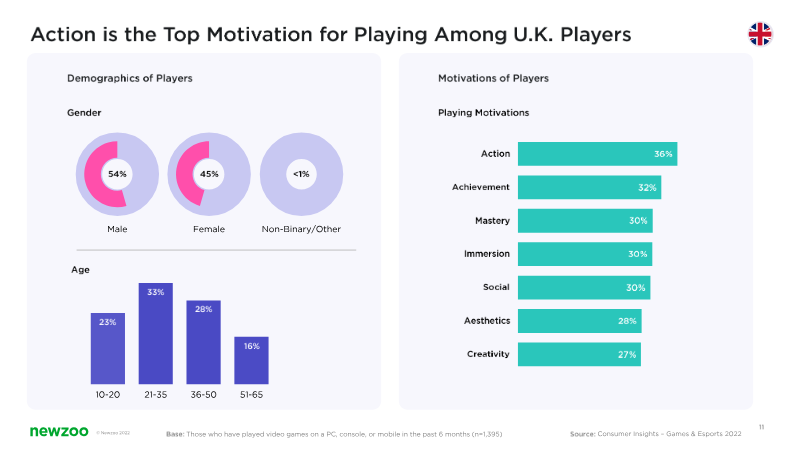
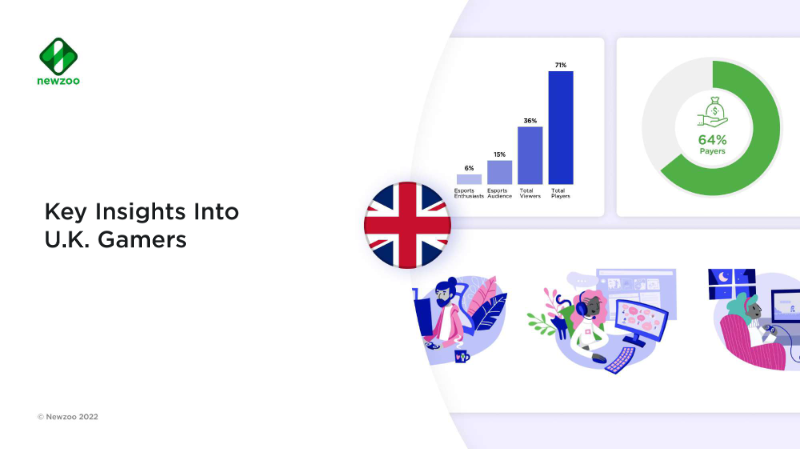
The United Kingdom represents a major global gaming hub, ranking as the sixth-largest market by revenue and tenth by player population as of late 2022.
- The UK is a major global gaming hub, ranking sixth in revenue and tenth in player population, with 71% of the population aged 10-65 identifying as game enthusiasts.
- Engagement is evenly split between active players (36%) and those who both play and view gaming video content (35%).
- Mobile gaming has the highest reach at 46%, followed by console (41%) and PC (29%), though PC and console users dedicate more time to gaming weekly.


Key Insights Into French Gamers
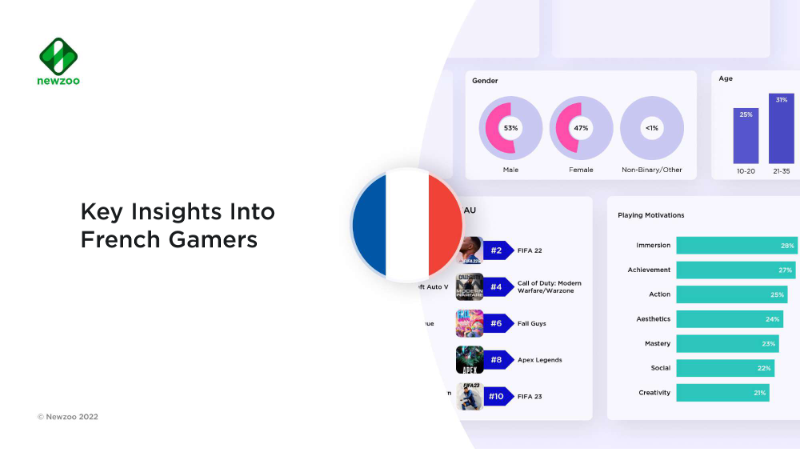
France represents a significant gaming market, ranking seventh globally in terms of revenue and fifteenth in total player count as of 2022.
- France is a top-tier global gaming market, ranking seventh in revenue and fifteenth in player count as of 2022.
- The French gaming population is highly engaged, with 71% of online users aged 10–65 identifying as enthusiasts, including 15% who follow esports monthly.
- Mobile is the leading platform with 44% reach, followed by console at 41% and PC at 30%, though PC users record the highest average weekly playtime at four hours and forty minutes.


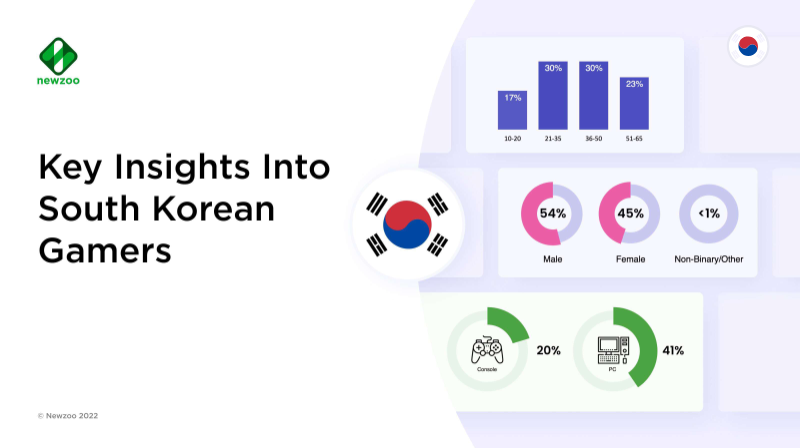
Key Insights Into South Korean Gamers
South Korea represents the fourth largest gaming market globally by revenue, valued at $8.3 billion, with a highly engaged population of 33 million gamers.
- South Korea is the world's fourth-largest gaming market, generating $8.3 billion in annual revenue from a highly engaged base of 33 million gamers.
- Gaming is a deeply integrated social activity, with 76% of the online population participating, 48% both playing and watching content, and 22% specifically following esports.
- Mobile is the primary platform for 59% of the online population, though PC gamers demonstrate higher engagement with an average of five hours of play per week.