Maxis
CompanyUnited States · Founded 1987
Maxis is an American video game developer and a division of Electronic Arts. The studio was founded in 1987 by Will Wright and Jeff Braun, and acquired by EA in 1997. Maxis is best known for its simulation games, including The Sims, Spore and SimCity.
Connections
Each row is a game or company named alongside Maxis, each column a document, oldest first. A mark means that document names it. Select a row to see those documents.
About the company
- Founded
- 1987
- Country
- United States
Company data from IGDB.com
Documents about Maxis


H1 FY26 Financial Results
Frontier Developments achieved significant financial growth during the first half of fiscal year 2026, characterized by a 26% year-over-year revenue increase to £59.6 million and a 76% surge in adjusted operating profit to £9.7 million.
- Frontier Developments reported a 26% year-over-year revenue increase to £59.6 million and a 76% surge in adjusted operating profit to £9.7 million for H1 FY26.
- The company has pivoted to a Creative Management Simulation (CMS) focus, which now generates 90% of total company revenue.
- The Jurassic World Evolution franchise is the primary growth driver, accounting for 63% of total revenue, followed by Planet Zoo at 15% and Planet Coaster at 11%.

Market Update: UEFN Monetization, Meta’s Vision, and the Future of Consoles
The gaming industry is currently navigating a period of structural transition, characterized by a shift toward platform-driven economies, hardware innovation, and evolving financial models.
- Epic Games is expanding UEFN monetization to empower creators, though the long-term impact remains uncertain regarding whether this revenue is truly additive or if it cannibalizes existing Fortnite store spending.
- Meta is prioritizing an entertainment-focused strategy for its hardware, exemplified by the $799 price point for its latest AR glasses, which aims to attract early adopters to build an app ecosystem despite current limitations in user comfort and content depth.
- The gaming investment landscape is shifting toward specialized financing models, such as UA (user acquisition) financing, which allows companies to raise capital specifically for scaling growth rather than relying solely on traditional equity rounds.

Why the Games Industry Might Triple (Despite Its Challenges)
The global games industry stands at a pivotal inflection point, poised to expand into a $600 billion market by leveraging historical growth patterns and emerging technological shifts.
- The global games industry is positioned to triple in size to a $600 billion market by shifting away from high-stakes, traditional development models.
- Leadership should categorize games into four distinct quadrants based on casual versus immersive experiences and offline versus online play to better align developer skill sets and operational focus.
- The traditional AAA greenlight process is becoming obsolete, necessitating a shift toward a barbell strategy that balances stable 'forever games' with small, autonomous teams focused on iterative experimentation.

Apple vs Epic Aftermath: A New Era for Game DTC
The gaming industry is undergoing a fundamental shift toward direct-to-consumer (DTC) monetization, catalyzed by recent legal rulings in the United States and the European Union that dismantle restrictive app store billing policies.
- Following the April 30, 2024, ruling, Apple now permits developers in the U.S. to freely link to external payment channels and advertise those channels within their apps without paying a 27% commission or displaying anti-steering 'scare screens.'
- Studios are increasingly adopting a hybrid monetization model where 'evergreen' impulse purchases remain in-app, while exclusive or high-value offers are routed through web-based stores to bypass platform fees.
- To drive traffic to web stores, developers are utilizing two primary strategies: offering direct discounts or providing 'extra value' through exclusive bundles, loyalty points, or cashback incentives that are unavailable in-game.

InZOI vs. The Sims – Can Krafton’s Life Sim Take on EA’s Giant?
The life simulation genre is currently facing a significant market disruption with the emergence of InZOI, a title developed by Krafton that aims to challenge the long-standing dominance of Electronic Arts’ The Sims franchise.
- Krafton’s InZOI is currently the most anticipated game in the life simulation genre, holding the top spot on Steam’s wishlist rankings with approximately 1.2 million entries.
- InZOI differentiates itself from the long-standing Sims franchise through high-fidelity, realistic graphics and advanced mechanics like vehicle operation and deep character customization.
- The game is experiencing high organic engagement on TikTok, driven by user-generated content rather than paid influencer campaigns, signaling strong viral potential among younger demographics.
Why You Should Create the Same Game, Over and Over
This analysis examines the strategic benefits of genre specialization and iterative development within the video game industry, primarily through an extract from Kim Nordstrom’s book, Up Down Up.
- Long-term studio stability is best achieved through genre specialization and iterative refinement of a proven formula rather than speculative diversification.
- Innovation should be constrained to one or two new systems per title to maintain a stable foundation while leveraging existing technical expertise and audience insights.
- Maxis demonstrated the efficacy of incremental development by releasing over 50 DLC packs for The Sims since 2000, using the data to inform low-risk, successful sequels.

The Genius AI Behind The Sims
Mark Brown's analysis explains how Maxis gave autonomy to the characters of The Sims franchise, focusing on the original game and The Sims 3.
- The Sims utilizes a utility-based AI architecture that shifts intelligence from characters to objects, allowing for complex emergent behaviors without exhaustive hand-scripted logic.
- Characters operate on a needs-based framework where internal motives like hunger and energy decay over time, prompting them to respond to 'advertisements' broadcast by objects in the game world.
- To prevent perfectly optimized or robotic behavior, the AI selects from top-scoring object interactions using strategic randomness, which preserves the necessity for player intervention.

Designing for Inclusivity in 'The Sims'
The development of The Sims franchise serves as a case study for integrating inclusivity into game design and studio culture.
- Maxis integrates diverse employee lived experiences into game development by actively consulting internal staff from various cultural and educational backgrounds to inform content, such as the 'Discover University' expansion pack.
- The studio maintains a 'people-first' culture by utilizing four core values—create collaboratively, challenge ourselves, champion inclusivity, and be authentic—which were defined by internal staff interviews rather than external agencies.
- To minimize hiring bias, recruitment panels are specifically trained to identify implicit bias and utilize standardized interview questions designed to prioritize inclusive perspectives.

Classic Game Postmortem - Raid On Bungeling Bay
The development of Raid on Bungeling Bay, released in 1984, serves as a pivotal case study in the technical ingenuity required during the early 8-bit computing era.
- The financial success of Raid on Bungeling Bay, which sold 800,000 units on the Nintendo platform in Japan, provided the essential capital required to launch Maxis.
- The project achieved unprecedented smooth-scrolling graphics on the Commodore 64 by utilizing manual, byte-level memory management and custom development interfaces.
- The game introduced a dynamic, clockwork resource-management system where enemy defenses escalated based on player progress, establishing early foundations for the simulation genre.
Tales from the Trenches: AI Disaster Stories
This presentation from the 2015 Game Developers Conference (GDC) serves as a post-mortem compilation, focusing on the technical and design failures encountered by artificial intelligence (AI) developers across various industry projects.
- AI development failures often stem from systemic issues like poor communication, lack of domain expertise, and the bypassing of established testing protocols.
- The 'black box' development approach frequently causes AI behavior to disconnect from animation and design intent, leading to unpredictable or broken gameplay.
- Relying on rigid, non-debuggable custom scripting languages creates significant technical debt and prevents developers from effectively diagnosing AI logic errors.

Challenge Balance and Diversity: Playing The Sims and The Sims 2
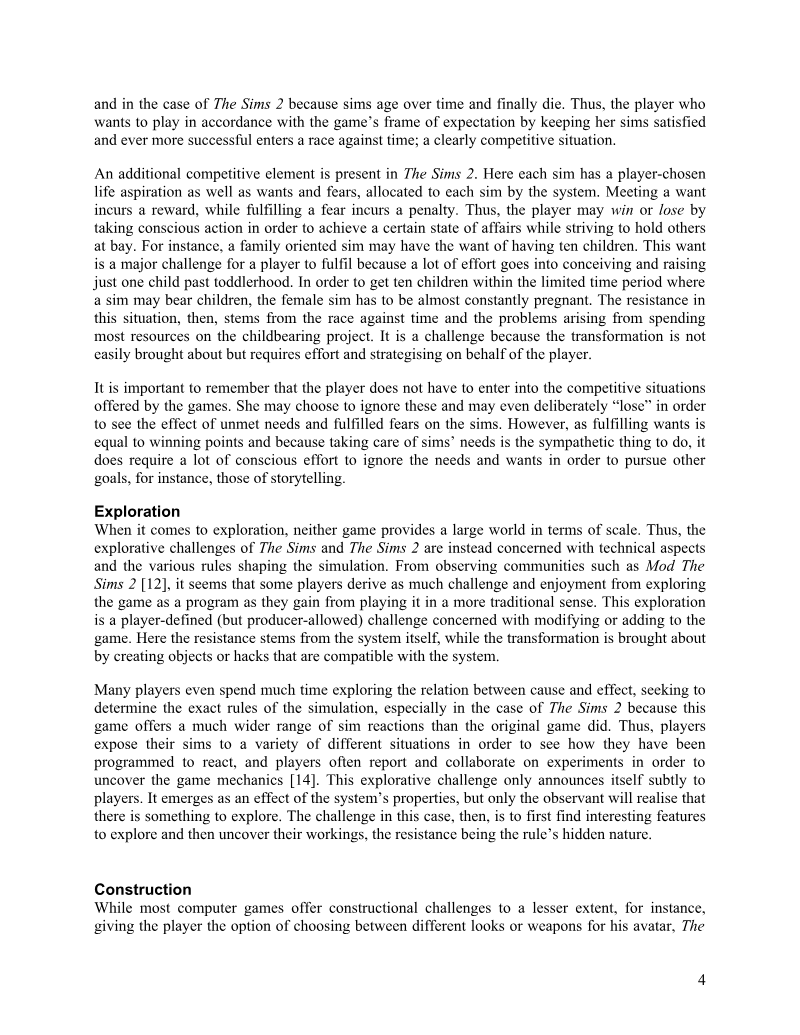
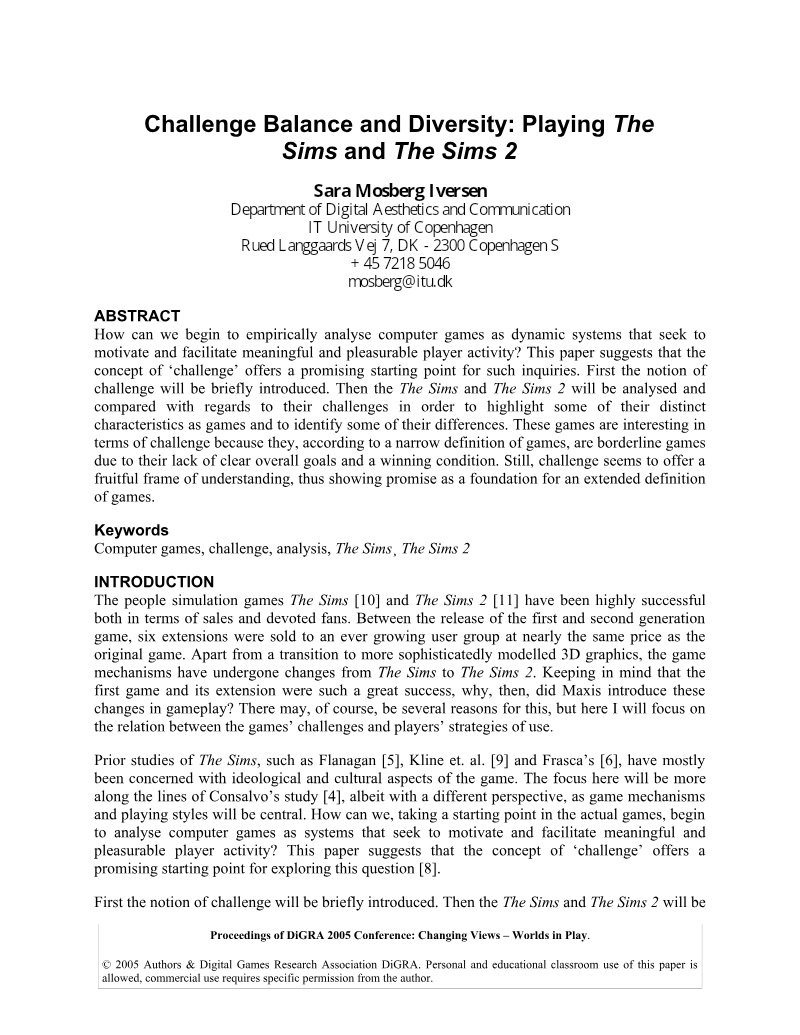
Sara Mosberg Iversen's paper uses the concept of challenge to examine The Sims (2000) and The Sims 2 (2004) as dynamic systems that motivate player activity, rather than as the ideological or cultural artifacts that much prior scholarship has focused on.
- The paper treats The Sims (2000) and The Sims 2 (2004) as dynamic systems that motivate player activity through challenge, rather than as ideological or cultural artifacts as much prior scholarship has done.
- The author classes these people-simulation games as 'borderline' games under a classical definition because they lack clear overall goals or winning conditions, yet argues challenge is a productive framework for understanding them and could support a broader definition of games.
- Challenge is defined experientially as a situation of resistance that calls for transformative action and requires non-trivial effort or has an uncertain outcome.