Digital Games
Company
Documents about Digital Games
Traumatic, Spectacular Prologues: AAA Players as Ethical Witnesses
Joanna Cuttell's 2018 paper in the Transactions of the Digital Games Research Association examines violent, traumatic opening sequences in AAA videogames, asking how these affective devices attach and motivate the player.
- The author argues that early violent spectacles in AAA openings act as cues for moral disengagement and function as enabling fictions that legitimate later 'righteous' violence.
- The study analysed fifteen separate games drawn from thirteen titles, including a trilogy, all released in the half decade before the research period.
- The author identifies three modes of traumatic representation in AAA openings: personal trauma of the player character, devastating world incidents, and combat vulnerability.
Computer Gameplay and the Aesthetic Practices of the Self: Game Studies and the Late Work of Michel Foucault
Feng Zhu's paper, published in the Transactions of the Digital Games Research Association (April 2018, Vol 3 No 3, pp 75-104), critically introduces Michel Foucault's late work on the practices of the self to computer game studies.
- Zhu argues that gameplay tasks players set themselves can be understood as a form of 'work on the self' that is ambivalent between aesthetic self-transformation and neoliberal self-improvement.
- The first assumption is that contemporary games emphasise suggesting or implying practices rather than demanding them for progression, a shift the author ties to design ideologies emphasising player choice.
- The second assumption is that these practices transform players through slow accumulation rather than sudden epiphany, a process the author links to the Greek concept of askesis.
Is Pokémon GO Feminist?: An Actor-Network Theory Analysis
Carina Assuncao's essay, published in the Transactions of the Digital Games Research Association (April 2018, Vol 3 No 3, pp 47-73), analyses the location-based augmented reality mobile game Pokémon GO (Niantic, 2016).
- The game's avatar creation uses a "choose a style" option instead of gender or sex, but the interface still offers only two options that are easily identifiable as male and female.
- The author argues that avatars follow a prototype of bodily fitness, and that all clothes available for female avatars are very tight fitting.
- Citing Dogtiev (2017), the paper reports that women account for nearly 40% of Pokémon GO players.
Transactions of the Digital Games Research Association: Game Design Lineages
This Transactions of the Digital Games Research Association paper, titled "Game Design Lineages," proposes the game design lineage as a research method.
- The authors argue that a game element's history should be read against the material constraints of its era, as with password saving in 8-bit games, which arose because storing player data was prohibitively expensive.
- The paper cites Raph Koster's view that designers often begin from an existing game and change one element, which he notes can be used to understand relations between games and how to group them.
- The authors argue that Diablo II largely establishes the crafting element through the Horadric Cube, which gave players a way to create endgame items beyond waiting for them to drop.
British Digital Game Studies
This historical overview examines the evolution of digital game studies in Great Britain from 2001 to 2018.
- British digital game studies emerged as a formal academic discipline between 2001 and 2018, catalyzed by the first major UK government research grant and the inaugural Game Cultures Conference in Bristol in 2001.
- The field is defined by an interdisciplinary methodology that integrates film theory, sociology, and educational psychology to analyze the social, cultural, and political dimensions of gaming.
- British scholarship distinguished itself from early global debates on ludology and narratology by prioritizing the wider societal context of digital games.
Queer Gamer Assemblages and the Affective Elements of Digital Games
Spencer Ruelos, a University of California, Irvine researcher, examines the affective and embodied relationship between LGBT/queer gamers and video games in an essay published in Press Start (2018, Volume 4, Issue 2), a student journal from the University of Glasgow.
- The author proposes three mechanisms that mediate queer gamers' affective connections to games: worlding elements, storytelling practices, and personal experiences.
- The essay argues that queer gamers' gaming identity exists at the encounter between a physical body and digital game technologies, framing gamers as socio-technological assemblages.
- The author describes Bully's achievement for kissing boys as making queerness persistent and explicit in a game's mechanics.
Blank Arcade: Exhibition of Games and Toys as Art
The Blank Arcade is a recurring exhibition of games, play art, and interactive media, organized by Lindsay Grace of American University in association with the Digital Games Research Association's annual conference.
- The Blank Arcade is a recurring games-and-play art exhibition organized by Lindsay Grace of American University in association with the Digital Games Research Association's annual conference, aiming to bring game art practice and history into the game studies community.
- Prior editions were held in Salt Lake City (2014), Lüneburg, Germany (2015), and Dundee, Scotland (2016), and the abstract proposes a 2018 edition.
- The model is designed to be sustainable for host conferences: organizers handle curation, outreach, advertising, and web hosting, while local hosts provide space, equipment, and logistics, with sponsorships sometimes covering shipping and catering.



Is My Avatar MY Avatar? Character Autonomy and Automated Avatar Actions in Digital Games
Ea Christina Willumsen, of the Department of Information Science and Media Studies at the University of Bergen, examines the boundary between the avatar and character dimensions of the player figure in digital games, building on Daniel Vella's (2015) framework.
- The author proposes avatar control and character complexity as two separate measures, and argues they are not in a zero-sum relationship. Character complexity can appear with any amount of avatar control.
- The paper defines character autonomy as situations where character complexity is emphasised while avatar control is limited or non-existent. Automated avatar actions are defined as actions performed by the avatar that promote focus on game mechanics.
- Hitman: Absolution is classed as automated avatar actions rather than character autonomy, because the cover-selection instance communicates nothing meaningful about the character's attributes, relationships, roles, or motivations.
Focus, Sensitivity, Judgement, Action: Four Lenses for Designing Morally Engaging Games
This paper, by Malcolm Ryan, Dan Staines, and Paul Formosa and published in the 2017 Transactions of the Digital Games Research Association, proposes four design lenses for morally engaging video games.
- The authors argue that moral skill extends beyond judgement, drawing on the Four Component Model to define focus, sensitivity, judgement, and action as the four lenses for moral gameplay.
- Citing Melenson (2011), the authors note that morality meters are a frequent source of frustration because they judge players without knowledge of their motives or circumstances.
- The authors argue that games which signpost moral scenarios can reduce the player's incentive to exercise their own moral sensitivity.
No-one Plays Alone
Chris Bateman's paper "No-one Plays Alone" appeared in Transactions of the Digital Games Research Association (2017, Vol. 3, No. 2, pp. 5-36).
- The paper proposes three Rules of Game Worlds, the third being that no-one plays alone, which it presents as applying to all games and fictional media.
- The author identifies three aesthetic flaws: rupture, inelegance, and perplexity, each tied to a clash between particular practices.
- Perplexity is described as the greatest problem for games courting a community of players, because players adopt new games more easily when practices are familiar.
Adolescents as Game Designers: Developing New Literacies
This paper by Pilar Lacasa, Sara Cortés, and María Ruth García-Pernía, published in the Transactions of the Digital Games Research Association (2017), analyses how adolescents develop digital literacies while designing video games in a school setting.
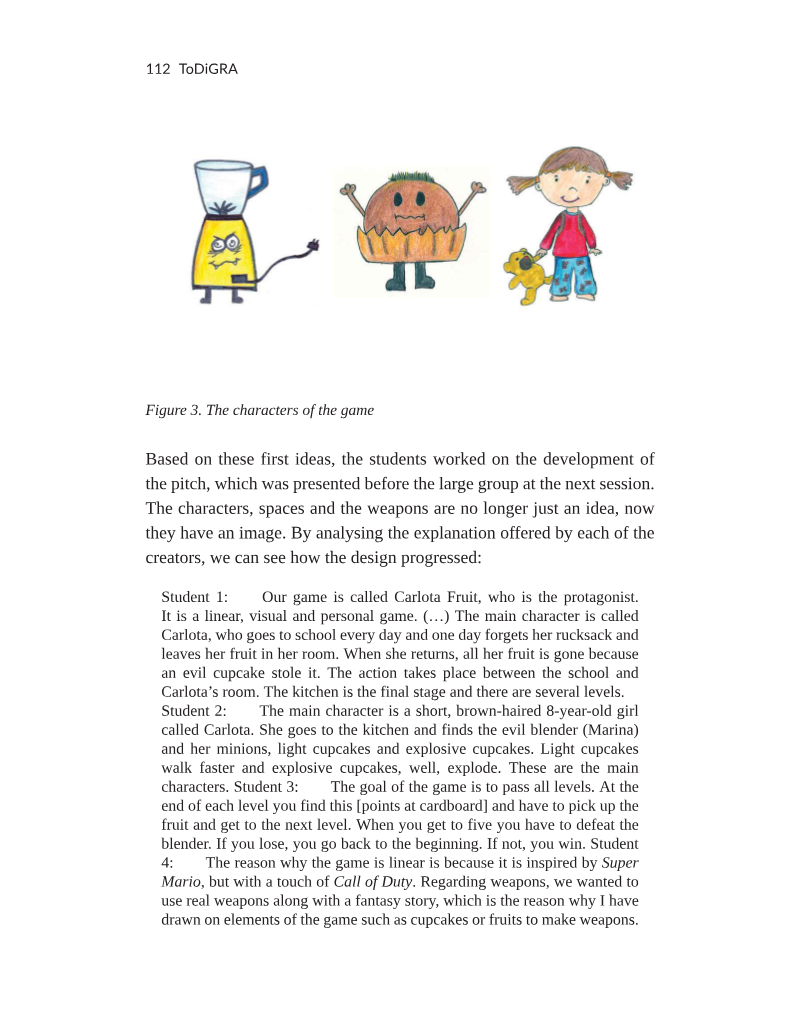
- The study followed twenty adolescents aged 14 to 16 at a Madrid secondary school across fourteen 90-minute sessions during the 2012-2013 academic year.
- Students were assigned five specialised roles within their teams, which the authors say both raised awareness of the game's dimensions and reinforced the social organisation of the work.
- Students' final presentations were structured around three parts: introduction, demo, and post-mortem.
Digital Games and Learning Mathematics: Student, Teacher and Parent Perspectives: Malaysia
This qualitative study, published in the International Journal of Serious Games (Volume 3, Issue 4, December 2016), explores the potential use of digital games in learning mathematics at secondary school level in Malaysia.
- All three teachers interviewed said students generally disliked mathematics, and the study links this to the difficulty of later grades. One teacher observed that students who were interested in lower forms lost interest as content became harder in Forms 4 and 5.
- All three teachers reported using a form of chalk-and-talk exposition, which they considered the best teaching method for mathematics. Two teachers said computer use in teaching was not effective.
- All three parents did not support being fully reliant on computer games or technology for learning, seeing computer technologies only as a supplement to traditional classroom teaching.