Loading the document
Key insights
5 slides
Core argument
Self-set gameplay tasks can be understood as work on the self.
Zhu argues that tasks players set themselves, and the action patterns they produce, can be understood this way. This work is described as ambivalent.
1 / 5
- 01Zhu argues that gameplay tasks players set themselves can be understood as a form of 'work on the self' that is ambivalent between aesthetic self-transformation and neoliberal self-improvement.See it on page 1
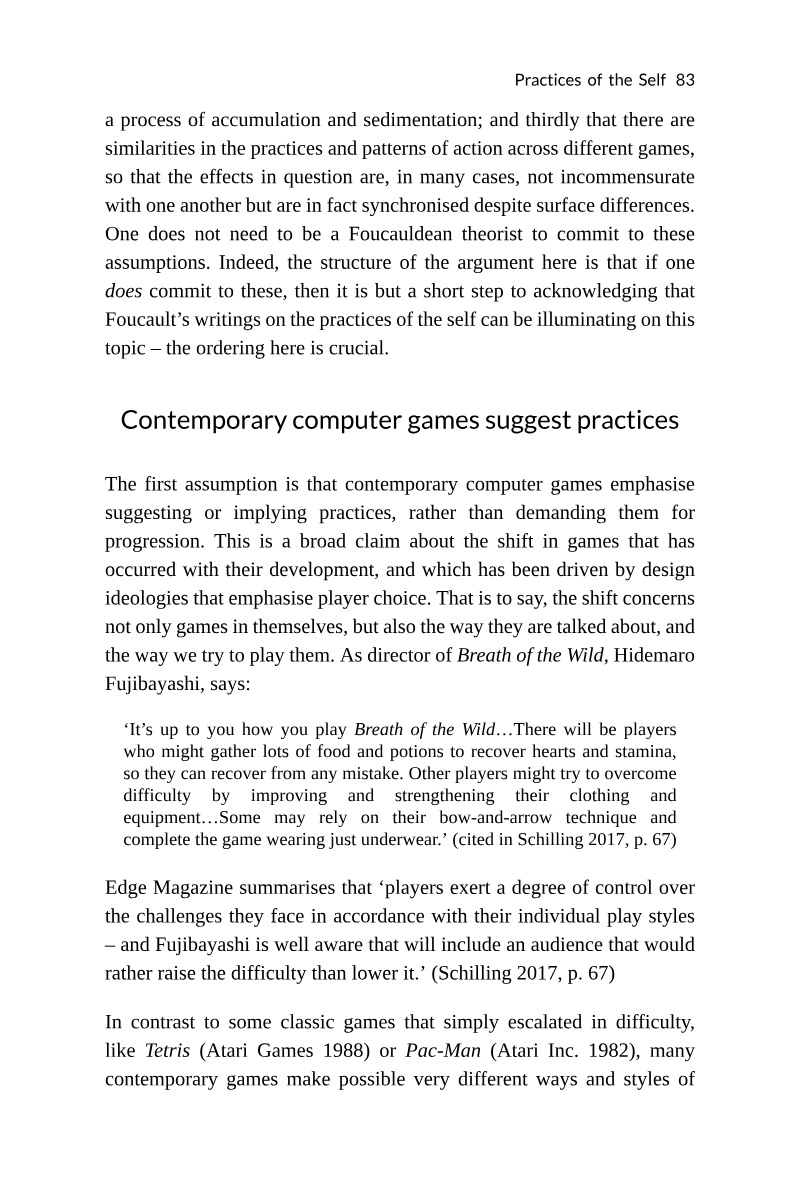
- 02The first assumption is that contemporary games emphasise suggesting or implying practices rather than demanding them for progression, a shift the author ties to design ideologies emphasising player choice.See it on page 9
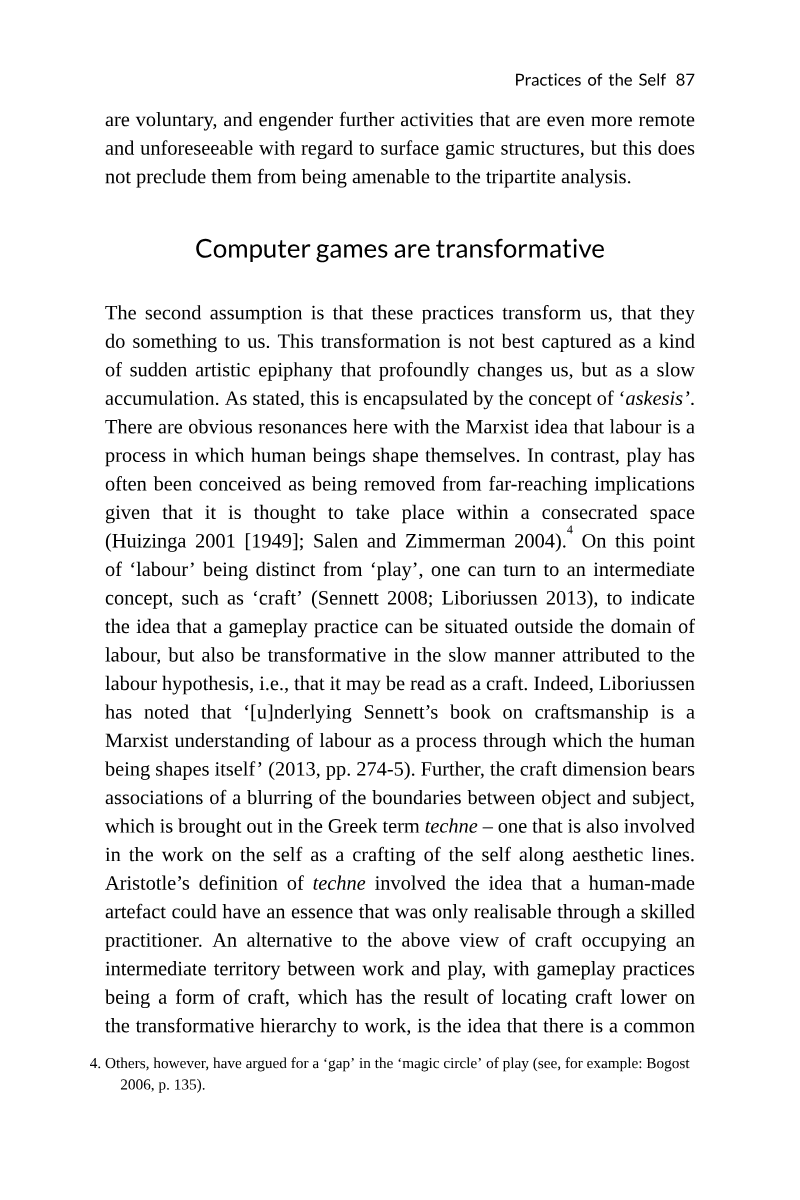
- 03The second assumption is that these practices transform players through slow accumulation rather than sudden epiphany, a process the author links to the Greek concept of askesis.See it on page 13
- 04The author states that one does not need to be a committed Foucauldian theorist to hold the three assumptions, though they collectively point towards his late work.See it on page 25
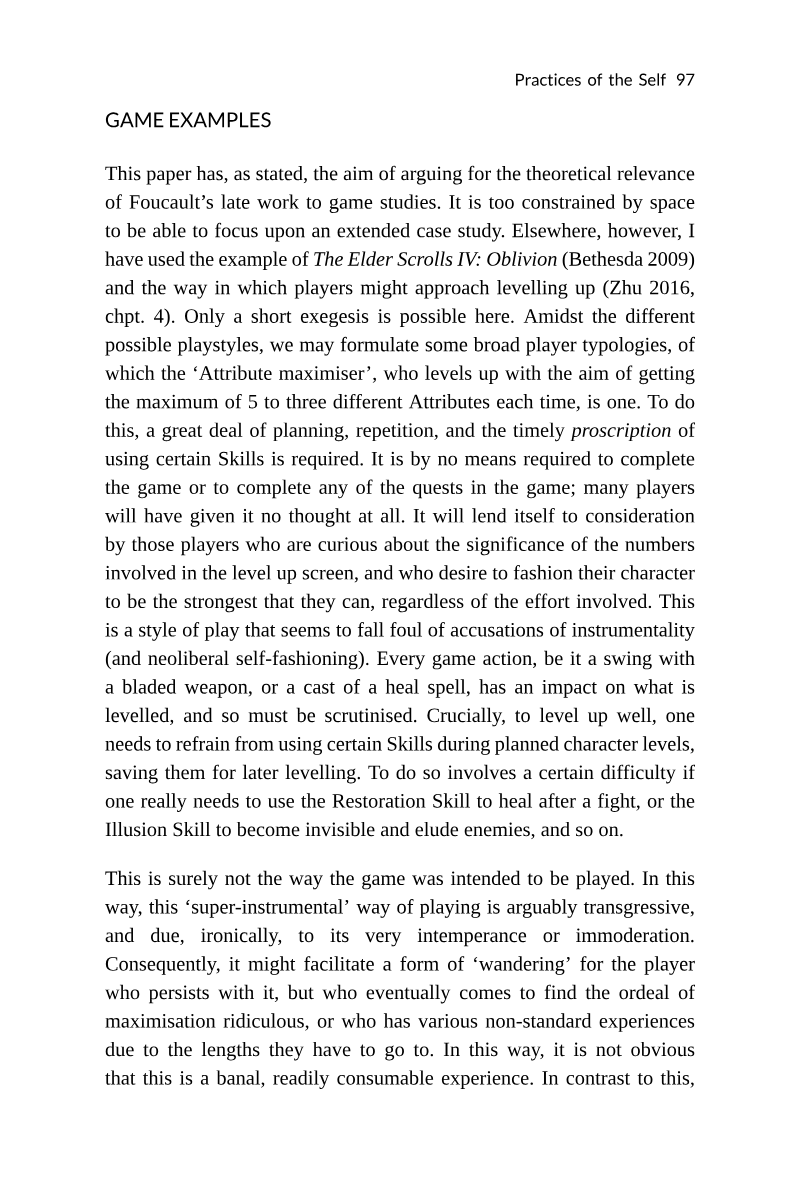
- 05Zhu describes the 'Attribute maximiser' style in The Elder Scrolls IV: Oblivion as requiring planning, repetition and avoidance of certain Skills, and says it is by no means required to complete the game.See it on page 23
- 06The author argues that the instrumental, super-instrumental style of play in Oblivion is arguably transgressive, and may facilitate a form of 'wandering' for players who persist with it.See it on page 23
Ask AI about this report
Summary
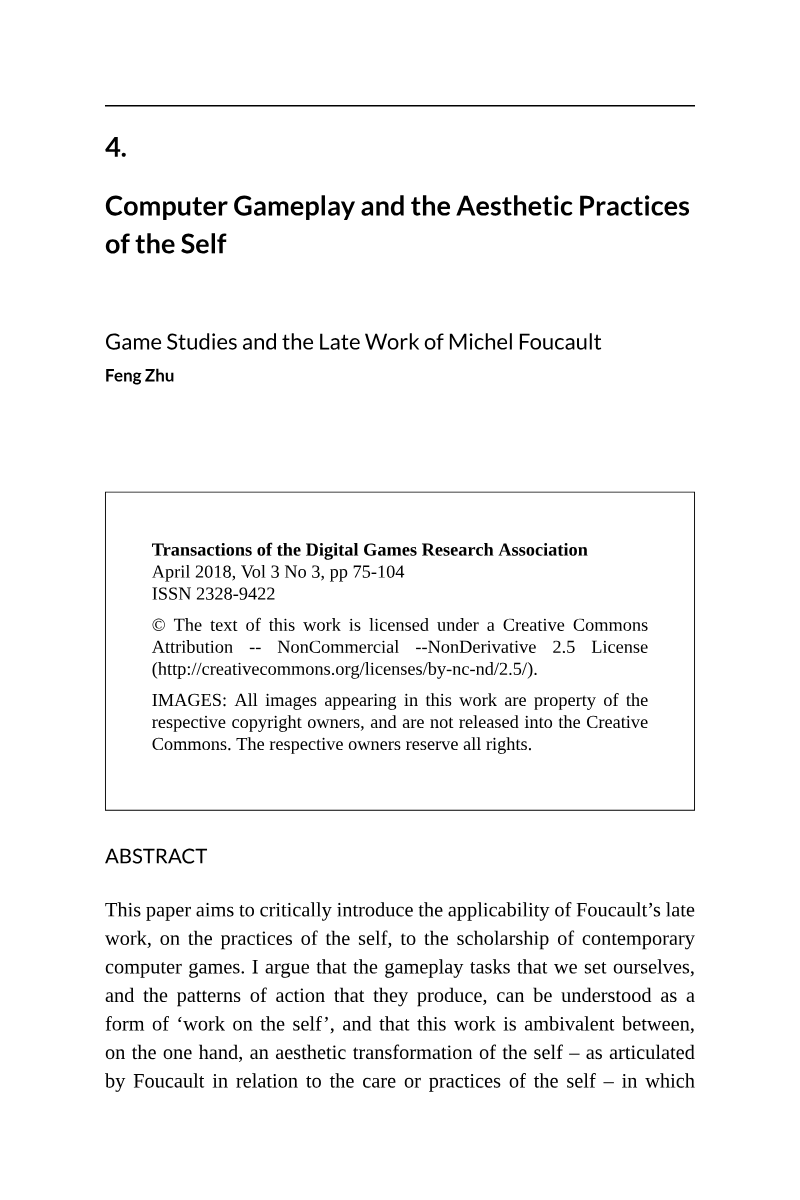
Feng Zhu's paper, published in the Transactions of the Digital Games Research Association (April 2018, Vol 3 No 3, pp 75-104), critically introduces Michel Foucault's late work on the practices of the self to computer game studies. Zhu argues that gameplay tasks players set themselves, and the action patterns they produce, can be understood as 'work on the self'. This work is described as ambivalent between an aesthetic transformation of the self, in which players break from imposed subjectivities, and a closer tethering to a neoliberal subjectivity centred on instrumentally driven self-improvement. The argument rests on three assumptions: that contemporary games suggest rather than demand practices, that these practices transform players slowly through accumulation, and that similar practices recur across different games. The author states that the assumptions are not explicitly rooted in Foucault's work. The paper uses The Elder Scrolls IV: Oblivion levelling as an illustrative example, drawing on the author's earlier thesis for a fuller treatment. The author notes that a 'super-instrumental' style of levelling in that game can be read as transgressive, and may either lead to reflection or reinforce instrumental mentalities.