2015
Company
Documents about 2015



MTG Corporate Responsibility Report 2011
MTG's 2011 Corporate Responsibility Report presents the Nordic-based broadcaster's "Modern Responsibility" framework, which spans 39 operating countries and organizes its work into business, broadcast and marketing, colleague, and community responsibility.
- MTG achieved a 16% total reduction in carbon emissions and office energy use by the end of 2011, resulting in a 6% decline in CO2 per employee compared to the 2009 baseline.
- The company expanded its geographic footprint in 2011 by entering four African nations—Ghana, Uganda, Tanzania, and Kenya—and acquiring stakes in TV Prima, Darial TV, and Balkan Media Group.
- MTG maintained a strong safety record with zero work-related accidents and an absenteeism rate of approximately 1% among its 3,031 employees.

Informe de Resultados: Cómo se proyecta el videojuego del futuro
El estudio 9127 de ADESE analiza cómo se proyecta el videojuego del futuro en el mercado español. Combina buzz research, grupos de discusión y entrevistas a jugadores, padres y expertos.
- Approximately 68% of all game sales are projected to transition to virtual stores or server-based platforms, effectively phasing out physical distribution.
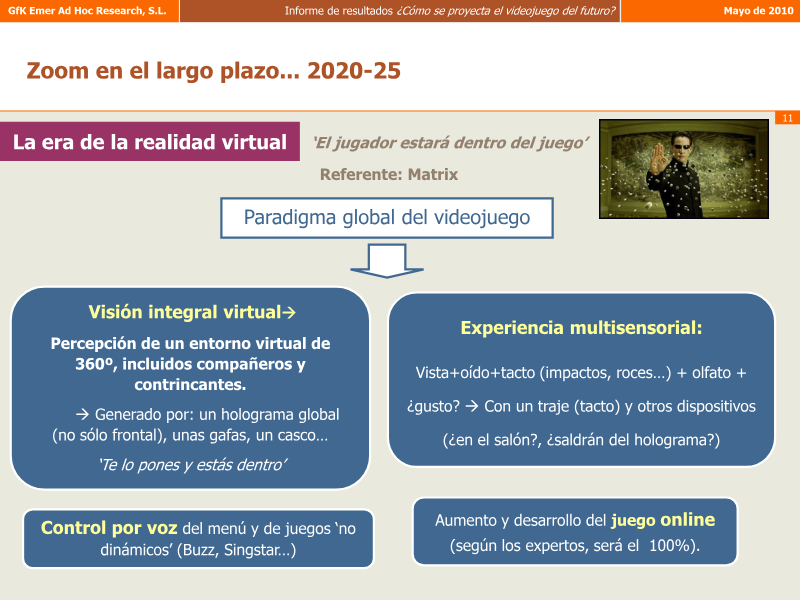
- Immersive virtual reality is identified as the primary technological driver for the industry through the 2020-25 period.
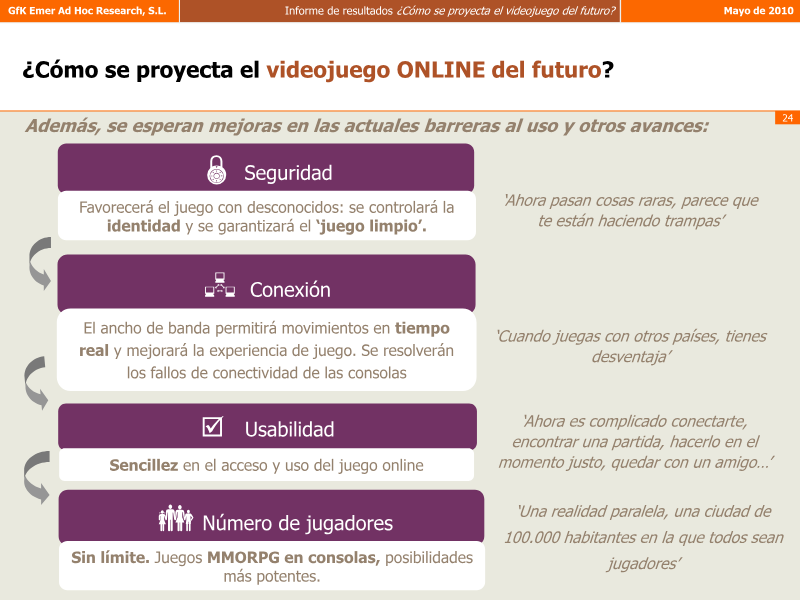
- Network latency is a critical barrier for 53% of moderately hardcore gamers, necessitating a shift toward high-bandwidth, low-latency infrastructure to support immersive content.
¿Cómo Se Proyecta el Videojuego del Futuro?: España
The study commissioned by ADESE explores how video games are expected to evolve, focusing on technological, social and market dynamics and projecting scenarios up to 2025.
- Industry experts project that 100% of games will transition to online-only ecosystems by 2025, driven by the need for anti-piracy measures, improved matchmaking, and ubiquitous broadband.
- Technological evolution through 2025 will shift from cloud-based distribution and motion-sensing controls toward immersive virtual reality, multisensory holographic interfaces, and voice-controlled navigation.
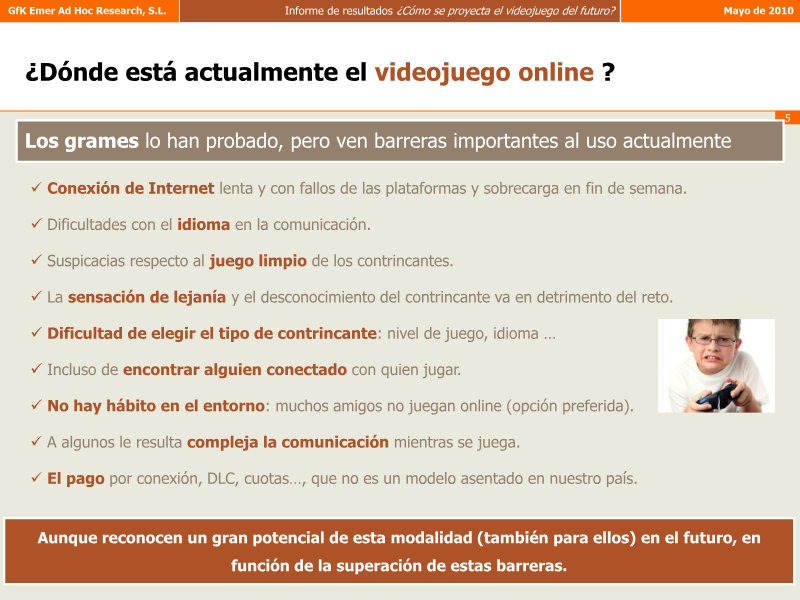
- Casual players currently resist online gaming due to specific barriers, including slow internet connections, language obstacles, distrust of payment models, and a lack of interest in complex online modes.
Argentinean Video Game Industry: 2020 Relevant Data Report
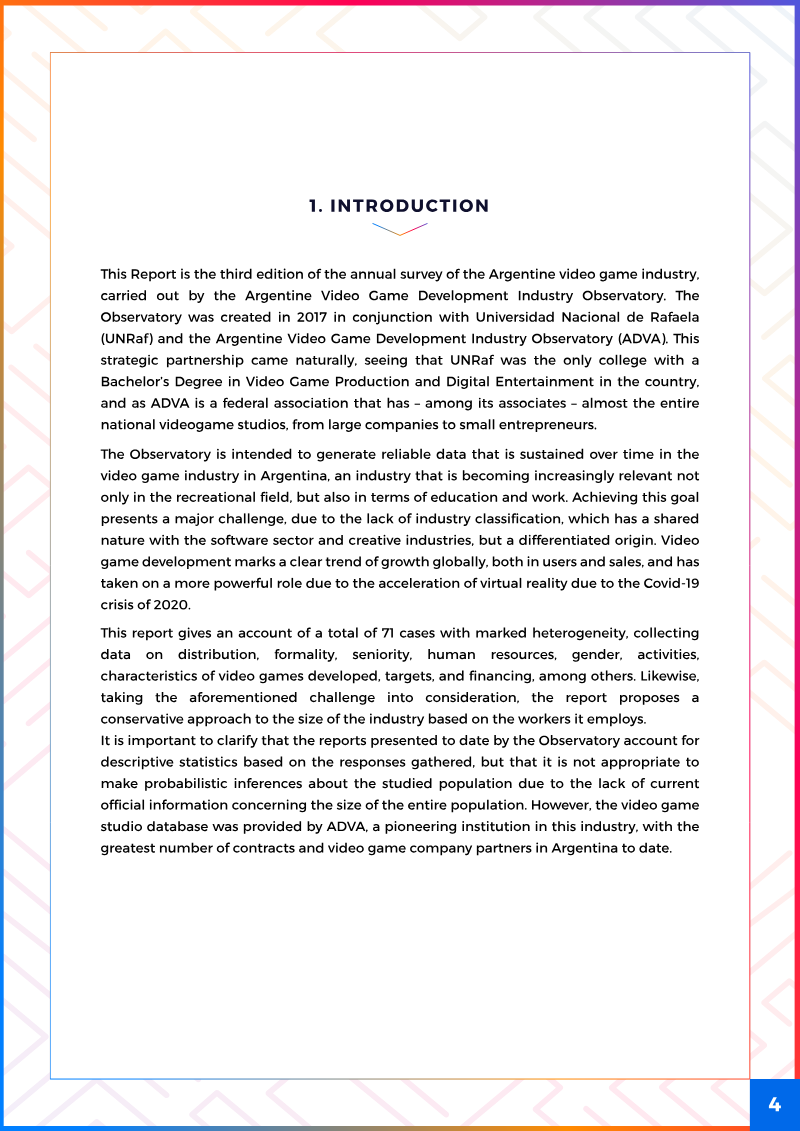
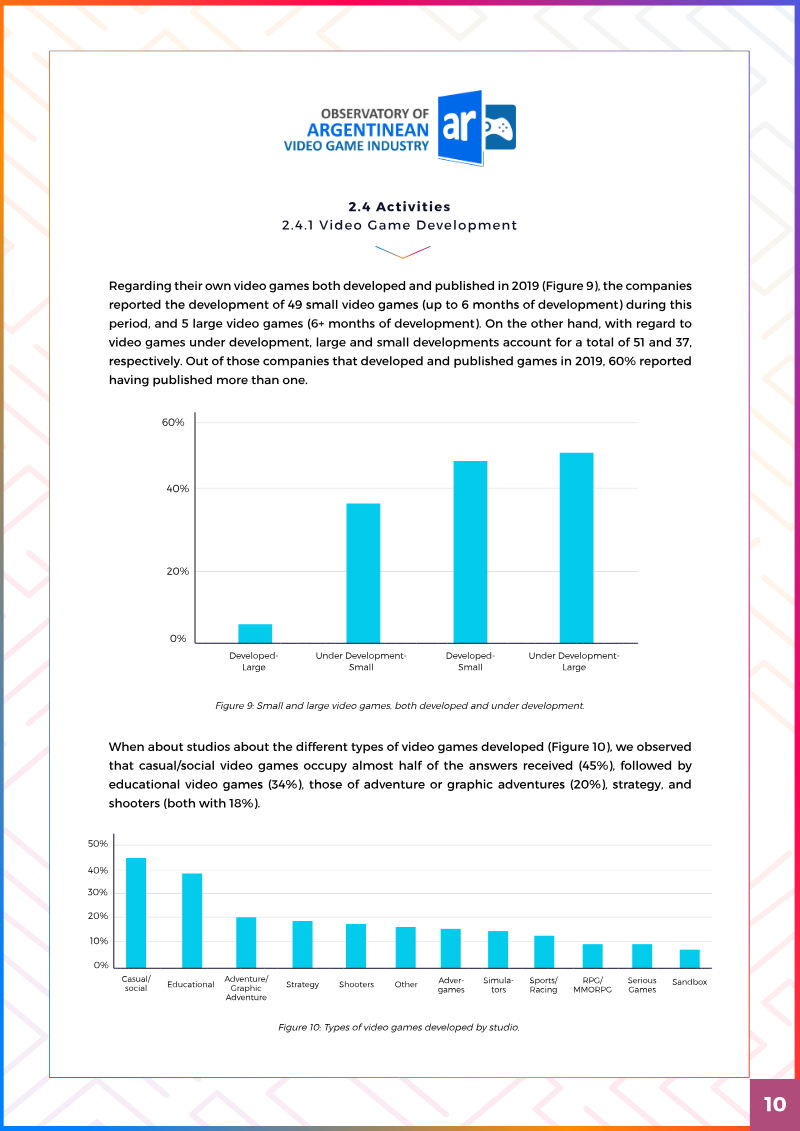
The Observatory of the Argentinean Video Game Industry's 2020 Relevant Data Report, the third annual edition of a survey conducted with Universidad Nacional de Rafaela and the industry association ADVA, presents descriptive statistics on the country's video game sector.
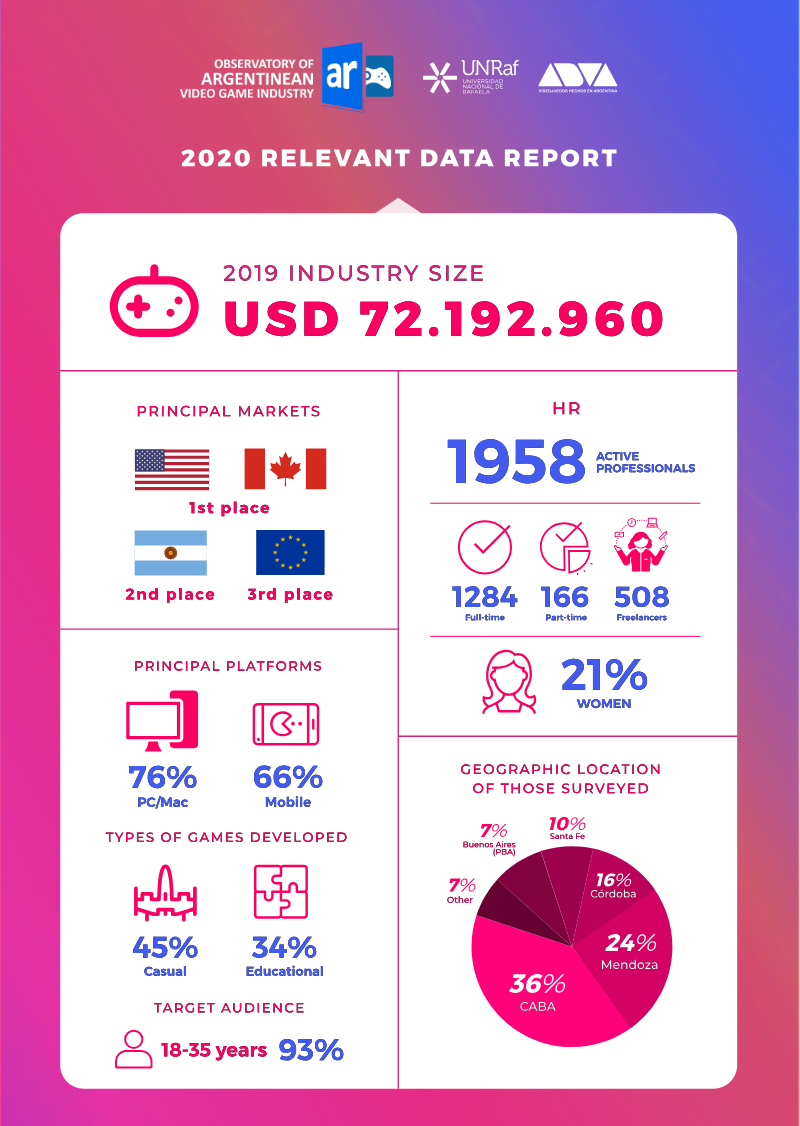
- The Argentinean video game sector is young and geographically concentrated: 36% of the 71 surveyed studios are in Buenos Aires City, followed by Mendoza (24%), Córdoba (16%), Santa Fe (10%), and Buenos Aires Province (7%), and about 60% were incorporated between 2015 and 2020.
- The sector's estimated size for 2019 is at least USD 72,192,960, calculated conservatively from employment figures and average hourly costs, and it employed roughly 1,450 formal workers (1,284 full-time, 166 part-time) plus 508 freelancers.
- Gender gaps are pronounced: women average 21% of employee-status workers but only 6% of company partners, and 18% of studios report no female employees.
Southeast Asia Game Industry Report 2021
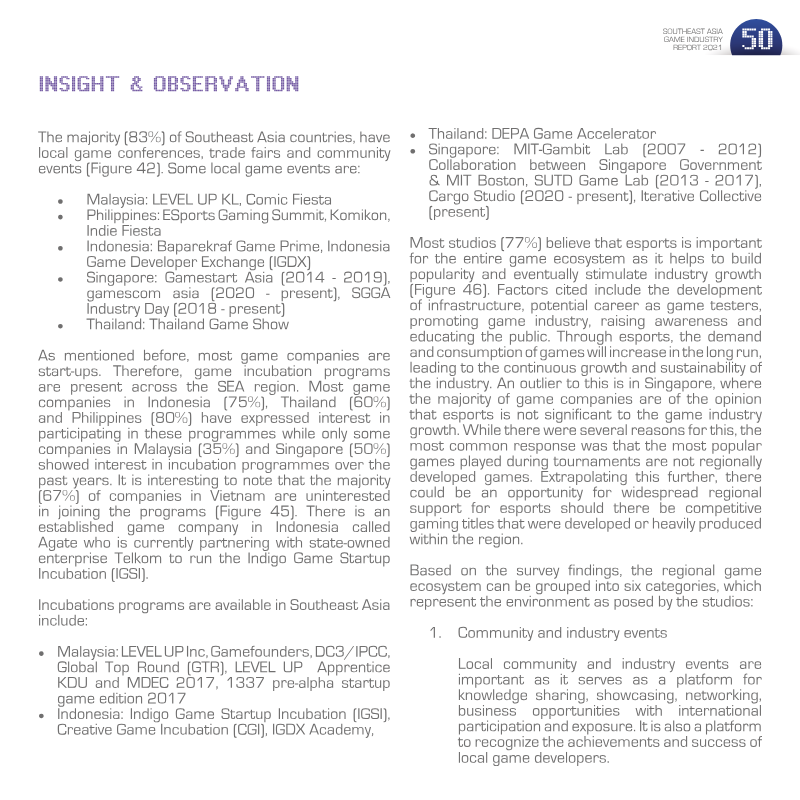
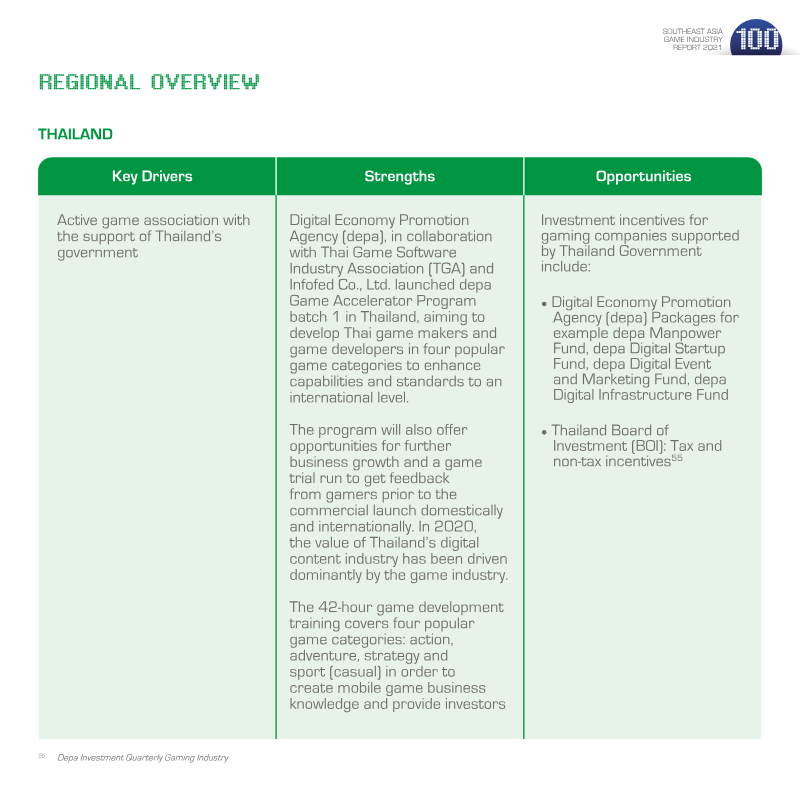
The Southeast Asia Game Industry Report 2021, produced by the Malaysia Digital Economy Corporation, assesses the maturity, workforce, funding environment, and growth potential of the region's game sector across six countries: Malaysia, Indonesia, the Philippines, Singapore, Thailand, and Vietnam.
- The Southeast Asia game market was valued at US$4.4 billion, about 70% of it from mobile, serving roughly 650 million people, with active gamers rising from 126 million in 2014 to 255 million in 2020.
- The sector is structurally small: most companies are young, locally owned, and employ fewer than eleven people, and most firms grow revenue at around 6% or less year on year, with Indonesia showing the strongest expansion.
- Talent acquisition is a persistent constraint, as most entry-level hires need three to six months of practical training and women make up a small share of staff at many firms; the Philippines is the notable exception where talent access is considered easy.

The Games Sector in Ireland: An Action Plan for Growth
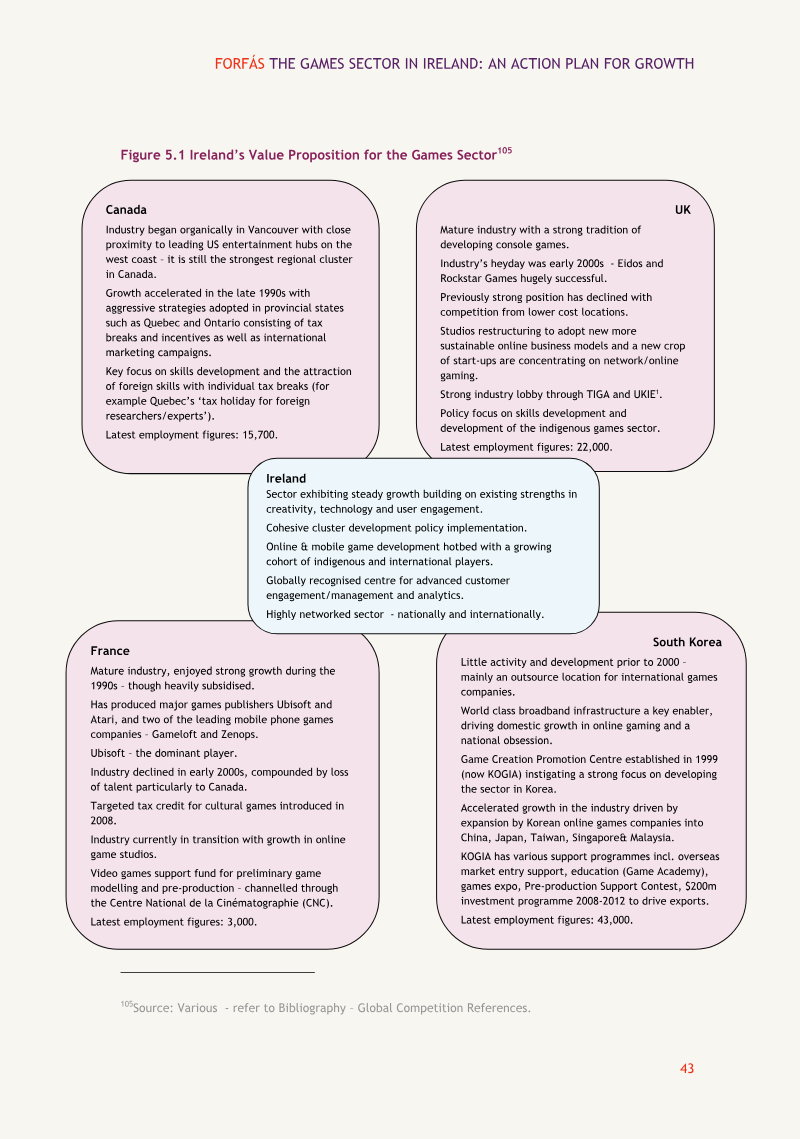
Forfás's action plan for Ireland's games sector argues that the industry is growing rapidly and that Ireland can become a global games hub for the 21st century, but only if policy is deliberately redesigned to capture the opportunity.
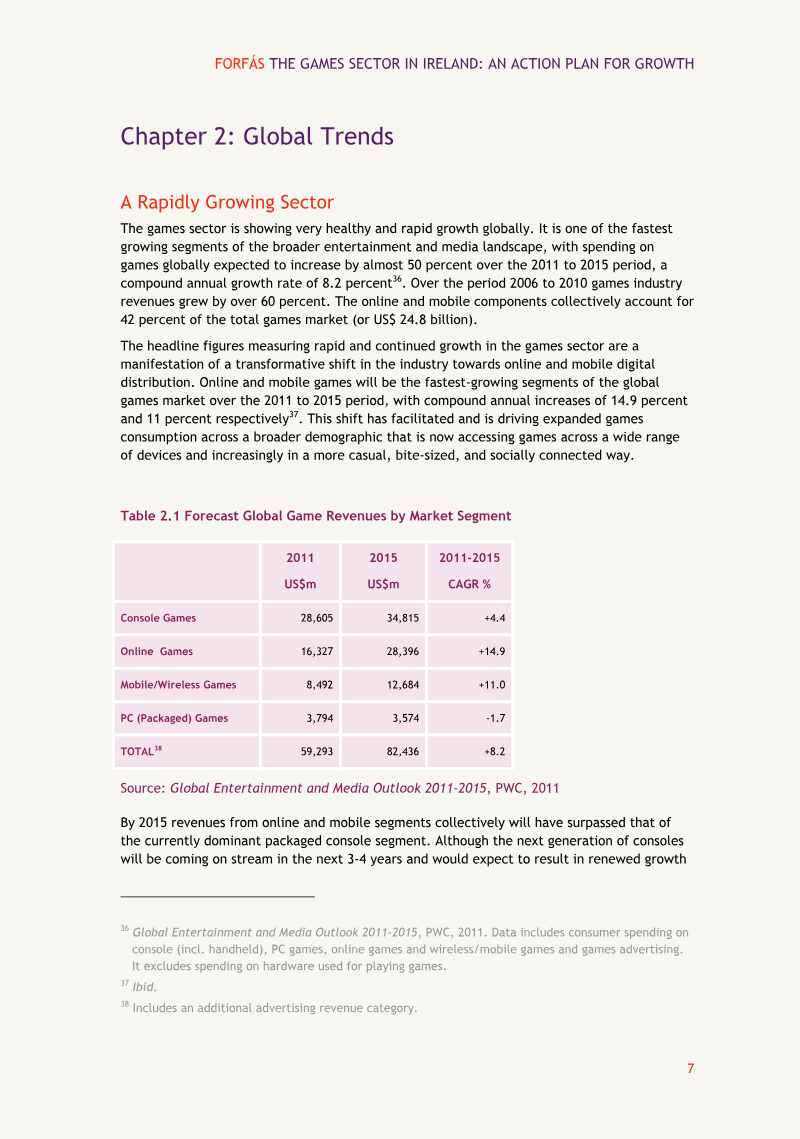
- Global games revenues are forecast to grow from US$59.3bn in 2011 to US$82.4bn by 2015, with online (14.9% CAGR) and mobile (11.0% CAGR) segments overtaking packaged console games.
- Ireland's core games employment has grown fivefold since 2004 to just over 2,000 people in 2011, with a target of 4,500 by 2014.
- Foreign-owned firms account for roughly 90% of Ireland's games jobs, concentrated in customer support, localisation, and game servicing, while indigenous firms are mostly micro-firms focused on development.

GungHo Business Report Vol. 23
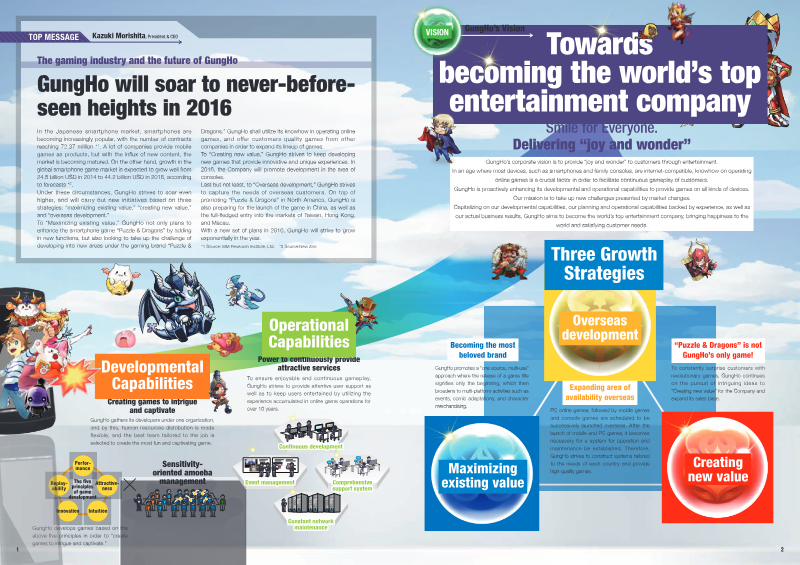
GungHo Online Entertainment’s business report outlines a strategic roadmap for 2016, centered on the goal of becoming a premier global entertainment company.
- GungHo reported 2015 financial results of 154.3 billion yen in sales and 72.4 billion yen in operating profit.
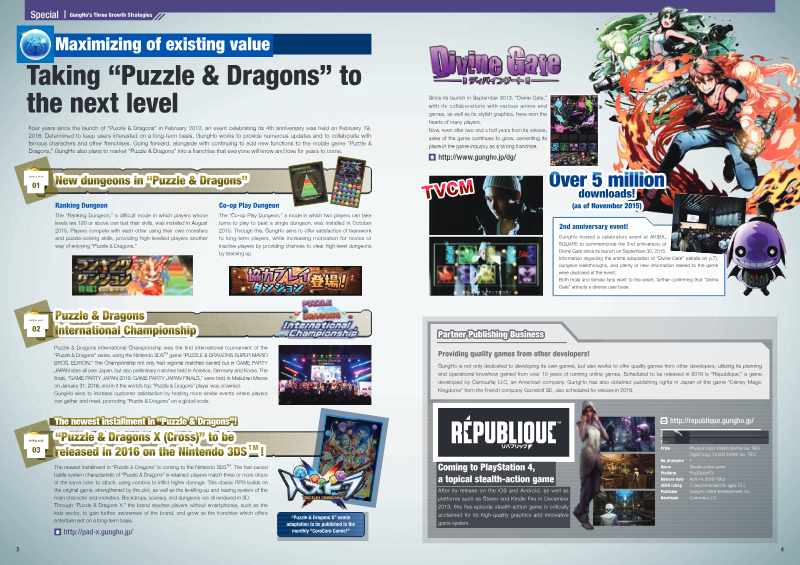
- The Puzzle & Dragons franchise remains the company's primary revenue driver, reaching over 53 million global downloads as of February 2016.
- The company is aggressively expanding internationally, including a collaboration with Tencent for a Chinese release of Puzzle & Dragons and a joint venture with Gamania for Taiwan, Hong Kong, and Macau.


GungHo Business Report Vol. 27
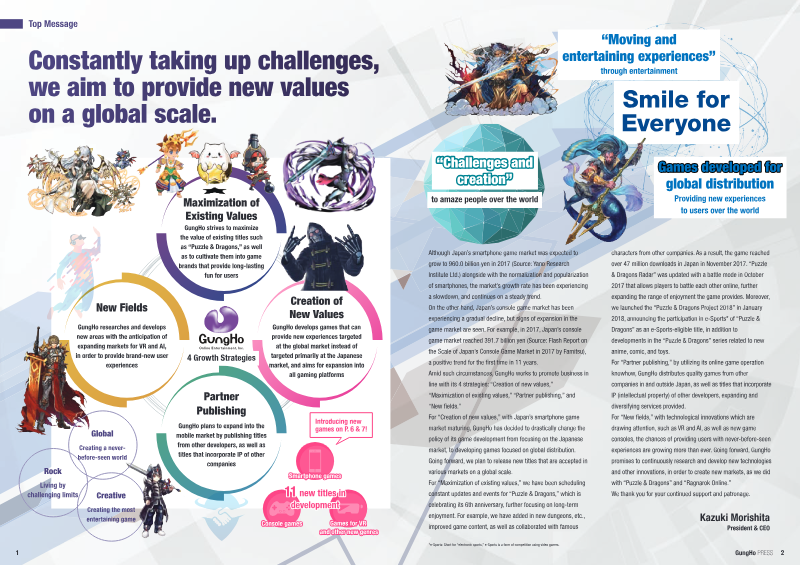
GungHo Online Entertainment’s business strategy focuses on the global expansion of its gaming portfolio and the long-term maximization of its intellectual property.
- GungHo experienced a significant financial downturn between 2015 and 2017, with net sales dropping from 154.3 billion yen to 92.3 billion yen and operating income falling from 72.4 billion yen to 34.4 billion yen.
- The company is pivoting from a Japan-centric model to a global distribution strategy, specifically targeting expansion into North American and European markets.
- Puzzle & Dragons remains the company's primary growth pillar, reaching 47 million downloads in Japan by late 2017 and utilizing cross-media strategies like anime and e-Sports to maintain relevance.



Q3 2015 Data Digest
The Q3 2015 Data Digest provides a comprehensive analysis of the iOS mobile application market, focusing on global and U.S. trends in downloads, revenue, and advertising strategies.
- Gaming remains the dominant App Store category, generating over 20 times the revenue of the next leading category.
- Clash of Clans maintained its lead in Q3 2015, though Game of War significantly narrowed the revenue gap in the U.S. market.
- Aggressive advertising on the Facebook network, particularly using high-production image and video assets, shows a strong correlation with increased revenue for gaming and lifestyle apps like those from ContextLogic.

China's & Southeast Asia's Mobile Games Market: Every Piece of the Puzzle
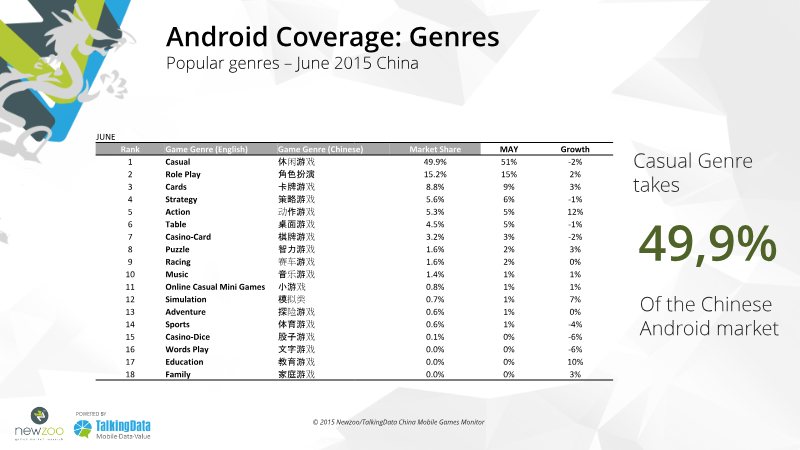
This analysis examines the mobile gaming landscape in China and Southeast Asia as of mid-2015, highlighting the region’s pivotal role in the global games market.
- Mobile gaming is the fastest-growing segment of the global market, projected to reach $44.2 billion by 2018 with a compound annual growth rate of 15.9%.
- China is the world's largest mobile games market, with 2015 revenues of $6.5 billion expected to grow to $11 billion by 2018.
- Southeast Asia is the fastest-growing region for gaming, with a projected revenue growth rate of 30.2% between 2014 and 2018, doubling total market value from $1.6 billion to $3.4 billion.


The eSports Industry to Date: The Drivers Behind Current and Future Growth
The global esports industry is undergoing a rapid transformation from a niche gaming subculture into a significant, multi-billion dollar economic force.
- The esports industry is on a trajectory to grow from $252 million in 2015 revenue to a $1 billion economy by 2019.
- Industry growth is driven by high engagement on streaming platforms like Twitch and a transition toward mainstream professionalization.
- Significant capital is entering the market, evidenced by a $26 million venture capital investment in Super Evil Megacorp.