Report
MTG Corporate Responsibility Report 2015
In 2015 the media group placed corporate responsibility at the core of its strategy, integrating ethical governance, sustainability and gender‑parity objectives across a global operation that spans 165 countries and includes broadcast, content localisation and e‑sports segments. The company achieved a 96 % compliance rate among 514 new hires—drawn from 38 nationalities—who signed a unified code of conduct, whistle‑blower and anti‑bribery policies aligned with the UN Global Compact and OECD guidelines, while stakeholder engagement was overseen by a dedicated board committee. Environmental performance showed mixed results: total carbon emissions rose 13 % since 2010, driven largely by travel that accounted for 61 % of emissions, and overall energy use increased 3 %. Nevertheless, the firm earned a 95 C rating on the Dow Jones Sustainability Index for the third consecutive time, a CDP disclosure score of 95 C, and operates a “green” office equipped with more than 200 solar panels. Targets for 2016 include a 23 % reduction in employee energy use (baseline 2010), expansion of renewable energy, and comprehensive data‑privacy training in response to upcoming EU legislation. Social impact was highlighted by a 91 % accessibility rate for
Modern Times GroupJan 2015
Report
MTG Corporate Responsibility Report 2014
Modern Times Group positioned 2014 as a year of deepening corporate responsibility, linking its expanding digital portfolio to heightened standards in data‑privacy, child protection, freedom of expression and sanctions compliance. The narrative underscores a strategic shift toward embedding ethical, anti‑corruption and sustainability practices across a globally dispersed media operation. Financially, the company recorded net sales of SEK 16.7 billion, up from SEK 13.3 billion in 2012, while operating income contracted, reflecting investment in new digital initiatives. Governance was reinforced through a dedicated corporate‑responsibility advisory group, multiple board committees and local representatives, ensuring that compliance mechanisms permeated all levels of the organization. A UN‑Global Compact‑aligned system saw 787 employees endorse an anti‑bribery policy, the launch of a sanctions‑risk register and an Interpol‑backed anti‑piracy project, alongside comprehensive updates to data‑protection protocols. The workforce grew to 4,186 full‑time equivalents, achieving an 84 % appraisal completion rate and a zero‑fatality safety record, with work‑related accidents falling from ten to six. Diversity expanded to 44 nationalities and the gender‑pay gap narrowed to women earning 75
Modern Times GroupJan 2014


Report
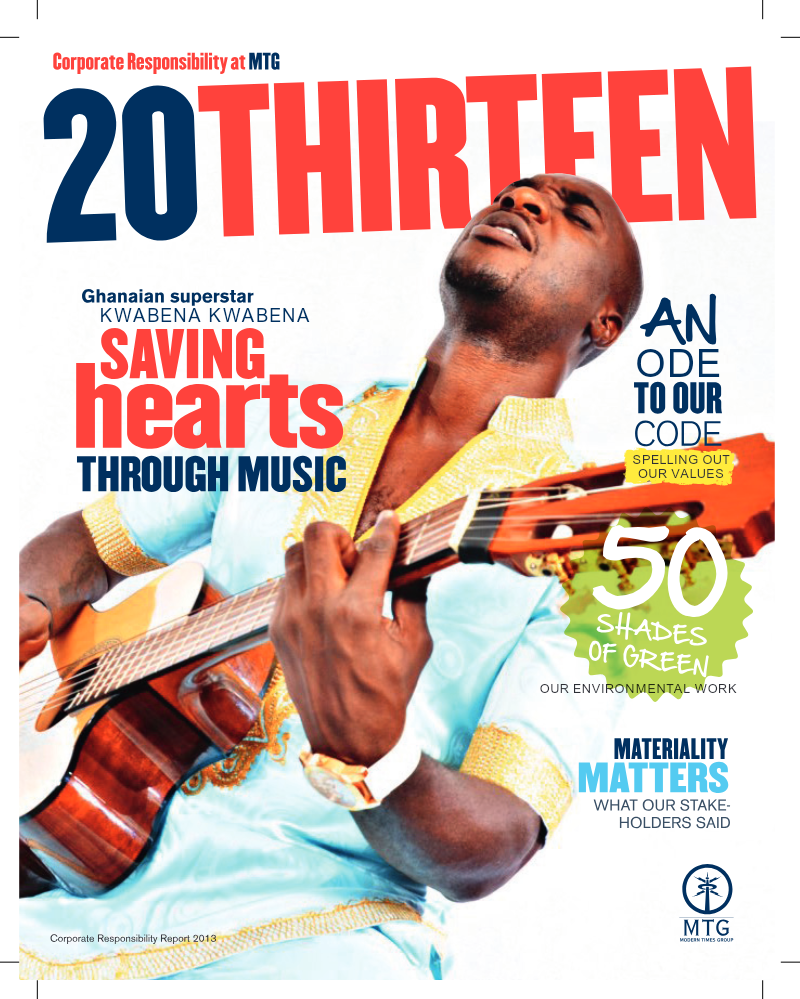
MTG Corporate Responsibility Report 2013
In 2013 the media group embedded sustainability within its core strategy, aligning business growth with responsible practices and earning inclusion in the Dow Jones Sustainability Europe Index and FTSE 4Good. Financially, the company generated €14.1 billion in net sales and €1.9 billion in operating profit while employing 3,361 staff and expanding into new European markets through the launch of its digital platform MTGx. Its corporate‑responsibility framework is built on four pillars—media responsibility, employees and workplace, environment and community, and business ethics—each supported by concrete actions and measurable targets. Compliance and societal impact were central to operations. A dedicated “C‑Team” ensured that broadcast and on‑demand content met EU, UK (Ofcom, ASA) and local regulations, with 85 % of programming already adapted for regional standards. The group leveraged its TV, radio and digital assets for charitable campaigns, delivering more than €4.3 million in media‑time value for Typhoon Haiyan relief, €438 k for the “Angels over Latvia” tour, €115 k for a Lithuanian zoo‑elephant project, and additional support for health, education and wildlife initiatives across Ghana, Estonia, Sweden, Bulgaria and other markets. Environmental performance improved markedly. The new London headquarters attained a BREEAM “Excellent” rating and installed roof‑mounted solar panels that now supply the majority of its electricity, producing a quantifiable reduction in CO₂ emissions. The company’s CDP climate‑change score rose to 88, reflecting stronger governance and disclosure. A materiality analysis highlighted data integrity, privacy and child‑online‑safety as top concerns, prompting new internal policies, anti‑corruption training completed by all staff, and an updated Code of Conduct with 78 % e‑learning uptake. Gender equity showed progress
Modern Times GroupJan 2013
Report
MTG Corporate Responsibility Report 2011
The 2011 Modern Responsibility Report demonstrates how Modern Times Group (MTG) has integrated a comprehensive sustainability framework across its operations in 39 countries, targeting employee welfare, anti‑corruption, climate action and community engagement. By the end of 2011 the company achieved a 5 % reduction in carbon footprint per employee—equating to a 16 % total cut in emissions—and a 6 % per‑employee decline in CO₂ versus the 2009 baseline, while overall office energy use fell by the same 16 % margin. These environmental gains were accompanied by a record‑low incidence of work‑related accidents (zero) and consistently low absenteeism around one percent. MTG’s expansion strategy in 2011 combined geographic and product growth, acquiring stakes in TV Prima, Darial TV and Balkan Media Group, launching Viasat HD, History HD and Nature HD in 22 Central‑ and Eastern‑European markets, and entering four African nations (Ghana, Uganda, Tanzania, Kenya). The broadcasting arm, including Strix, continued to produce and co‑produce TV formats sold in more than 80 territories, while its gambling subsidiary Bet24 remained a marginal revenue source subject to strict responsible‑gaming controls. Stakeholder dialogue was institutionalised through a GRI‑aligned materiality analysis, enabling MTG to meet 14 of 15 short‑term sustainability targets for the year. Employee turnover averaged 18 % among 3,031 staff (mean age 34) and training participation rose, though the rollout of anti‑bribery e‑learning was deferred for policy refinement. The whistle‑blower system recorded only two operational reports, underscoring a relatively clean compliance environment. Community contributions
Modern Times GroupJan 2011
Report
MTG Corporate Responsibility Report 2010
The 2010 Modern Responsibility report presents Modern Times Group’s first GRI‑aligned disclosure, expanding the reporting perimeter to encompass all subsidiaries and leased assets that employ staff. It establishes a comprehensive materiality analysis, stakeholder survey, and a crisis‑support team, framing corporate responsibility as a strategic pillar that underpins responsible broadcasting across MTG’s television, radio and digital platforms. The document’s thesis is that transparent governance, measurable sustainability targets, and inclusive social initiatives can drive long‑term value for both the business and its broader stakeholder community. Governance is overseen by a seven‑member board—six independent non‑executives, five men and two women—supported by audit, remuneration and Modern Responsibility committees. The report sets concrete performance goals, including training 50 % of relevant staff on compliance by the end of 2010 and achieving full coverage by 2012, reducing per‑employee CO₂ emissions by 5 % versus the 2009 baseline by February 2012, and extending a supplier self‑check system to half of MTG’s partners. Parallel gender‑equity objectives launch a women‑in‑leadership network in Sweden and benchmark gender‑pay gaps in Scandinavia by June 2011 and globally by February 2012. Operational outcomes for 2010 demonstrate strong social and environmental stewardship. MTG achieved 100 % subtitling/closed‑captioning for Swedish output, delivered 110 hours of compliance training, recorded only 21 internal complaints and incurred no fines. Philanthropic activity leveraged media assets to donate roughly 111 million SEK of airtime and raise over €58 million for health, disaster relief and child‑health campaigns across more than 20 countries. The United for Peace football tournament engaged 130 youths from 12 nations, with 88 % reporting new friendships and a near‑universal endorsement of sport as a conflict‑resolution tool, while the Playing for Change initiative secured a Social Capitalist award and raised 160 k SEK. Environmental performance shows a 7 % rise in total greenhouse‑gas emissions to 15,032 t CO₂e, driven mainly by facility energy (5,496 t) and business travel (8,727 t), raising per‑employee emissions to 5.6 t CO₂e. In response, MTG plans greener travel options, country‑specific green‑action lists, 80 % employee training in “green thinking,” and supplier CO₂ assessments to meet the 5 % per‑employee reduction target. The report thus captures a global, multi‑segment (broadcasting, digital, philanthropy, sports) snapshot of MTG’s 2010 responsibility performance and its forward‑looking commitments through
Modern Times GroupJan 2010
Report
MTG Corporate Responsibility Report 2009
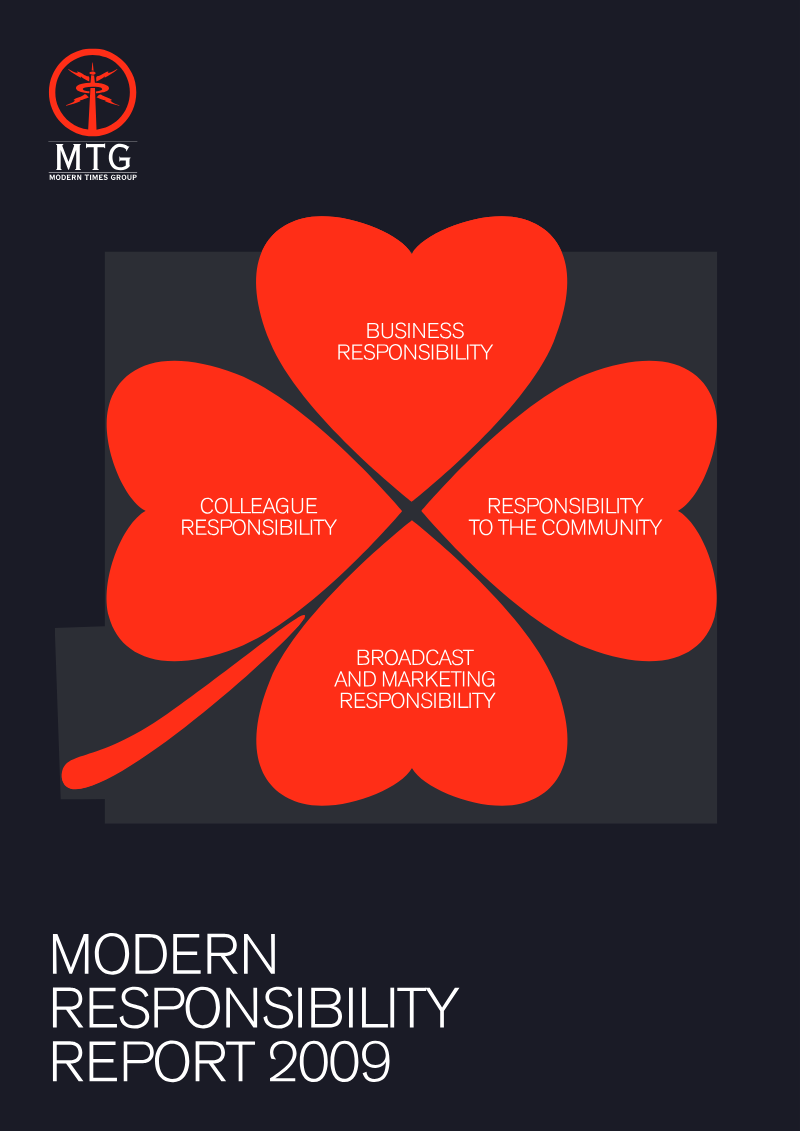
The 2009 Modern Responsibility Report presents Modern Times Group’s (MTG) effort to embed corporate responsibility across its broadcasting and media operations while navigating the aftermath of the 2008‑09 financial crisis. The report’s thesis is that a structured, multi‑pillar responsibility programme can coexist with commercial growth, even as the group expands its channel portfolio and geographic reach. In 2009 MTG recorded net sales of SEK 14.2 billion and launched three new channels—TV3 Puls, Prima COOL and Viasat Hockey—while completing a major restructuring of its Bulgarian assets. Despite revenue growth, operating income fell to a loss of SEK 1.4 billion and basic earnings per share turned negative at ‑30.86 SEK. The responsibility framework, introduced in 2004, is now governed by the CEO, board directors, a central committee and local “Green Ambassadors,” with KPIs, internal audits and external consultancy guiding progress. Targets for 2010 include broader KPI coverage, reduced carbon emissions and enhanced stakeholder communication across business, broadcast‑marketing, colleague and community dimensions. Employee engagement proved strong: 86 % of the 2,906 staff across 38 national markets completed the annual survey, 88 % expressed enthusiasm for their work and 90 % embraced the company’s three lead words. Gender balance approached parity overall (52 % male, 48 % female) though managerial levels remained skewed (63 % male, 37 % female). Internal recruitment accounted for 40 % of hires. The carbon footprint for 2009 amounted to roughly 13 000 t CO₂e across 19 countries, split evenly between facilities and office‑supply material use, with an intensity of 4.2 t CO₂e per employee (0.9 t per MSEK turnover). ISO 14001 certification for the Swedish radio division and energy‑efficient headquarters illustrate concrete mitigation steps. Partnerships with WWF and Sweden’s BLICC, together with expanded carbon‑footprint audits, underscore MTG’s commitment to environmental stewardship within the
Modern Times GroupJan 2009
Report
MTG Corporate Responsibility Report 2008
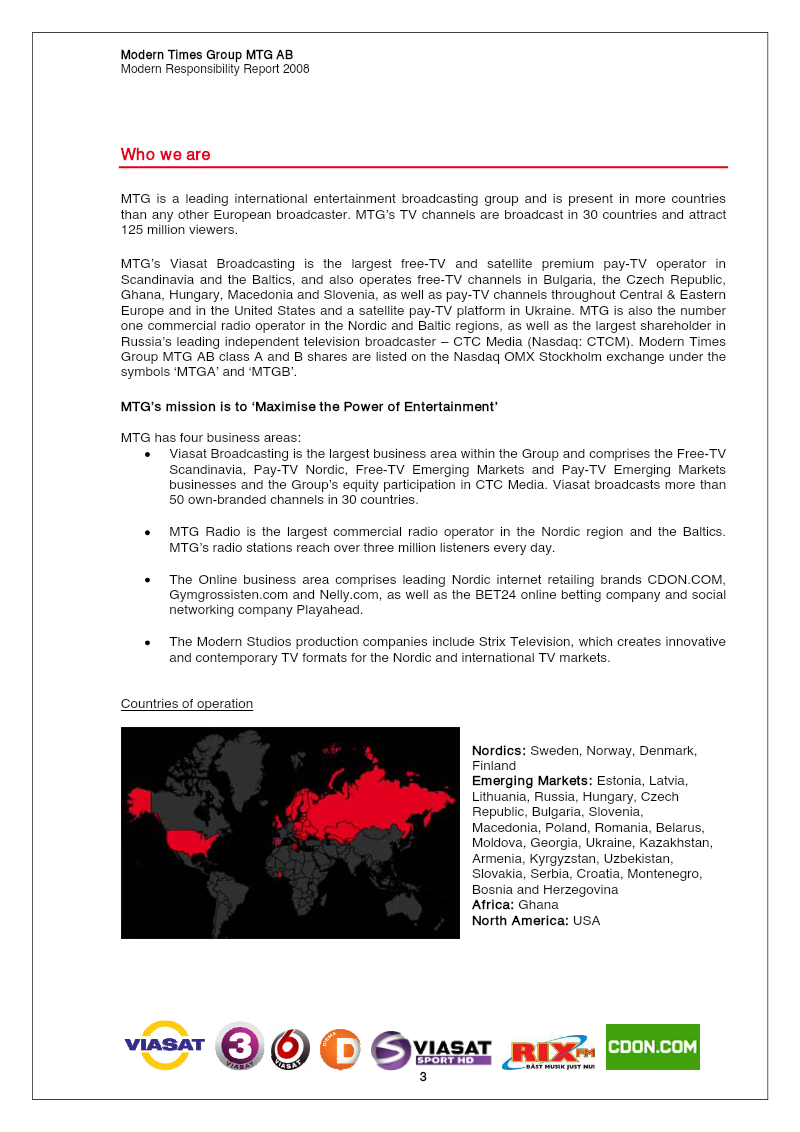
Modern Times Group’s Modern Responsibility programme, launched in 2004, is presented as a strategic framework for leveraging entertainment to create social and environmental value across the company’s global operations. The initiative is positioned as core to MTG’s mission to “maximise the power of entertainment,” with responsibility articulated through five measurable pillars: community, environment, colleagues, broadcasting standards, and marketing. In 2008 the group reached 125 million viewers in 30 countries, operating 70 brands across television, radio, online retail and production. Financial performance showed net sales rising to SEK 13.2 billion and operating income to SEK 2.6 billion, while basic earnings per share more than doubled to SEK 43.25. Employee data indicate an average workforce of 2 810, with 35 % female representation, a 22 % turnover rate and 461 training days delivered to 46 % of staff. Community engagement generated 78 million SEK of donated airtime and raised 56 million SEK for charities, while environmental actions reduced office energy use by 28 % relative to national standards and produced a total carbon footprint of 4 223 tonnes CO₂ (3.0 t per employee), calculated under the Greenhouse Gas Protocol with external verification. Stakeholder governance is overseen by senior management, a dedicated coordinator and a Modern Responsibility Committee, supported by local ambassadors in each market. Reporting draws on internal data, carbon accounting from Tricorona Climate Partner, and regular stakeholder feedback through surveys and focus groups. The 2008 snapshot underscores MTG’s expanding footprint, its commitment to ethical broadcasting, and its ambition to deepen responsibility reporting in subsequent years.
Modern Times GroupJan 2008