2015
Company
Documents about 2015

The Impact of Kickstarter on Board Game Design
This paper, presented at DiGRA 2022 by Gordon Calleja of the University of Malta, examines how Kickstarter and similar crowdfunding platforms such as Gamefound have reshaped board game design, production, marketing, and distribution.
- Crowdfunding platforms such as Kickstarter and Gamefound have connected backers' purchasing power directly to designers, enabling games that traditional publishers would have rejected as lacking a market, being too costly to produce, or being insufficiently appealing.
- The paper argues this shift has weakened the influence of conventional gatekeepers (publishers, distributors, and to some degree reviewers) and disrupted the traditional three-tier distribution model, with changes that appear largely irreversible.
- Kickstarter has raised expectations for visual aesthetics and component quality, and these expectations shape design decisions from the earliest stages of ideation.
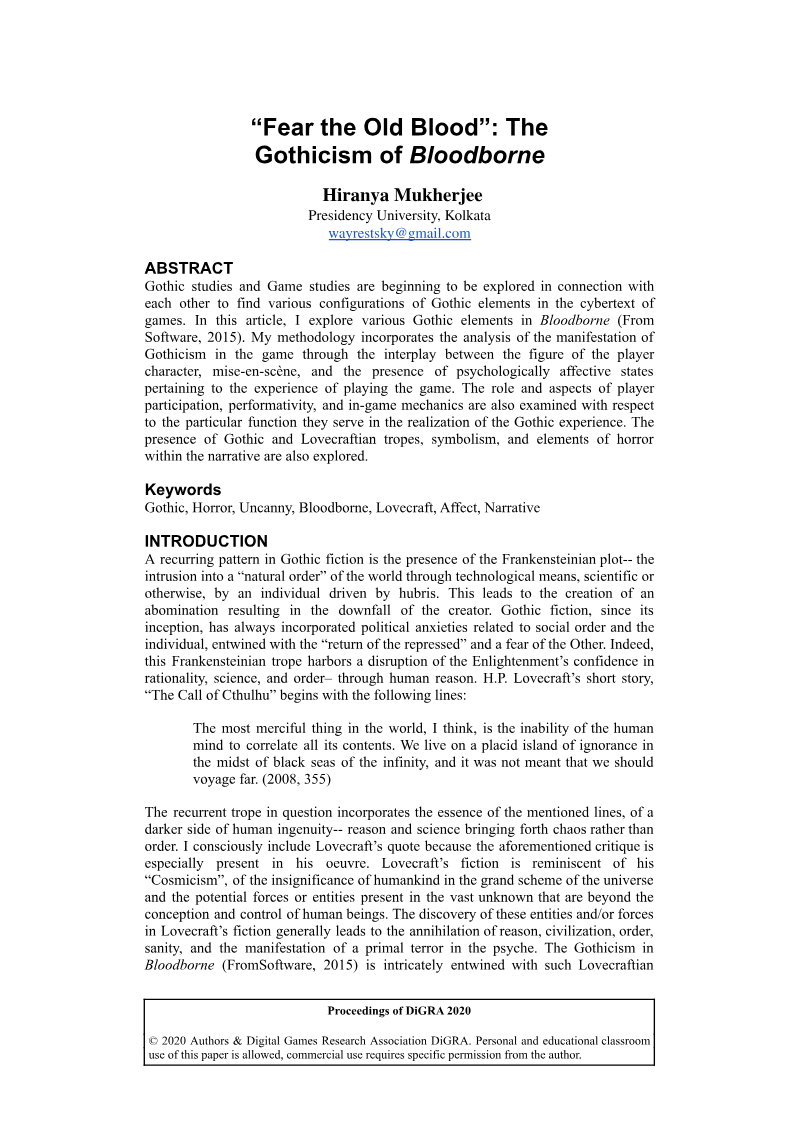
"Fear the Old Blood": The Gothicism of Bloodborne
Bloodborne, FromSoftware's 2015 action role-playing game, is examined here as a sustained work of Gothic horror, with its atmosphere, narrative structure, and imagery read through established critical frameworks of the Gothic and the Lovecraftian.
- The report's central claim is that Bloodborne's gradual empowerment of the player does not dissolve its Gothic mood: a pervasive threatening gaze keeps pressure on the player, who must assemble a fragmented narrative like a detective, while themes of cosmic indifference and Frankensteinian hubris persist throughout.
- The analysis frames Bloodborne's Gothicism through Krzywinska's account of Gothic in games, which identifies coordinating elements such as the false hero, mise-en-scène, affective states, style, and function.
- Doubling and the uncanny are shown through the imposter Iosefka and a lifeless doll modeled on Lady Maria, which together expose the obsessive, displaced desire of Gehrman.
Six Years of UKGTF
Established in 2015, the UK Games Fund serves as a critical support mechanism for the nation’s independent games development sector.
- Since its 2015 launch, the UK Games Fund has supported nearly 200 independent game projects with individual grants of up to £25,000.
- The fund has directly supported approximately £14 million in early-stage projects, generating an estimated £20 million in wider economic leverage.
- Portfolio companies report an average staff growth of 45% following their initial funding application.
Lessons From a Disappointing Game Launch: Spire Of Sorcery
This analysis examines the commercial underperformance of the RPG Spire of Sorcery to provide a cautionary framework for independent developers transitioning between projects.
- A massive disconnect between pre-release interest and sales resulted in a 0.01 'Hype to Reality' ratio for Spire of Sorcery, significantly underperforming the industry median of 0.15.
- Despite accumulating 80,000 Steam wishlists, the title sold fewer than 1,500 copies during its October 2021 launch week.
- Radical shifts in game mechanics between 2019 and 2021 alienated legacy fans and caused technical issues, leading to 'Mixed' Steam reviews that deterred new players.
Can Playfulness Be Designed? Understanding Playful Design through Agency in Astroneer
Bódi's article asks whether playfulness can be intentionally designed, using the survival-crafting game Astroneer as its case study.
- Playful design is analysed through 'agency,' defined as the possibility space for meaningful player action that a game's design affords and constrains, drawing on Murray and Salen and Zimmerman.
- Meaningful play is framed as a relational feedback loop in which players perceive the outcomes of their actions and see them integrated into the game world.
- Astroneer's open-ended goals and creative problem solving are classified as paidic, exploratory play rather than ludic, rule-bound, win-oriented play, following Caillois and Frasca.
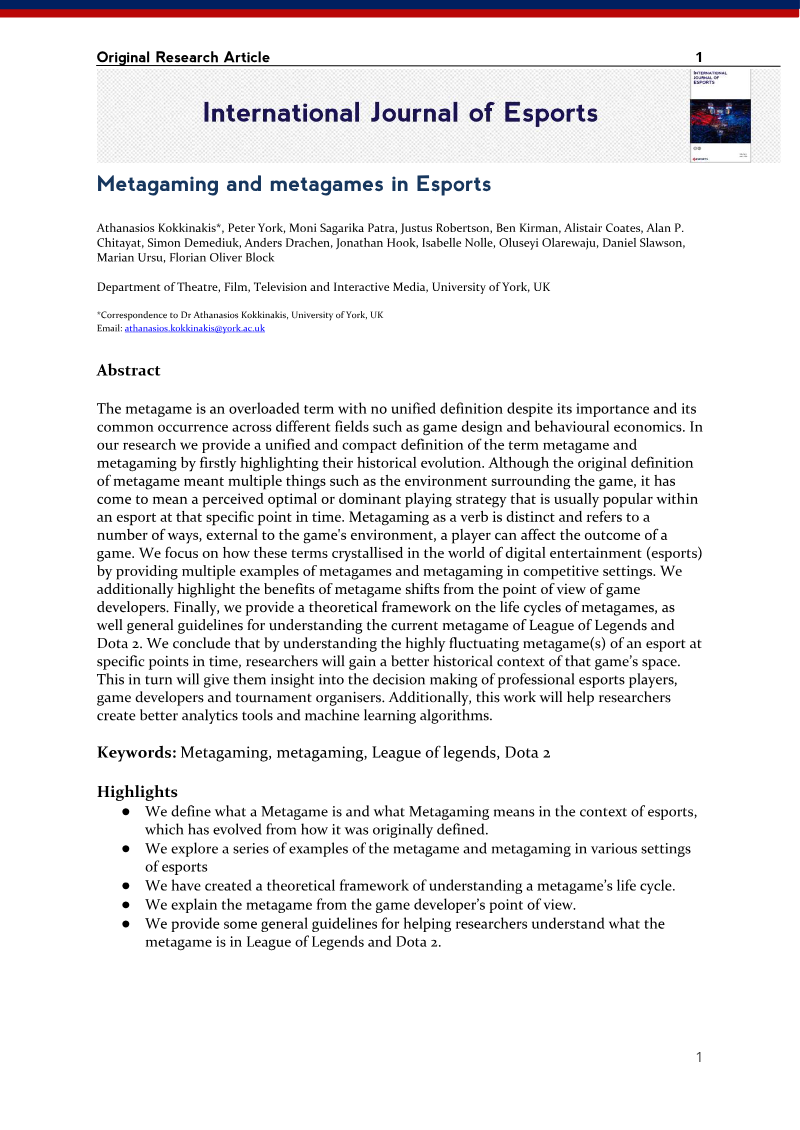
Metagaming and Metagames in Esports
The paper argues for a unified definition of the metagame in esports as the perceived optimal or dominant playing strategy at a given moment, with metagaming describing the use of information external to the game to shape play.
- The paper proposes a unified definition of the esports metagame as the perceived optimal or dominant playing strategy at a given moment, with metagaming meaning the use of information external to the game to shape play.
- Accurate esports analytics, casting, and machine learning depend on understanding the prevailing metagame, because the same character or statistic can carry different meanings as dominant strategies shift.
- Win rates alone can mislead: Dota 2's Death Prophet shows a 68% win rate despite a pick rate of only about 5.6%.
Gaming Under Biopolitical Sovereign Power: The Chronotope of the Abject in The Binding of Isaac
Mike Piero's analysis of The Binding of Isaac: Rebirth argues that the game's form is its critical content.
- Mike Piero's analysis argues that The Binding of Isaac: Rebirth's form is its critical content, using Bakhtin's threshold chronotope, Kristeva's abjection, and Agamben's homo sacer to frame the player as a biopolitical subject under permanent emergency.
- The randomly generated rooms, abject creatures, and repeated descents into the basement are read as devices that stage the player's experience of living under a state of exception that governs bare life.
- The analysis reworks the Abraham and Binding narrative within a Western religious frame, treating the game as a space to examine sovereignty, bare life, and subjectivity.
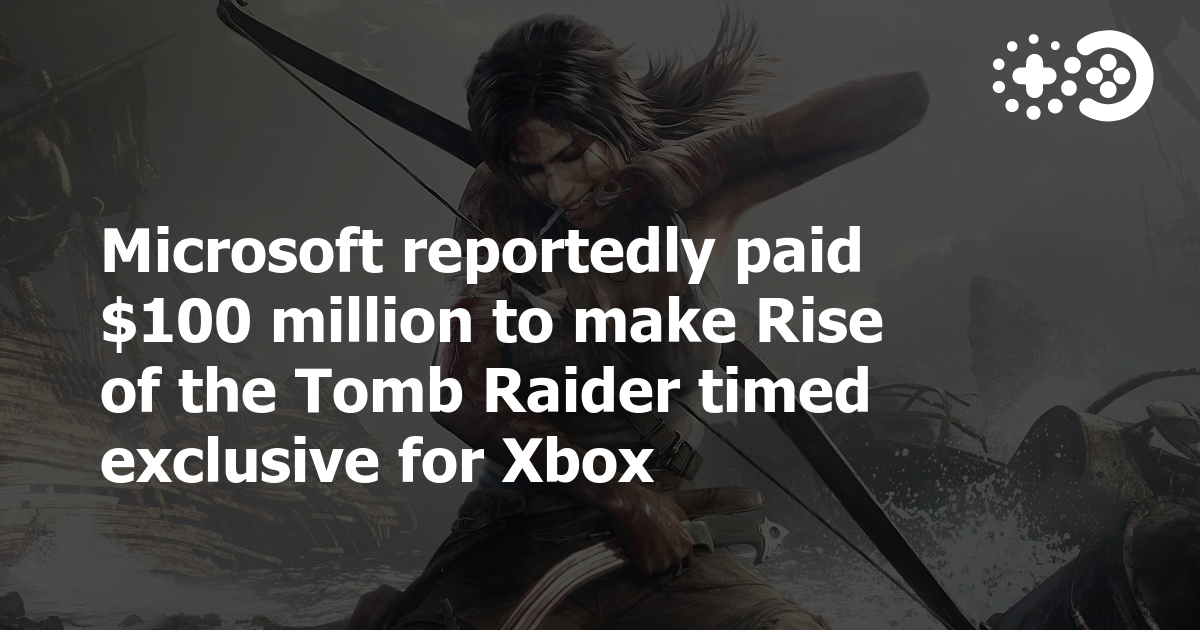
Microsoft Paid $100 Million for Rise of the Tomb Raider Timed Exclusive
The financial terms of the 2015 timed exclusivity agreement for the video game Rise of the Tomb Raider have surfaced, revealing that Microsoft paid $100 million to secure the title for the Xbox platform.
- Microsoft reportedly paid $100 million to secure a one-year timed exclusivity deal for the 2015 release of Rise of the Tomb Raider on Xbox.
- The financial detail was revealed on the LinkedIn profile of Fabien Rossini, the former director of strategic planning at Square Enix, before being removed.
- Rise of the Tomb Raider sold over 1 million units within its first two months of release.
How China’s Playtime Restrictions Might Stimulate Grey Market and Steer Kids to Use VPNs
The provided text examines the impact of Chinese government regulations on the domestic video game market, specifically focusing on how strict playtime limitations for minors may inadvertently strengthen the grey market.
- China’s 2021 regulations limiting minors to three hours of gaming per week are expected to drive increased use of VPNs and reliance on the grey market to bypass restrictions.
- The grey market for video games in China remains robust, with console sales in the grey market nearly tripling those in the official market as of 2018.
- Steam wishlist conversion rates have significantly declined, with games released between 2023 and 2025 selling an average of 0.22 copies per wishlist in their debut month, compared to 0.45 copies for games released between 2020 and 2022.

New Earth: Fantasy Pantheon Inspired by Afro-Brazilian Religion
Eliane Bettocchi's research report presents "New Earth," a fantasy role-playing game setting whose pantheon and faith systems draw on Afro-Brazilian religions, particularly Candomblé, Umbanda, and Tambor de Mina.
- The report's central thesis is that Eurocentric foundations in game design (the Hero's Journey, Judeo-Christian dualism, and European aesthetic proportions) narrow the stories and players games can serve, and that decolonial design principles offer a corrective.
- "New Earth" is a fantasy RPG setting whose pantheon and faith systems draw on Afro-Brazilian religions, particularly Candomblé, Umbanda, and Tambor de Mina, with Orisha-inspired deities, clerics, champions, and monks.
- The setting centers descendants of enslaved Africans and Indigenous peoples defeating colonizers and rebuilding their identities, and its temples are architecturally derived from African compounds.

Buzz Capital Investment into Games Studios and Publishers
Buzz Capital, in partnership with the investment group Premiere Capital, has completed a £500,000 financing round for two UK-based gaming entities: the narrative-focused studio Dream Harvest and the publishing and live-operations support firm Fundamentally Games.
- Buzz Capital and Premiere Capital have completed a £500,000 investment round into two UK-based gaming entities, Dream Harvest and Fundamentally Games.
- The UK video game market reached a valuation of £7 billion in 2020, representing a 29.9% increase over 2019 figures.
- Dream Harvest is a narrative-focused studio founded in 2015, known for titles such as 'Neuroslicers' and 'NeuroNet: Mendax Proxy'.
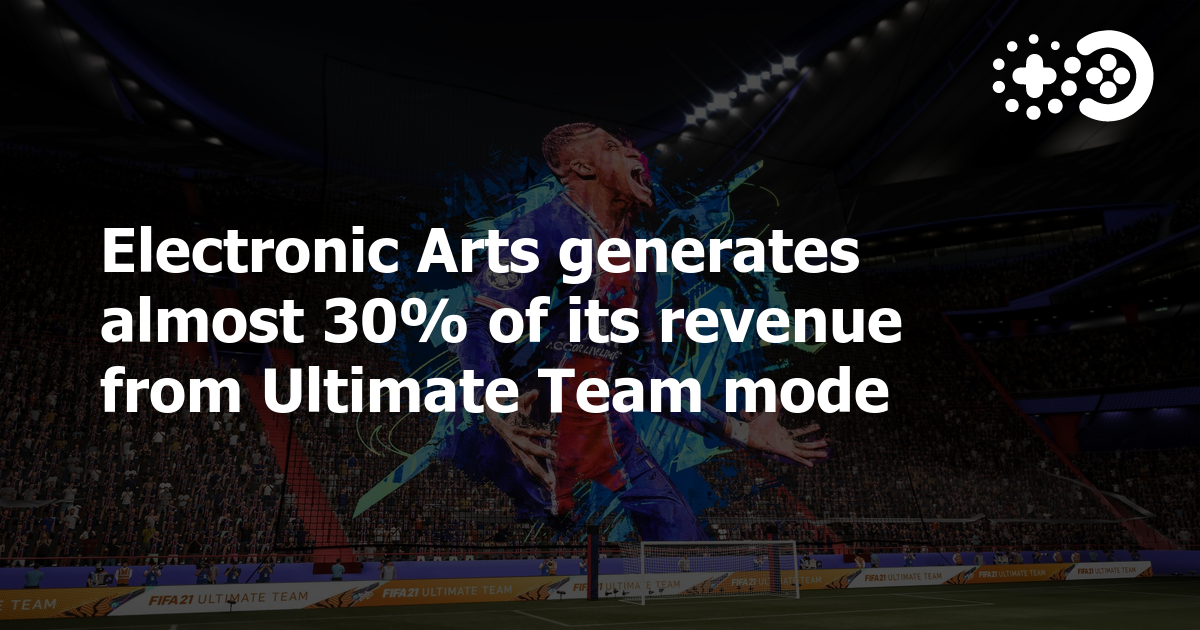
Electronic Arts Generates Almost 30% of its Revenue from Ultimate Team Mode
Electronic Arts has become increasingly reliant on its Ultimate Team game mode, which generated $1.62 billion in revenue during the 2021 fiscal year.
- Electronic Arts generated $1.62 billion from its Ultimate Team mode in fiscal year 2021, accounting for 29% of the company's total $5.62 billion revenue.
- Revenue from the Ultimate Team mode has nearly tripled over the last seven years, growing from $587 million in fiscal year 2015 to $1.62 billion in 2021.
- The Ultimate Team revenue figure aggregates earnings from multiple sports titles, including Madden NFL, NHL, and FIFA, with FIFA Ultimate Team serving as the primary contributor.