South Korea gaming industry reports and market data
Documents
App Annie breakdowns the Korean mobile game market
The South Korean mobile gaming market represents a highly mature, high-revenue ecosystem characterized by a dominant preference for the Google Play platform.
- South Korea ranks seventh globally in game downloads but third in total revenue, driven by exceptionally high average revenue per user (ARPU).
- The country is the second-largest market globally for Google Play revenue, reflecting a mature ecosystem where growth is driven by monetization efficiency rather than download volume.
- The mobile market is bifurcated by platform: Google Play is dominated by domestic publishers and the Kakao platform, while the iOS App Store is more receptive to foreign titles from companies like King, Supercell, and GungHo.

Cyber-psychologist Berni Good talks free-to-play gaming
The free-to-play gaming sector requires a sophisticated understanding of player psychology to successfully integrate monetization strategies without causing user disengagement.
- Transparency in monetization is the primary driver of player trust and long-term retention, as opaque or coercive payment structures lead to significant user backlash.
- Monetization strategies must be rooted in psychological triggers, as high levels of game satisfaction do not inherently correlate with a player's willingness to spend.
- Players are motivated by conspicuous consumption, using digital items and aesthetic upgrades to signal status and gain competitive advantages within the game environment.

News roundup: Gamevil buying Com2us, Kabam and GREE reorg and Kixeye's mobile entry
The mobile gaming industry experienced a period of significant structural realignment during the first week of October 2013, characterized by tactical downsizing at established firms and aggressive expansion by others.
- Gamevil is acquiring its primary competitor, Com2uS, marking a major consolidation in the South Korean mobile gaming market.
- Kabam closed its Austin studio and GREE offered voluntary redundancies to 200 staff members as part of a broader industry shift toward smartphone-centric platforms.
- Established developers including Kixeye, Stardock, and Jagex are pivoting toward mobile-first strategies to target the core gaming demographic.

Monetizer: Glu Mobile's Odyssey: Age of Gods
The mobile role-playing game Age of Gods, developed by TalentWalker and published by Glu Mobile, serves as a case study in the challenges of cross-market game localization.
- Age of Gods, developed by TalentWalker and published by Glu Mobile, fails to bridge the design gap between Asian market complexity and Western player expectations, leading to an inaccessible onboarding experience.
- The game’s tutorial is ineffective at explaining core mechanics like turn-based combat, squad management, and resource cultivation, leaving players without context for basic objectives or item quality tiers.
- Monetization is hindered by an unconventional pricing structure that features a steep jump from a $1 entry point to an $8 tier, while aggressively pushing a $20 recommendation over smaller options.

Com2uS USA's Don Lim talks about the Korean publisher's great success
Com2uS established itself as a mobile-first developer with a fifteen-year history, achieving significant growth in 2012 by transitioning its business model from paid applications to a free-to-play strategy.
- Com2uS achieved significant growth in 2012 by pivoting its business model from paid applications to a free-to-play strategy, anchored by the success of the social title Tiny Farm.
- The integration of KakaoTalk as a gaming platform was a critical driver for developer success in 2012, utilizing social features like friend invitations and gifting to boost virality and engagement.
- Widespread Android adoption in the Korean market during 2012 served as a foundational catalyst for the company's expansion by facilitating broader Google Play distribution and revenue.
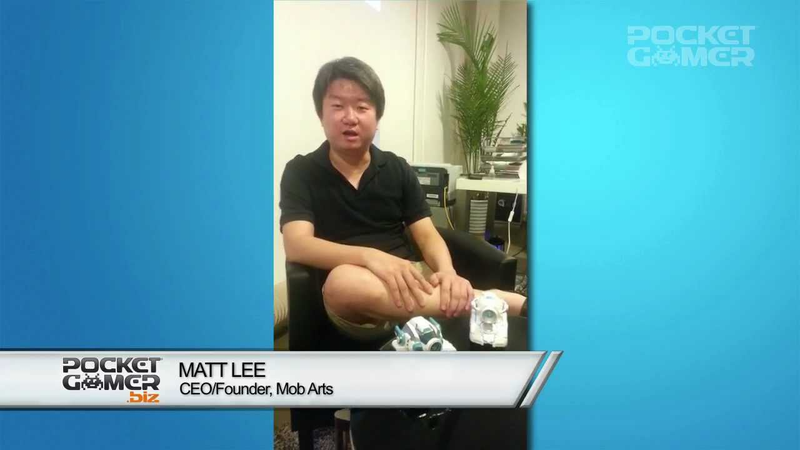
Pocket Gamer Biz interview Matt Lee, CEO of Mob Arts
Mob Arts, a Beijing-based mobile entertainment developer, distinguishes itself within the Chinese gaming landscape by prioritizing original intellectual property and innovative design over the common industry practice of cloning existing titles.
- Mob Arts differentiates itself in the Chinese market by prioritizing original IP and 3D-rendered console-style mechanics over the industry-standard practice of cloning existing titles.
- The studio’s flagship title, Space Tank, achieved strong international validation in the Korean market by securing nearly 7,000 five-star reviews within its first week of launch.
- Success for international developers in China requires high-quality game design, effective localization, and a commitment to providing consistent, compelling content updates for user retention.

Korea's Game Exports: Reading Beyond the Aggregate Numbers
The South Korean game industry serves as the nation’s primary content export engine, generating an estimated USD 8.60 billion in 2025 and accounting for 57.7% of total content export value.
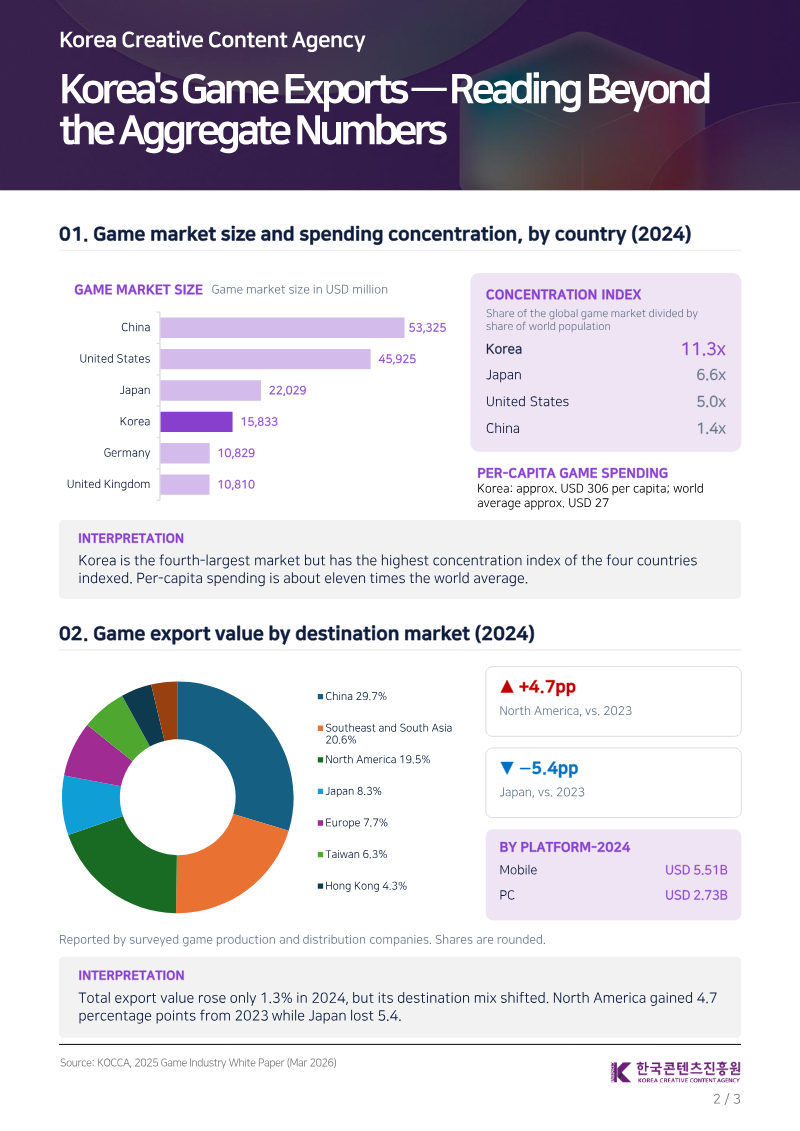
- The South Korean game industry generated USD 8.60 billion in exports in 2025, representing 57.7% of the nation's total content export value.
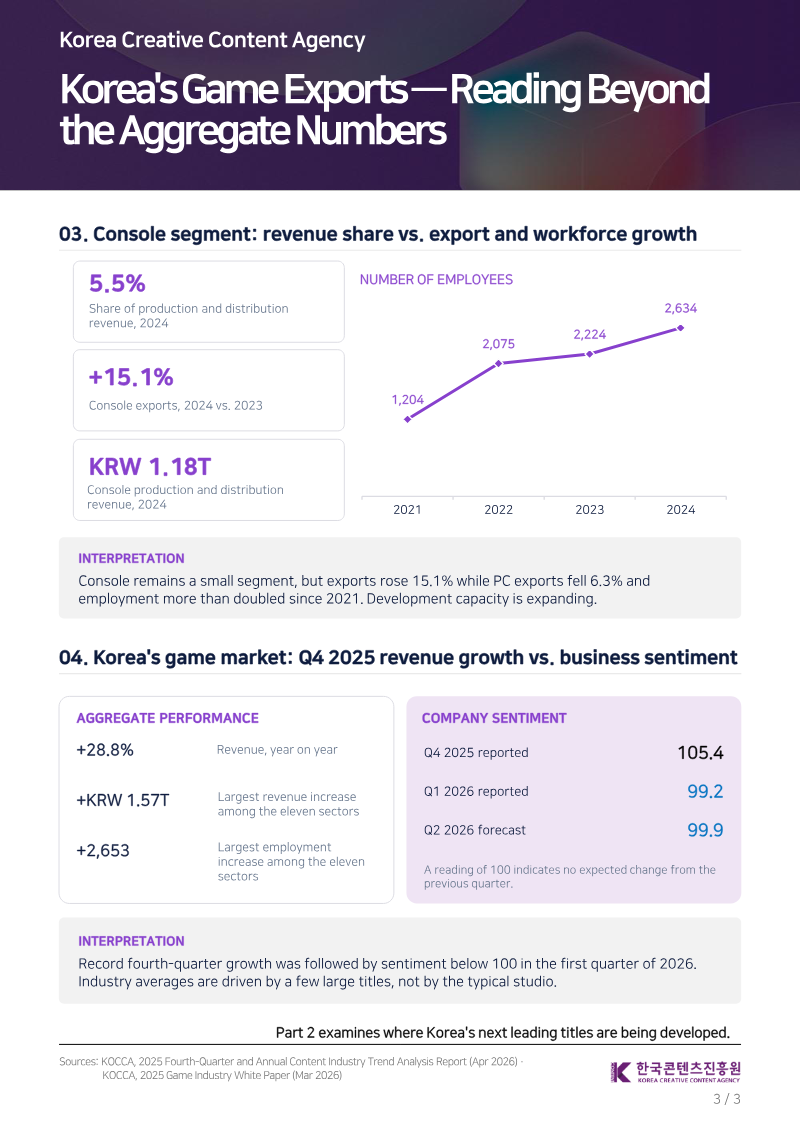
- Console game exports grew by 15.1% in 2024, supported by a workforce that has more than doubled since 2021 as studios pivot development capacity.
- Mobile gaming remains the primary revenue driver, accounting for USD 5.51 billion of the industry's export total.

Korea's Game Studios: Where the Next Breakout Title Is Actually Built
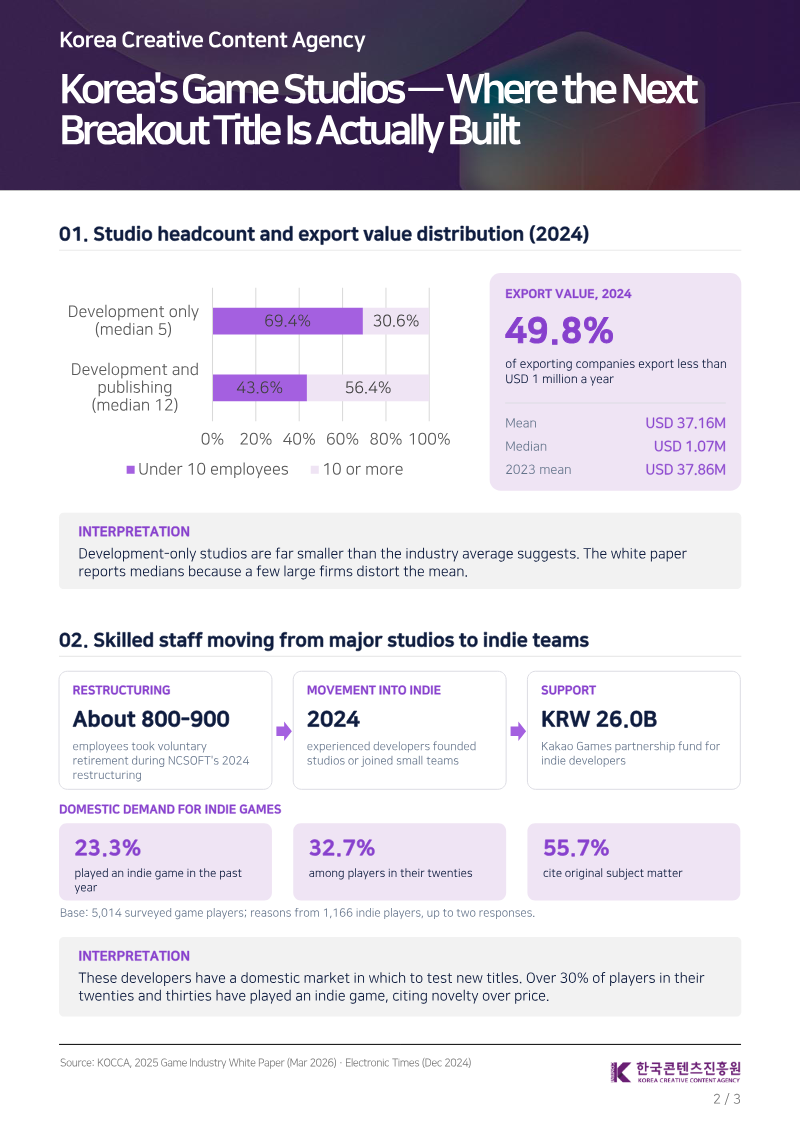
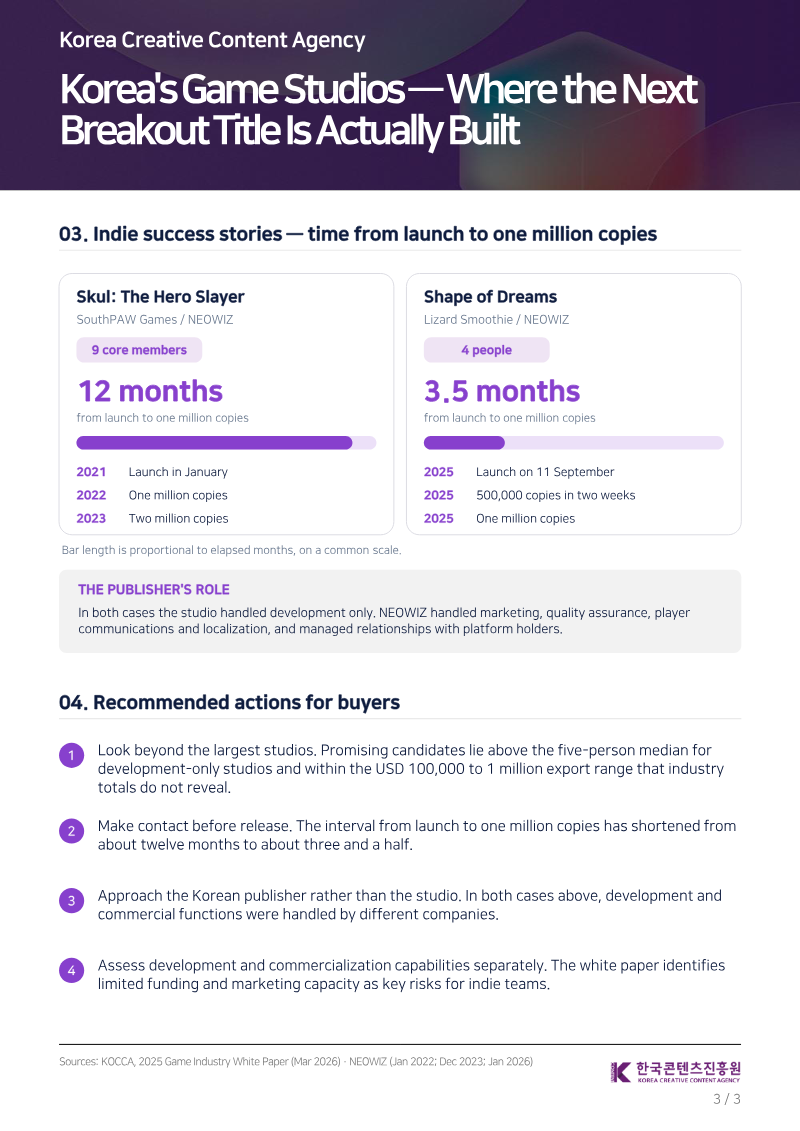
The South Korean gaming landscape is currently defined by a significant structural shift toward small-scale, high-impact development studios.
- The South Korean gaming industry is shifting from a concentration of large-scale publishers to a decentralized ecosystem dominated by studios with fewer than ten employees.
- A significant migration of experienced talent from major publishers to smaller indie teams accelerated in late 2023, directly improving the quality and marketability of independent projects.
- Small, agile studios are now identified as the primary engine for innovation and the most likely source of the next generation of globally competitive Korean titles.

Korea's Game Developers and AI: What Changes in Licensing Contracts
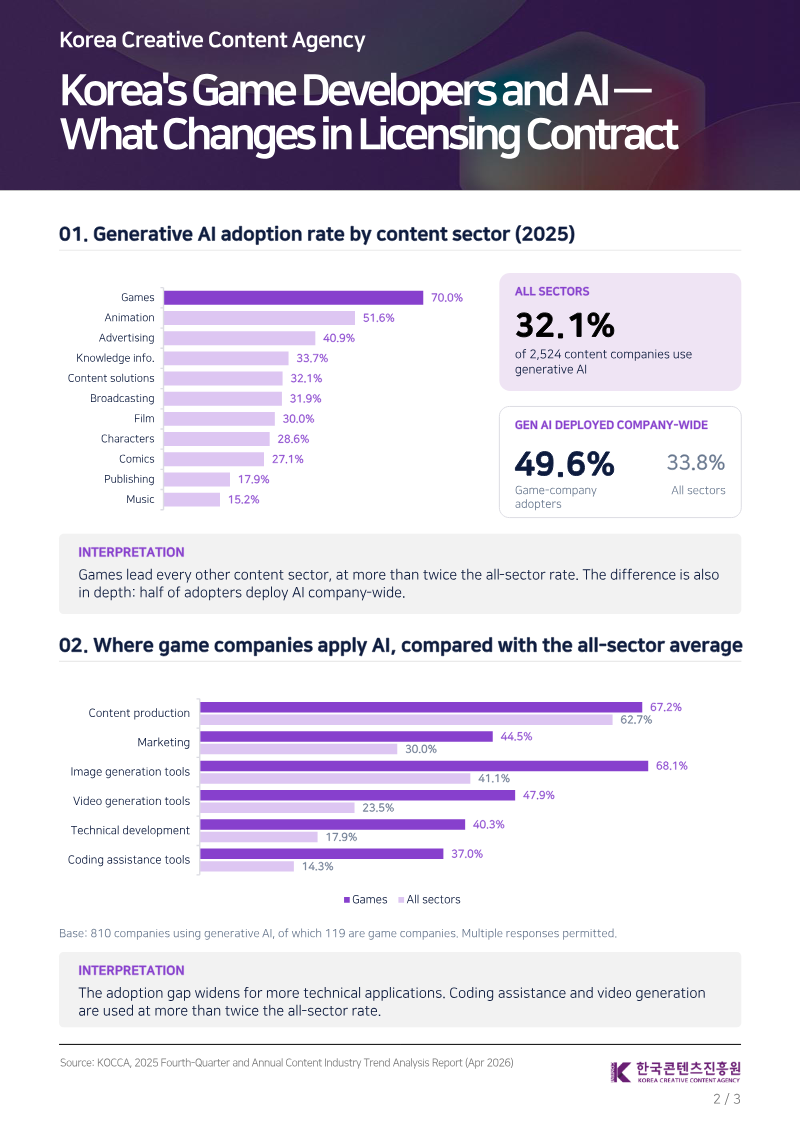
Generative artificial intelligence has become a foundational element of the South Korean game industry, with adoption rates reaching 70 percent, significantly outpacing all other content sectors.
- As of 2025, 70% of South Korean game companies have integrated generative AI into their development workflows, making the gaming sector the leader in AI adoption among all Korean content industries.
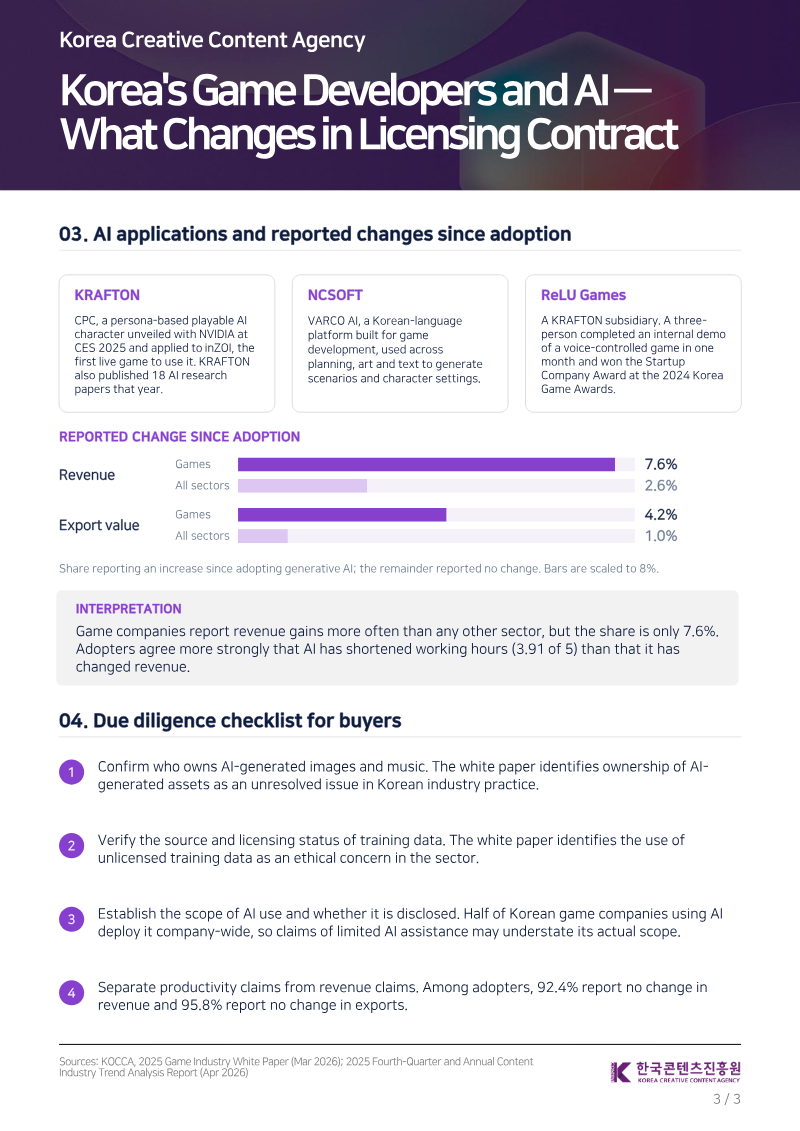
- Half of all Korean game companies have moved beyond departmental experimentation to full company-wide deployment of AI, marking a permanent shift in production methodologies.
- The widespread use of AI-generated assets has created significant legal complexities regarding copyright ownership and potential intellectual property infringement.