Neogames Finland
Association7 documents
Documents
Report64 pages
The Game Industry of Finland Report 2024
The 2024 overview of Finland’s game sector presents a comprehensive assessment of an industry that remains a global technology leader while confronting a tightening financing environment. Employment reached roughly 4,300 individuals, equivalent to about 3,800 full‑time positions, underscoring the sector’s significance within the national economy. However, a pronounced drop in private risk capital and publisher backing has pushed many studios toward B2B subcontracting, co‑development agreements, and an expanding reliance on European Union and national public R&D programmes, especially after recent reductions in regional funding streams.
Talent depth continues to drive innovation, with Finnish teams at the forefront of AI‑assisted development, proprietary engines, and cloud‑gaming solutions. Persistent shortages of senior developers and specialists in Unreal Engine, together with increasing regulatory complexity and geopolitical uncertainty, pose constraints on future growth. New public R&D instruments and targeted regional SME support aim to mitigate these pressures and sustain the ecosystem’s dynamism.
Geographically, the industry is anchored by a network of regional hubs, notably Jyväskylä’s EXPA, which serves as a northern innovation cluster. The ecosystem is highly diversified, ranging from global powerhouses such as Supercell—employing over 800 staff and delivering seven worldwide hit titles—to agile indie studios like Snowhound, which hosts more than 120 employees from over twenty nationalities, and niche ventures such as Soihtu DTx, which secured a $4.2 million seed round for a clinically validated mental‑health game. Across the board, firms are expanding into cross‑platform and co‑development projects, exemplified by collaborations between Ubisoft RedLynx and Zaibatsu Interactive, reflecting a broader trend toward collaborative, multi‑disciplinary production.
- Finland’s game industry currently employs approximately 4,300 individuals, representing about 3,800 full-time positions.
- A significant decline in private risk capital and publisher funding has forced studios to pivot toward B2B subcontracting, co-development agreements, and increased reliance on EU and national public R&D programs.
- The ecosystem remains anchored by major players like Supercell, which employs over 800 staff and has produced seven global hit titles, alongside diverse ventures like the mental-health game developer Soihtu DTx, which recently secured a $4.2 million seed round.
- Finnish studios are increasingly adopting collaborative production models, evidenced by cross-platform partnerships such as the collaboration between Ubisoft RedLynx and Zaibatsu Interactive.
- Despite innovation in AI-assisted development and cloud gaming, the industry faces growth constraints due to a persistent shortage of senior developers and specialists proficient in Unreal Engine.
+1
Neogames FinlandJan 2024
Report147 pages
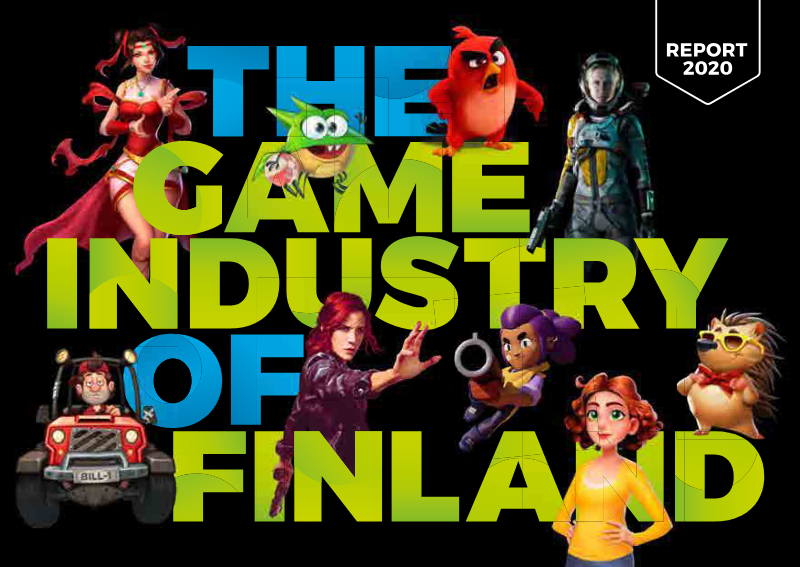
The State of the Finnish Game Industry 2020
The Finnish game industry solidified its position as a cornerstone of the national economy in 2020, maintaining a turnover exceeding €2 billion for the sixth consecutive year. Despite a slight contraction in the total number of active studios to approximately 200, the sector experienced a maturation phase characterized by increased revenue stability and a rise in high-performing firms. With 46 studios now generating over €1 million annually and a collective net profit surpassing €500 million, the industry demonstrated remarkable resilience against the operational disruptions of the COVID-19 pandemic. This economic strength is supported by a workforce of 3,600 professionals, with a persistent demand for hundreds of additional hires, reflecting a healthy, expanding ecosystem.
The industry is currently undergoing a strategic transformation driven by technological shifts toward cloud gaming, artificial intelligence, and Games as a Service models. While developers benefit from a robust network of public funding, private investment, and professional associations, they face mounting pressures from market consolidation, rising user acquisition costs, and regulatory fragmentation. To remain competitive in a saturated global market, Finnish studios are increasingly prioritizing data-driven design, social integration, and the development of strong intellectual property. This shift is accompanied by a positive trend in workforce diversification, with female representation reaching 22 percent.
The Finnish landscape remains defined by a diverse array of entities, ranging from global mobile giants like Supercell and Rovio to specialized indie developers and B2B service providers. These companies successfully balance creative autonomy with sustainable business practices, leveraging both original IP and work-for-hire models. By integrating emerging roles such as content creators and streamers into the development lifecycle, the industry continues to evolve, ensuring that Finnish studios maintain their significant footprint in the global digital entertainment market through innovation in mobile, console, and emerging technology platforms.
- The Finnish game industry maintained a turnover exceeding €2 billion in 2020, marking the sixth consecutive year of achieving this milestone.
- Industry profitability remains strong with 46 studios generating over €1 million annually and a collective net profit surpassing €500 million.
- The sector employs 3,600 professionals across approximately 200 active studios, with a persistent demand for hundreds of additional hires.
- Strategic development is shifting toward cloud gaming, artificial intelligence, and Games as a Service models to combat rising user acquisition costs and market saturation.
- Workforce diversification is improving, with female representation in the industry reaching 22 percent.
Neogames FinlandJan 2020
Whitepaper22 pages
Game Industry Policy Recommendations for 2019‑2024: Finland
Three ways to bring Finland to the forefront of the digital shift............. 3 More than half of Finns and nearly a third of the global population 4 play games actively............................................................................... The Finnish game industry 5 is the success story of the 21st century.....
- The Finnish game industry is a significant success story, with almost 3,000 employees and a growing number of companies employing over 50 people with turnovers exceeding 10 million euros by 2017.
- Finland has a high rate of game players, with over half of Finns and nearly a third of the global population actively playing games. The average age of a Finnish player is 38 years old.
- The shift to digital distribution revolutionized the game industry, allowing developers to retain 70% of profits, a significant increase from the previous 15-25%. Rovio's Angry Birds was an early beneficiary of this change.
- Key policy recommendations include allocating 100 million euros to address the talent shortage, making Finland an attractive place for digital development, and advocating for Europe to drive global regulation of digital markets.
- Finnish game development has a long history, starting with Chesmac in 1979, and saw its first boom with the advent of WAP in 1999, despite WAP not meeting expectations. Notable successes include Housemarque’s Supreme Snowboarding, Remedy’s Max Payne, and Sulake’s Habbo Hotel.
Neogames FinlandJan 2019
Report136 pages
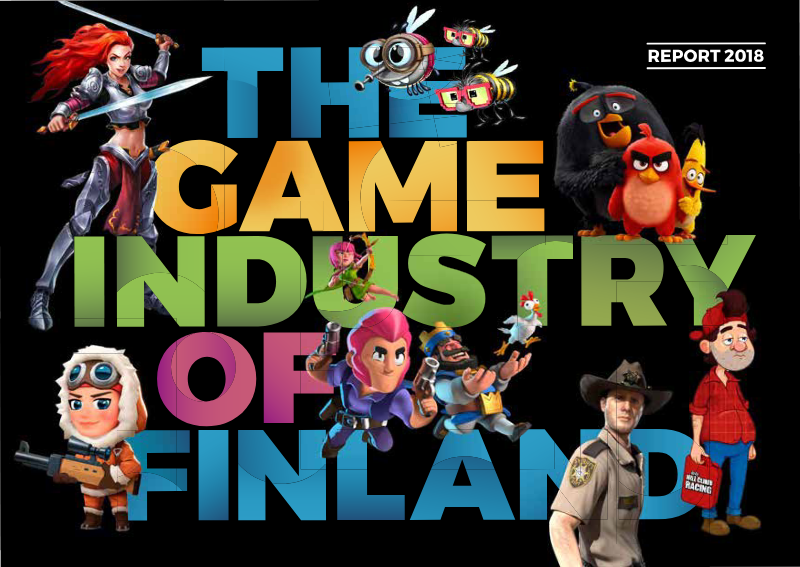
Finnish Game Industry Report 2018
Fingersoft • Ηill Climb Racing 2 Futureplay • Battlelands Royale Next Games • Τhe Walking Dead: Our World Rovio Εntertainment • Angry Birds 2 Small Giant Games • Εmpires & Puzzles Supercell • Brawl Stars, Clash Royale, Clash of Clans and Ηay Day Remedy Εntertainment • Control Rival Games • Τhief of Τhieves: Season One Superplus Games • Ηills of Steel Nitro Games • Ηeroes of Warland Κukouri Mobile Εntertainment • Pixel Worlds Publisher Neogames Finland ry (2019) 2.
- The Finnish game industry has a strong history of significant international investments and acquisitions, including Softbank acquiring 51% of Supercell (2012-2014) and Tencent acquiring 80% of Supercell (2016), alongside numerous game studio acquisitions.
- Helsinki is a global leader in mobile game development, hosting over 80 companies, 1,600 employees (28% non-Finnish), and generating a 2018 turnover of 1.7 billion EUR, with 98.4% from exports.
- Finnish developers are rapidly adopting Nintendo (Switch) as a target platform, with its popularity growing from 4% in 2016 to 20% in 2018; chat games also emerged as a new focus (5% in 2018).
- Multiplatform development is common, with Android (75%), iOS (71%), and PC/PC online (50%) being the most popular platforms in 2018, while Windows mobile and Facebook are no longer targeted.
- Finnish game developers are actively exploring new market disruptions like blockchain, cross-platform games, cloud gaming, subscription models, HTML5 (including chat games), and XR technologies, demonstrating a strong ability to adapt.
+1
Neogames Finland ryJan 2019
Report46 pages
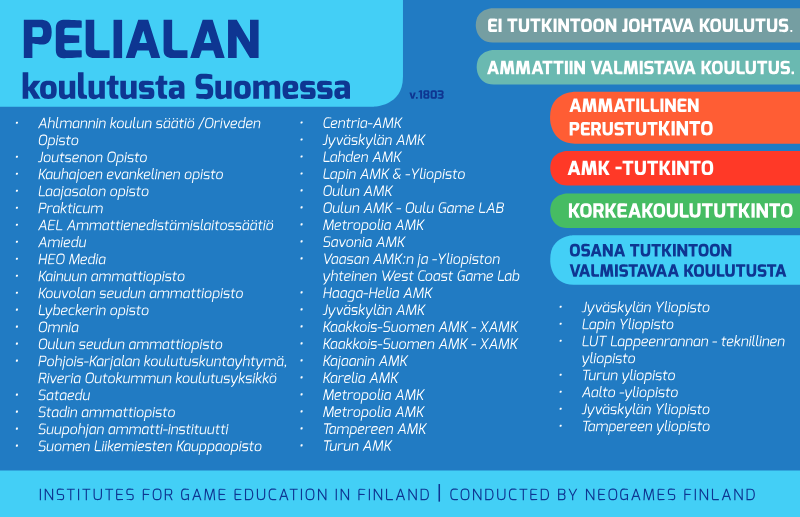
Koulutusta Suomessa
• Ahlmannin koulun säätiö /Oriveden • Opisto • • Joutsenon Opisto • • Kauhajoen evankelinen opisto • • Laajasalon opisto • • Prakticum • • AEL Ammattienedistämislaitossäätiö • • Amiedu • • HEO Media • • Kouvolan seudun ammattiopisto • • Lybeckerin opisto ...
- Finland offers a wide range of game industry education, from vocational training to university degrees, including programs focused on game programming, design, art, and business.
- Vocational education (AMMATILLINEN PERUSTUTKINTO) includes programs like Datonomi, Media-alan perustutkinto (Animation and Game Industry), and Peliohjelmoija, with durations typically ranging from 2 to 3 years.
- Universities of Applied Sciences (AMK) offer Bachelor's degrees (AMK-TUTKINTO) in fields such as Information Processing (Tietojenkäsittely) and Culture and Arts (Game Design), generally lasting 3.5 to 4 years.
- Several institutions offer non-degree game-related training, such as 'Kohti Pelialaa' at Joutsenon Opisto (9 months, 31 ECTS), 'Spelproduktion' at Prakticum (1 year, 60 ECTS), and 'Pelisuunnittelu' at HEO Media (9 months, 60 ECTS).
- Specialized programs exist, like Oulu Game LAB (Oulun AMK), West Coast Game Lab (Vaasan AMK & Yliopisto), and Metropolia AMK's 3D-animation and visualization with a focus on game graphics.
+1
Neogames FinlandJan 2018
Report72 pages
Finnish Game Industry Report 2016
16 | The State of The Finnish Game Industry 22 | Location of Companies and Clusters 36 | Trends and Future / Platforms and Genres 43| Trends and Future / Industry Framework 48 | The Industry Support and Networks 49 | Suomen Pelinkehittäjät ry 55 | IGDA Finland ry 4 72 | Studio Profiles (separate file) ABOUT THIS REPORT Cities: Skylines have conquered the world, and well over a billion people FOR almost a decade, our game all over the globe...
- The Finnish game industry employed 2,750 people in 2016, a steady increase from 2,500 in 2014 and 2,700 in 2015. The industry's turnover reached €2.5 billion in 2016, up from €2.4 billion in 2015 and a significant rise from €87 million in 2008.
- The number of active Finnish game companies grew from 2 in 2002 to 250 in 2016, with a notable acceleration in new studio founding years after 2010.
- Key challenges for Finnish game developers include the high cost and difficulty of user acquisition for Free-to-Play games, the unpredictability of the industry, and the need for professional management as companies grow.
- Mobile e-sports showed faster progress than VR in 2016, with VR remaining a niche market due to immature technology. Wargaming and Zynga established mobile development operations in Helsinki.
- Rovio's 'The Angry Birds Movie,' released in spring 2016, became the most successful film based on a mobile game. Secondary platforms like AppleTV and Android TV are gaining importance for mobile developers due to easier discoverability.
Neogames FinlandJan 2016
Report116 pages
Finnish Game Industry Report 2014
17 | The Founding Years of Studios 29| Financial Outlook ob 40 | Finnish game developer studios assn. Fingersoft • Hill Climb Racing Rovio Entertainment • Angry Birds, Supercell • Clash of Clans, Hay Day Two Men and a Dog • Zombie Catchers THE OLDEST Finnish game companies still in existence are turning 20 this year (2015).
- The Finnish game industry experienced explosive growth in 2014, with turnover reaching approximately €1.8 billion, a 100% increase from the previous year, though accounting practice changes affect direct comparability.
- The industry's turnover per employee significantly increased, from €75,850 in 2008 to €720,000 in 2014, largely due to digital distribution and the Free-to-Play (F2P) model in mobile games.
- Employment in the Finnish game industry has grown steadily, reaching 2,500 people in 2014, up from 1,147 in 2008.
- The concentration of game developer studios in the capital area (Helsinki, Vantaa, Espoo) has decreased from 64% in 2009 to 38% in 2014, with regional clusters emerging in cities like Turku and Tampere.
- The Finnish game industry has a history rooted in the late 1990s 'Internet bubble,' with Nokia's investment in WAP protocol influencing its direction into the next decade.
+1
Neogames FinlandMar 2015