Monetization reports and market data
Documents

Building the Metaverse with Jon Radoff, CEO of Beamable
The gaming industry is undergoing a fundamental shift toward a decentralized, creator-centric metaverse, defined not as a singular corporate destination but as the next evolution of the internet.
- The metaverse is evolving into an open, decentralized ecosystem defined by interoperable standards and spatial computing rather than singular, walled-garden corporate platforms.
- Studios should shift from high-risk, monolithic project models toward capital-efficient, rapid iteration cycles to ensure long-term viability.
- Developers can improve efficiency by utilizing modular, third-party backend infrastructure to offload complex engineering tasks, allowing teams to focus exclusively on core game design.

TWIG 145: How FIFA Ultimate Team's new Preview Packs actually boosted loot box sales
The gaming industry is currently navigating a period of intense regulatory scrutiny regarding loot boxes, with legislative efforts in regions like the United Kingdom and Australia, alongside age-appropriate design codes, threatening the future of this monetization model.
- Electronic Arts reported that FIFA Ultimate Team 'Preview Packs' increased engagement and conversion rates, though analysts caution that these results may be skewed by seasonal revenue spikes.
- The gaming industry faces significant regulatory pressure in the UK and Australia regarding loot boxes, forcing developers to explore alternative monetization models to mitigate potential revenue losses.
- Developers are transitioning toward monetization strategies that emphasize skill, time, and direct cost, such as battle passes, ticket-based mission entry, and higher-priced direct asset purchases.

TWIG 144: Riot makes $100M on mobile. Micenuts?
Riot Games has generated over $100 million in global mobile player spending across its portfolio, a figure that, while significant in isolation, represents a modest contribution relative to the publisher’s annual PC revenue of $1.5 billion to $2 billion.
- Riot Games has generated over $100 million in total mobile player spending, led by League of Legends: Wild Rift ($65 million), Teamfight Tactics ($28 million), and Legends of Runeterra ($16 million).
- Despite the $100 million mobile milestone, these earnings remain a modest fraction of Riot’s annual PC revenue, which typically ranges between $1.5 billion and $2 billion.
- Mobile adoption remains limited, with Wild Rift reaching 50 million installs, while Teamfight Tactics and Legends of Runeterra have only achieved 6 million and 3 million installs, respectively.

Mobile Game Genre Report: Puzzle Games
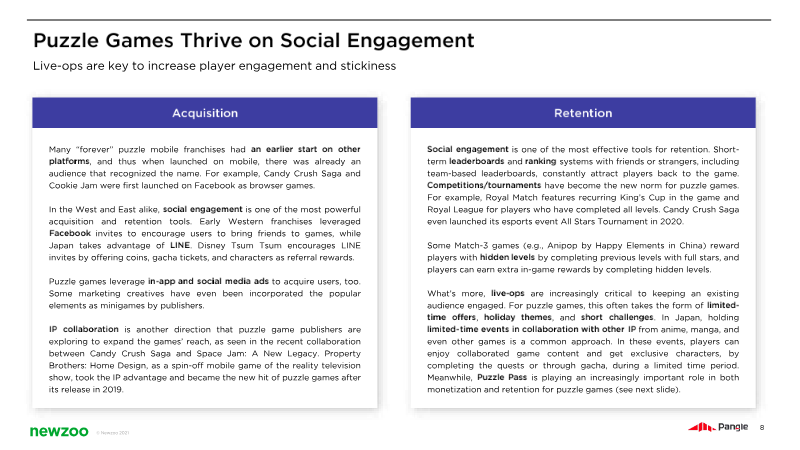
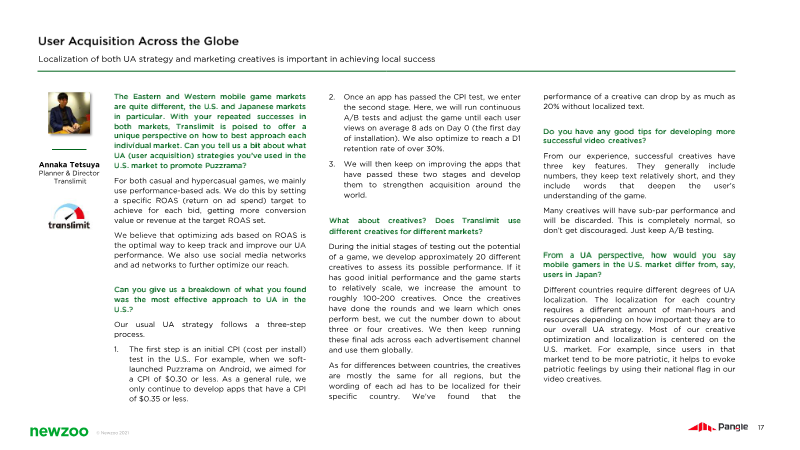
This analysis examines the mobile puzzle game market, contrasting dynamics between Western and Eastern regions with a focus on the United States, United Kingdom, Japan, and South Korea.
- The global mobile puzzle game market generated $6.9 billion in 2020, with the United States leading at $2.0 billion, followed by Japan at $1.2 billion and China at $0.9 billion.
- Puzzle games account for 8% of total mobile game revenue and represent the most popular genre across the United States, United Kingdom, Japan, and South Korea.
- Western markets favor casual experiences and in-app advertising (IAA), whereas Eastern markets demonstrate a higher propensity for in-app purchases (IAP) and complex mechanics like gacha systems.

Fireside Chat: Is it Time to Rethink the Ad Monetisation Waterfall
The mobile advertising landscape is undergoing a fundamental transition from manual, waterfall-based mediation to fully automated, real-time bidding.
- The mobile advertising industry is transitioning from manual waterfall mediation to fully automated real-time bidding, with full adoption expected within the next two years.
- Privacy-related changes, specifically the deprecation of IDFA, have triggered a 20% to 50% decline in eCPM across the industry.
- Developers must move beyond eCPM and fill rates to incorporate payment terms and opportunity costs into their financial models to accurately assess the net value of ad networks.

What are Your Existing Users Worth & How to Extract Maximum Value
This presentation outlines methodologies for valuing existing game user cohorts and leveraging that value to optimize growth.
- Treat existing user cohorts as financial assets by modeling the 'area under the curve' to project future revenue and secure non-dilutive capital.
- Calculate the residual value of cohorts—the expected revenue after initial acquisition—to optimize user acquisition (UA) efficiency and align costs with projected lifetime value (LTV).
- Prioritize capital-efficient funding by stacking ad network credit and free cash flow before resorting to debt facilities or equity to avoid unnecessary dilution.

Superstar Session: Making Profitable Hypercasual Hits
Achieving profitability in the hypercasual gaming sector requires a fundamental shift away from the traditional obsession with low Cost Per Install (CPI) toward a more nuanced strategy centered on the relationship between Lifetime Value (LTV) and acquisition costs.
- Profitability in hypercasual gaming is driven by the ratio between Lifetime Value (LTV) and acquisition costs, rather than a singular focus on minimizing Cost Per Install (CPI).
- Successful titles function as ad impression multiplication machines where the cumulative value of ad views must consistently exceed the cost of user acquisition.
- The development lifecycle consists of an initial data-gathering investment phase followed by a strategic throttling phase to ensure marketing campaigns maintain sustainable net revenue.

Panel: What Changes in Ad Monetisation Post-IDFA - The Good, the Bad & the Ugly
The removal of the Identifier for Advertisers (IDFA) and the implementation of App Tracking Transparency (ATT) have fundamentally restructured the mobile advertising ecosystem.
- The removal of IDFA and the implementation of ATT have forced a shift from granular, user-level tracking to fragmented measurement strategies, rendering traditional metrics like D7 ROAS less effective.
- Developers are pivoting to contextual intelligence and behavioral modeling, utilizing on-device data such as session depth and game category to identify high-value users without personal identifiers.
- The loss of deterministic data and effective retargeting capabilities has necessitated a move toward hybrid monetization models to maintain revenue efficacy.

Panel: Tools & Techniques for Game Economy Analysis & Optimisation
Successful game economy design requires a sophisticated balance between player progression, monetization, and content depth.
- Design game economies using a sources and sinks model to manage player time as the primary resource, ensuring progression remains rewarding while avoiding difficulty spikes that cause churn.
- Prioritize median values and high-percentile player behavior in data analysis rather than relying on simple averages, which often mask the nuances of diverse player segments.
- Implement hybrid monetization strategies, such as rewarded videos, to sustain engagement for non-paying users without compromising the experience for high-spending loyalists.

Maximising IAP Revenue With Global Pricing
Maximizing in-app purchase revenue requires a transition from static, U.S.-centric pricing models to dynamic, region-specific strategies that account for local purchasing power and demand elasticity.
- Transitioning from static, U.S.-centric pricing to region-specific models based on local purchasing power and demand elasticity can increase monthly revenue by 24% to 45% in growth markets like Indonesia, Brazil, and Europe.
- Developers should move beyond simple currency conversion by building a propensity-to-buy index that incorporates macroeconomic indicators such as GDP, device penetration, and local consumer goods pricing.
- Pricing strategies must be treated as an iterative process with monthly adjustments to account for fluid game economies, currency fluctuations, and competitive market pressures.

Superstar Session: Critical Traffic Patterns & Insights to Monetise Your Game in Japan & SEA Markets
Maximizing monetization in Japan and Southeast Asia requires a departure from standardized global strategies in favor of deep culturalization and region-specific engagement tactics.
- Success in Japan and Southeast Asia requires moving beyond basic translation to deep cultural integration, as superficial localization fails to resonate with local audiences.
- Japanese gameplay must be optimized for short, one-handed sessions to align with structured daily commuting habits.
- Southeast Asian markets show consistent mobile usage throughout the day and a higher propensity for video-based ad interactions compared to other regions.
The Future of App Monetisation: An Industry Outlook
The mobile gaming industry is currently navigating a period of significant disruption and opportunity, driven by evolving privacy regulations and shifting consumer behaviors.
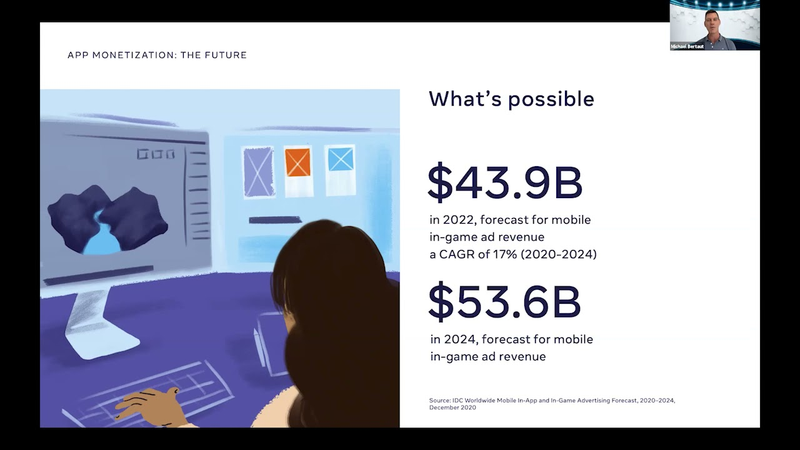
- Mobile game in-app ad revenue is projected to exceed $53 billion by 2024, with a forecasted compound annual growth rate of 17%.
- Developers are shifting toward hybrid monetization models that integrate both in-app purchases and in-app advertising to mitigate the impact of privacy regulations like Apple’s iOS 14.5.
- In-app ad revenue for games saw a 21.3% increase in 2021, significantly outpacing the growth of non-gaming applications.