Monetization reports and market data
Documents
Monetization Madness - How Games Make Money - Extra Credits
The monetization of video games is a foundational element of game design that dictates how developers support their projects and interact with their audiences.
- A game's chosen revenue model is a foundational design element that dictates gameplay mechanics, development processes, and long-term player engagement strategies.
- Modern monetization has shifted from simple pay-to-play arcade models to complex, hybrid strategies that combine premium purchases, free-to-play access, and ongoing microtransactions.
- Free-to-play models, which originated in South Korea and the mobile sector, rely on continuous revenue streams such as cosmetic microtransactions, subscriptions, and randomized loot boxes.

Key Challenges for Blockchain Gaming ft. Lars Doucet
This analysis examines the fundamental challenges facing blockchain technology within the gaming industry, focusing on the disconnect between theoretical promises and practical implementation.
- The 'degraded blockchain' problem occurs when game assets rely on centralized servers, nullifying the benefits of decentralization because a central authority can still arbitrarily alter or remove user assets.
- Play-to-earn models frequently function as unsustainable finance-driven schemes that rely on continuous new investment rather than genuine gameplay value to maintain economic stability.
- Digital land speculation creates artificial scarcity that mirrors real-world housing crises, leading to rent-seeking behaviors that alienate the broader player base.

Scaling Up a Merge Game with Antti Hattara, CEO Starberry Games
The merge genre has evolved from a simple casual category into a highly competitive landscape where long-term retention is the primary determinant of success.
- Long-term retention beyond 90 days is now the primary metric for success in the highly competitive merge game market.
- Developers can differentiate their titles by pivoting from simple idle mechanics toward complex city-building simulations.
- Scaling requires a dual strategy of consistent content updates and advanced performance marketing, leveraging automated tools to overcome IDFA deprecation challenges.

Here's How You Capitalize From the Apple vs. Epic Court Ruling
The Epic versus Apple litigation serves as a pivotal catalyst for a structural shift in mobile game monetization, moving the industry away from total reliance on proprietary app store payment systems.
- The Epic vs. Apple litigation has legitimized the use of external payment links and web-based storefronts, allowing developers to bypass traditional 30% platform commission fees.
- Large-scale publishers adopting direct-to-consumer web commerce are reporting revenue increases of up to 40%.
- Moving monetization to web-based channels enables real-time A/B testing on pricing and bundles, bypassing the rigid update cycles imposed by proprietary app stores.

Apple vs Epic Games Trial: Who Won?
The recent court ruling in the Apple versus Epic Games case represents a complex, split decision that carries significant implications for the mobile gaming industry.
- The court ruled that Apple must allow developers to include external links and buttons that direct users to alternative payment methods, effectively challenging the App Store's long-standing payment monopoly.
- While the court rejected Epic Games' claim that Apple is an illegal monopoly, it ruled in favor of Epic under California’s unfair competition law.
- Transitioning to external payment models could potentially increase revenue for mobile developers by 30% to 40% by bypassing Apple’s 30% commission on in-app purchases.

TWIG 149: Reaction to Axie Infinity’s $1.2 Billion Annualized Revenue
The current landscape of blockchain-based gaming is characterized by extreme volatility, speculative hype, and a lack of sustainable business models.
- Current blockchain gaming models like Axie Infinity rely on a constant influx of new users to maintain liquidity, creating a fragile ecosystem that risks collapse once growth plateaus.
- Axie Infinity’s annualized revenue figure of $1.2 billion is widely criticized as a misleading metric that conflates short-term speculative spikes with sustainable business performance.
- NBA Top Shot serves as a cautionary example of volatility, with monthly gross sales plummeting from $230 million to $34 million within a few months.

TWIG 148: China curbs playtime + Nexters SPACs at $1.9B + Playtika acquires Reworks for $400M cash
The gaming industry is currently navigating significant regulatory shifts in China, where new government mandates restrict individuals under the age of 18 to three hours of video game playtime per week.
- New Chinese regulations restrict minors to three hours of gaming per week, limited to one hour daily between 8:00 p.m. and 9:00 p.m. on Fridays, weekends, and holidays, forcing Chinese developers to pivot toward Western markets.
- Playtika acquired an 80% stake in Reworks for $400 million in cash, with an option to purchase the remainder for up to $200 million to compete in the design entertainment app market.
- Mobile developer Nexters went public via SPAC at a $1.9 billion valuation, aiming to consolidate the Eastern European and Russian markets despite concerns over its reliance on the $20 million monthly revenue generated by Hero Wars.
Children's In-Game Spending: 2020 GameTrack Report
The 2020 GameTrack report, conducted by Ipsos for the Interactive Software Federation of Europe, examines trends in children’s in-game spending across major European markets, including the UK, France, Germany, Spain, and Italy.
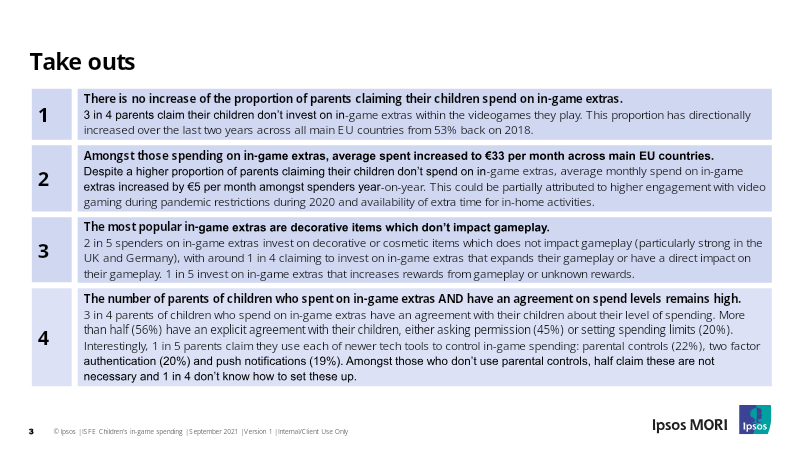
- The vast majority of children do not engage in in-game purchases, with 74% of parents reporting zero spending on extras in 2020.
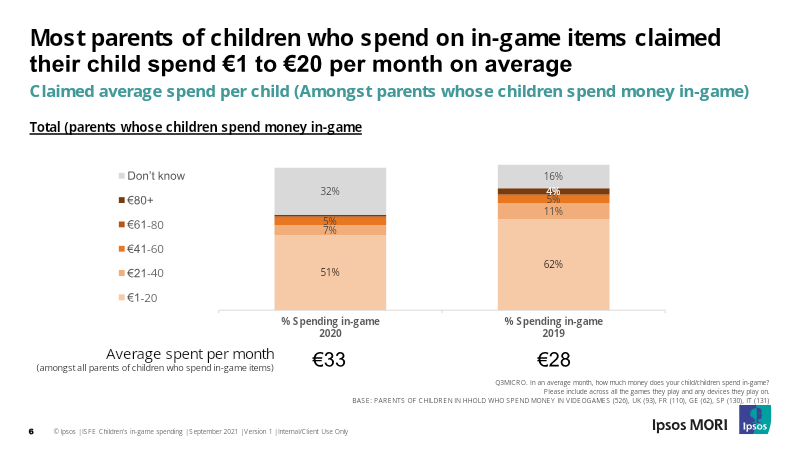
- Among the minority of children who do make in-game purchases, the average monthly expenditure rose to €33 in 2020, a €5 increase from the previous year.
- Cosmetic or decorative items that do not impact gameplay are the most popular purchases, favored by 39% of children who spend money in games.

India F2P Games Conference | Aug 26, 2021 (Thurs @10AM - 2PM IST / Aug 25 Wed @9:30PM PST)
The Indian free-to-play (F2P) gaming sector is undergoing a rapid transformation, evolving from a low-cost outsourcing hub into a sophisticated, high-growth market capable of producing original, globally competitive intellectual property.
- The Indian F2P sector is transitioning from an outsourcing hub to a creator of original, globally competitive IP, driven by a mobile-first user base and a shift toward high-monetization midcore genres.
- Successful studios are adopting a 'craftsman' production model that prioritizes the granular deconstruction of global hits to master the mechanics of engagement and retention.
- Developers are increasingly treating games as 'live services' by utilizing backend-as-a-service solutions and CI/CD pipelines to focus resources on core gameplay innovation rather than foundational infrastructure.

PocketGamer.Biz with Sunday, RoundTables - What’s the secret of a successful hypercasual game?
The hypercasual gaming sector operates on a foundation of rapid iteration, data-driven validation, and a relentless focus on marketability.
- Hypercasual success depends on communicating the core mechanic within a three-second video advertisement to minimize cost-per-install.
- Development teams should remain lean, typically consisting of three to four people, to facilitate rapid prototyping and agile market testing.
- Developers must prioritize data-driven performance benchmarks over creative intuition, pivoting immediately to new concepts if retention and lifetime value metrics are not met.

SciPlay's Joe Byrne on Social Casino
The social casino industry is currently navigating a significant strategic shift, driven by the need for granular market intelligence and the operational challenges posed by the deprecation of IDFA.
- Social casino developers are shifting toward a higher volume of spenders with smaller transaction sizes, necessitating a focus on increasing average transaction value and session frequency.
- The deprecation of IDFA has forced companies like SciPlay to rely on granular market intelligence, including detailed taxonomy and competitive performance analysis, to guide product roadmaps and M&A activity.
- Social casino games are increasingly adopting meta-progression systems—such as progression maps, builder mechanics, and narrative-driven live operations—to improve player retention and engagement.

IDFA Loss: Real Data & Real Talk
The deprecation of the Identifier for Advertisers (IDFA) on iOS has fundamentally restructured the mobile gaming industry, resulting in a 15% to 20% decline in revenue across diverse portfolios.
- The deprecation of IDFA has caused a 15% to 20% decline in revenue across mobile gaming portfolios due to the collapse of granular tracking and lookalike audiences.
- Market efficiency has decreased as the loss of deterministic tracking leads to higher costs per mille and lower install quality.
- Niche, whale-dependent genres like social casino and strategy games have experienced the most significant disruptions, whereas broad-market titles remain more resilient.