Mobile reports and market data
Documents

Publishing 101: What Game to Build, Why, and Which Publisher is Right for You by John Wright
Mobile game publishing serves as a critical strategic lever for developers navigating a challenging financial landscape characterized by a five-year low in venture capital funding.
- Publishers prioritize a 'hunting' strategy over 'farming,' with hunting yielding a 1-in-20 to 1-in-50 success rate compared to the 1-in-300 to 1-in-500 success rate of portal-based farming submissions.
- Developers should adopt a 'plus one' strategy by iterating on existing successful game mechanics rather than pursuing high-risk, true innovation, which has a high failure rate due to unpredictable market reception.
- Lean development teams should focus exclusively on core product engineering and MVP development, leveraging publishers to provide the necessary capital, marketing expertise, and expensive third-party technology stacks.

Why Your Game's Ads Need to Evolve–Fast | AI-Powered Creative Intelligence Platform to Unlock Scale
Modern game marketing requires a fundamental shift from intuition-based strategies to a rigorous, data-driven framework that treats creative assets as quantifiable variables.
- AI-driven creative optimization allows studios to 10x human compute by deconstructing competitor ads into granular data points like colors, music, emotions, and call-to-action messaging to identify high-win-rate patterns.
- Treating creative production as a science rather than just art enables studios to reduce failure rates, which can otherwise exceed 95% when ads are not aligned with specific audience preferences across different regions and platforms.
- Data-backed creative adjustments can lead to significant performance gains, such as a 5x increase in win rates for a sports-related advertiser after optimizing messaging to better resonate with the target audience.

Week in Mobile Games E43 - NetEase scales back, Jam City's Ludia sale, & why Savvy wants Pokémon Go
The global mobile gaming industry is undergoing a period of significant structural realignment characterized by aggressive cost-cutting, divestment, and a pivot toward core competencies.
- Niantic is reportedly exploring the sale of its gaming portfolio, including Pokémon GO, to Scopely as it seeks to pivot toward becoming a pure technology provider.
- NetEase is scaling back its U.S.-based development operations to refocus on domestic production, signaling a shift away from expensive Western studio acquisitions.
- Unity’s stock price surged despite a 25 percent decline in revenue and substantial losses, driven by investor confidence in the company's new cost-reduction and portfolio adjustment measures.

TWIG #319 Scopely 💰 Niantic, Marvel Rivals Drama, and Xbox in Downfall?
The gaming industry is currently navigating a period of significant structural realignment, characterized by aggressive consolidation, shifting consumer demographics, and the struggle to maintain growth in a stagnant market.
- The console market has shifted into a zero-sum environment where Sony is consistently gaining market share at the expense of Microsoft.
- Niantic’s gaming division is currently the subject of acquisition rumors at a valuation of $3.5 billion, highlighting the ongoing struggle to sustain growth in the location-based augmented reality sector.
- Chinese firms like NetEase are pivoting away from costly Western satellite studios, signaling a broader industry-wide shift toward lean operations and away from speculative expansion.

2.5 gamers x Live AM(F)A #8 - Ask Me Anything @ February 19 5:00pm CET
Modern mobile game development requires a sophisticated approach to user acquisition and data management in an increasingly privacy-centric landscape.
- Developers should prioritize internal testing and beta tracks over global releases to maintain store visibility and maximize feature potential in a privacy-centric environment.
- To bypass the limitations of Apple’s SKAdNetwork and the decline of IDFA, studios are shifting toward creative-level attribution and on-device calculations.
- Early-stage game ideation should be validated using conversion-based campaigns on platforms like Facebook, as these provide more accurate audience behavior data than click-based metrics.

The #1 AI Skill You NEED to Succeed in Marketing (Hint: It’s Not Data Crunching)
Artificial intelligence is fundamentally reshaping the landscape of user acquisition by functioning as a critical force multiplier that enhances creative production and strategic decision-making.
- Prompt engineering is the critical skill for 2025, as marketers must learn to write effective creative briefs, storyboards, and narratives to direct AI tools rather than relying on full automation.
- AI acts as a force multiplier for User Acquisition (UA) teams, enabling individuals to perform the work of five people by leveraging AI for data analysis, decision-making, and creative generation.
- Strategic implementation of AI in creative production can significantly improve performance metrics, with one expert reporting an increase in creative win ratios from 10% to 50%.

The Smart Way to Extend Your Game's Lifecycle
The game industry is currently undergoing a strategic shift toward cross-platform development and direct-to-consumer monetization models to combat rising production costs and shrinking budgets.
- Developers can significantly increase profit margins by utilizing alternative web shops like Xsolla, which charge 5-6% in fees compared to the 30% commission standard on major mobile, Steam, and console platforms.
- Successful free-to-play monetization requires integrating revenue models—such as in-app purchases, subscriptions, or ads—into the core game design early to avoid player friction and ensure the economy feels natural.
- Extending a game's lifecycle can be achieved by porting titles to new platforms, transitioning premium games to free-to-play models, or adding multiplayer functionality to legacy titles to drive new sales.

Week in Mobile Games E42: Brawl Stars' highs, Squad Busters' struggle, & AppLovin's $900m games sale
Supercell has achieved a significant financial turnaround in 2024, reporting €2.78 billion in non-GAAP revenue as every title in its portfolio experienced year-over-year growth for the first time in a decade.
- Supercell reported €2.78 billion in 2024 non-GAAP revenue, marking the first time in a decade that every title in its portfolio achieved year-over-year growth.
- AppLovin is divesting its apps business for $900 million to focus exclusively on its high-growth advertising division, signaling a strategic retreat from direct game development.
- DeNA experienced an 8,000% quarterly profit surge driven by the strong market reception and high player retention of Pokémon Trading Card Game Pocket.

Supercell's Record Year: Crushing It, But At What Cost?
Supercell experienced a record-breaking fiscal year in 2024, reporting €2.8 billion in revenue, a 77% year-over-year increase. EBITDA also saw significant growth, rising 78% to €876 million.
- Supercell achieved a record-breaking 2024 fiscal year with €2.8 billion in revenue and €876 million in EBITDA, representing year-over-year growth of 77% and 78% respectively.
- The company’s financial resurgence was driven by a strategic pivot from organic user acquisition toward increased marketing expenditures and expanded live operations.
- Brawl Stars served as a primary revenue engine through aggressive updates, though the title is now showing signs of revenue deceleration that may create difficult year-over-year comparisons.

TWIG #318 Supercell’s Records, Unity’s Chaos & AppLovin’s Fire Sale
The global gaming industry is currently navigating a period of profound structural adjustment, characterized by market saturation, declining revenue per user, and a strategic pivot away from high-risk, mega-budget projects.
- AppLovin has exited game development by divesting its studio portfolio for $900 million, a sharp decline from its previous $2.4 billion valuation, to focus exclusively on high-margin, AI-driven ad-tech.
- Supercell generated a record €2.8 billion in revenue, driven by aggressive live-ops and marketing for titles like Brawl Stars, though the strategy faces concerns regarding rising user acquisition costs and long-term sustainability.
- The gaming industry is shifting away from high-risk, mega-budget projects toward sustainable, cash-flow-focused models as founders increasingly prioritize long-term ownership over acquisition-led growth.

Key aspects for Mobile Game Growth in 2025: UA, speed, monetization & globalization with Airbridge
The mobile gaming industry is undergoing a significant transformation as it moves toward 2025, characterized by the rise of hybrid-casual mechanics and a shift in innovation hubs toward emerging markets like Vietnam, Turkey, and South Korea.
- Mobile game growth in 2025 is driven by three core pillars: speed, monetization, and globalization, with industry development shifting away from Europe toward regions like Vietnam, Turkey, and South Korea.
- The number of apps on the Apple App Store doubled between 2022 and 2023, indicating that despite increased competition and user acquisition headwinds, developer interest remains high.
- Hybrid-casual games are defined by a revenue profile where 40–60% of income is generated via ads and 0–40% via in-app purchases, necessitating a focus on deep game economies to support long-term monetization.
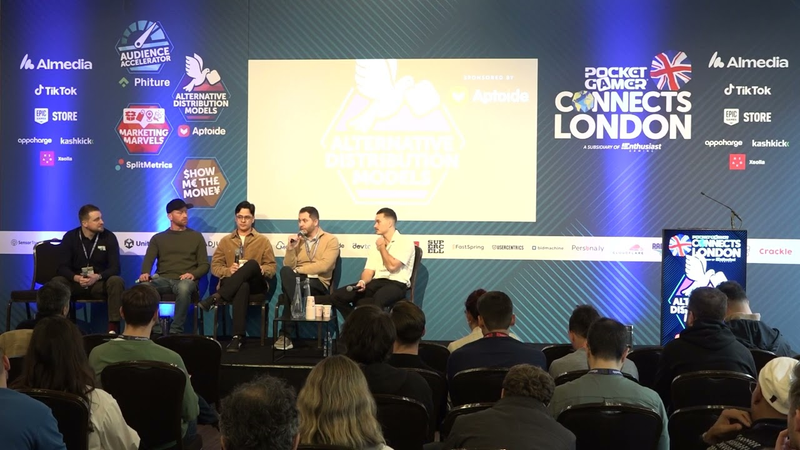
Panel: A New Era – How Alternative App Stores Are Opening Up New Opportunities For Game Makers.
The mobile gaming landscape is undergoing a structural transformation as alternative app stores evolve from niche, Asia-centric platforms into a viable global strategy for developers.
- Alternative app stores have transitioned from niche, Asia-centric platforms into a viable global strategy for mobile game developers seeking to bypass the Apple and Google duopoly.
- These platforms improve developer profitability by offering higher in-app purchase margins and greater economic flexibility compared to traditional storefronts.
- Alternative stores currently represent the third-largest segment by user volume in the mobile gaming market, indicating a significant shift toward a fragmented, multi-platform ecosystem.
Writers
Games and companies
Games