Mobile reports and market data
Documents

Whiteout Survival - How to Fake It to Make It
The mobile gaming industry is currently defined by a strategy of pairing casual, hyper-casual, or misleading gameplay advertisements with deep, complex 4X strategy monetization.
- Mobile strategy games like Whiteout Survival and Last War: Survival are achieving commercial success by using hyper-casual mini-game advertisements to funnel broad audiences into complex 4X monetization loops.
- Developers are mitigating the discrepancy between misleading ads and actual gameplay by integrating these casual mini-games directly into the core product as side activities or recurring events.
- While this 'fake' advertising strategy often results in lower user retention rates compared to traditional targeting, it remains a dominant and sustainable model for growth in the post-IDFA mobile landscape.

Ad tech that optimises for publishers | Jaivir Nagi from Crackle Technologies #pgconnects
Crackle Technologies focuses on optimizing ad monetization for game publishers, addressing a significant imbalance in the industry where investment in user acquisition has historically outpaced investment in monetization tools.
- Game publishers are currently losing revenue by relying on manual, cohort-based pricing instead of utilizing machine learning to determine the personalized value of individual users.
- The gaming industry faces a critical supply-demand imbalance where time spent in games has grown significantly faster than available advertising budgets, putting downward pressure on yields.
- While the buy-side of the advertising ecosystem has already widely adopted AI to identify user value, the sell-side remains under-resourced and reliant on manual management.

Breaking Silos & Boosting Growth: Metica’s AI-Driven Edge
Metica provides an AI-driven platform designed to accelerate mobile game growth by integrating user acquisition (UA) and in-game monetization into a unified, data-centric ecosystem.
- Studios implementing Metica’s integrated growth loops, which unify user acquisition and in-game monetization, have reported revenue uplifts ranging from 16% to over 40%.
- The platform utilizes contextual multi-armed bandits to test multiple game variants simultaneously, significantly accelerating production cycles compared to traditional A/B testing methods.
- By predicting individual player lifetime value (LTV) and feeding that data back into ad networks, the system improves targeting precision and assists financial teams in creating more accurate long-term forecasts.

From Prototypes to Hits: Inside Rollic’s Playbook with CEO Burak Vardal
The mobile gaming industry is undergoing a fundamental shift from hyper-casual, ad-driven models toward hybrid-casual experiences that prioritize long-term retention and in-app monetization.
- The mobile gaming industry is shifting from hyper-casual, ad-driven models to hybrid-casual experiences that prioritize long-term retention and in-app monetization.
- Successful hybrid-casual titles now require sustainable engagement cycles spanning 180 to 365 days, moving away from the short-term production cycles of the past.
- To maintain a competitive edge, studios must employ a rigorous testing culture that involves discarding over 1,000 prototypes annually to focus resources on high-potential concepts.

Vita Mahjong Game Review: Ads in Gaming? Yes!
Vita Mahjong serves as a prime example of a high-volume, ad-centric mobile gaming model that prioritizes aggressive monetization and scale over complex gameplay mechanics.
- Vita Mahjong generates $55 million in annual revenue, with 70% of that income derived from interstitial advertising rather than in-app purchases.
- The game maintains a massive scale of 3.4 million daily active users by reinvesting 70% to 80% of its $146,000 daily revenue back into aggressive user acquisition.
- Marketing strategy relies on high-velocity creative testing, including AI-generated content and health-focused claims regarding Alzheimer’s prevention and sleep improvement.
GOAT: Felix Braberg on Ad Monetization, and Fun | Full Interview
This analysis explores the current state of mobile game ad monetization, emphasizing the strategic balance between revenue generation and player retention.
- Implementing a mediation platform is the single most effective strategy for publishers, as it can double ad revenue by increasing competition among networks.
- Publishers should follow the '5% rule' for network integration: continue adding ad networks to a mediation stack as long as each network contributes at least 5% of total revenue.
- Successful hybrid-casual games like 'We Are Warriors' demonstrate that high ad frequency is viable, achieving 15–16 rewarded ad impressions per day for 82% of their user base.

Week in Mobile Games E44 - AppLovin vs. short-sellers
AppLovin currently faces scrutiny following allegations from short-sellers regarding metric inflation and data tracking practices.
- AppLovin leadership has formally refuted short-seller allegations concerning metric inflation and data tracking practices, which had caused temporary volatility in the company's share price.
- The mobile gaming industry is currently defined by a cautious investment climate and ongoing layoffs, making mid-to-late-stage funding difficult to secure.
- Despite broader funding challenges, there is a notable resurgence in early-stage studio formation as developers seek to mitigate rising user acquisition costs.

Mobile App Trends: 2025 Edition
Adjust and AppLovin's 2025 mobile app outlook portrays an app economy in recovery, with 2025 framed as a year for refining and scaling recent innovations rather than launching new ones.
- Global mobile consumer spending is projected to reach $626 billion by 2030, supported by a 2024 surge in app installs and a 35% App Tracking Transparency opt-in rate.
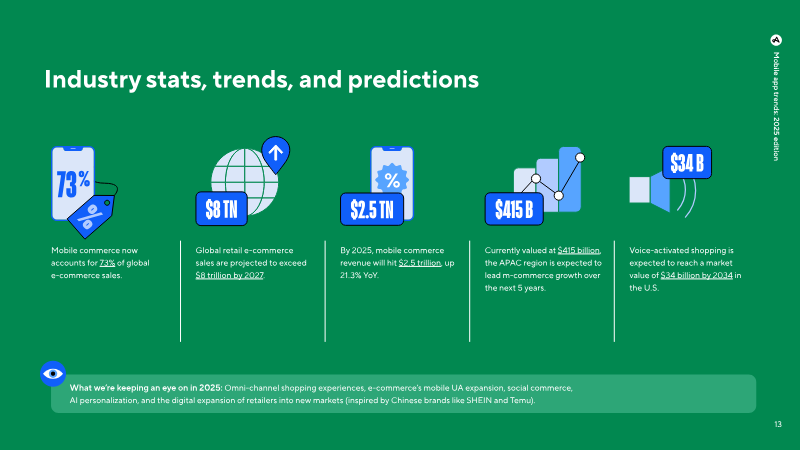
- Mobile commerce accounts for 73% of global e-commerce sales, with 2025 revenues expected to hit $2.5 trillion despite rising acquisition costs averaging $3.44 per install.
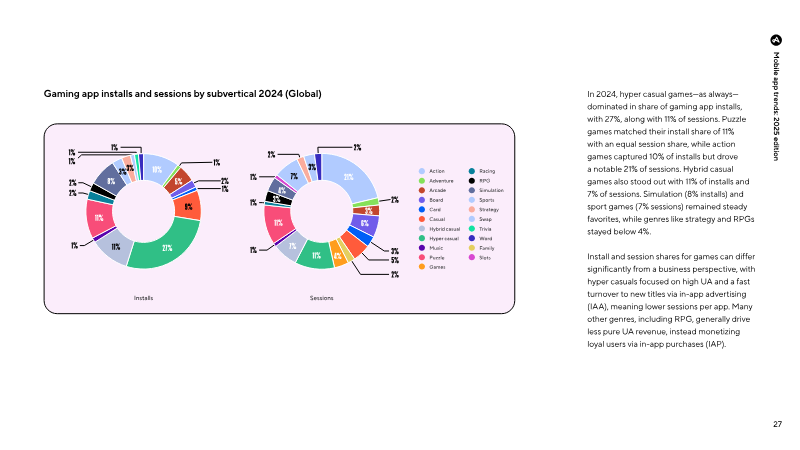
- The mobile gaming sector is projected to reach $126.1 billion in 2025, with strategy games experiencing an 83% growth in installs and global session lengths exceeding 30 minutes.



Mobile Games Industry Trends Survey: Winter 2024/25
The Winter 2024/25 PocketGamer.biz survey portrays a mobile games industry that returned to market growth in 2024 while still absorbing the effects of continued layoffs.
- Rising user acquisition costs are the primary threat to profitability, cited by 64.2% of industry professionals as the greatest challenge to the sector.
- The industry is in a period of consolidation, with 56.7% of professionals identifying widespread layoffs as the most impactful trend of the 2024/25 period.
- Strategic focus has shifted away from new IP, as evidenced by over 40% of organizations releasing zero new titles in the past year to prioritize existing live operations.

TWIG #320 Unity’s Fate, Fake Ads, Loot Boxes & GTA’s UGC Revolution
Hasbro’s digital gaming division has achieved notable success through a licensing-heavy strategy, exemplified by the $112 million contribution from Monopoly Go, which fueled a 22% year-over-year growth.
- Hasbro’s digital gaming division grew 22% year-over-year, driven largely by a $112 million contribution from the licensed title Monopoly Go.
- The Epic Games Store generates $1.1 billion in annual revenue, though this figure is primarily sustained by Fortnite integration rather than third-party game sales.
- Unity is struggling to pivot to its Vector ad-tech platform due to the sunsetting of IronSource, loss of key architectural talent, and persistent data quality issues.

Rise of Vietnam: Mobile Gaming Boom—Key Players, Winning Strategies & What’s Next
Vietnam has rapidly ascended to become a global mobile gaming powerhouse, with the domestic industry projected to surpass $1 billion in annual revenue by 2025.
- Vietnam’s mobile gaming industry is projected to exceed $1 billion in annual revenue by 2025, supported by a consistent 30 percent year-over-year growth rate.
- Local studios including iKame, Brave Stars, and ABI Games have become top global publishers by prioritizing high-scale, ad-monetized ultra-casual and super-casual titles.
- The industry’s success is driven by a collaborative ecosystem where developers share data and gameplay templates to maintain lean production models and high user retention.
Welcome To PG Connects London 2025 - Chris James
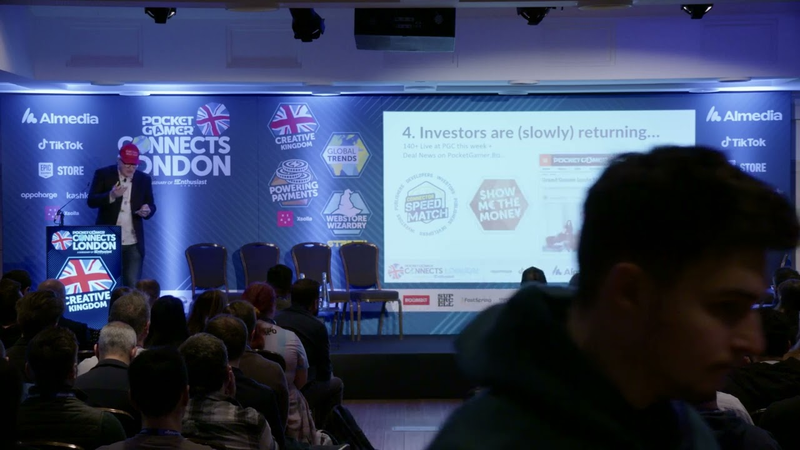
The Pocket Gamer Connects London 2025 conference, hosted by Steel Media CEO Chris James, serves as a strategic industry gathering aimed at analyzing the current state of the global games market and identifying growth opportunities for the year ahead.
- The global games industry generated between $188 billion and $200 billion in revenue last year, maintaining its position as the world's largest entertainment sector.
- Approximately 40,000 industry jobs were lost globally over the past 18 months, though recruitment activity remains ongoing for those seeking new roles.
- The distribution landscape is shifting away from the Apple and Google duopoly, with new app stores and direct-to-consumer portals emerging from companies like Aptoide, Huawei, Samsung, and Epic Games.