Mobile reports and market data
Documents
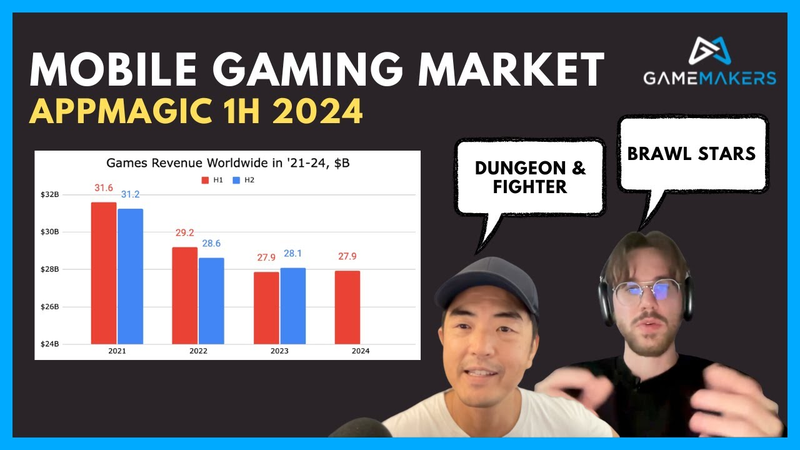
Mobile Gaming Market Review 1H2024 | AppMagic Data Analysis
The mobile gaming market reached a state of stabilization during the first half of 2024, effectively concluding the post-pandemic decline.
- The mobile gaming market stabilized in 1H 2024, ending the post-pandemic decline with Tier 1 Western markets recording a 7% revenue increase despite modest global download growth of 1–2%.
- Major studios are shifting strategy from high-risk new title development to optimizing existing assets through sophisticated LiveOps and enhanced monetization frameworks.
- Success is increasingly driven by the 'casualization' of core mechanics, exemplified by Brawl Stars' revenue recovery and the integration of hyper-casual loops in 4X strategy titles like Last War: Survival and Whiteout Survival.
Retention for Mobile Games 101
Mobile game success relies on a dual-pronged strategy that balances offensive engagement tactics with defensive churn mitigation.
- Retention is an offensive strategy focused on player motivation and progression, while churn management is a defensive strategy focused on identifying and removing friction points in UI, UX, and SDK integrations.
- Effective retention analysis requires moving beyond simple level-to-level funnels by tracking granular events to understand player behavior between progression milestones.
- To identify churn, analyze the time spent on specific events by measuring the deviation in player progression speeds across cohorts, which can be constructed using standard tools like Excel or Google Sheets.

Game Monetisation Design: Strategies, Trends, and Best Practices with Oscar Clark
Sustainable game monetization centers on the principle that revenue should be a byproduct of player value rather than an end in itself.
- Prioritize player value over immediate revenue, as viewing money as the sole driver causes designers to miss the psychological factors that influence engagement and retention.
- Design monetization around 'shortcuts'—tools that allow players to play longer, perform better, or maximize rewards—while distinguishing between temporary consumables and permanent aspirational items.
- Understand the 'fan' economy by recognizing that a player's willingness to spend is not directly correlated to their disposable income; developers should value all fans regardless of their monthly spend level.

Is Zenless Zone Zero FLOP or NOT?
Zenless Zone Zero represents a significant shift in the trajectory of HoYoverse titles, failing to replicate the explosive financial success and player engagement levels established by predecessors like Genshin Impact and Honkai: Star Rail.
- Zenless Zone Zero is underperforming commercially compared to HoYoverse predecessors Genshin Impact and Honkai: Star Rail, failing to achieve similar levels of financial success and player engagement.
- The game suffers from a core gameplay loop that feels derivative in a saturated market, leading to diminishing returns despite high production values and fluid combat.
- Player retention is negatively impacted by tedious, mandatory puzzle-based mini-games that frequently interrupt the primary combat experience.
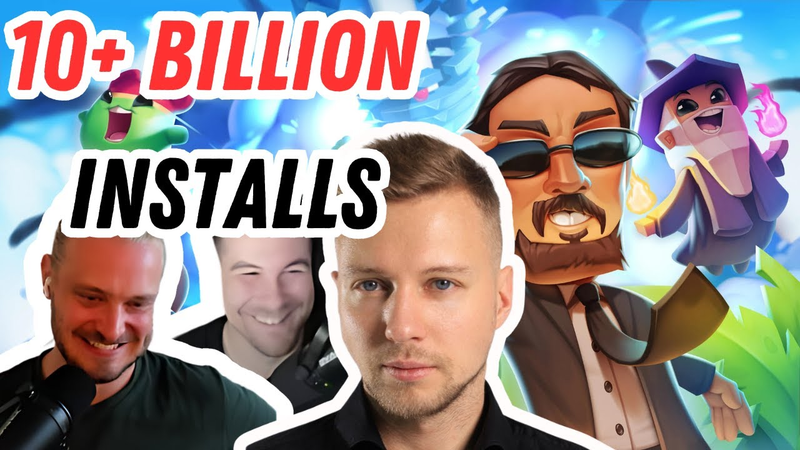
10+ billion installs x Azur Games Review live: Launching hypercasual with long ROAS
The hyper-casual gaming sector has undergone a significant transformation following the post-COVID market correction, characterized by heightened competition and declining eCPMs.
- The hyper-casual sector has shifted toward hybrid-casual models that prioritize long-term retention and sustainable profitability over short-term user acquisition metrics to counter declining eCPMs.
- Publishers are successfully scaling titles released as far back as 2019 by moving away from rigid industry benchmarks and focusing on long-term lifetime value.
- Monetization strategies now integrate in-app purchases alongside traditional ad-driven revenue to boost the lifetime value of players.

TWiG #291 Valve Salaries, Leaked MiHoYo Strategy, and Failing Disney IPs!
The global video game industry is currently navigating a period of significant structural transition, characterized by shifting demographic preferences and the struggle to balance traditional monetization with emerging subscription models.
- The global video game industry is projected to grow from $200 billion in 2022 to $307 billion by 2027, driven primarily by Gen Alpha and Gen Z preferences.
- Valve’s 2021 operational data highlights extreme profitability, with a lean staff of 336 employees earning an average annual compensation of $1.32 million, though this model limits the company's ability to scale.
- Subscription-based models like Microsoft's Game Pass have yet to achieve the mass-market adoption necessary to replace traditional hardware-centric revenue strategies.

AdQuantum’s Sergey Sukhov On Strengthening Ad Network Bonds for Better Performance
Smaller game studios can achieve significant scale by cultivating strategic partnerships with larger ad networks and growth agencies.
- Smaller studios can secure superior financial terms and specialized resources by positioning themselves as collaborative partners willing to experiment with new ad formats and strategies.
- Performance optimization must shift away from generic industry benchmarks toward granular, bespoke analysis using Mobile Measurement Partners and internal business intelligence tools.
- Lifetime value (LTV) and return on ad spend (ROAS) remain the foundational metrics for success in the current mobile gaming landscape.

Behind the Wheel of IP Licensing with Hutch's co-CEO, Peter Hansen-Chambers
The strategic integration of intellectual property within the mobile racing genre hinges on shifting from transactional licensing to long-term, relationship-based partnerships.
- Successful IP licensing in mobile racing requires shifting from transactional deals to long-term, relationship-based partnerships that prioritize community engagement over rigid initial KPIs.
- Developers must move away from console-style replication and instead adopt a mobile-first creative vision that demonstrates how a game can expand an automotive brand’s reach to new demographics.
- Securing high-profile partnerships depends on a studio’s proven track record of reliability and creative integrity, which eventually shifts the dynamic from cold-pitching to being actively sought out by manufacturers.

Project RISE review: Supercells *NEW* Rogue-lite Game is in pre-alpha!
Project RISE represents a strategic pivot for Supercell, marking a departure from the studio’s traditional focus on competitive player-versus-player experiences toward a cooperative, rogue-lite PVE model.
- Supercell is pivoting from its traditional competitive PvP focus to a cooperative, rogue-lite PvE model set within the Clash universe.
- Project RISE features a floor-based progression system with extraction-style mechanics that allow players to retain upgrades between sessions.
- The current pre-alpha build suffers from technical instability, including performance lag and a lack of essential UI elements like mini-maps.

The Next Era of Voice Games
Voice-controlled gaming is undergoing a fundamental shift, moving from primitive, high-friction interactions to sophisticated, AI-driven experiences that leverage the natural human instinct for speech.
- Advancements in large language models and native audio-to-audio processing have reduced latency to under half a second, transforming voice from a novelty into a high-fidelity primary input mechanism.
- The sector is successfully targeting casual demographics—specifically millennial parents, children, and seniors—to convert passive television-viewing time into active, social gaming engagement.
- Studios are utilizing subscription-based models that prioritize high user retention over aggressive monetization, with development cycles typically lasting between six and nine months.

TWIG #290 Nintendo's anti-AI Stance, 4-day Work Weeks, and Netflix Games' Clap Back
The global gaming industry is currently navigating a period of significant structural transition, characterized by shifting monetization models, evolving labor practices, and the cautious integration of generative artificial intelligence.
- Nintendo is explicitly prioritizing human-led design over generative AI to protect its brand equity against the influx of low-quality, AI-generated market content.
- Hybrid-casual games like Hexa Sort are successfully leveraging aggressive ad-monetization, with advertisements accounting for up to 65% of their total revenue.
- The gaming industry is experiencing a cooling trend regarding four-day work weeks, as companies increasingly view them as an impediment to operational efficiency in a competitive five-day global market.
Vietnamese Mobile Gaming in 2024: Four Billion Downloads & Emerging Trends
Vietnam has emerged as a significant force in the global mobile gaming industry, characterized by rapid growth over the past four to five years.
- Vietnamese developers achieved four billion mobile game downloads in the past year, securing over 90 positions on global top-chart rankings.
- The industry is supported by a robust ecosystem of approximately 400 game companies and over 1,500 independent developers.
- Studios are shifting from hyper-casual titles to hybrid-casual models, incorporating deeper narratives and in-app purchases to improve lifetime value and offset rising acquisition costs.
Writers
Games and companies
Games