Global reports and market data
Documents
Profiling Academic Research on Digital Games Using Text Mining Tools
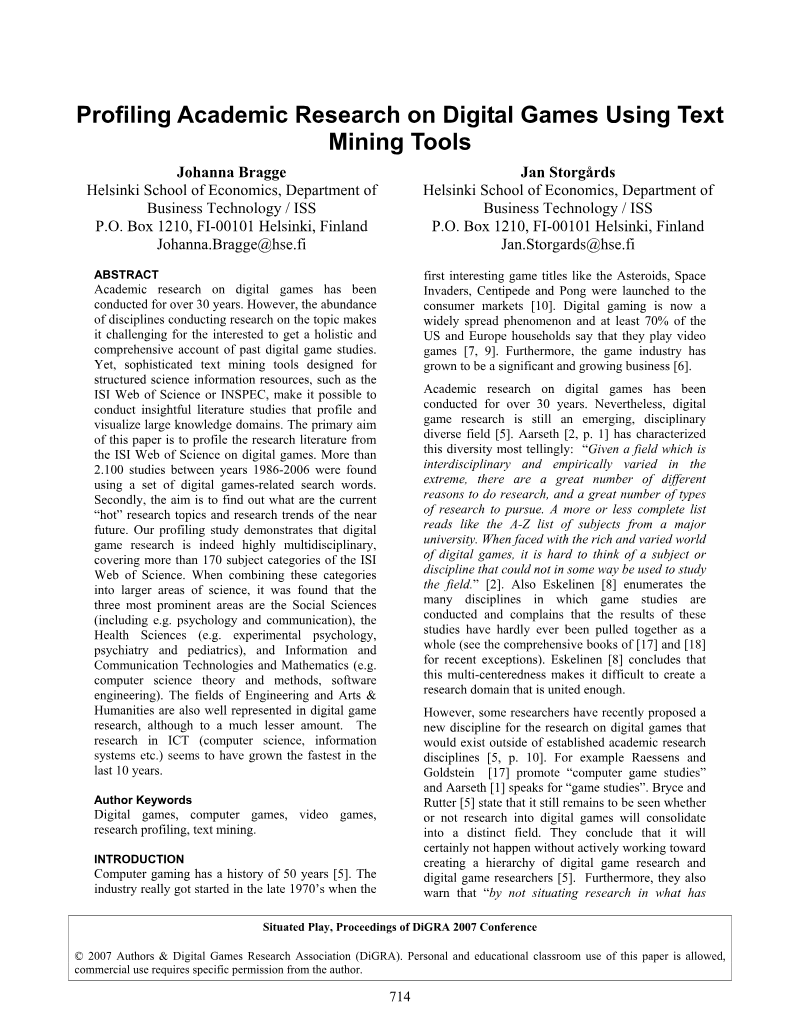
Academic research on digital games, spanning from 1986 to 2006, is a profoundly multidisciplinary field, encompassing over 170 subject categories within the ISI Web of Science.
- The study analyzes 2,136 ISI Web of Science records (1986–2006) on digital games using VantagePoint text mining, with articles making up 81% of records, and maps the field's thematic and geographic evolution.
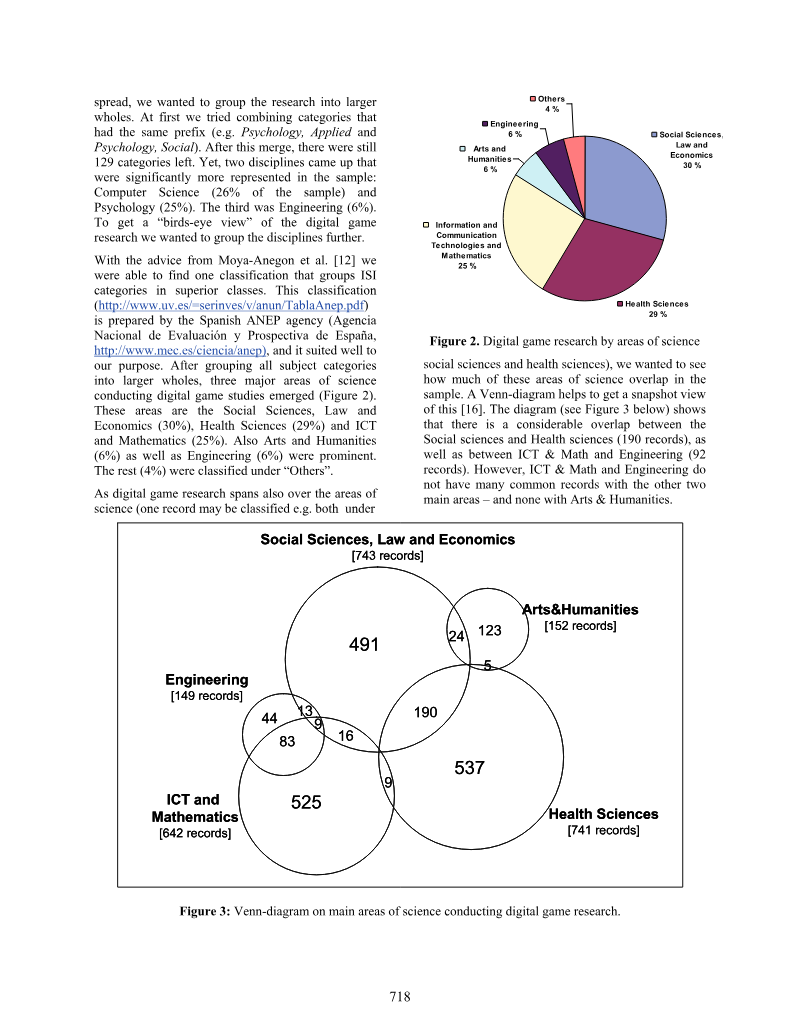
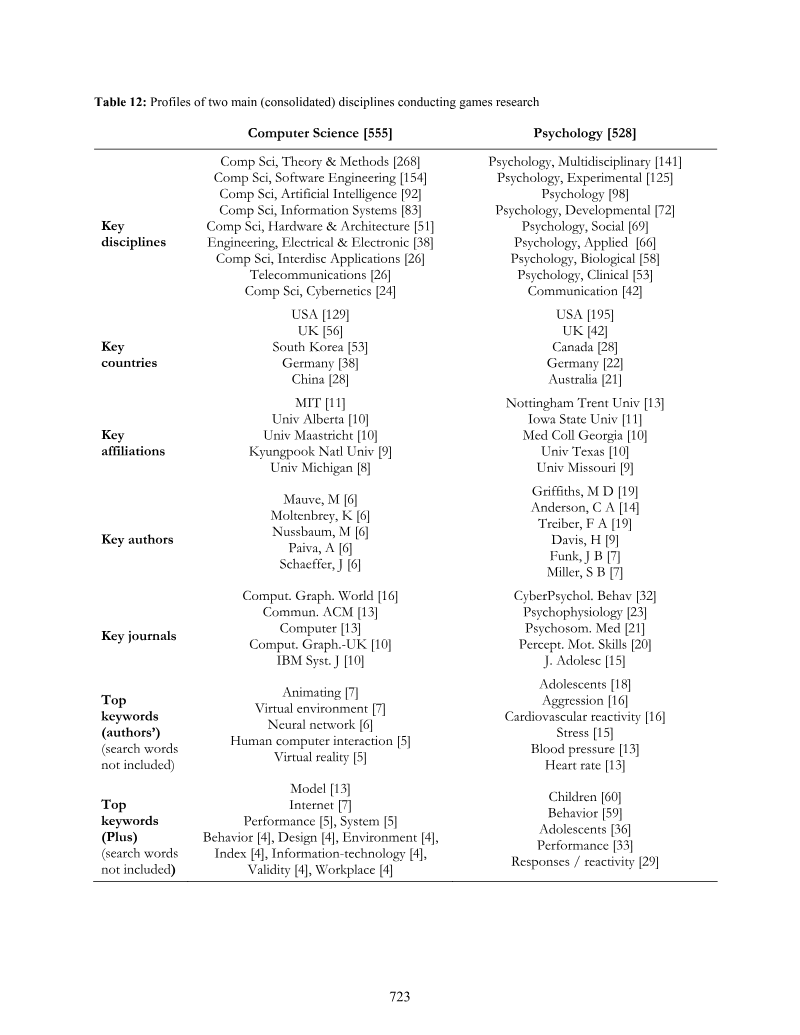
- Three research areas dominate: Social Sciences, Law & Economics (30%), Health Sciences (29%), and ICT & Mathematics (25%); at the discipline level Computer Science (26%) and Psychology (25%) lead.
- ICT & Mathematics is the fastest-growing area, rising 160% between the 1997–2001 and 2002–2006 periods, and publication volume rose steadily with a pronounced peak after 2003.
Visiting the Floating World: Tracing a Cultural History of Games Through Japan and America
This paper establishes a framework for understanding the complex cultural and industrial relationships between Japanese and American games, critiquing the application of Orientalism in game studies.
- Consalvo argues Japanese cultural influence on the West has a longer history than recent media scholarship acknowledges, and that digital games' transnational flows and Japanese corporate power cannot be understood through simple East-West binaries.
- The paper draws parallels between art history and games, showing how Japanese art, porcelain, and fans became popular in Europe and America through mass production, dealer and collector influence, World Fairs such as the 1876 Centennial Exposition, and borrowing by Western painters like the Impressionists and John La Farge.
- Nintendo's cautious localization strategy after the 1983 crash is presented as having shaped what Western audiences came to see as acceptable games.
Dimensions of Play: Gameplay, Context, Franchise and Genre in Player Responses to Command and Conquer: Generals
Geoff King's study examines how players responded to Command and Conquer: Generals, drawing on 284 reviews, 184 from Amazon and 100 from GameSpot.
- Gameplay is the dominant concern in player responses, addressed in roughly 58% of Amazon reviews and about 82% of GameSpot reviews, with graphics and comparisons to earlier series entries also prominent.
- The study argues that game experience is multi-dimensional, with players weighing gameplay, graphics, franchise continuity, narrative, technical performance, and geopolitical context in shifting combinations.
- The geopolitical dimension (post-9/11 Middle East resonances and the terrorist-aligned GLA faction) is named directly in only about 9–12.5% of reviews, rising to roughly 21–31% when oblique references are included.

MMOs as Practices
The document "MMOs as Practices" by Ren Reynolds explores whether acts within Massively Multiplayer Online (MMO) games can be understood through Alasdair MacIntyre's definition of "Practice" from After Virtue.
- Ren Reynolds applies Alasdair MacIntyre's definition of a "practice" from After Virtue to MMO-specific acts such as ganking, ninja looting, and power leveling, arguing these acts can be morally evaluated rather than dismissed as trivial play.
- The paper argues that many MMO activities occupy a nexus between the social and the ludic and meet MacIntyre's criteria of being coherent, complex, socially established, and cooperative, generating internal goods tied to excellence.
- Raid strategies emerge through repeated play and are documented and shared within communities, and guild norms often include public identification, suggesting a shared notion of positive conduct.
Counting Barrels in Quake 4: Affordances and Homodiegetic Structures in FPS Worlds
The document, "Counting Barrels in Quake 4: Affordances and Homodiegetic Structures in FPS Worlds," examines the inherent tension between the increasingly complex and immersive visual and narrative elements in First-Person Shooter (FPS) games and their fundamentally simple core ludic structures.
- First-person shooters have grown far more sophisticated in graphics, AI, and narrative integration, yet their underlying ludic structure has barely changed since the genre's earliest days.
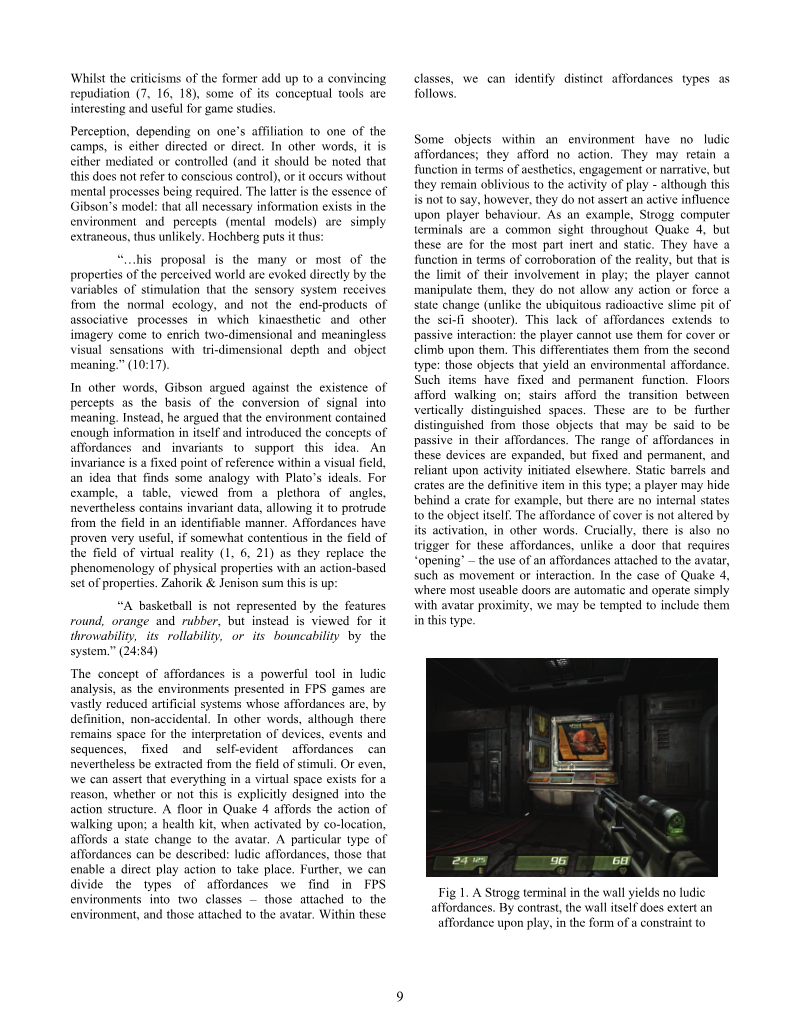
- Drawing on Gibson's concept of affordances, the analysis classifies in-game objects into static, environmental, state-changing, and singular or critical types, separating those that matter to play from decorative ones.
- A player's core actions in games like Quake 4, moving through space and acting on objects, reduce to a small, fixed set of parameterized affordances, which the author identifies as the root of tension between the depth of the game's reality and the simplicity of its play.
Gamic Realism: Player, Perception and Action in Video Game Play
This paper argues for a phenomenological approach to understanding realism in video games, asserting that it is primarily dependent on the player's embodied experience and action rather than mimetic representation.
- Realism in video games rests on the player's embodied, action-based experience rather than on graphical fidelity or resemblance to external reality, drawing on Merleau-Ponty's phenomenology.
- The author argues the controller functions as an extension of the player's body, producing a body-subjective form of "gamic realism" grounded in action.
- The paper positions itself against Chris Crawford's view that games represent a "subset of reality" and Jesper Juul's view that games are "half-real," arguing both locate realism in formal rules or fictional settings instead of physical engagement.
Approaching Game-Studies: Towards a Reflexive Methodology of Games as Situated Cultures
This paper argues that the study of games as cultural practice requires a methodology grounded in reflexivity and situatedness, two complementary tools that together keep play at the center of inquiry while situating the researcher and the game within local and cultural contexts.
- The paper argues that game studies needs a methodology built on reflexivity (making the researcher's involvement visible) and situatedness (embedding the player and game in local, embodied social practice), keeping play central to inquiry.
- It builds on Espen Aarseth's call to account for the researcher's position as player and refines it with anthropologist Tom Boellstorff's advocacy of participant observation.
- Aarseth's framework of gameplay, game-structure, and game-world, and his adaptation of Bartle's player typologies, are critiqued as risking overly universal and Eurocentric categories when applied without attention to local cultural variation.
Player-Character Dynamics in Multi-Player Role Playing Games
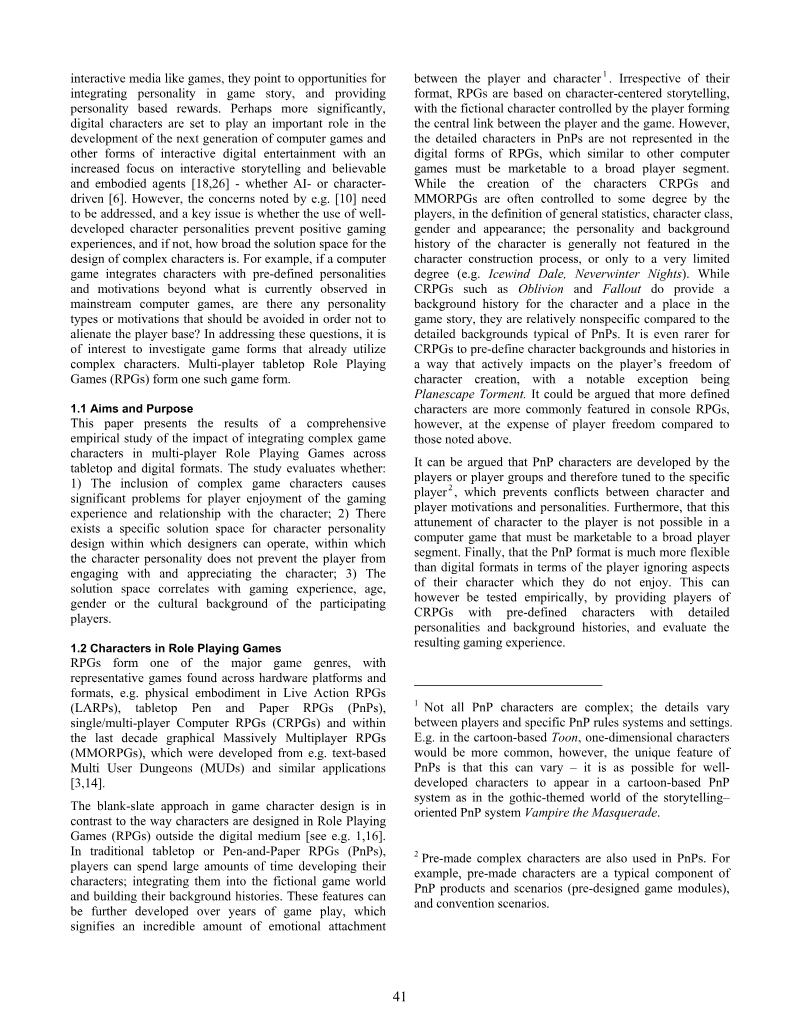
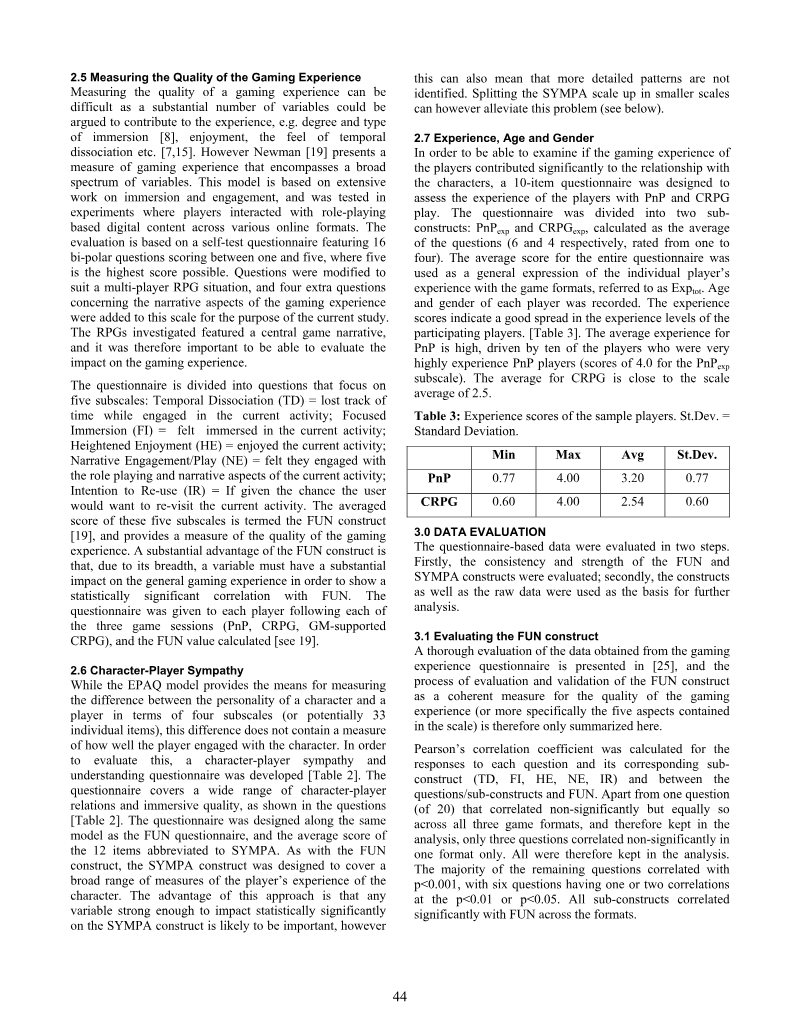
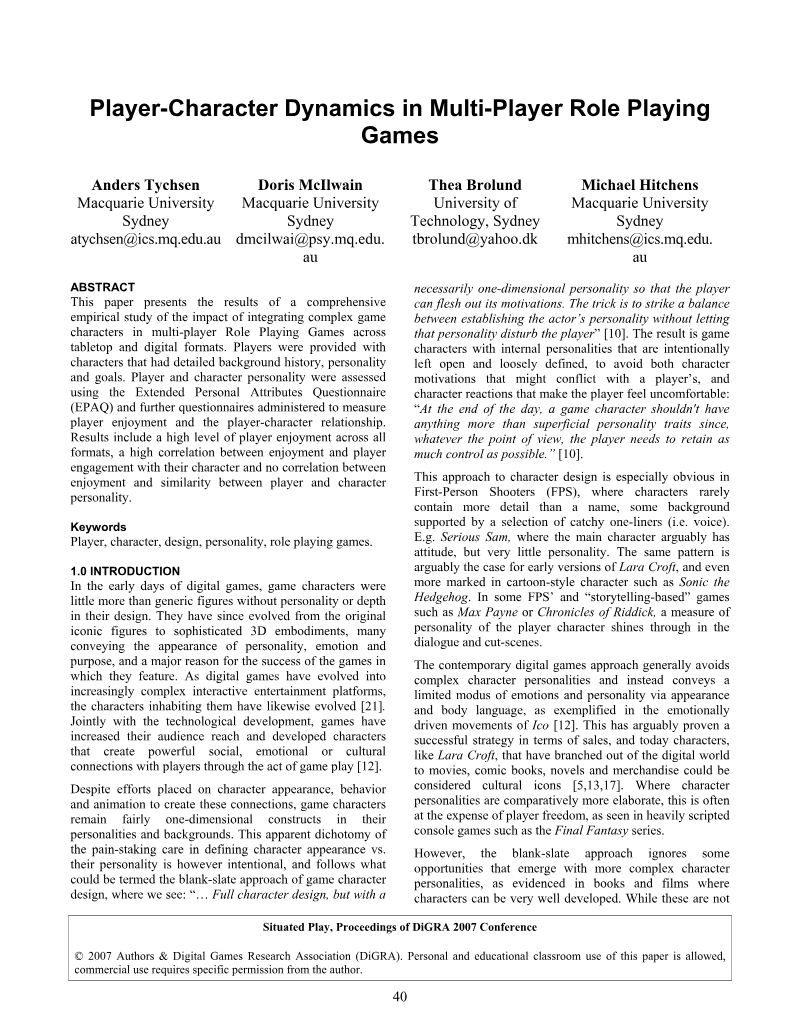
This study examines the influence of integrating complex, detailed player characters into multi-player role-playing games, encompassing both tabletop and digital formats.
- The study found no statistically significant correlation between player-character personality differences and player enjoyment (the Fun measure), suggesting personality match does not meaningfully drive satisfaction in multiplayer RPGs.
- The authors conclude that character design quality, rather than how closely a character's personality matches the player's, appears to determine player satisfaction.
- Complex, pre-defined characters were readily accepted by adult and young adult players, challenging the assumption that rich personalities undermine player agency.
Videogame Music: Chiptunes Byte Back?
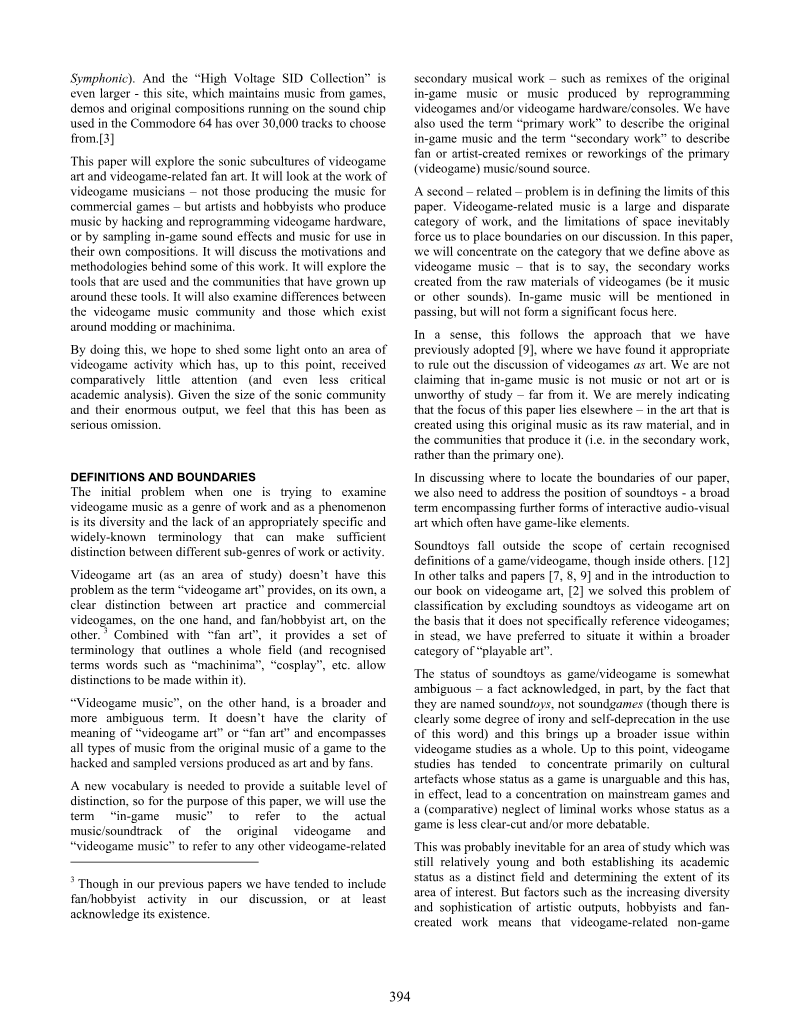
This paper explores the sonic subcultures of videogame music, focusing on artists and hobbyists who create music by hacking and reprogramming videogame hardware or sampling in-game sounds, rather than those producing music for commercial games.
- The authors argue that videogame music has received far less scholarly attention than videogame visual art, despite substantial overlap between the two communities and the large volume of fan-produced output.
- Fan-produced videogame music is vast in scale: one remix site hosts more than 1,400 tracks and a Commodore 64 music archive contains over 30,000.
- The paper defines its scope carefully, distinguishing "in-game music" from "videogame music" and excluding soundtoys from videogame art, and frames secondary works as remixing or reworking of game music and sound effects.

Girls and Gaming: Gender Research, "Progress" and the Death of Interpretation
This paper critiques the persistent lack of critical interpretation in research concerning gender and gameplay, arguing that much of the work in this area, including "girl-friendly" game design, merely re-instates and legitimizes existing gender stereotypes.
- The authors argue that gender-and-gaming research has stagnated around an essentialist conception of gender, exemplified by the early Cassell and Jenkins volume and Sheri Graner-Ray's 'girl-friendly' game design work, which treats socially constructed conventions as natural inner truths.
- The recurring 'findings' about what girls prefer are framed not as simple methodological errors but as products of a self-reinforcing epistemic framework, and the authors contend this orthodoxy reinstates inequality of access and opportunity.
- The supposed contrast between cooperative girls and competitive boys is challenged: the authors' observations show many girls enjoy highly competitive play, and apparent cooperation often occurs within forms socially permitted for girls.
Critical Potential on the Brink of the Magic Circle
"Critical Potential on the Brink of the Magic Circle" examines "brink games" or "forbidden games," which are defined by their strategic exploration of the permeable boundary between games and reality.
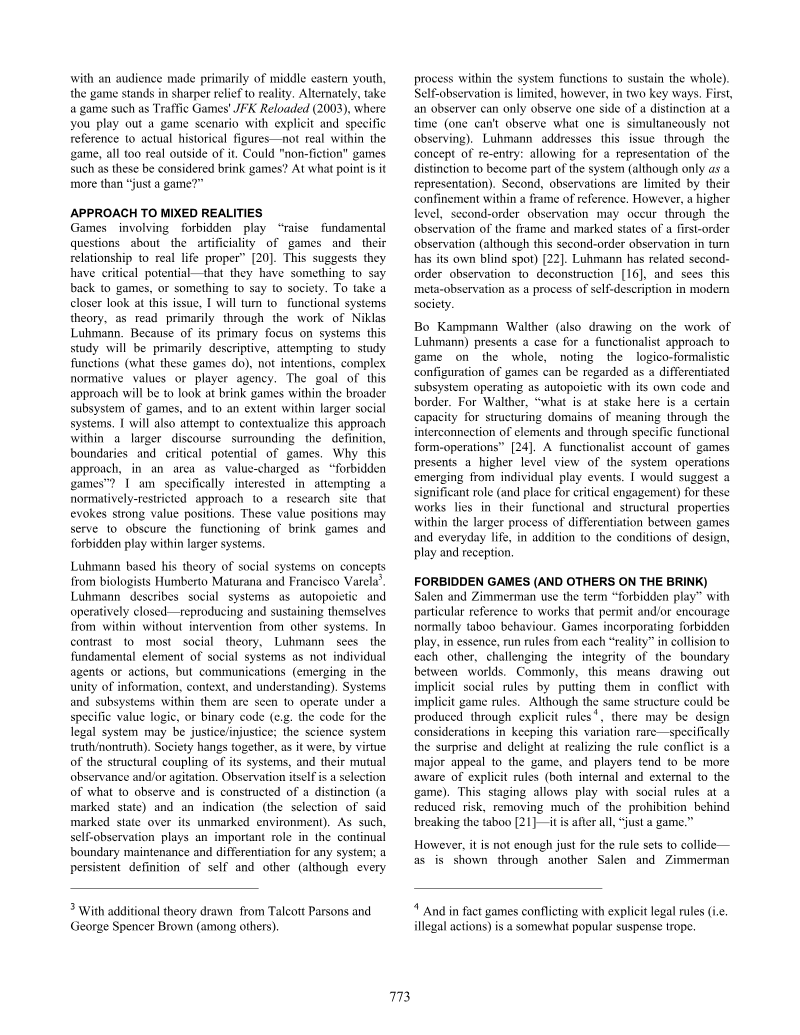
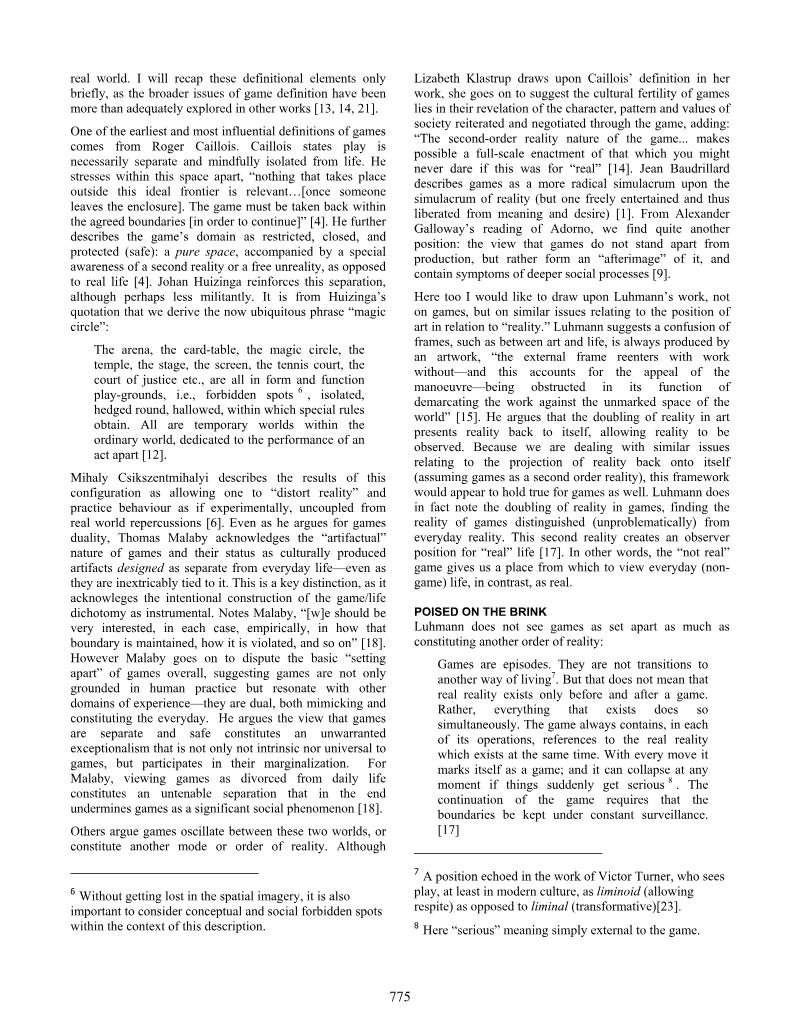
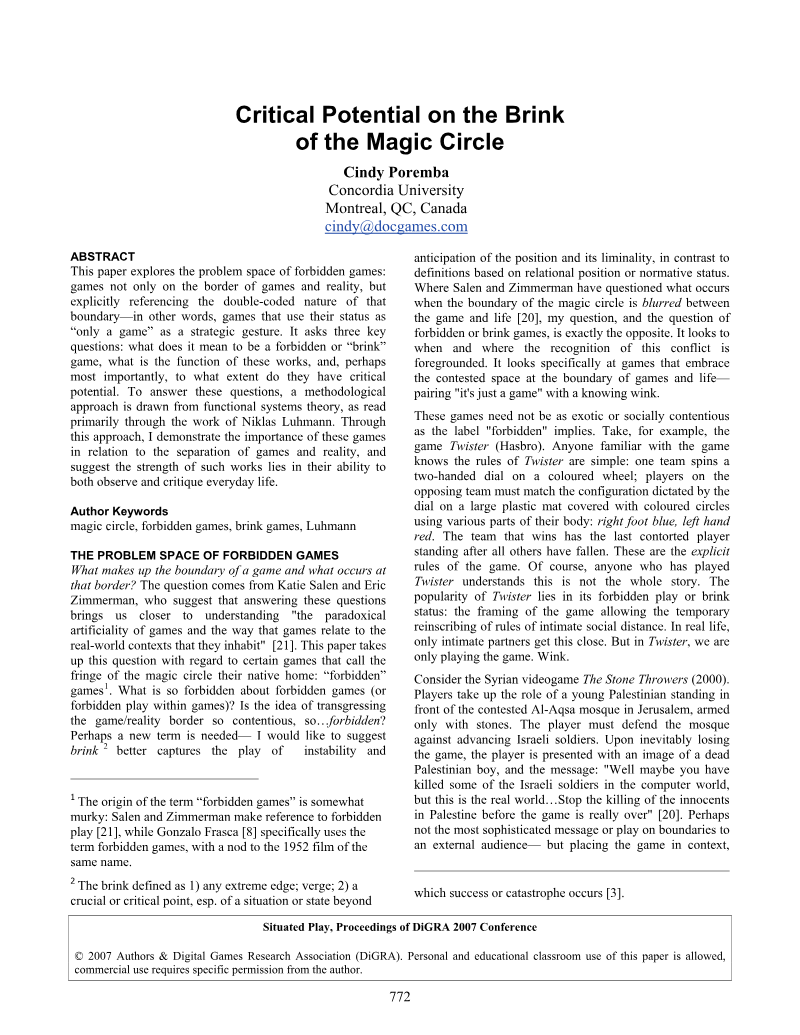
- Poremba's paper argues that 'brink' or 'forbidden' games, such as The Stone Throwers, Intimate Controllers, and Twister, deliberately blur the boundary between play and reality, making them worth studying for the tension they create between in-game and real-world rules.
- The paper's principal theoretical contribution is challenging the classic 'magic circle' concept (Huizinga, Caillois), which treats games as set apart from reality, in favor of viewing games as entangled with social life.
- Drawing on Luhmann's functional systems theory, the author proposes a descriptive, function-focused approach for assessing the critical potential of brink games.
Designing Games to Effect Social Change
This paper outlines best practices for designing games intended to effect social change, often referred to as serious games, persuasive games, or news games.
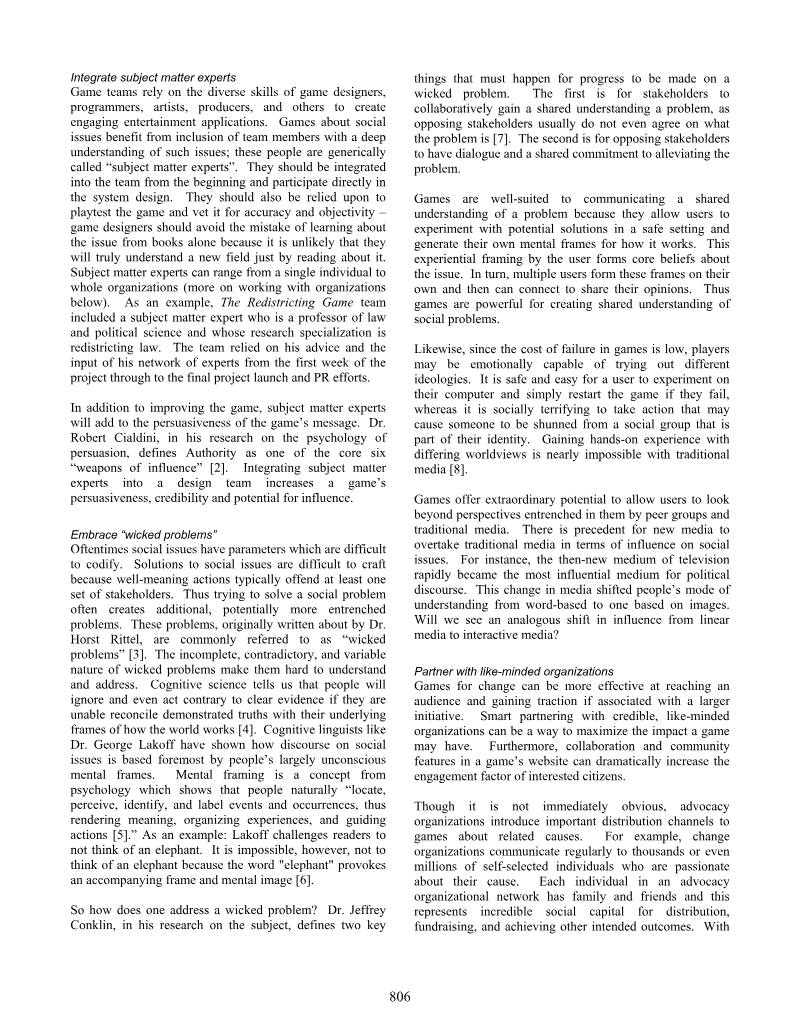
- Games for social change have struggled to demonstrate measurable real-world impact, and the paper proposes a framework to close that gap, starting with defining quantifiable intended outcomes at the beginning of production.
- Core recommendations include integrating subject matter experts into the design team, partnering with credible advocacy organizations, building sustainable community features, and measuring knowledge transfer through in-game surveys or focus groups.
- The Redistricting Game set a goal of generating 5,000 letters to Congress and built a "Write Congress" feature into its game flow, with advocacy partnerships extending its reach.