1 free read left. Create a free account for unlimited reading + AI research.
Create free accountWhitepaper DiGRA
1 free read left. Create a free account for unlimited reading + AI research.
Create free accountWhitepaperDiGRA
The authors contend that these findings are not simple methodological errors but outputs of a self-reinforcing epistemic framework that reinstates inequality of access and opportunity.
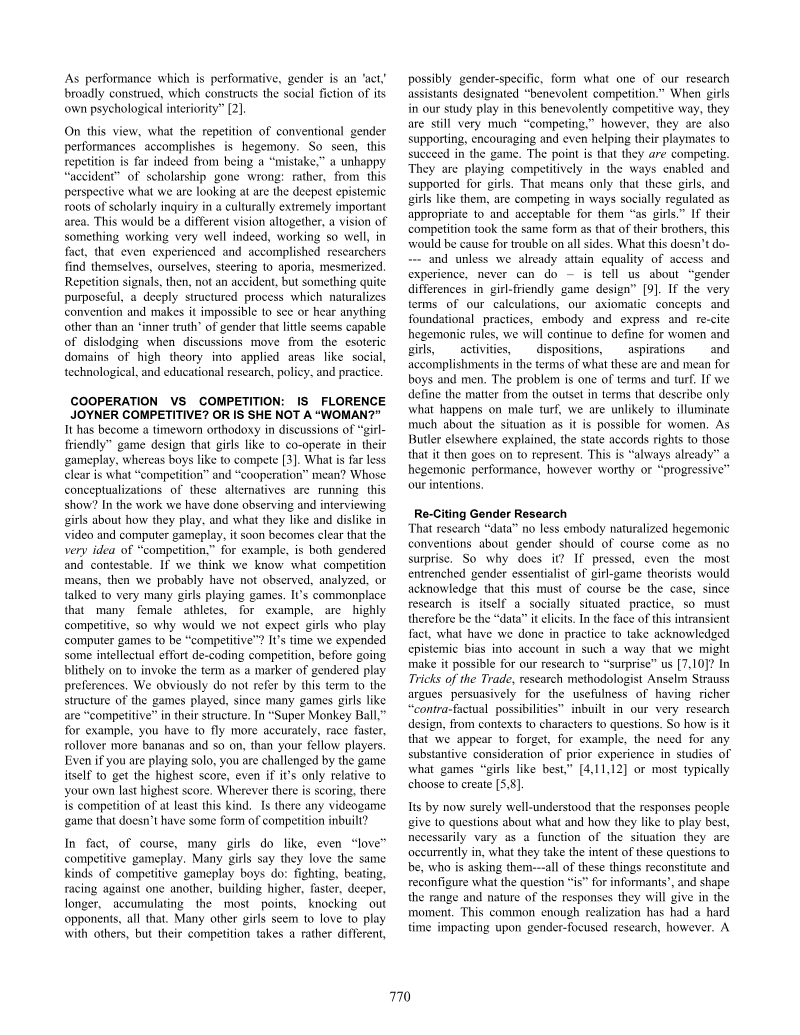
This paper argues that research on gender and gaming has stagnated around a narrow, essentialist conception of gender that the authors describe as canonical, most visibly represented by the early Cassell and Jenkins volume and the widely cited "girl-friendly" game design work of Sheri Graner-Ray. Drawing on theorists such as Judith Butler, Michel Foucault, Eve Sedgwick, Donna Haraway, and Dorothy Smith, the authors contend that the recurring "findings" about what girls like best are not mere methodological errors but products of a self-reinforcing epistemic framework that treats socially constructed gender conventions as natural and inner truths. Their central claim is that this persistent orthodoxy reinstates inequality of access and opportunity, and they call for a return to interpretive, critical inquiry capable of surprising researchers and challenging their assumptions.
A key illustration concerns the supposed contrast between girls who cooperate and boys who compete. The authors argue that this distinction rests on unexamined definitions of competition drawn from male-coded contexts. Their observations of girls playing video and computer games show that many girls enjoy highly competitive play, and that where girls do appear to play cooperatively, they are often still competing within forms that are socially permitted for girls. Because most games embed scoring and rankings, competition is nearly universal in gameplay, which the authors suggest makes the cooperation-versus-competition dichotomy analytically unstable. They further argue that research responses vary with the context and identity of the questioner, so that the data elicited by gender research already reflect the hegemonic assumptions the research seeks to examine.
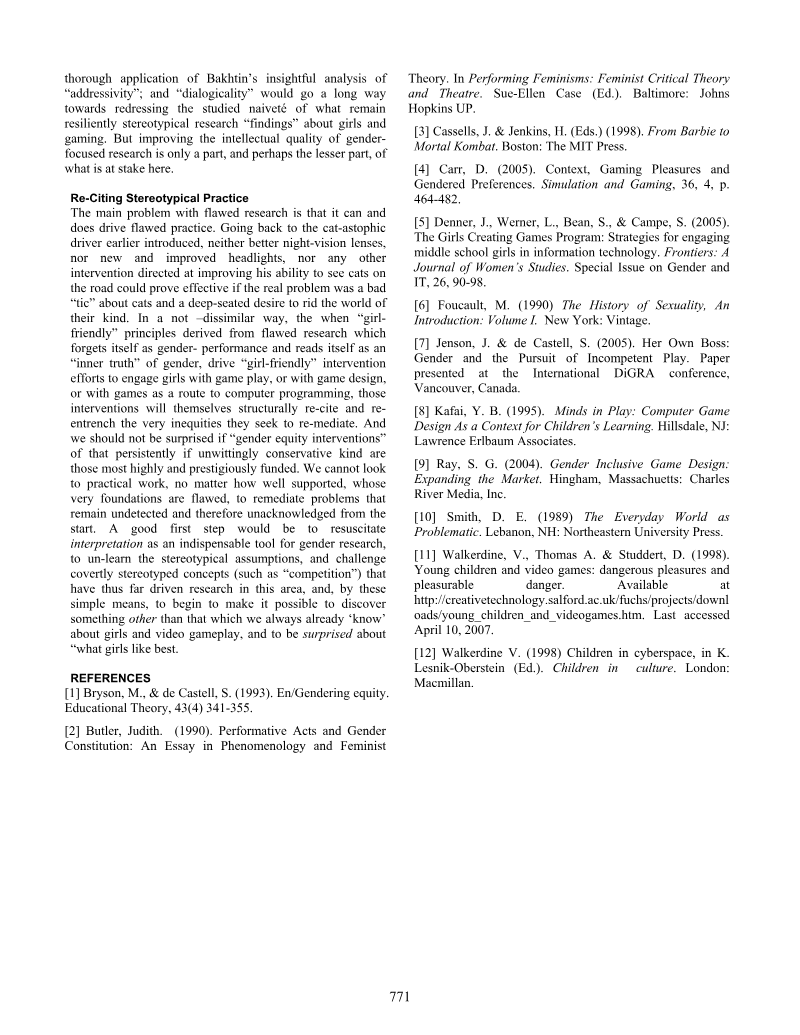
The authors extend their critique to practice, maintaining that flawed research produces flawed interventions. "Girl-friendly" design principles and outreach programs built on stereotypical premises may unintentionally reproduce the very inequities they aim to remedy, and the authors caution that such approaches have often been the most heavily funded. Their proposed remedy is a renewed commitment to interpretation, informed by Bakhtin's concepts of addressivity and dialogicality and by Strauss's emphasis on counterfactual possibilities, as a means of unlearning stereotypical assumptions and making genuine discovery possible.
DiGRA · 2022
DiGRA · 2022
DiGRA · 2022

DiGRA · 2022
DiGRA · 2022
DiGRA · 2022
DiGRA · 2022
DiGRA · 2022
DiGRA · 2022

DiGRA · 2022
DiGRA · 2022
DiGRA · 2022
Game Developers Conference · 2022