Global reports and market data
Documents

Real-Time Sweetspot: The Multiple Meanings of Game Company Playtests
This study examines the multifaceted role of playtesting within a Swedish game development company, focusing on a real-time strategy (RTS) game in development between March 2006 and February 2007.
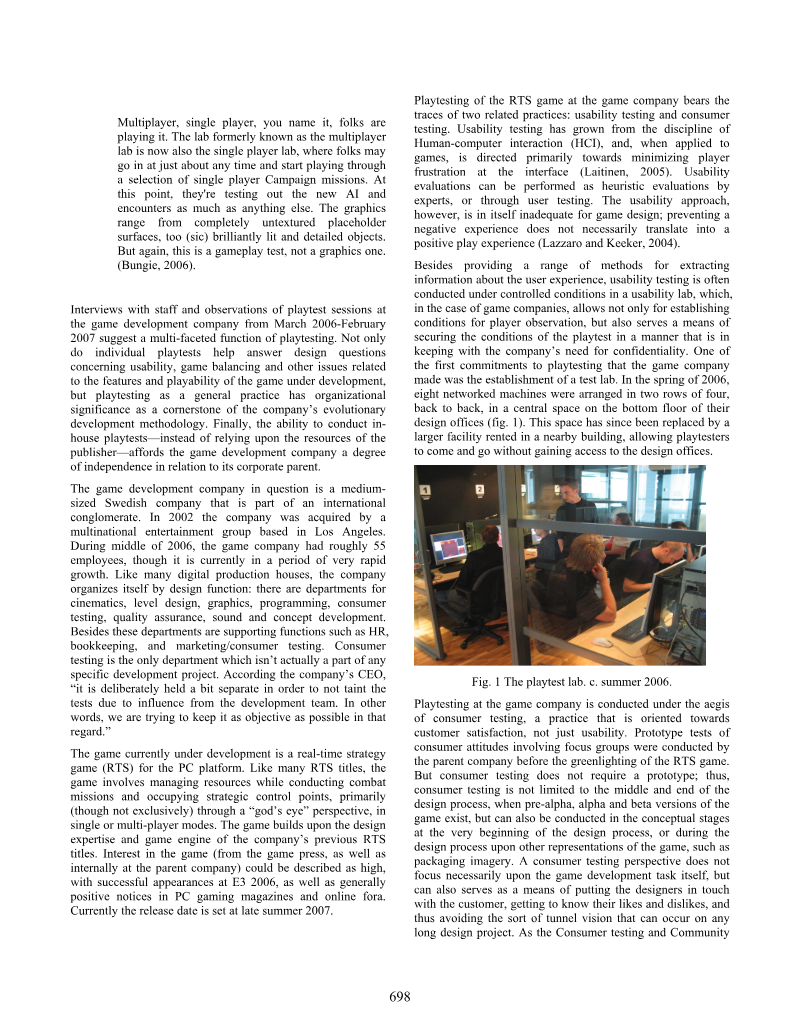
- The paper examines a single 'Sweetspot' balancing playtest conducted in March 2006 for a real-time strategy game at a medium-sized Swedish studio owned by an international entertainment conglomerate, based on interviews and observations from March 2006 to February 2007.
- Playtesting serves more than design iteration: inside the company it creates clarity in an evolutionary, biweekly build-based process, and outside it communicates project status to the publisher and parent company.
- In the Sweetspot test, eight playtesters rated four builds varying unit hit points and reinforcement tempo, and the lead designer implemented changes overnight, with the next build confirming the balancing decision.
Virtual Worlds and Fraud: Approaching Cybersecurity in Massively Multiplayer Online Games
The document examines the growing phenomenon of financial fraud within and originating from Massively Multiplayer Online Games (MMOGs), termed "virtual fraud."
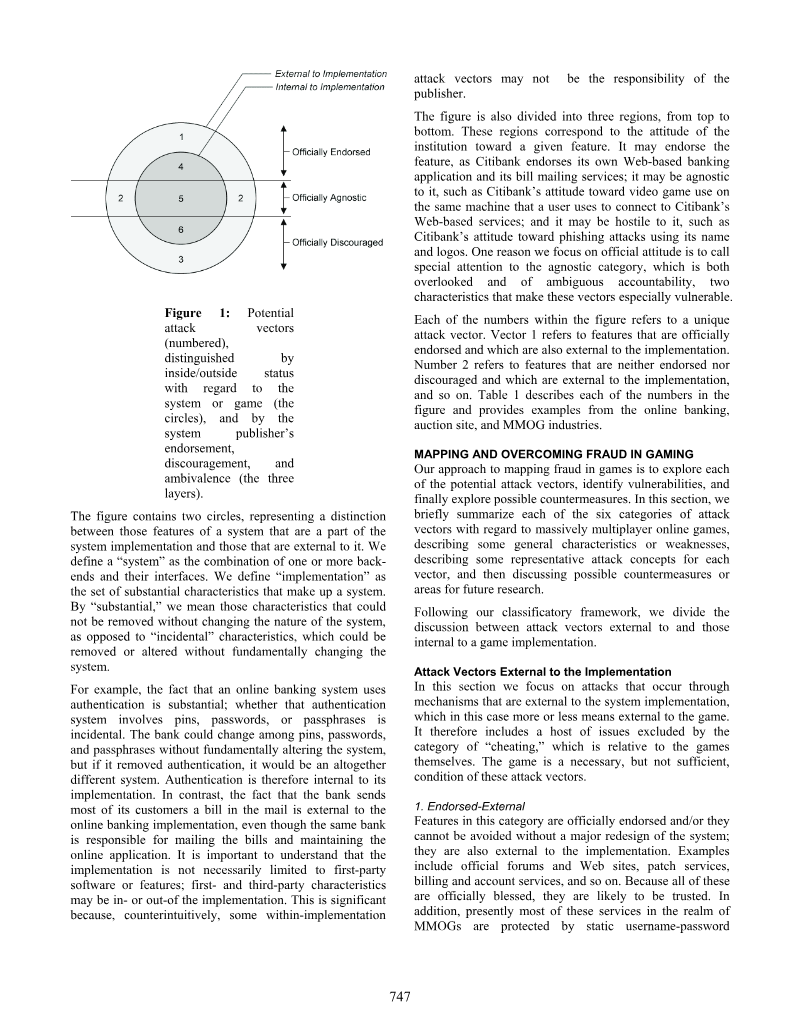
- Fraud in massively multiplayer online games is emerging as a security threat because the monetization of virtual possessions and growing product placement are pulling conventional online fraud (phishing, click-fraud, impression fraud) into game environments.
- Game scripts and modifications can serve as vehicles for malware and spam, making game content itself a potential attack channel.
- The authors argue that MMOGs are a distinct security domain, since their rule complexity and social features set them apart from earlier cheating research, which focused narrowly on cheating (taxonomies, bot detection, lag exploitation, player ranking).
The State of the Art: Western Modes of Videogame Production
The "State of the Art: Western Modes of Videogame Production" analyzes the evolution of Western videogame production, contrasting early industrial models with contemporary trends towards decentralized, participatory development.
- The study traces the producer-consumer boundary in Western videogame production from Atari's founding in 1972 through the UK home-computer boom of the early 1980s, arguing that the line between making and playing games has grown increasingly porous.
- Atari's loosely managed, Fordist-influenced production gave way to home consoles that moved play into private space, while Spectrum-era bedroom coding and cassette copying fostered a more integrated relationship between creators and players.
- Interviews with eleven industry professionals conducted in 2006 indicate that development is increasingly governed by market research, licensing arrangements, and consumer demand rather than purely creative or technical possibility, with long working hours and globally distributed teams common.
Exporting Wars: Literature Theory and How It Explains the Video Game Industry
The document, "Exporting Wars: Literature Theory and How It Explains the Video Game Industry," posits that the video game industry, a unique convergence of information technology and cultural production, is inadequately analyzed by conventional cultural economics frameworks.
- Dymek argues that the video game industry sits between information technology and cultural industries, and that Caves's cultural-industries framework captures familiar dynamics such as uncertain demand, the coordination of a 'motley crew' of creative and technical workers, hit-driven markets, and long development cycles, but is incomplete.
- The central gap identified is interactivity (emergence and simulation), which distinguishes games from other media; to fill it, the paper draws on ludology and Aarseth's cybertext theory, framing games as a cybernetic user-machine relationship rather than an authored text.
- The paper proposes a 'cybertext-cultural industry' perspective that joins cultural-industry production with technological development, arguing that bridging literary theory with economic analysis gives a fuller account of games than either alone.
Experiential Modes of Game Play
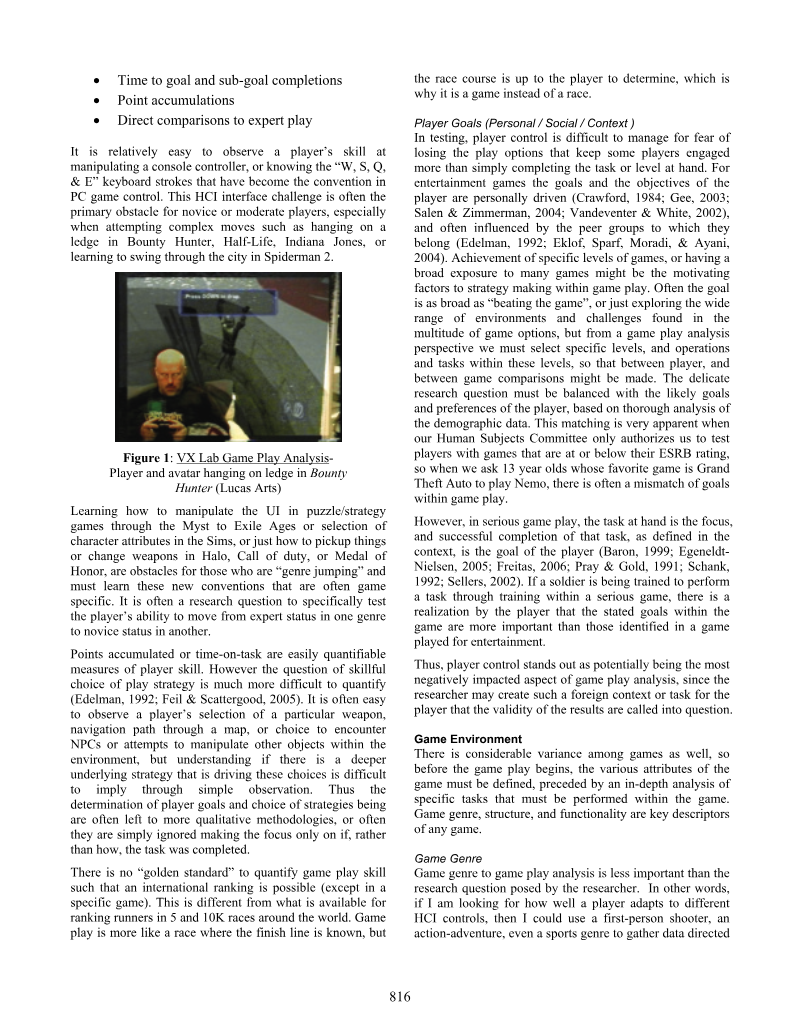
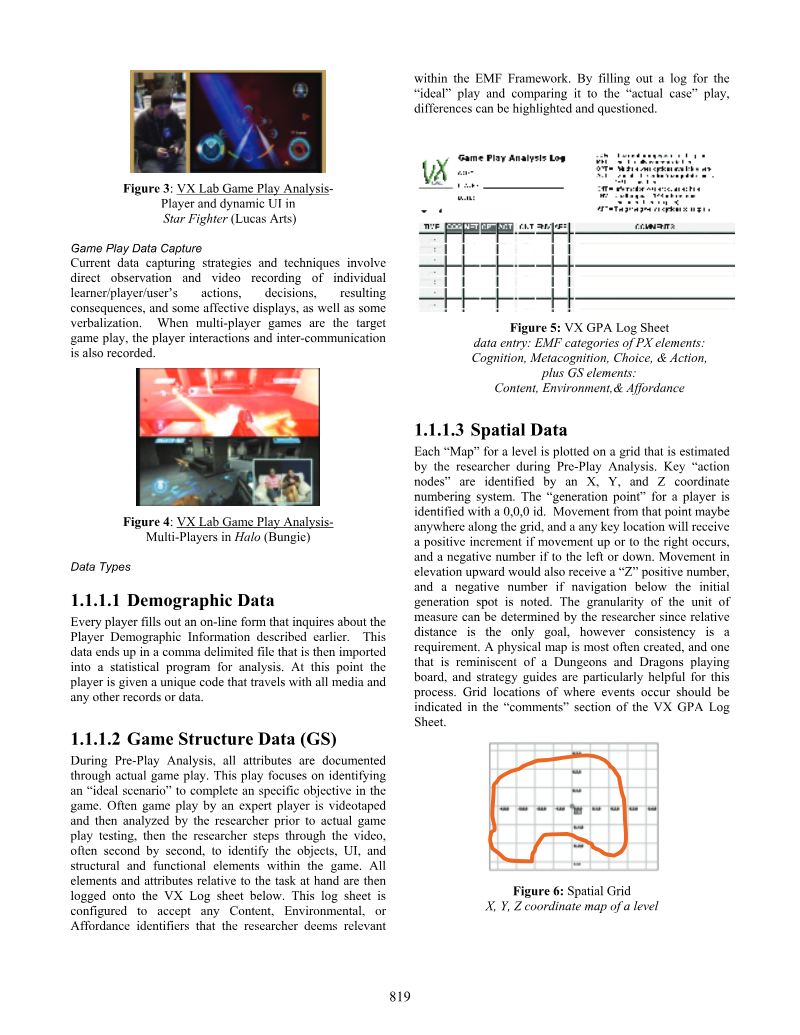
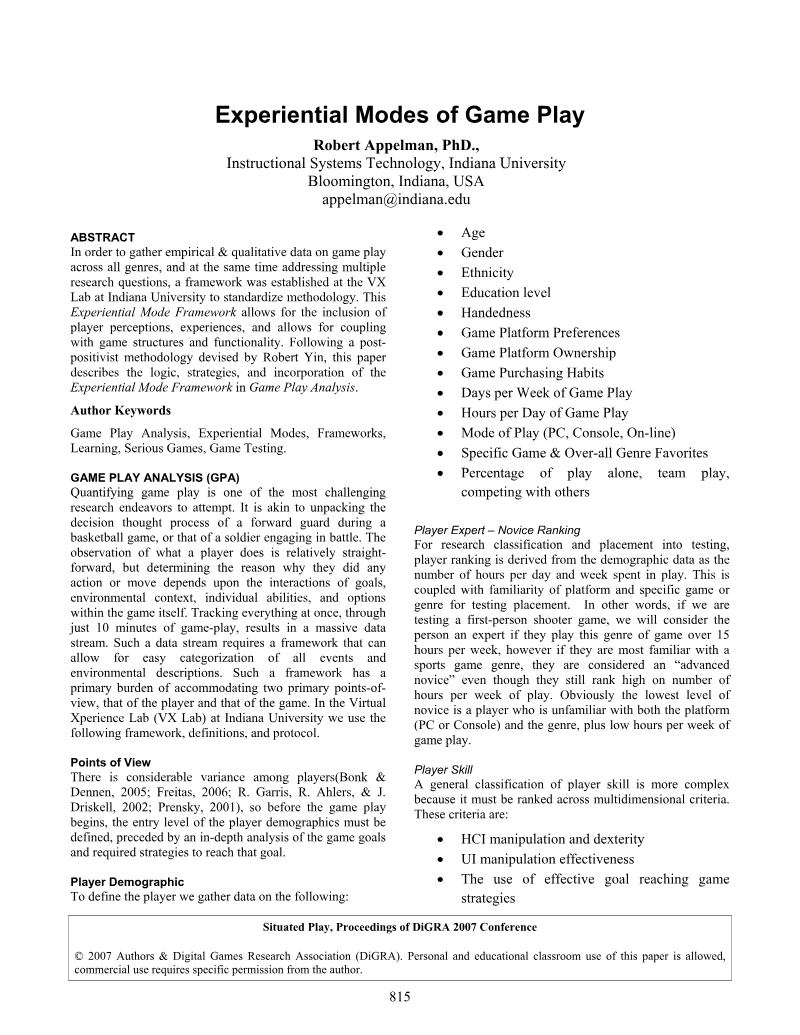
The document outlines the Experiential Mode Framework (EMF) developed at the VX Lab at Indiana University for standardizing game play analysis.
- The Experiential Mode Framework (EMF), developed at Indiana University's Virtual Xperience Lab, separates game analysis into Player Experience (cognition, metacognition, choice, action) and Game Structure (content, environment, affordances) to make game play easier to study systematically.
- The framework uses Robert Yin's multiple case study methodology, treating each play session as a distinct case and comparing patterns across sessions rather than aggregating results into statistical scores.
- The methodology has four phases: pre-play analysis of demographics and game structure, data capture via video, observation and interviews, pattern-based analysis, and summative conclusions.
Levels of Sound: On the Principles of Interactivity in Music Video Games
This paper introduces the principles of interactivity in music video games, a small but diverse genre with roots in the 1970s.
- The paper divides music video games into two overlapping categories, rhythm games and electronic instrument games, and argues their interactive properties can be organized into a grammar of design.
- The framework identifies seven recurring qualities: active scores, rhythm action, quantisation, synaesthesia, play as performance, free-form play, and sound agents.
- Rhythm games centre on repetition and matching a tempo, with success measured as a score, whereas instrument games emphasize quantised, open-ended composition where the input-to-sound mapping is governed by convention rather than physics.
Eight Ways Videogames Generate Emotion
This paper introduces a comprehensive model for understanding how single-player videogames generate emotion, focusing on the player's role and the different aspects of a game that elicit emotional responses.
- Frome's paper proposes a conceptual model crossing two player roles (observer-participant and actor-participant) with four emotion types (game, narrative, artifact, ecological), yielding eight categories of emotion inputs videogames can present.
- The model is descriptive rather than predictive: it offers vocabulary and a guide for future empirical research but does not claim to forecast individual player responses, given variability in backgrounds and cultural contexts.
- The ecological emotion category captures responses to represented events as if they were real, such as jumping at a sudden ghost or feeling vertigo on a virtual cliff, which Frome links to mental processes that do not distinguish representation from reality.
Developing a Pattern Language for Flow Experiences in Video Games
This document outlines the development of a pattern language specifically designed to foster "flow" or optimal experiences in video games.
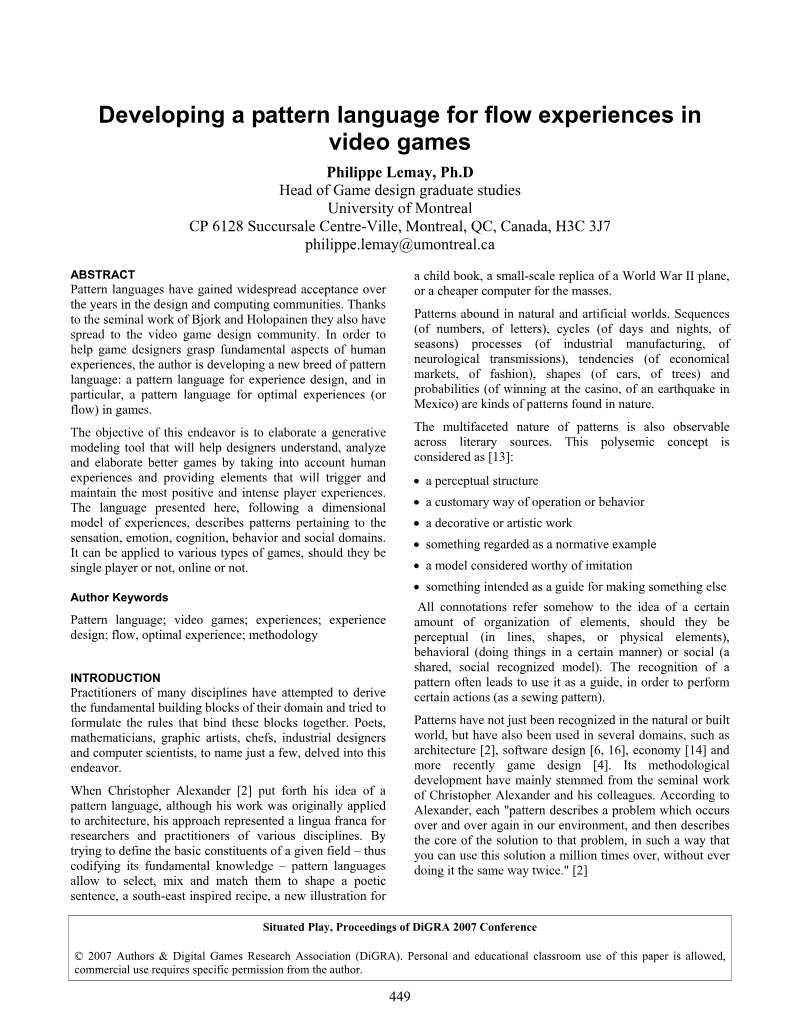
- Philippe Lemay (University of Montreal) proposes a pattern language for designing flow experiences in video games, presented at the 2007 DiGRA conference, borrowing a method long used in architecture, software design, and HCI.
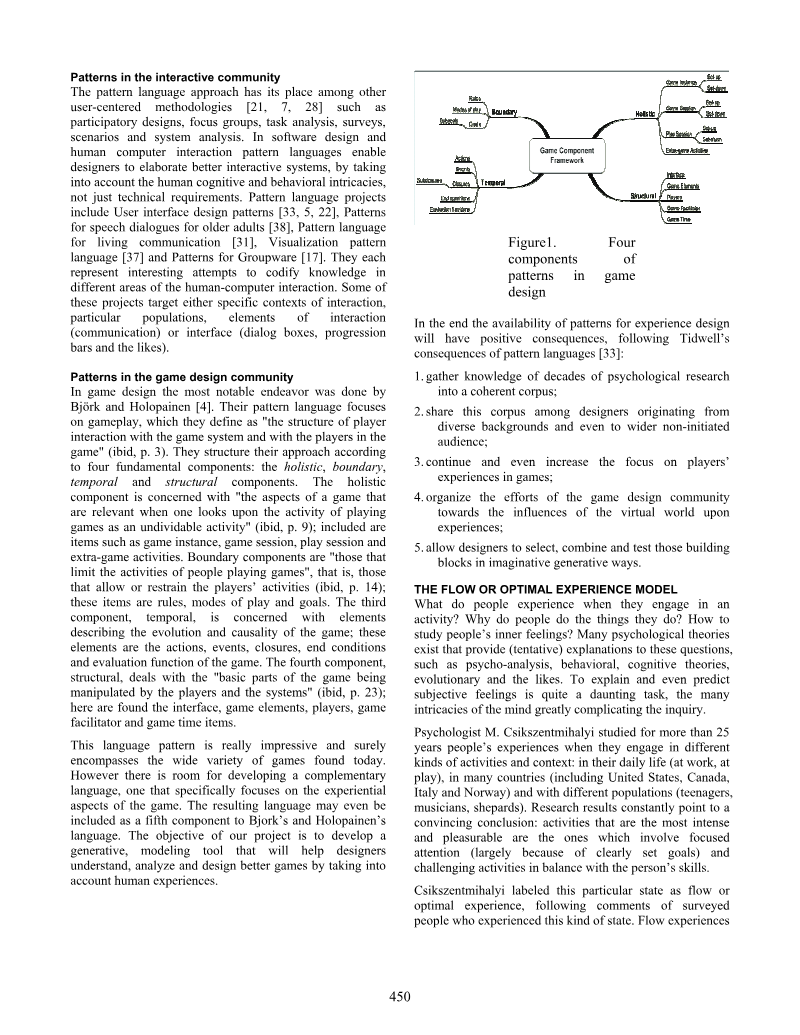
- The work extends Björk and Holopainen's gameplay-focused pattern language with a fifth component centered on experiential qualities rather than replacing it.
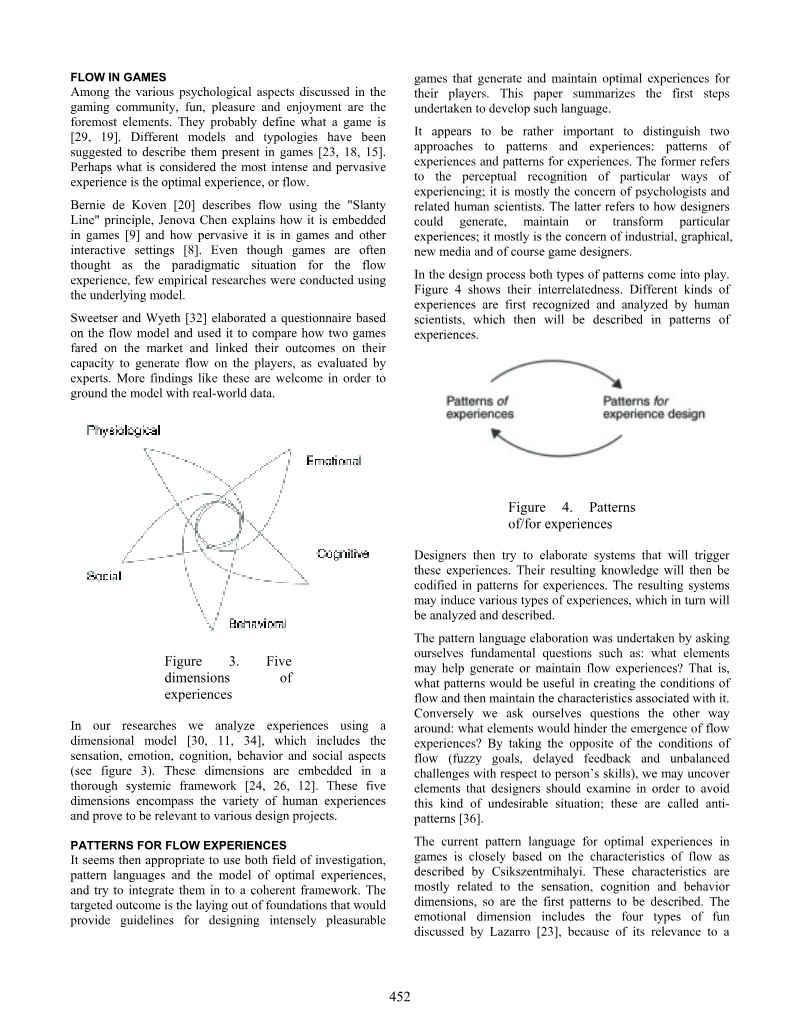
- The framework is grounded in Csikszentmihalyi's flow model, whose conditions include clear goals, immediate feedback, and a balance between challenge and skill, and whose characteristics include intense concentration, loss of self-consciousness, and altered perception of time.

Creating Multiplayer Ubiquitous Games Using an Adaptive Narration Model Based on a User's Model
The document proposes an innovative method for developing Multiplayer Ubiquitous Games (MUGs) through an adaptive narration model driven by a comprehensive user profile.
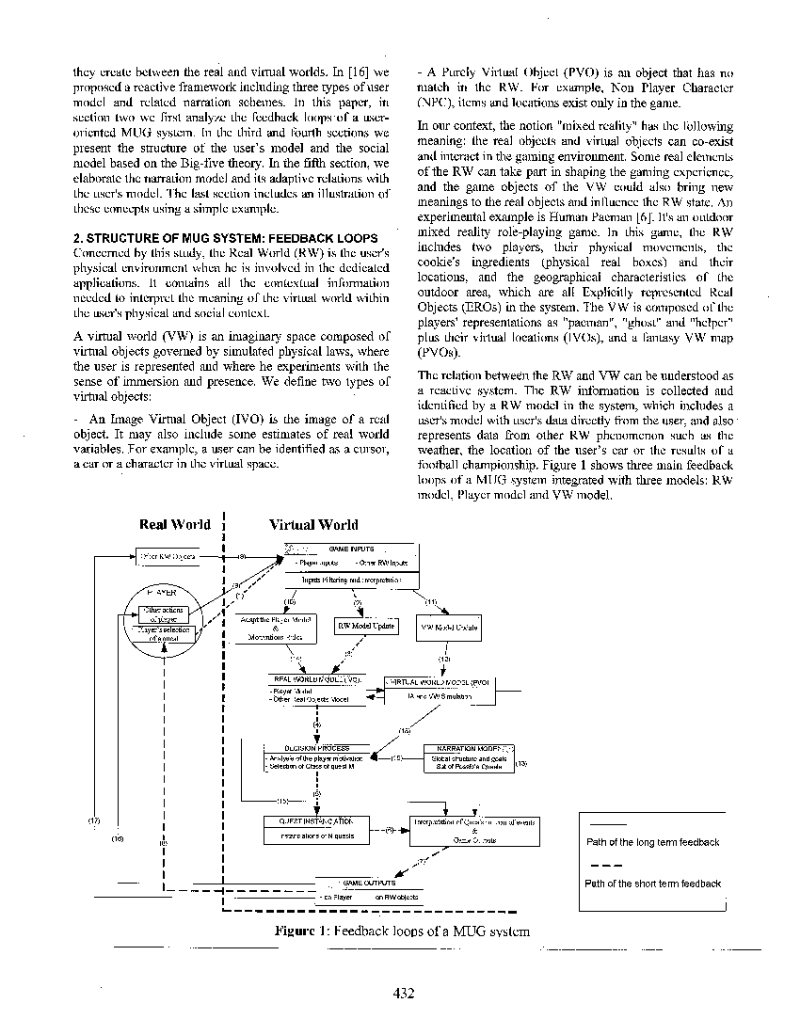
- The paper proposes an adaptive narration model for Multiplayer Ubiquitous Games (games blending real-world and virtual-world interaction) in which quests are tailored to each player's profile rather than drawn from the pre-scripted structures typical of MMORPGs.
- Player profiles are initialized using the Five-Factor Model of personality and Bartle's player types, and are treated as dynamic, updated via exponential smoothing with weighted vector equations as players make choices.
- Quests are sorted into four classes (Destruction, Exploration, Social Interaction, and Creation), with the class chosen according to the distance between the quest and the player's profile, then instantiated using location and social data.
Perceptions of Player in Game Design Literature
The document, "Perceptions of Player in Game Design Literature," investigates the representation and conceptualization of players within contemporary professional game design literature, primarily focusing on recent game design books.
- Olli Sotamaa's analysis of ten recent game design books finds no clear consensus on what a player is, and concludes that the field's understanding of players remains inarticulate and ambiguous.
- Many claims about players in game design literature rest on anecdote and personal experience rather than rigorous empirical research.
- Competing frameworks treat players differently: market-oriented models (Bateman and Boon's Myers-Briggs-based clusters, hardcore/casual splits) treat them as consumer segments, while play-style taxonomies such as Bartle's achiever, socializer, explorer, and killer types emerged from late-1980s and early-1990s MUD communities.
Revising Immersion: A Conceptual Model for the Analysis of Digital Game Involvement
This paper proposes a refined conceptual model for understanding player involvement in digital games, advocating for "incorporation" as a more precise term than "immersion."
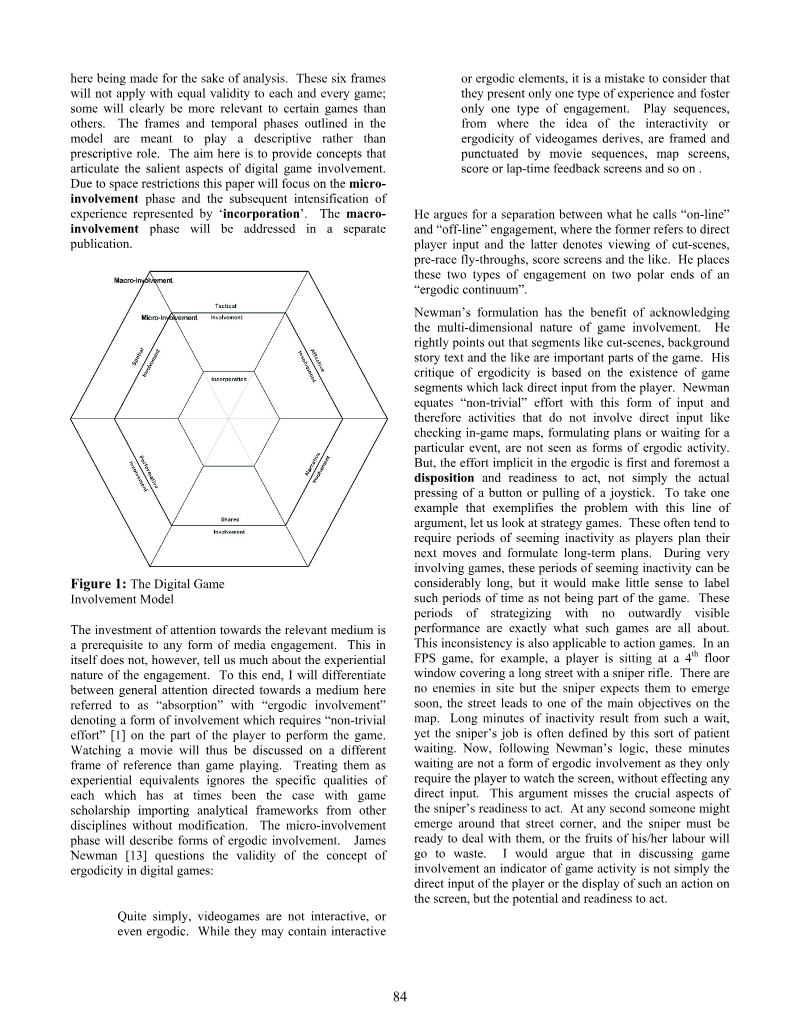
- Calleja's paper argues that the vague, binary metaphor of immersion should be replaced by 'incorporation,' which better describes inhabiting a virtual environment, acting meaningfully within it, and remaining present to others.
- The model analyzes digital game involvement through five frames (tactical, narrative, shared, performative, and spatial) and places its analytical focus on the micro-level momentary engagement rather than macro-level motivational phases.
- A key distinction is between designed narrative and personal narrative; the paper finds that in massively multiplayer online games most players largely disregard the designed storyline and instead construct personal narratives through play and collaboration.

Teacher Roles in Learning Games: When Games Become Situated in Schools
This paper examines the integration of learning games, specifically professional simulation games, into school environments and the resulting impact on teacher roles and student engagement.
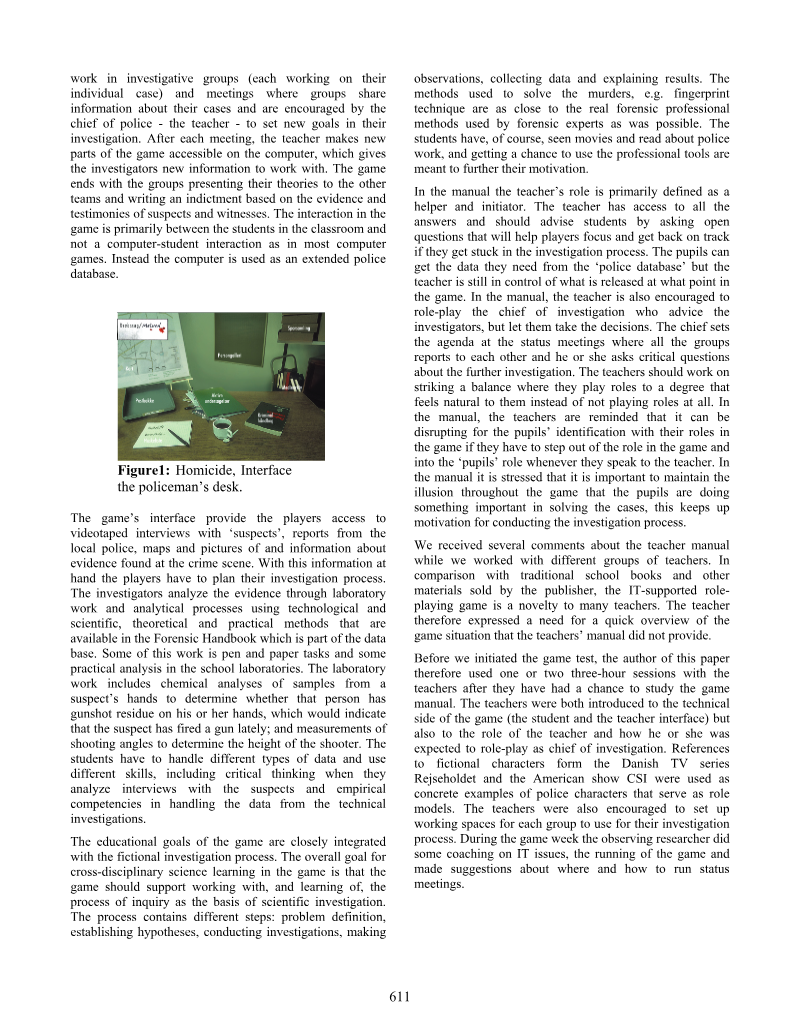
- Teachers using professional simulation learning games such as Homicide must balance two overlapping roles: a fictional in-game role (police chief) and a pedagogical role as supervisor of students who may know more about the specialized content than the teacher.
- The study draws on about 120 hours of full-time video observation across four 13-to-15-year-old school classes, supplemented by group interviews, pre- and post-tests, and student work logs.
- Breaking the game's fiction undermines its meaning: when a science teacher had students practice fingerprint-lifting as a standalone transferable skill, students confused by the irrelevance to the murder narrative became visibly less engaged.